
The interesting thing about a video generator’s landing page is how little it actually commits to. Hailuo AI leads with three phrases — “native multimodal generation, precise multimodal editing, production-ready content creation” — and they read like a spec sheet while telling you almost nothing you could verify on a Tuesday afternoon with your own footage.
That isn’t a knock unique to one vendor. Marketing copy for generative tools tends to describe intent and architecture, not measured quality — so a page can be completely truthful and still leave you guessing about whether the output holds up. This piece does something narrow and, I think, more useful than another “10 features” rundown: it reads Hailuo AI’s official pages closely, separates what the docs genuinely state from what you’d still have to test yourself, and flags where the page simply stays quiet.
To be clear up front: there’s no hands-on here. I didn’t run a single generation. Everything below is compiled from Hailuo AI’s own pages (checked 2026-08-11) plus general background on how systems like this are built. Where the docs don’t say something, I’ll say so rather than fill the gap with a guess.
So what is Hailuo AI once you strip the marketing off?
Start with the plainest fact, because it’s also the most checkable. Hailuo AI describes itself, in its own page title, as a “Video & Image Generator for Creators” (per its official pages, checked 2026-08-11). That’s the category, and it’s worth pinning down because “video generator” and “image generator” are often two separate products from two separate teams. Here the positioning bundles both under one roof, aimed at creators rather than, say, enterprise pipelines or developers wiring things into a backend.
The subscribe page also announces that “MiniMax H3 Is Live” and points to a “MiniMax Design” download, alongside a line inviting new users to claim free credits and “unlock AI video creation” (per the official subscribe page, checked 2026-08-11). So the branding ties Hailuo AI to MiniMax’s H3 release — I’ll come back to that relationship in the FAQ, because it’s the kind of thing the page implies more than it spells out.
The most concrete signal of how you actually use it comes from an example prompt the page shows: “Describe the video content you want to generate, for example, ‘A child flying a kite in the park, golden sunlight, camera pans up.'” (per the official subscribe page, checked 2026-08-11). That one line tells you more than the three headline phrases combined — it confirms a text-prompt input where you describe a scene, lighting, and a camera move, and the system generates video from that description. It’s the difference between reading an adjective and seeing the actual interface expectation.
Here’s my honest read: the category is unambiguous, and the input model is clear enough from that example. What the pages I checked do not publish is the stuff you’d normally want before committing — clip length limits, output resolution, per-generation credit costs, or any independent quality benchmark. That’s not unusual for a consumer creative tool, but it does mean the “spec” you can actually rely on is thinner than the page’s confident phrasing suggests.
What do “native multimodal generation” and “precise multimodal editing” actually mean?
These are the two phrases doing the heaviest lifting on the page, so they deserve a careful translation rather than a nod. Both appear verbatim in Hailuo AI’s own copy — “native multimodal generation, precise multimodal editing, production-ready content creation” (per the official subscribe page, checked 2026-08-11) — and each describes a design intent, not a test result.
Native multimodal generation. In general terms, “native multimodal” usually points to a model built to handle more than one type of data — text, images, video — inside a single system, rather than stitching separate specialist models together with glue code. The claimed upside of that approach is that a prompt combining, say, a reference image and a text instruction can be understood as one coherent request instead of being handed off between tools. That’s the concept. What Hailuo AI’s page asserts is that its generation is native multimodal; what it does not do on the pages I read is demonstrate the difference in output, so treat the phrase as a description of how the system is positioned to work, not proof that it works better than a bolted-together alternative.
Precise multimodal editing. This one signals that you’re not limited to a single roll-of-the-dice generation — the tool is positioned to let you edit, guided by text and/or image input, and “precise” implies targeted changes rather than regenerating the whole thing from scratch. But “precise” is exactly the kind of word that only means something once you’ve watched it fail or succeed on a real edit. The docs claim the capability; they don’t quantify how precise, so I’m reporting the claim, not endorsing the adjective.
Production-ready content creation. The third phrase is a claim about the output’s intended use — that what comes out is meant to be usable without a heavy post-production pass. If you’re deciding whether Hailuo AI output is ready to drop straight into a client deliverable, the word “production-ready” is a starting hypothesis to test, not a verdict you can lean on.
If this seems like I’m being pedantic about three phrases, that’s the whole point of a spec-angle read. The words describe an architecture and an ambition. Whether the result clears your bar is a question the official copy structurally cannot answer — and pretending otherwise is how people end up disappointed. For a wider sense of what solid docs should actually disclose before you trust them, I’ve written about that in our documentation checklist.
Is a free trial with 3000 credits enough to know if it’s worth it?
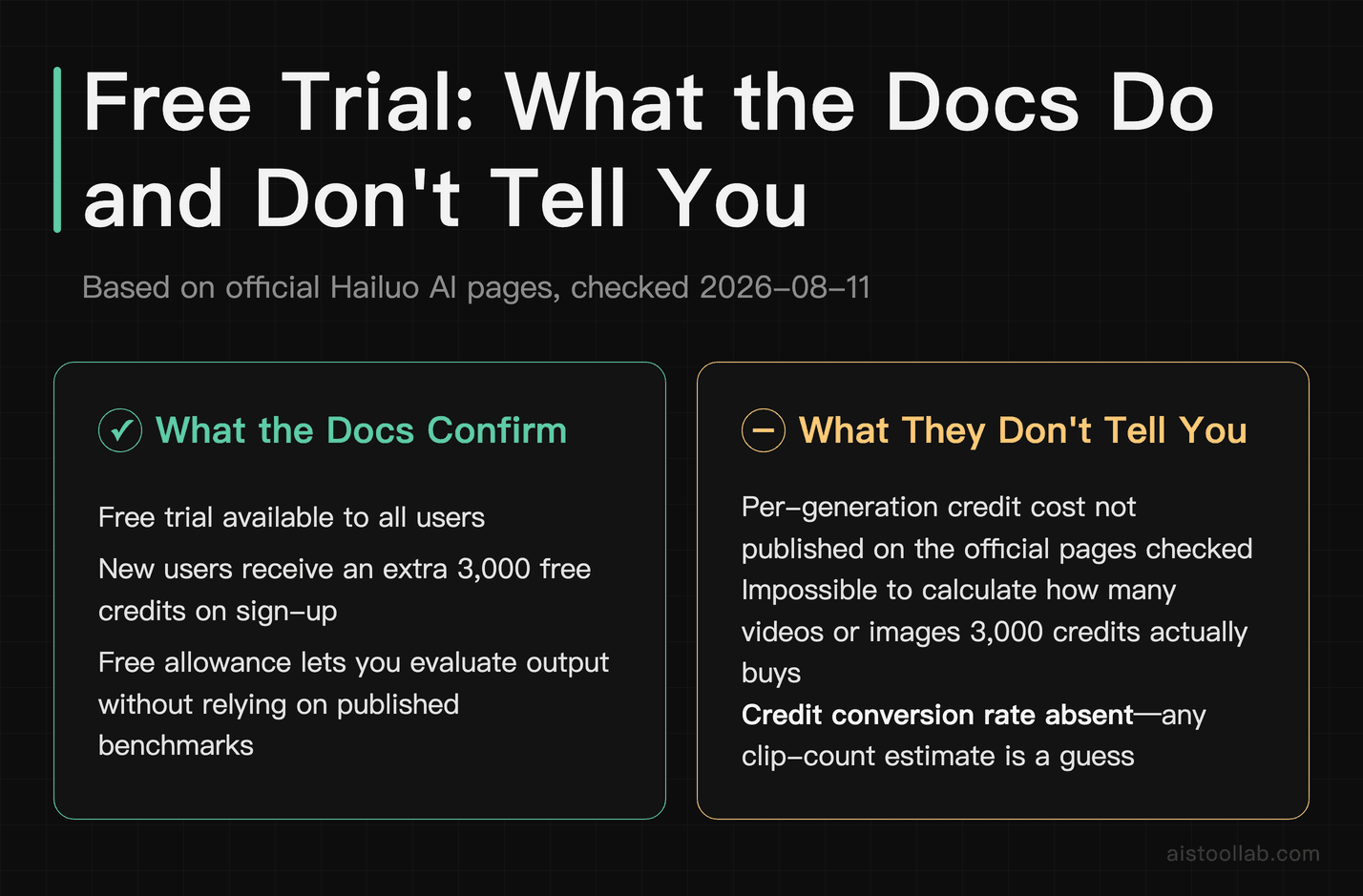
Here’s where the docs are, refreshingly, specific. Hailuo AI states that all users can try it free, and that new users get an additional 3000 free credits — the page’s own wording is that MiniMax H3 is live, “all users can experience it free, and new users get an extra 3000 free credits” (per the official subscribe page, checked 2026-08-11). A separate line confirms new users “receive free credits and unlock AI video creation.” So two things are established: a free trial exists for everyone, and a 3000-credit welcome allowance exists for new accounts.
What the pages I checked do not state is how many credits a single generation actually costs. Without that number I can’t honestly tell you how many videos or images 3000 credits buys — anyone who gives you a clip count is guessing, because the conversion rate isn’t published where I looked. If that figure matters to your decision (and for video generation it usually does, since longer or higher-quality clips tend to cost more), that’s a question to answer inside the product with your own account, not from the marketing page.
Still, a free allowance is the honest evaluator’s best friend, precisely because the docs don’t publish benchmarks. The most useful thing you can do with 3000 free credits isn’t to make a pretty demo — it’s to reproduce a real job. Feed it the actual prompt from a project you’d otherwise shoot or license, using the kind of scene description the page itself models (“a child flying a kite… golden sunlight… camera pans up”), and judge the result against the standard your work already has to meet. That converts three unverifiable adjectives into a yes/no you can actually act on. A free trial won’t tell you the tool is the best on the market; it will tell you whether it clears your bar, which is the only comparison that pays your bills.
Three creators who’d sensibly spend their free credits here
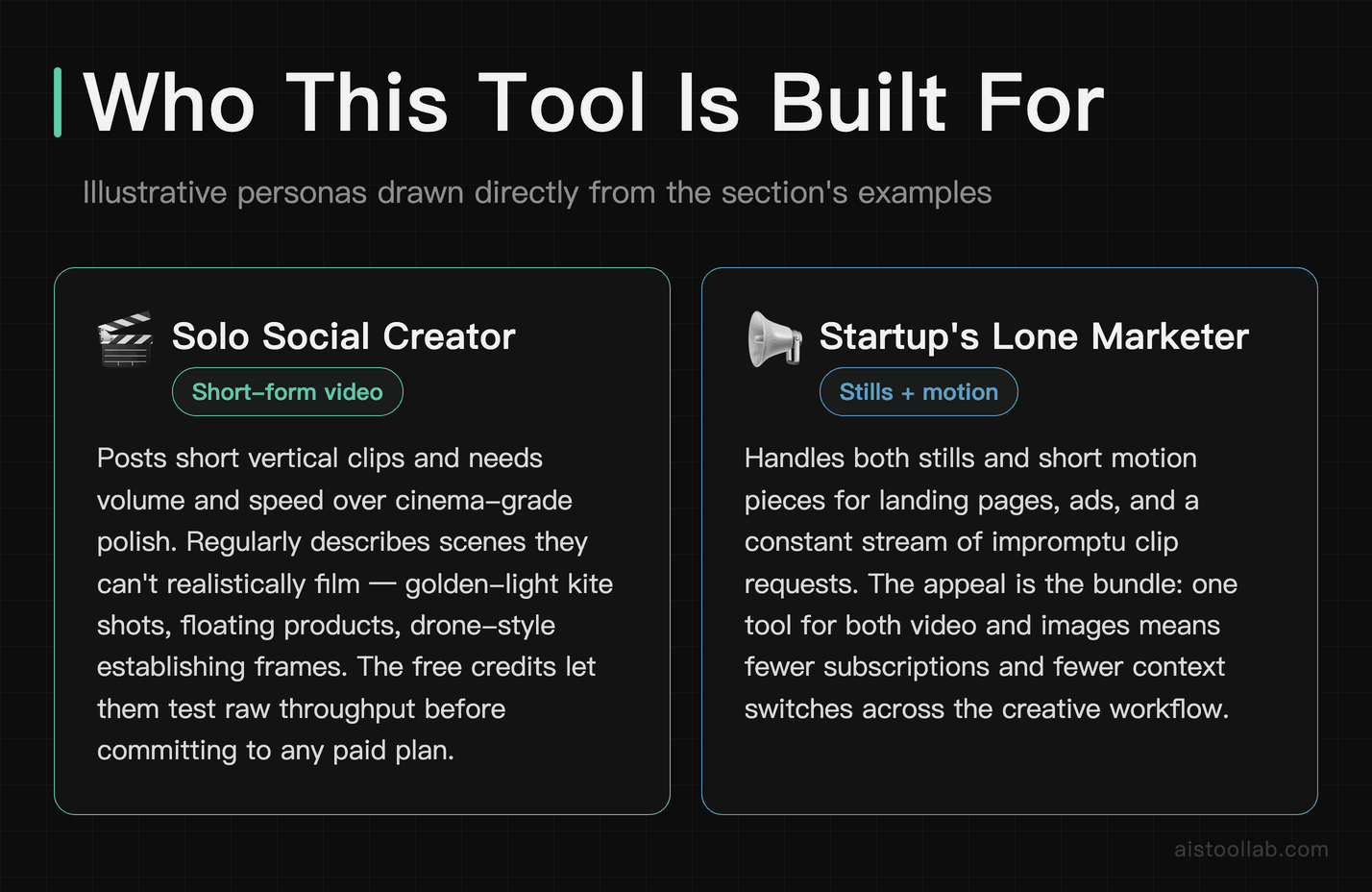
Because the docs are thin on numbers, the smartest way to think about fit is by situation rather than by score. These are illustrative personas — step into whichever one resembles you.
Say you’re a solo social creator posting short vertical clips. You need volume and speed more than cinema-grade polish, and you’re constantly describing scenes you can’t realistically film — a kite in golden light, a product floating in mid-air, an establishing shot you have no drone for. A text-to-video tool that takes a scene description and a camera move is squarely aimed at that job, and the free credits let you find out whether the output survives being posted before you commit to a paid plan. If your channel lives on quantity, the “native multimodal generation” claim matters less to you than raw throughput, which is exactly what a free allowance lets you probe.
Imagine you’re the only marketer at a small SaaS startup. You’re generating both stills and short motion pieces for landing pages, ads, and a Slack-thread’s worth of “can you make a quick clip for this?” requests. The appeal here is the bundle — one tool positioned for both video and images means fewer subscriptions and fewer context switches. The claim to test with your free credits is “production-ready”: can the output go straight into a campaign, or does everything need a rescue pass in another editor? That answer decides whether this saves you time or just adds a step.
Or picture an indie designer prototyping concepts for clients. You’re not shipping the generated frames as finals; you’re using them to sell an idea in a pitch deck before anyone greenlights a real shoot. “Precise multimodal editing” is the feature you’d lean on most, because pitches are iterative — the client wants the same scene but warmer, or the same character but seated. If it can’t hold a scene steady across edits, you’ll want to know before a client is watching your screen.
Reading the claims against what’s actually verifiable
Because there’s no independent benchmark to hand and no hands-on run behind this article, a normal tool-versus-tool scorecard would mean inventing numbers I can’t source — so I’m not going to. Instead, here’s the more honest table for a spec-angle piece: every headline claim on the page, exactly what the docs state, and where verification currently stops. This isn’t a ranking and there’s no winner column; it’s a map of what you can rely on today versus what you’d still have to test. All entries are as of the 2026-08-11 check.
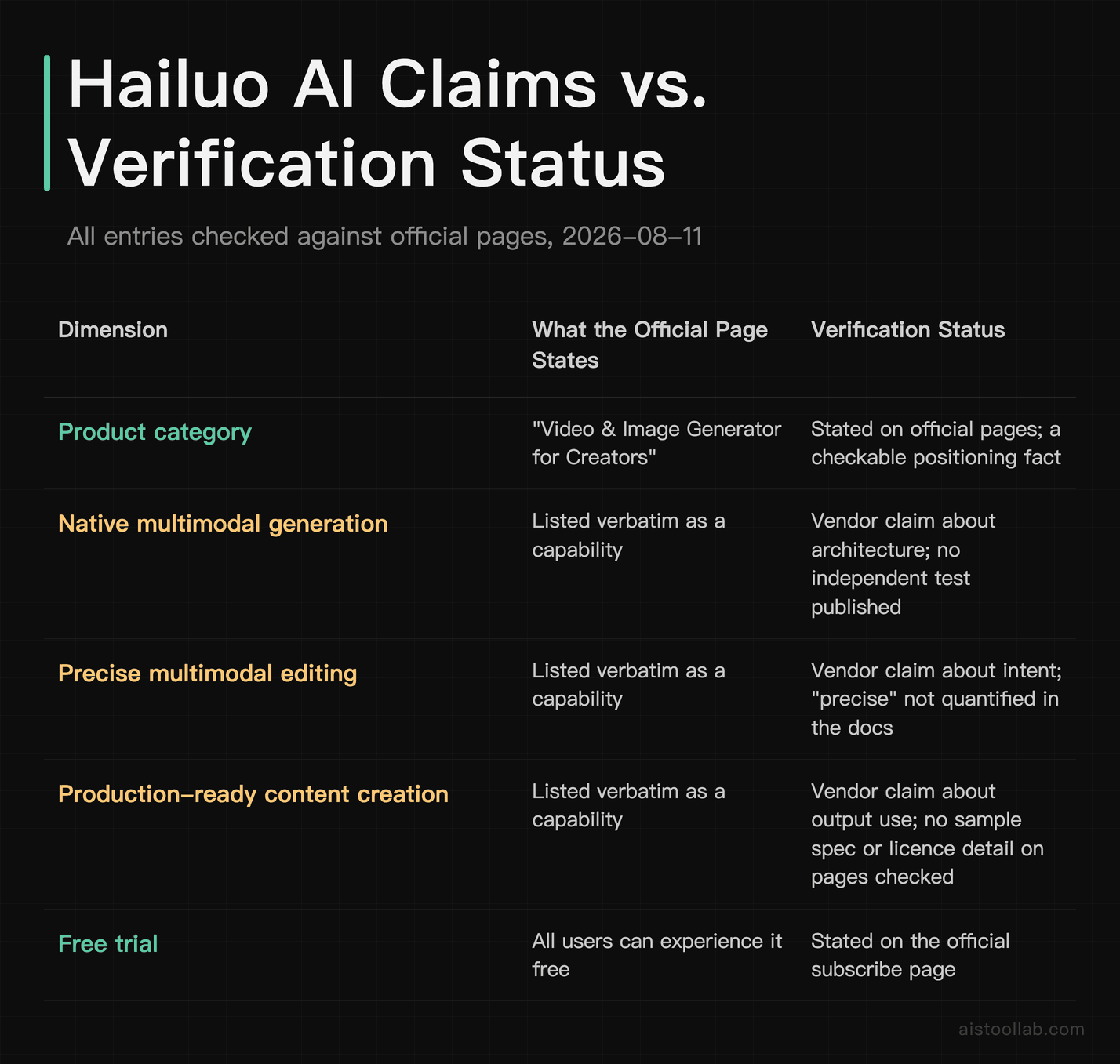
Notice the shape of that table: the top half is genuinely useful and checkable, the middle three rows are vendor claims you’ll want to test, and the bottom row is a straight blank the docs don’t fill. That’s not a criticism of the writing on Hailuo AI’s page — it’s the normal state of a consumer generative tool’s marketing surface, and it’s exactly why the free allowance carries so much weight in the decision.
When the docs alone aren’t enough to decide
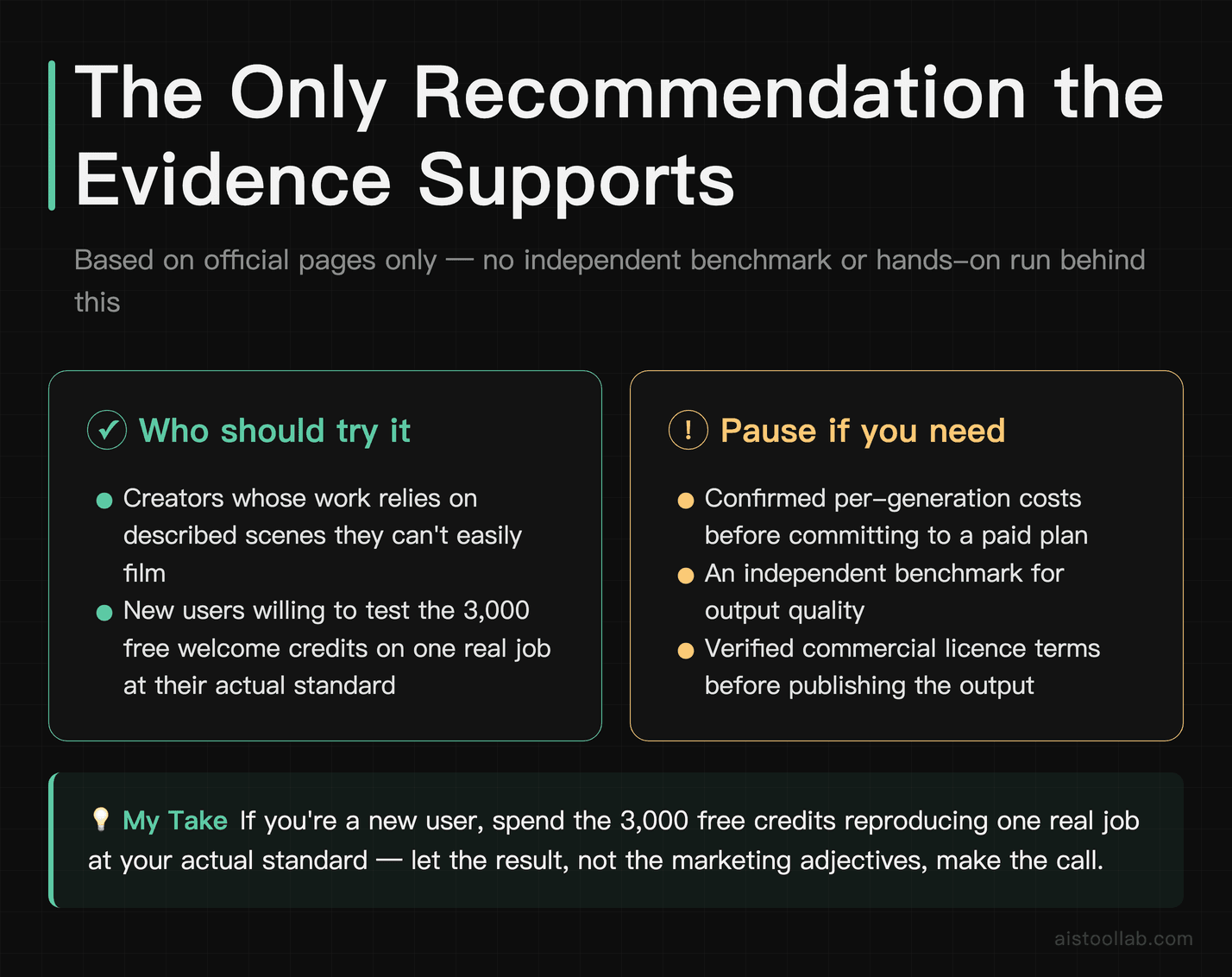
Pull it all together and the picture is clear about what it’s clear about. Those are facts you can act on. The three headline phrases — native multimodal generation, precise multimodal editing, production-ready content creation — are the vendor’s description of intent and architecture, and they’re honest as positioning even though they can’t, by their nature, tell you whether the output clears your particular bar. The pages don’t publish per-generation costs, hard limits, an independent benchmark, or a full commercial licence, and I’d rather flag those gaps than paper over them.
So here’s the only recommendation the evidence actually supports: if you’re a creator whose work leans on described scenes you can’t easily film, spend the 3000 free credits reproducing one real job — same prompt, same standard you’re already held to — and let the result, not the adjectives, make the call. That’s a free way to convert three unverifiable claims into a decision you can defend, and it beats trusting any spec sheet, including this reading of one.


Frequently Asked Questions
Is Hailuo AI the same thing as MiniMax, or a separate product?
The pages I checked don’t lay out a formal corporate structure, so I’ll stick to what’s actually visible. Hailuo AI’s subscribe page announces that “MiniMax H3 Is Live,” points users to a “MiniMax Design” download, and threads MiniMax branding through the H3 launch messaging (per the official subscribe page, checked 2026-08-11). Read plainly, that ties Hailuo AI to MiniMax’s H3 model release rather than presenting it as an unrelated third-party product. What I can’t responsibly do is detail the exact relationship — which is the brand, which is the model, which is the company — from these pages alone, because that specific breakdown isn’t spelled out where I looked. If the corporate lineage matters for a procurement or legal reason, treat the branding as a strong signal and confirm the specifics against Hailuo AI’s own terms and about pages rather than my inference. For general context on how model providers get consumed downstream by front-end tools, our write-up on Pika AI covers similar territory in the video-generation space.
Does “production-ready” mean I can use the output commercially?
Not automatically, and this is worth slowing down on. “Production-ready content creation” is a claim about output quality and intended use, not a licence grant, and the two are separate questions. The page does carry a usage note that content is AI-generated and asks users to “use this feature lawfully and in a friendly way” (per the official subscribe page, checked 2026-08-11), which tells you the vendor is flagging responsible use — but it isn’t a full commercial-rights statement. The pages I checked don’t publish a complete licence covering ownership, resale, or client deliverables. So if your plan is to drop generated frames into a paid campaign or a client project, don’t infer permission from the word “production-ready” — read Hailuo AI’s actual terms of service, which is where rights and restrictions actually live. My general rule for any generative tool: a marketing adjective describes what the output looks like; only the terms describe what you’re allowed to do with it, and mixing those two up is how people end up in a takedown they didn’t see coming.
Last updated: 2026
This is one way to choose.
👉 Browse the AI Tools Library to see what else is worth a look.