1. A bigger toolbox is often where agents start failing
Ask how an AI agent decides which tool to reach for, and the intuitive answer is “it reasons about it.” That’s half right. The half that’s wrong — the mechanics of picking the correct tool out of many, and calling it with valid arguments — turns out to be a distinct problem from reasoning, and it’s where a lot of agents quietly come apart.
Before we go further, one honest caveat about the “2026 benchmark numbers” you’ll see quoted around this topic: a lot of them aren’t traceable to a specific published source. The durable, checkable findings in this space still come from a cluster of named papers from 2022–2024, and much of what circulates as a fresh 2026 leaderboard figure has no report you can actually open. My rule below — and a fair rule for you — is simple: if a success-rate percentage can’t be pointed at a specific paper, report, or dataset, treat it as marketing, not evidence. So I’ll describe what the research establishes qualitatively and name the source each time, rather than invent numbers.
The starting insight comes from work that studied tool selection directly. Gorilla (“Gorilla: Large Language Model Connected with Massive APIs,” Patil et al., UC Berkeley, 2023) looked at models calling large sets of real APIs and documented a specific failure mode: models hallucinate API calls — inventing endpoints that don’t exist, or calling a real one with arguments that don’t fit its schema. ToolLLM / ToolBench (Qin et al., 2023) studied the same challenge across a large collection of real-world APIs. The pattern both describe is the same: as the number of available tools grows, the model’s job shifts from “reason about the task” to “retrieve and disambiguate the right tool,” and that second job doesn’t come for free.
That reframes the whole design question. When people say an agent “chose the wrong tool,” it’s usually one of a few concrete things: it retrieved the wrong candidate because the tool’s description was vague, it confused two similarly named tools, or it produced a syntactically valid call that’s semantically wrong for the step. The practical takeaway that falls out of this — and it lines up with how careful teams write tool specs — is that the tool descriptions and schemas the model sees are part of the reasoning surface, not just plumbing. If you’ve ever tuned how you phrase a request to get a better result, the intuition transfers; I wrote about that habit in How to Submit Content to AI Tools and Get Better Results, and the same clarity discipline applies to the descriptions you hand an agent.
2. ReAct, Chain-of-Thought, and iterative planning aren’t rivals — they’re different jobs
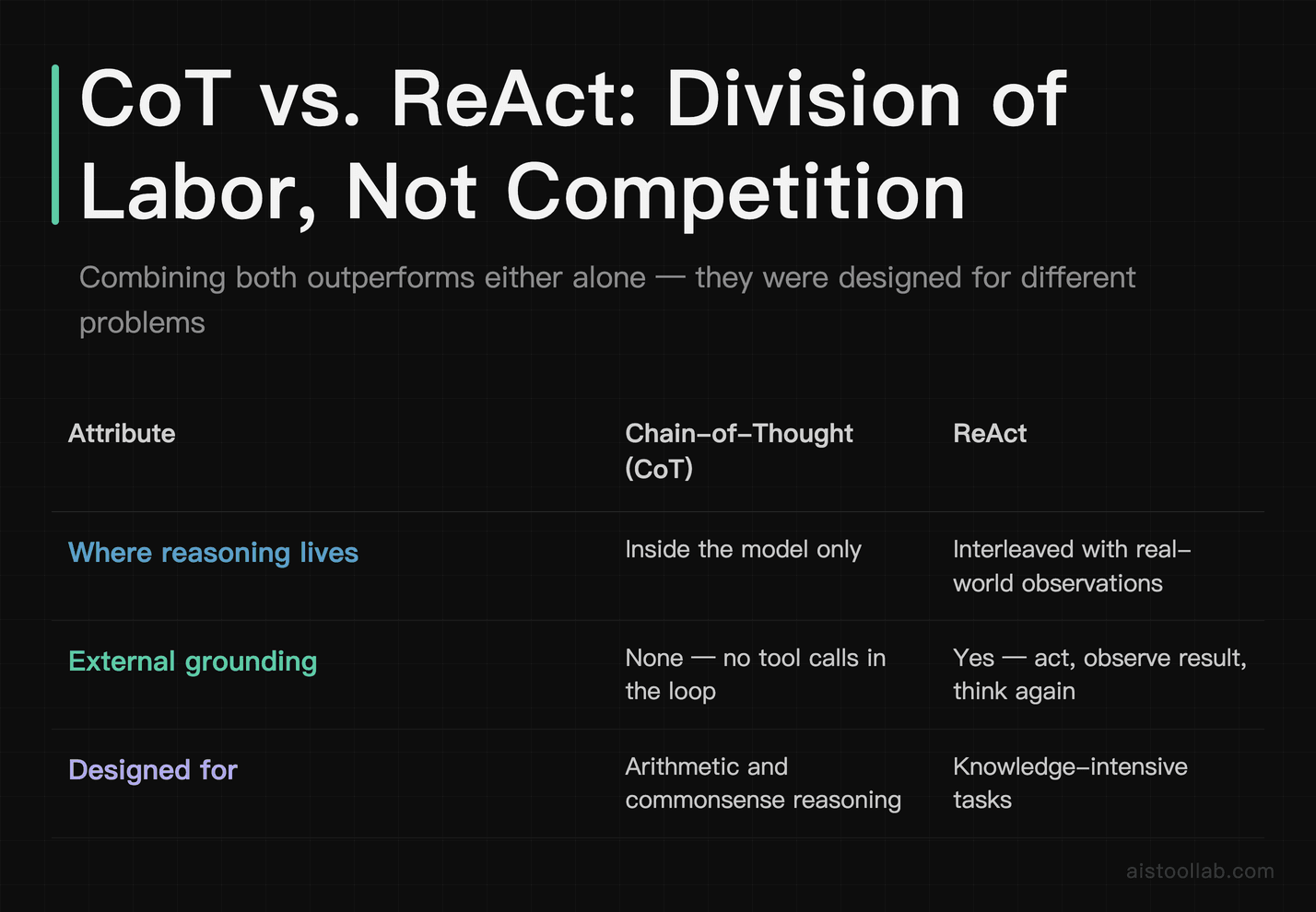
These three get lined up like competitors, but they were designed to solve different things, and the research reads more like a division of labor than a horse race.
Chain-of-Thought (“Chain-of-Thought Prompting Elicits Reasoning in Large Language Models,” Wei et al., 2022) gets the model to lay out intermediate reasoning steps before answering. It helps on arithmetic and commonsense reasoning, and the paper notes it emerges more strongly at larger model scale. But CoT reasons entirely inside the model — it never checks anything against the outside world. That’s exactly why it can walk through a confident chain of steps and still land on a fabricated fact. There’s no tool call in the loop to ground it.
ReAct (“ReAct: Synergizing Reasoning and Acting in Language Models,” Yao et al., ICLR 2023) interleaves reasoning traces with actions and observations: think, act (call a tool), observe the result, think again. The paper’s reported contribution is that grounding reasoning in real observations reduced the kind of fact-fabrication CoT is prone to on knowledge-intensive tasks, and that combining the two worked better than either alone. It also flags ReAct’s own failure mode — agents can get stuck repeating an unhelpful action, like re-running a search that returns nothing useful. So it trades one error class for another, rather than eliminating error.
Iterative planning is a family, not a single method. Reflexion (“Reflexion: Language Agents with Verbal Reinforcement Learning,” Shinn et al., 2023) adds verbal self-reflection: the agent reviews a failed attempt, writes down what went wrong, and retries with that note in context. Plan-and-Solve prompting (Wang et al., 2023) has the model draft a full plan first, then execute it. These help most when a task is genuinely multi-step and a wrong first attempt is recoverable — and they cost more, because “try, reflect, retry” means running the expensive part several times.
As for cross-architecture leaderboards, AgentBench (“AgentBench: Evaluating LLMs as Agents,” Liu et al., Tsinghua and collaborators, 2023) is worth naming precisely because it’s often cited as a “2026 benchmark” when it isn’t — it’s a 2023 multi-environment suite spanning things like operating-system, database, and knowledge-graph tasks. Its headline qualitative finding was a large gap between top commercial models and open models on genuinely agentic, long-horizon tasks, with instruction-following and multi-step consistency as the bottlenecks. I’m deliberately not quoting per-architecture success percentages here, because I can’t point you to a specific 2026 report that measured them the way the question implies.
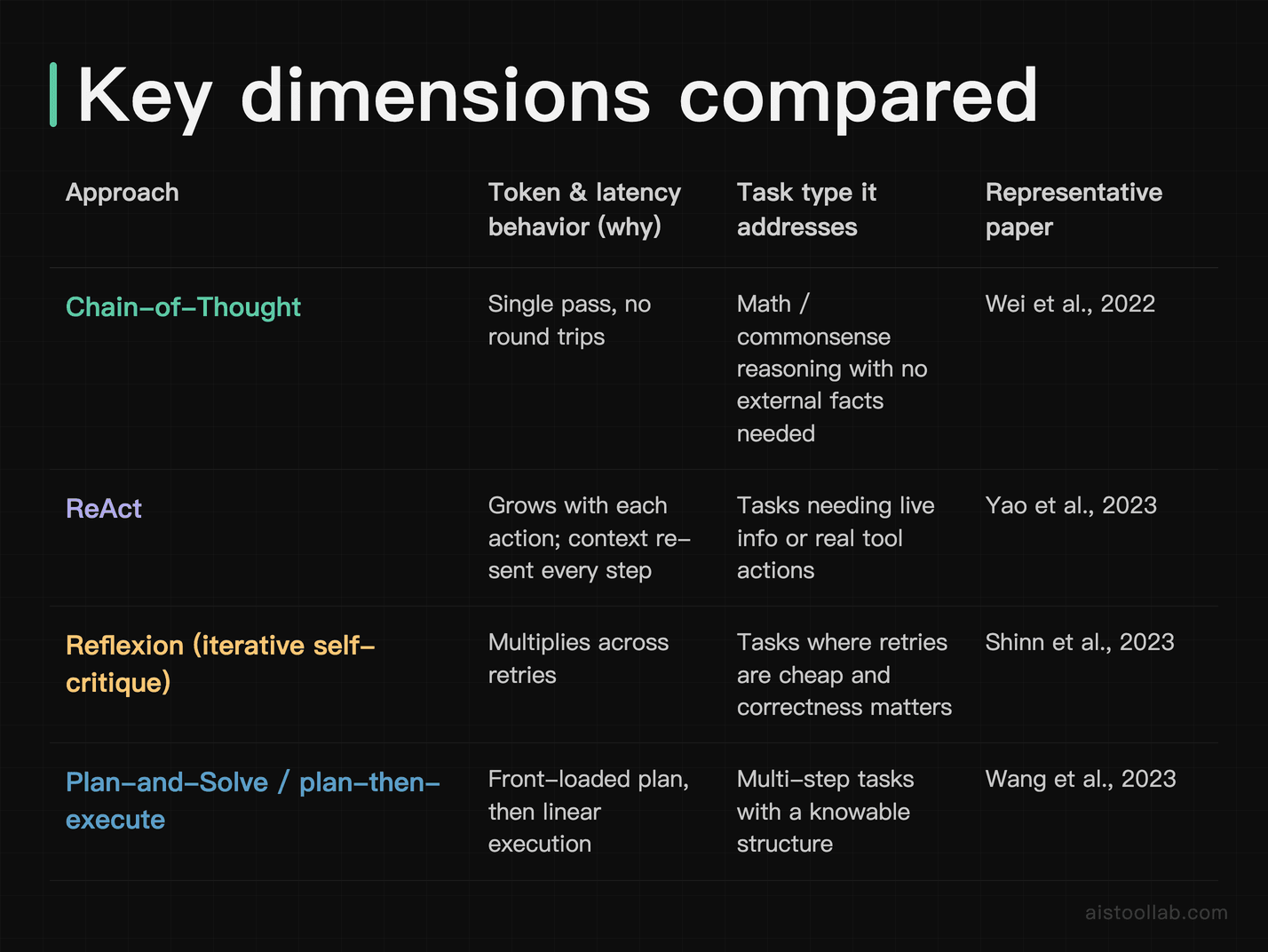
Here’s a descriptive map of how the four common approaches differ. It’s not a scored ranking — the cells reflect each method’s structure and its representative paper, not a “winner.”
- Chain-of-Thought — Core idea: Reason in explicit steps, internally; Calls external tools?: No; LLM calls per task (structural): Typically one pass; Recovers from its own errors?: No built-in correction
- ReAct — Core idea: Interleave thought → action → observation; Calls external tools?: Yes; LLM calls per task (structural): One per action step; Recovers from its own errors?: Partial — reacts to observations, no explicit reflection
- Reflexion (iterative self-critique) — Core idea: Retry with written self-feedback across attempts; Calls external tools?: Yes (usually); LLM calls per task (structural): Multiple full attempts; Recovers from its own errors?: Yes — learns from failed trials
- Plan-and-Solve / plan-then-execute — Core idea: Draft a full plan first, then execute steps; Calls external tools?: Not specified in the paper; LLM calls per task (structural): Plan first, then step-by-step execution (call count not specified in the paper); Recovers from its own errors?: Limited unless replanning is added
3. Every tool call has a bill: tokens, latency, and the over-planning trap
The cost-performance side is where mechanism matters more than any headline number, because the structure of tool use is where the cost comes from — and that part you can reason about directly.
A single tool-augmented step isn’t one model call. It’s the model producing a tool call, the tool executing, and the result getting fed back into the context for the next decision — which is another model call. So an N-step tool chain is at least N round trips, and each round trip re-processes a context that keeps growing as observations pile up. That’s why token usage on agentic runs tends to climb faster than the number of steps suggests, and why latency accumulates: you’re paying per turn and re-reading history every turn. None of that needs a benchmark to see; it’s the arithmetic of the loop.
Where I have to stop short of specifics is the actual dollar and millisecond figures for “adding tool use to a small vs. large model.” I don’t have a public source I can point you to that measured that cleanly across model sizes in a way I’d stake a claim on, so I’m not going to put a multiplier on it. What I can say confidently is the shape of the mechanism: iterative approaches like Reflexion re-run the expensive attempt, so they incur that cost repeatedly; pure Chain-of-Thought never leaves the model, so it avoids the per-turn round trips entirely; and ReAct interleaves reasoning with tool actions, so its cost scales with how many actions the task needs.
Then there’s the trap that runs the other way — over-planning. Toolformer (“Toolformer: Language Models Can Teach Themselves to Use Tools,” Schick et al., Meta, 2023) framed a point that’s easy to forget: deciding when to call a tool is itself a skill, and the right answer is sometimes “don’t.” Agents can take a task the base model could answer directly and decompose it into an unnecessary chain of tool calls, or spin in a loop that never terminates until it hits a max-iteration cap. So chaining isn’t free virtue. The honest state of the research is that “when to chain vs. when to answer directly” is still an actively studied, unsettled question — I wouldn’t trust any tidy rule that claims to have nailed it.
4. What production telemetry actually tends to surface
Moving from benchmarks to running systems changes what “reliability” even means. A benchmark asks “did it get the right answer once?” Production asks “does it get the right answer every time a customer hits it?” — and those aren’t the same question.
That gap is exactly what τ-bench (“τ-bench: A Benchmark for Tool-Agent-User Interaction in Real-World Domains,” Sierra, 2024) was built to expose. Its notable framing is measuring consistency across repeated trials rather than a single pass — and the qualitative finding is that agents which succeed once often fail when you run the same task again. If your intuition is “it worked in the demo,” that’s precisely the intuition production breaks. Consistency, not peak capability, is usually the thing standing between a working prototype and something you’d put in front of customers.
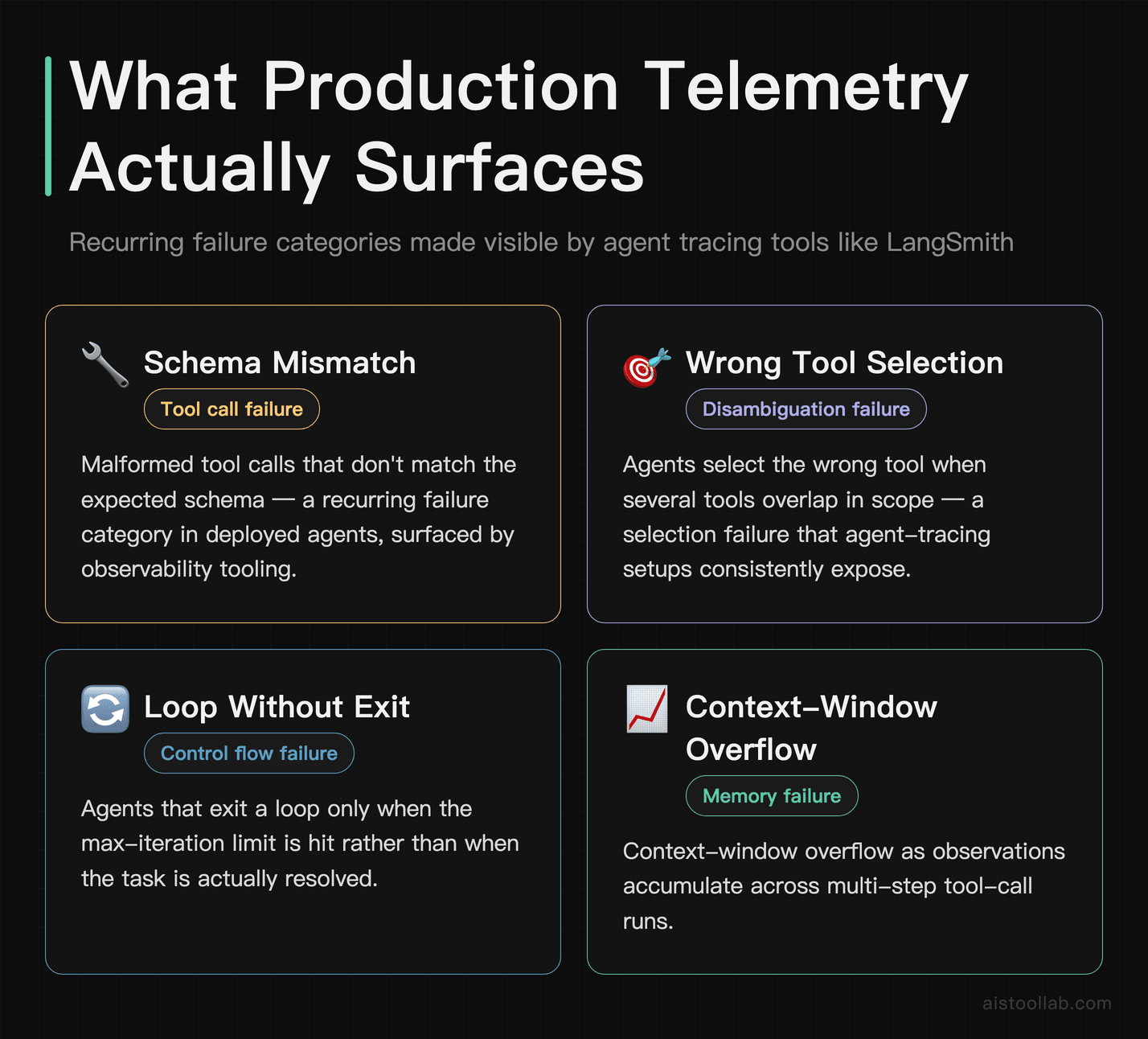
The failure modes that observability tooling (tracing platforms like LangSmith from LangChain, and similar agent-tracing setups) tends to make visible cluster into a handful of recurring categories: malformed tool calls that don’t match the schema; wrong-tool selection when several tools overlap; loops that exit only on a max-iteration limit; context-window overflow on long runs; and the nastiest one — a confident, well-formatted answer that’s silently wrong. That last category is dangerous precisely because it doesn’t throw an error, so it doesn’t show up in your crash logs at all.
On business impact, I’ll stay honest rather than dramatic: I don’t have citable public telemetry that assigns a percentage to “how often production agents fail” or a dollar figure to what that costs, so I won’t invent one. The defensible statement is qualitative — reliability and consistency are central barriers to shipping agents in real workflows, alongside raw model intelligence, and the teams that treat their own logs as the primary evidence tend to find failure modes the public benchmarks never showed them.
Where this shows up: three situations to picture
Say you’re a solo developer building a customer-support agent. The task is mostly retrieval plus a couple of actions (look up an order, issue a refund). This is where ReAct-style grounding earns its keep — the agent needs live data, and CoT alone would happily invent an order status. Your risk isn’t reasoning; it’s the refund tool firing with wrong arguments, so your energy goes into tight schemas and guardrails, not fancier planning.
Imagine you’re a data analyst wiring an agent to a SQL database and a charting tool. Here the tools overlap in dangerous ways — “query” and “aggregate” can look interchangeable to a model — so tool selection is your main failure surface. Clear, distinct tool descriptions speak to that surface directly, because your errors come from disambiguation, not from a lack of steps that a heavier planning loop would add.
If you’re a founder shipping an agent that books calendar events and sends emails, the over-planning trap is your enemy. These are simple, near-atomic actions; an agent that decomposes “send this email” into a five-step plan is adding latency and failure points for nothing. You want the agent biased toward acting directly, with iterative retry reserved for the genuinely ambiguous cases. If part of your build involves wrapping a model in a shareable interface for testing, the mechanics in Gradio are a reasonable place to start.
Read the papers, then trust your own logs over any 2026 leaderboard you can’t trace
Frequently Asked Questions
What’s the actual difference between ReAct and Chain-of-Thought?
Chain-of-Thought keeps everything inside the model’s head — it writes out reasoning steps and then answers, but it never touches the outside world. That’s great for problems the model can solve from what it already knows, like arithmetic or commonsense chains, but it’s also why CoT can produce a fluent, confident answer built on a fact it made up. There’s nothing in the loop to check reality. ReAct (Yao et al., 2023) adds that missing loop: it alternates between reasoning and taking an action, like calling a search tool or an API, then reads the real result before continuing. The ReAct paper’s contribution is that this grounding reduced the fact-fabrication CoT is prone to on knowledge tasks. The honest catch is that ReAct introduces its own failure — it can get stuck repeating an action that isn’t helping. So the difference isn’t “one is better”; it’s that CoT reasons without the world and ReAct reasons with it, and each buys a different error profile.
Why do agents pick the wrong tool or hallucinate a tool call?
Two mechanisms, mostly. The first is retrieval and disambiguation: when an agent has many tools available, it has to find the right one before it can use it, and if two tools have similar names or vague descriptions, it grabs the wrong candidate. The second is the call itself — the model can produce a syntactically valid function call that’s semantically wrong, or invent an endpoint or argument that doesn’t exist. The Gorilla work (Patil et al., UC Berkeley, 2023) documented exactly this hallucinated-API-call pattern when models face large tool sets. The practical implication is that your tool descriptions and schemas are part of the model’s reasoning surface, not background plumbing. Vague, overlapping descriptions are a direct cause of wrong selection. Tightening them — distinct names, precise argument descriptions, clear “use this when…” guidance — addresses the disambiguation problem at its source, rather than relying on a bigger model to paper over an ambiguous schema.
Does a bigger model always choose tools better?
Not automatically, and treating “bigger model” as the fix is where a lot of budgets get burned. AgentBench (Liu et al., 2023) did find a real gap between top commercial models and open models on long-horizon agentic tasks, though a gap between two groups of models doesn’t by itself isolate model scale as the cause of any difference in multi-step consistency. But tool selection is partly an information-retrieval and specification problem, and those don’t fully dissolve with scale — a larger model still picks the wrong tool if two tools are described interchangeably, or still fabricates a call if the schema it was shown is ambiguous. There’s also the cost side: a bigger model per turn, multiplied across every round trip in a tool chain, adds up fast. The defensible way to think about it is that model size and prompt/tool-spec quality are separate levers. Reach for the bigger model when your bottleneck is genuinely reasoning over many steps; reach for cleaner tool specs and guardrails when your bottleneck is selection or malformed calls — which, in many production systems, it is.
Is iterative planning worth the extra cost?
It depends entirely on whether retries are cheap and correctness is expensive to get wrong. Iterative methods like Reflexion (Shinn et al., 2023) work by attempting a task, reflecting in writing on what failed, and trying again with that note in context. That genuinely helps on hard, multi-step tasks where a first attempt is likely to miss and a second, informed attempt can recover. The cost is structural: you’re re-running the expensive part several times, so token usage and latency multiply. That math makes iterative planning a poor fit for high-volume, simple, latency-sensitive actions — booking a meeting, sending a message — where the base task rarely needs a second try and users are waiting. It’s a better fit for lower-volume, high-stakes tasks where a wrong answer is costly and users will tolerate a few extra seconds. I’d resist applying it everywhere by default; match the planning depth to the task’s actual difficulty and error cost rather than assuming more deliberation is always safer.
How can I actually measure my own agent’s reliability?
Start by measuring the thing benchmarks usually don’t: consistency across repeated runs, not a single pass. τ-bench (Sierra, 2024) is built around exactly this idea, because agents that succeed once frequently fail on a repeat of the same task, and a one-shot success rate hides that completely. In practice that means running representative tasks many times and tracking how often the agent lands the correct outcome, not just whether it can ever land it. Pair that with tracing — platforms like LangSmith let you see the actual sequence of tool calls, arguments, and observations for each run, which is where you’ll spot the real failure modes: schema-mismatched calls, wrong-tool selection, loops hitting a max-iteration cap, or context overflow on long runs. The category to hunt hardest for is the silent wrong answer, because it produces no error and won’t appear in crash logs. Your own logs, run at volume against real tasks, reflect your specific system and its real workload in a way an external leaderboard built on different tasks does not.
What are the most common production failure modes?
From what agent-tracing tooling tends to surface, they cluster into a handful. Malformed tool calls — the model produces an argument set that doesn’t match the tool’s schema — are common and at least visible, since they usually throw an error. Wrong-tool selection shows up when several tools overlap in purpose, and it’s sneakier because the call succeeds; it just did the wrong thing. Non-terminating loops, where the agent keeps acting without making progress until a max-iteration limit stops it, waste tokens and time. Context-window overflow bites long-running agents as observations accumulate past what the model can hold. And the worst category is the silently wrong answer: well-formatted, confident, and incorrect, with no error raised. I’m describing categories rather than frequencies on purpose — I don’t have citable public telemetry that assigns percentages to how often each occurs, so I won’t fake a distribution. But knowing the categories tells you what to instrument for, which is something a number you can’t act on doesn’t.
Should beginners even build multi-tool agents, or start simpler?
Start simpler, and let the task pull you toward complexity rather than reaching for it up front. A lot of what looks like “agent” work is really a single tool call wrapped in reasoning, and the over-planning trap — where an agent decomposes a trivial task into an unnecessary chain — adds latency and failure points for no benefit. Toolformer (Schick et al., 2023) made the underlying point that deciding when to call a tool is itself a skill, and sometimes the right choice is not to. So build the smallest thing that works: one or two well-described tools, tight schemas, and clear guidance on when each applies. Add iterative planning or longer tool chains only when you’ve watched real runs fail in ways a simpler design can’t fix. Beginners who chase elaborate multi-tool architectures early usually end up debugging their own added complexity rather than the task. The through-line across all the research here is that clarity — of tools, of specs, of scope — matters, and the demos, which lean on architectural ambition, tend to underplay it.
Last updated: 2026
This is one way to choose.
👉 Browse the AI Tools Library to see what else is worth a look.