

The myth that a hash identifier can name the exact algorithm
Here’s a belief that trips up a lot of people the first time they paste a mysterious string into a hash identifier tool: they expect it to spit back a single, confident answer — “this is SHA-256, done.” In reality, most of the time the honest output is a shortlist of candidates, ranked by likelihood, with a quiet asterisk that says “best guess.”
That’s not a flaw in the tools. It’s a direct consequence of how cryptographic hashes are built. A hash is designed to be a fixed-length fingerprint from which the original input is hard to recover — and, inconveniently for anyone doing identification, it usually reveals very little about the algorithm that produced it either. A 32-character hexadecimal string could be MD5. It could also be NTLM, MD4, or a couple of other functions that happen to output 128 bits. The string alone can’t tell you which.
So the interesting question isn’t “what magic lets a tool identify a hash?” It’s “what signals actually exist in a hash, and how much can you legitimately infer from them?” Once you understand that, the whole category of hash identifier tools stops looking like a black box and starts looking like structured, probabilistic pattern matching — which is exactly what it is.
Contents
What a cryptographic hash actually is
A cryptographic hash function takes an input of any size — a password, a file, an entire disk image — and produces a fixed-length output called a digest. The same input always produces the same digest (it’s deterministic), but even a one-bit change to the input produces a wildly different output. That last property is the avalanche effect, and it’s why “hello” and “hellp” hash to strings that share nothing visible in common.
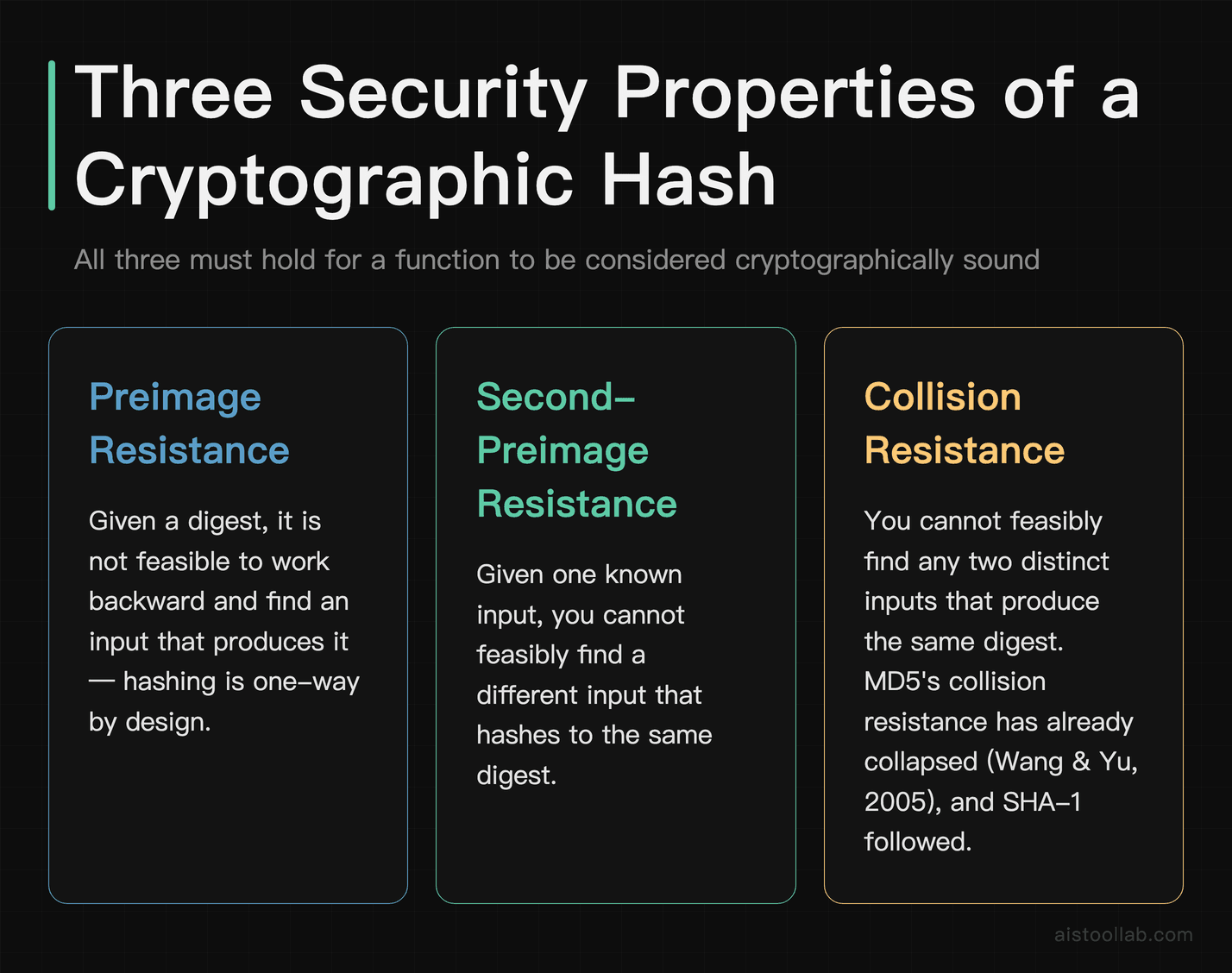
Three security properties define whether a hash function is considered cryptographically sound:
- Preimage resistance — given a digest, you can’t feasibly work backward to find an input that produces it. Hashing is one-way by design.
- Second-preimage resistance — given one input, you can’t feasibly find a different input that hashes to the same digest.
- Collision resistance — you can’t feasibly find any two distinct inputs that produce the same digest.
When cryptographers say an algorithm is “broken,” they usually mean one of these properties has fallen. MD5’s collision resistance collapsed years ago — Xiaoyun Wang and Hongbo Yu documented practical collisions in “How to Break MD5 and Other Hash Functions” (2005). SHA-1 followed: the SHAttered research, published as “The first collision for full SHA-1” (Marc Stevens et al., 2017, a collaboration between CWI Amsterdam and Google), demonstrated a real, working collision. Neither is considered safe for security purposes anymore, though both still show up constantly as fast checksums for non-adversarial file integrity.
Why password hashes are a different animal
MD5, SHA-1, and the SHA-2 family (including SHA-256) were built to be fast — great for verifying that a 4 GB download arrived intact, terrible for storing passwords. If an attacker steals a database of fast-hashed passwords, they can try billions of guesses per second on commodity hardware.
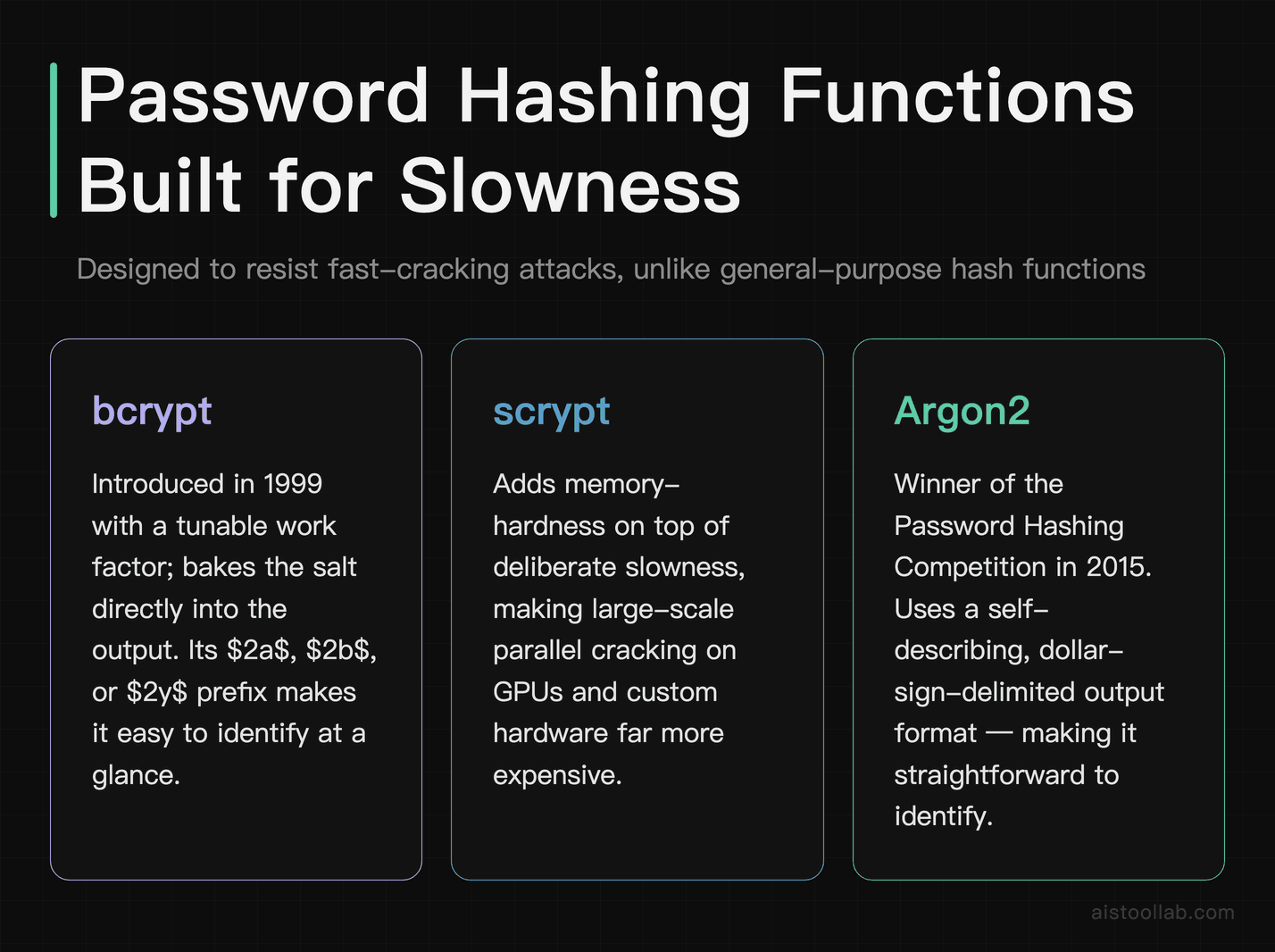
Password hashing functions deliberately invert that priority. They’re built to be slow and, in newer designs, memory-hungry:
- bcrypt, introduced in Niels Provos and David Mazières’ paper “A Future-Adaptable Password Scheme” (USENIX, 1999), has a tunable work factor and bakes the salt directly into the output. That’s why bcrypt hashes are so easy to spot — they start with
$2a$,$2b$, or$2y$. - scrypt, from Colin Percival’s “Stronger Key Derivation via Sequential Memory-Hard Functions” (2009), adds memory-hardness, making large-scale parallel cracking on GPUs and custom hardware far more expensive.
- Argon2, which won the Password Hashing Competition in 2015, also uses a self-describing, dollar-sign-delimited format.
The practical upshot: password hashes often carry explicit metadata in their structure — a prefix, cost parameters, the salt — whereas a bare MD5 digest carries none, which makes their format basically self-documenting.
How identification actually works
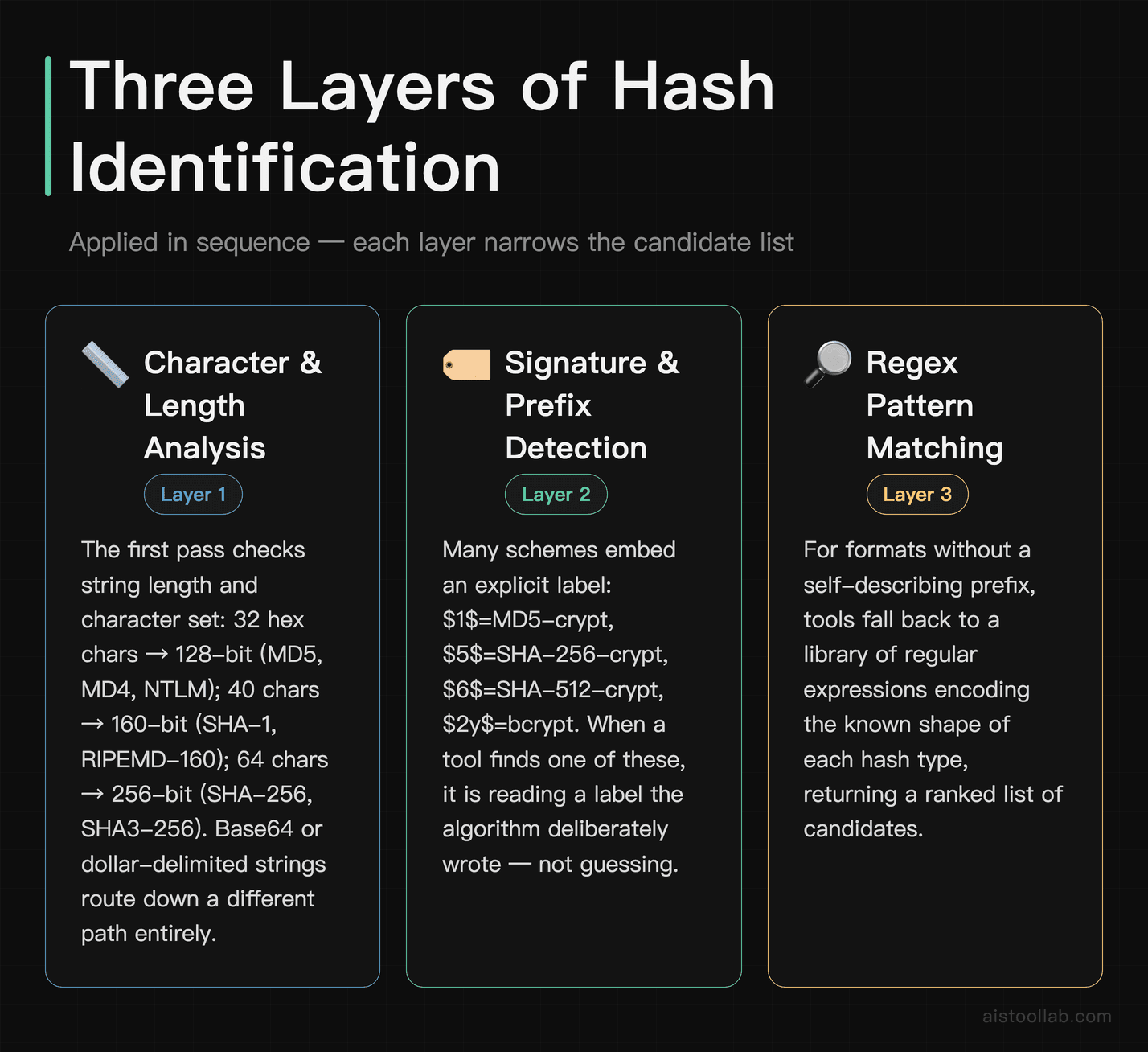
Strip away the marketing and hash identification comes down to a few layered techniques, applied roughly in this order.
Character and length analysis
The first pass is dumb but effective: how long is the string, and what character set does it use? A pure hexadecimal string of 32 characters points to a 128-bit digest (MD5, MD4, NTLM, and friends). Forty hex characters means 160 bits (SHA-1, RIPEMD-160). Sixty-four means 256 bits (SHA-256, SHA3-256, and others). Base64-encoded or dollar-delimited strings get routed down a different path entirely.
Signature and prefix detection
This is where identification gets much more confident. Many schemes prepend an identifier to their output. In the traditional Unix crypt format, $1$ means MD5-crypt, $5$ means SHA-256-crypt, $6$ means SHA-512-crypt, and $2y$ means bcrypt. When a tool sees one of these, it isn’t guessing — it’s reading a label the algorithm deliberately wrote.
Pattern matching against known formats
For everything without a self-describing prefix, tools fall back to a library of regular expressions that encode the known shape of each hash type. Open-source utilities like hashID, the classic hash-identifier Python script, and Name-That-Hash all work this way — they match your input against dozens or hundreds of format patterns and return every type that fits. hashcat, the widely used password-recovery tool, also ships an example hash for every mode it supports, which effectively doubles as a reference catalog for what each format looks like.
Rainbow table lookup
A rainbow table is a precomputed mapping from known inputs to their hashes, cleverly compressed to trade storage for computation. It doesn’t identify an algorithm so much as reverse a specific unsalted hash — if the plaintext was in the table, you get it back. This is precisely why salting exists: a unique random salt per password means an attacker would need a separate table for every salt, which destroys the economics of precomputation.
Comparing the common algorithms
The table below lays out the checkable, published characteristics of five algorithms you’ll encounter constantly. “Security status” here reflects documented cryptographic consensus (collision attacks for MD5 and SHA-1, as cited above), not an editorial ranking — and none of this is a recommendation of one over another outside its intended context.
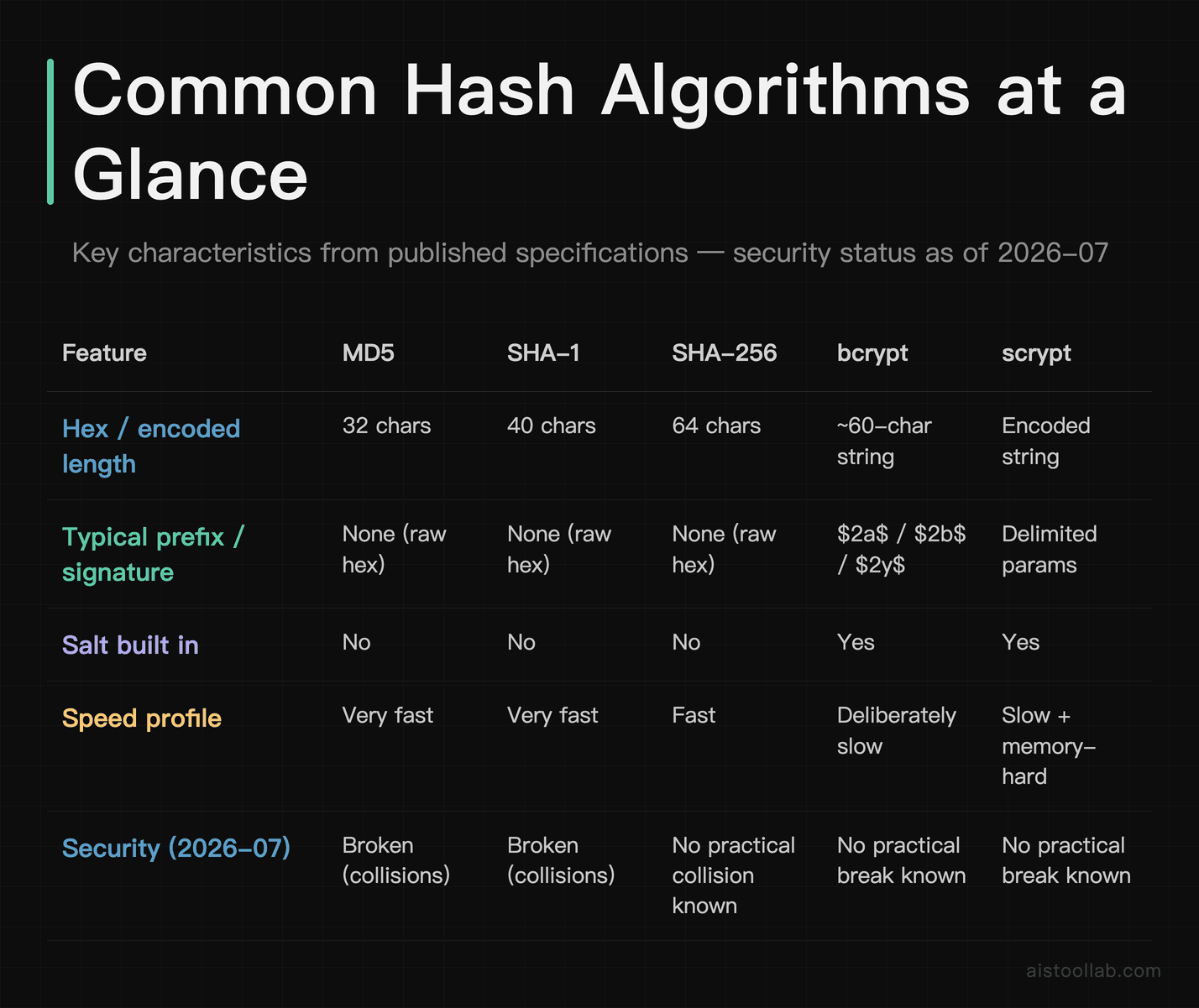
Notice the pattern: the fast, raw-hex functions carry no built-in signature, which is exactly why they’re ambiguous to identify. The password-focused functions carry rich structural metadata, which makes them easy to identify but hard to crack. Those two facts are two sides of the same design decision.
Where this matters in the real world
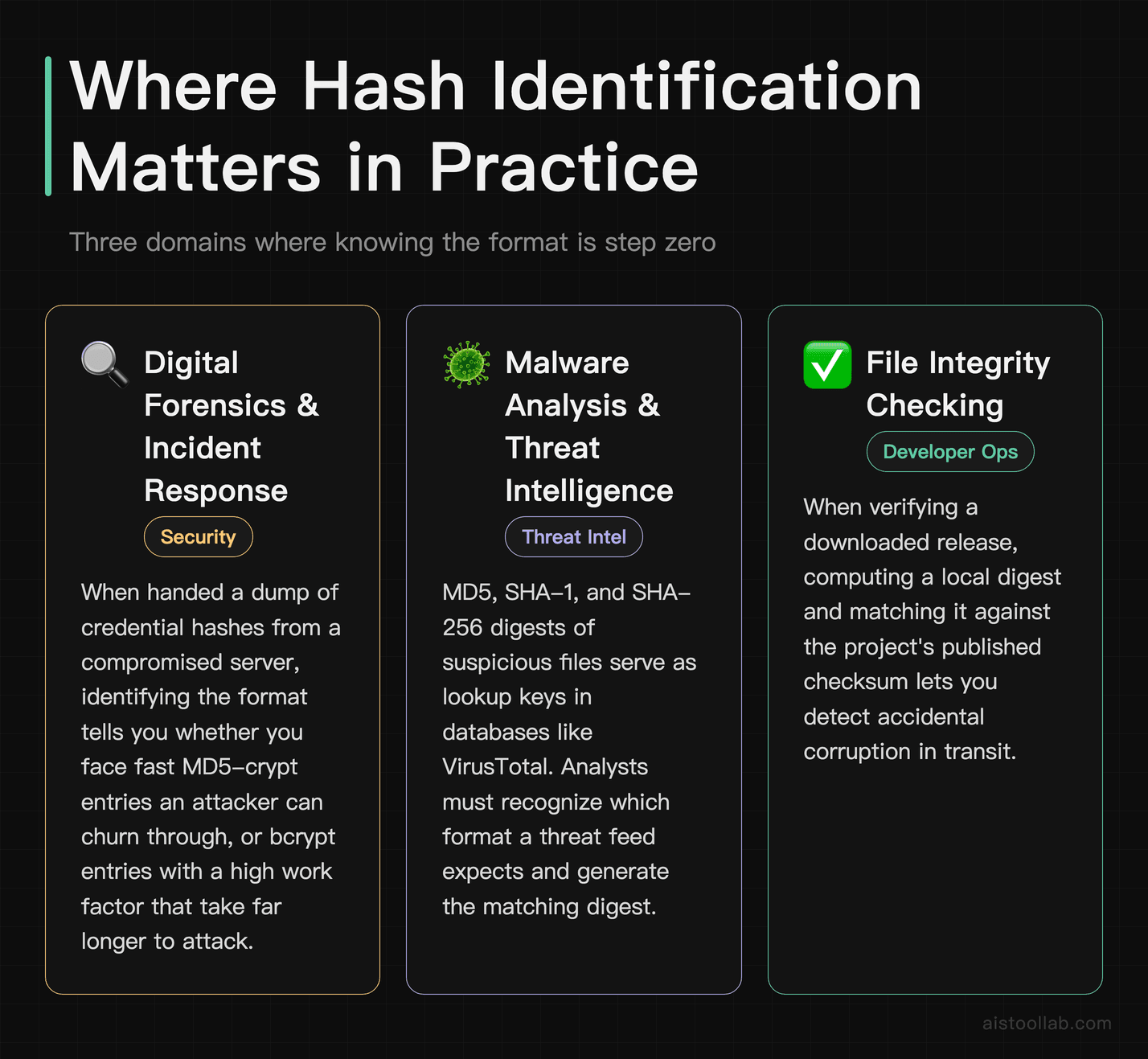
Digital forensics and incident response
Say you’re a responder handed a dump of credential hashes pulled from a compromised server. Before you can decide whether they’re recoverable, migrate them, or flag them as already-weak, you need to know the format. Identifying the type is step zero — it tells you whether you’re looking at fast MD5-crypt entries that an attacker could churn through, or bcrypt entries with a high work factor that would take far longer to attack.
Malware analysis and threat intelligence
File hashes are a common currency of threat intel. When you submit a suspicious binary to a service like VirusTotal, its MD5, SHA-1, and SHA-256 digests become lookup keys against large databases of known-good and known-bad files. Recognizing which digest format a threat feed expects — and generating the matching one — is routine work in a malware analyst’s day.
File integrity checking
If you’re a developer verifying a downloaded release, the project’s site publishes a checksum next to the download. Matching your locally computed digest against the published one lets you detect accidental corruption in transit; it only supports a tamper-detection conclusion when the published checksum comes from a trusted source that wasn’t altered alongside the file. Here MD5 and SHA-1 are still commonly used precisely because the threat model isn’t an adversary forging collisions — it’s catching an accidental byte flip.
Password systems and audits
Imagine you’re the sole engineer inheriting a legacy authentication system with no documentation. Peeking at a sample stored hash and identifying its format tells you whether you’re sitting on a security liability (say, unsalted MD5) or something modern. That identification often drives the decision to force a rehash-on-next-login migration to a stronger scheme.
Do online hash identifiers really use machine learning?
This is worth being straight about, because the marketing sometimes gets ahead of the engineering. A common approach for a hash identifier — open-source or hosted — is to work from a curated database of format signatures and regular expressions. When you paste a string, it’s matched against those known patterns, and the tool returns the candidates that fit. That’s deterministic pattern matching, not learning.
Some hosted tools layer on statistical scoring to rank ambiguous results, and a few describe that layer as “machine learning.” Whether a given tool’s ranking is genuinely a trained model or just weighted heuristics is something you’d have to confirm against that specific tool’s own documentation — I wouldn’t assume it either way. But here’s the part that doesn’t change regardless of the technique: because a bare 32-hex string is genuinely ambiguous, no amount of clever ranking can turn “probably one of these five” into “definitely this one.” The ceiling on certainty is set by the cryptography, not by the tool. If you want a deeper look at how specific products differ on accuracy and coverage, I broke that down in the Hash Identifier Tools Compared piece.
Frequently Asked Questions
Can a hash identifier tell me the exact algorithm for certain?
Only sometimes. If the hash carries a self-describing signature — a bcrypt $2y$ prefix, or a Unix crypt $6$ marker — then yes, the format is effectively labeled and identification is reliable. But for raw, unstructured digests like a plain 32-character hexadecimal string, the honest answer is a ranked list of candidates. That string could be MD5, MD4, NTLM, or several other 128-bit functions, and nothing in the digest itself distinguishes them. A good tool acknowledges this by returning multiple possibilities rather than pretending to certainty. The way to narrow it further is context: where did the hash come from? A Windows credential dump makes NTLM likely; a Linux /etc/shadow file with a $1$ prefix points to MD5-crypt. Identification is as much about the surrounding evidence as the string.
Is identifying a hash the same as cracking it?
No, and conflating the two causes a lot of confusion. Identification tells you which algorithm probably produced a digest. Cracking means recovering the original input that was hashed. These are separate operations with different difficulty. Identifying a bcrypt hash takes milliseconds because the format announces itself. Cracking that same bcrypt hash could take an impractically long time thanks to its deliberately slow work factor. Identification is a prerequisite for cracking — you need to know the format before you can attempt recovery — but knowing the type does not on its own reveal the plaintext, especially for salted, slow password functions. Think of identification as reading the label on a locked box, and cracking as picking the lock.
Why do different algorithms produce hashes of the same length?
Because output length is just a design parameter, and multiple independent algorithms happen to target the same bit-width. MD5, MD4, and NTLM all produce 128-bit digests, so all three render as 32 hexadecimal characters. SHA-1 and RIPEMD-160 both produce 160 bits, or 40 hex characters. The length narrows the field but rarely pins down a single answer for raw digests. This overlap is one reason hash identification is probabilistic rather than definitive. The algorithms weren’t coordinated to be distinguishable — they were each designed to a security target, and collisions in output format are simply a side effect.
Are MD5 and SHA-1 still safe to use?
It depends entirely on your threat model. For security-sensitive work — password storage, digital signatures, certificate integrity — both are considered broken because practical collision attacks exist, as documented by Wang and Yu (2005) for MD5 and the SHAttered research (2017) for SHA-1. You should not rely on them where an adversary might deliberately craft colliding inputs. But for non-adversarial file integrity — confirming a download didn’t get corrupted, deduplicating files, generating cache keys — they remain serviceable for detecting accidental changes (provided the reference checksum comes from a trusted source that wasn’t altered alongside the file), and are still widely used precisely because they’re fast. The mistake is using them where collision resistance actually matters. Match the tool to the threat: accidental corruption is a very different problem from a motivated attacker.
What makes bcrypt and scrypt better for passwords than SHA-256?
Speed, inverted. SHA-256 is engineered to be fast, which is a virtue for integrity checking and a liability for password storage — an attacker with a stolen database can test enormous numbers of guesses per second. bcrypt deliberately slows this down with a configurable work factor, so you can dial the cost up as hardware improves. scrypt goes further with memory-hardness, requiring large amounts of RAM per guess, which makes massively parallel cracking on GPUs and custom silicon far more expensive. Both also incorporate a per-password salt automatically, defeating precomputed rainbow tables. Argon2 was the winner of the 2015 Password Hashing Competition and is a more recent function in this lineage. The general principle: for passwords you want a function that’s expensive to compute on purpose.
What exactly is a rainbow table?
A rainbow table is a precomputed data structure that maps known plaintexts to their hash values, using a chaining technique that trades storage space for reconstruction time. Instead of storing every input-to-hash pair (which would be astronomically large), it stores compressed chains and regenerates the rest on lookup. For an unsalted hash of a password that is already covered by the table, a rainbow table can reverse it quickly, though how fast depends on the table’s size, the algorithm, and the hardware used. Its fatal weakness is salt: because a salt makes every password’s hash unique even when two users chose the same password, an attacker would need a separate table for every possible salt value, which is computationally hopeless. That’s the entire reason modern password schemes salt by default — it turns a one-time precomputation attack into an infeasible per-target one.
Can salted hashes be identified?
Often yes, because the salt is usually stored right alongside the hash in a structured format. A bcrypt string, for example, embeds the algorithm identifier, the cost factor, and the salt all in one self-describing output, which makes it trivial to identify even though it’s salted. The salt protects against reversal and precomputation attacks, not against format recognition. What salt does prevent is the shortcut of looking a hash up in a database of known digests — since the salt makes the output unique, a straight lookup will fail even for a common password. So identifying the scheme and recovering the plaintext remain two different challenges, and salt raises the bar sharply on the second one.
Is it safe to paste hashes into an online identifier?
Treat this as a real consideration, especially in a professional context. A raw hash of a random file is usually low-risk to submit. But a password hash from a production system — even though it’s one-way — is still sensitive material, and pasting it into an unknown third-party service means handing that data to someone whose logging and retention policies you can’t see. For sensitive forensics or incident-response work, offline open-source tools like hashID or Name-That-Hash keep everything on your own machine, so you’re not submitting the data to a third party in the first place. If you’re weighing hosted versus local options for routine developer work, I compared several in the AI Developer Utility Tools roundup. As a rule of thumb: casual, non-sensitive strings are fine online; anything from a real system stays local.
The takeaway
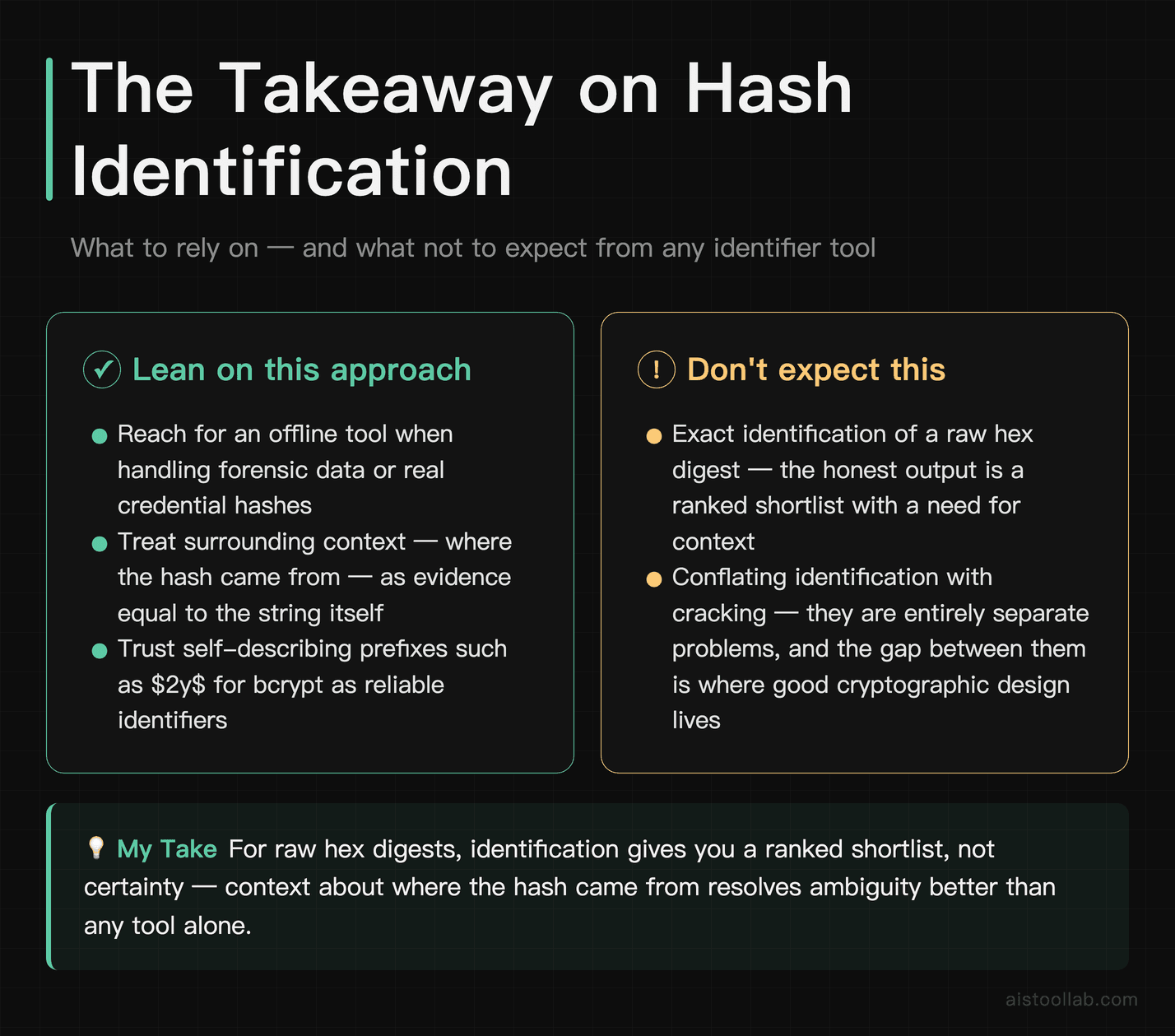
Hash identification isn’t magic and it isn’t machine learning wizardry — it’s structured pattern recognition sitting on top of the deliberate design choices baked into each algorithm. Self-describing formats like bcrypt announce themselves; raw digests like MD5 leave you with a ranked shortlist and a need for context. If you’re doing forensics or handling real credential data, I’d reach for an offline tool and lean on the surrounding evidence — where the hash came from — as much as the string itself, because that context does more to resolve ambiguity than any identifier can. And if you only remember one thing: identifying a hash and cracking it are entirely separate problems, and the gap between them is exactly where good cryptographic design lives.
Last updated: 2026
Found this review helpful?
👉 Browse the AI Tools Library to find the right tools for your workflow.
Related reading: Hash Identifier Tools Explained: Getting Started with Common Hash Types and Detection Methods