

“Random Is Random,” Right? Not Even Close
Here’s a belief that quietly causes security bugs: the idea that once text or numbers “look random,” they’re all equally random. Type Math.random() in a browser console, get a jumble of digits, and it feels done. Generate a page of lorem ipsum for a mockup, and it feels like the same category of thing as the token you just used to reset someone’s password.
It isn’t. The word “random” is doing an enormous amount of hidden work, and the gap between two kinds of it — the fast, predictable kind and the unpredictable, security-grade kind — is exactly where real problems live. Mozilla’s own documentation is blunt about it: MDN’s page on Math.random() states that it “does not provide cryptographically secure random numbers” and warns not to use it for anything security-related, pointing developers to the Web Crypto API’s crypto.getRandomValues() instead. That warning exists because people kept reaching for the convenient function in the wrong place.
So let’s actually take random text generation apart — the algorithms underneath it, why some are fine for filler and toxic for tokens, where large language models fit now that they can also “generate text,” and which implementation you’d reach for depending on whether you’re filling a UI, seeding a test suite, or minting a secret.
Contents
Two Families of Randomness, and Why the Difference Matters
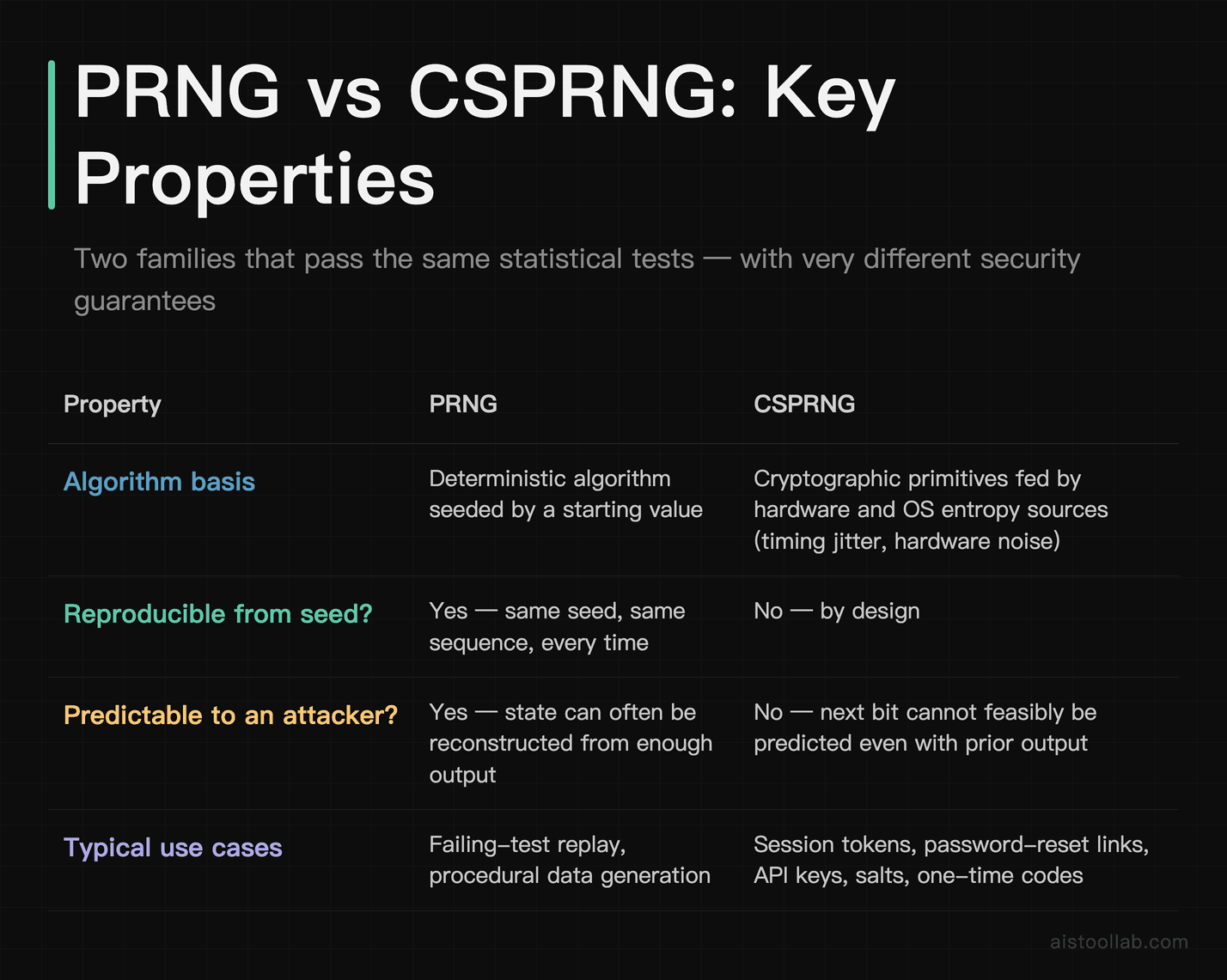
Almost everything called a “random text generator” falls into one of two families, and internalizing the split is worth the effort.
Pseudo-random generators (PRNGs) are deterministic algorithms. You give them a starting value — a seed — and they produce a stream of numbers that passes many statistical tests for randomness but is entirely reproducible. Same seed, same sequence, every time. That reproducibility is a feature, not a bug: it’s why you can rerun a failing test with the same “random” input, or regenerate the same procedural data on two machines. The catch is predictability. If someone learns the algorithm and enough output, they can often reconstruct the internal state and predict what comes next.
Cryptographically secure generators (CSPRNGs) are built so that even an attacker who sees a chunk of output cannot feasibly predict the next bit or recover the internal state. They typically draw entropy from hardware and operating-system sources (timing jitter, hardware noise, and so on) and pass it through cryptographic primitives. They are the correct choice for anything an adversary would want to guess: session tokens, password-reset links, API keys, salts, one-time codes.
The reason this distinction gets blurred is that both can spit out text that looks the same to a human. A random 20-character string from a PRNG and one from a CSPRNG are visually indistinguishable. The difference only shows up when someone is actively trying to predict it — which is precisely the moment it matters most.
The Core Algorithms, From Simple to Secure
Linear Congruential Generators (LCGs)
The LCG is the “hello world” of pseudo-randomness. It’s a one-line recurrence: each new value is the previous value multiplied by a constant, plus another constant, taken modulo a third. That’s it. Donald Knuth’s The Art of Computer Programming, Volume 2: Seminumerical Algorithms covers the theory in depth, including how badly a poorly chosen set of constants degrades the output.
LCGs are fast, use almost no memory, and are trivially seedable — which is why they still turn up in embedded systems and older standard libraries. But they have well-documented weaknesses. The classic cautionary tale is RANDU, an LCG shipped on IBM mainframes decades ago, whose output values, when plotted in three dimensions, fall onto a small number of parallel planes — a failure exposed by the spectral test that Knuth describes. The practical takeaway: an LCG is fine for a jiggle of visual noise or a quick throwaway shuffle, and unsuitable for simulations that depend on high-dimensional randomness, let alone security.
The Mersenne Twister
The Mersenne Twister is a general-purpose pseudo-random number generator. It was introduced by Makoto Matsumoto and Takuji Nishimura in “Mersenne Twister: A 623-dimensionally equidistributed uniform pseudo-random number generator,” published in ACM Transactions on Modeling and Computer Simulation, Vol. 8, No. 1, 1998. The name comes from its period length, which is tied to a Mersenne prime — an astronomically long cycle before the sequence repeats, and good equidistribution across many dimensions, which is where LCGs fall apart.
This is why it became a default. Python’s official documentation for the random module states that it uses the Mersenne Twister as its core generator. It gives you high-quality, reproducible pseudo-randomness for simulations, sampling, procedural generation, and test data. But — and the Python docs say this directly — it is not suitable for security or cryptographic purposes. Its internal state can be reconstructed from observed output, so it must never mint a secret.
Modern cryptographic methods
CSPRNGs are a different design goal entirely. Rather than optimizing for speed and reproducibility, they optimize for unpredictability. In practice you rarely implement one yourself; you call into the operating system or a vetted library. On Unix-like systems this bottoms out at kernel interfaces like /dev/urandom; in code you reach for os.urandom() or Python’s secrets module, whose documentation explicitly recommends it for “generating cryptographically strong random numbers suitable for managing secrets.” In the browser and Node, the Web Crypto API’s crypto.getRandomValues() and the crypto module play that role.
The honest rule of thumb: if the answer to “would it hurt if someone predicted this?” is yes, you want a CSPRNG. If the answer is no, a good PRNG like the Mersenne Twister is faster and reproducible, which is often exactly what you want.
Where LLMs Fit — and Where They Don’t

Now the newer wrinkle. When people say “AI text generator” in 2026, they often mean a large language model, and it’s worth being precise about how different that is from everything above.
Algorithmic generators produce structurally random output: gibberish strings, lorem ipsum, random records that don’t mean anything. LLMs produce semantically coherent text — plausible product descriptions, realistic-sounding names, sample support tickets, fake-but-believable user bios. They’re sampling from a learned distribution over language, not from a mathematical recurrence. And their sampling step usually uses a PRNG under the hood (that’s what a “temperature” and “seed” parameter are influencing).
That makes them complementary, not competing. If you need 10,000 filler paragraphs to stress-test how your layout handles overflow, an LLM is heavier and slower — a lorem ipsum generator or a scripted loop is a good fit. If you need test data that looks like real human writing — say, realistic review text so your sentiment pipeline isn’t trained on nonsense — an LLM earns its keep. And critically: an LLM is not designed to generate a secret. It’s a different family — non-deterministic in ways you can’t audit — and there’s no security rationale to route a cryptographic requirement through a text model.
I dig into how these language-model utilities stack up against deterministic dev tools in the AI Developer Utility Tools Compared 2026 piece, if you want the tooling angle rather than the algorithm angle.
Comparing the Approaches
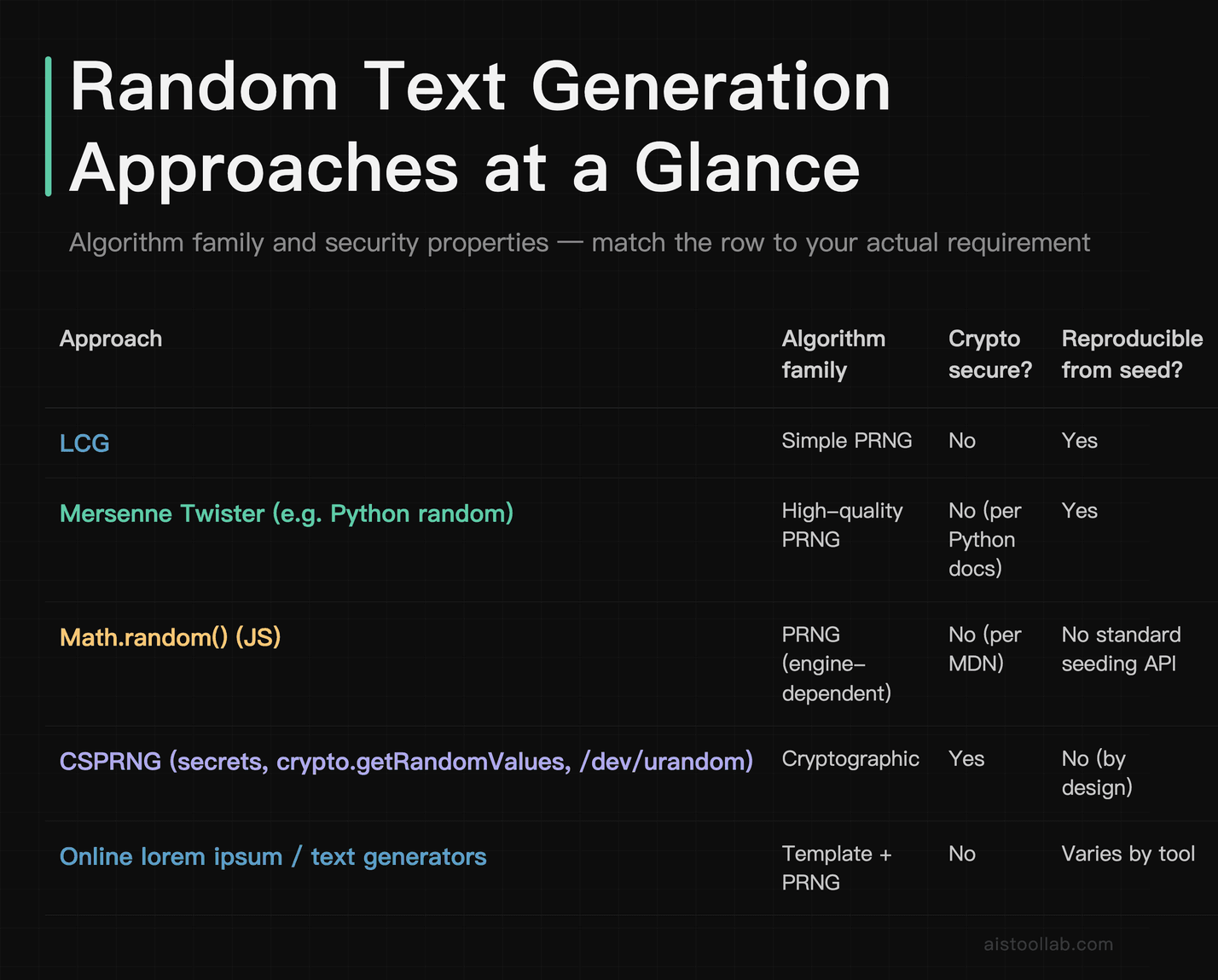
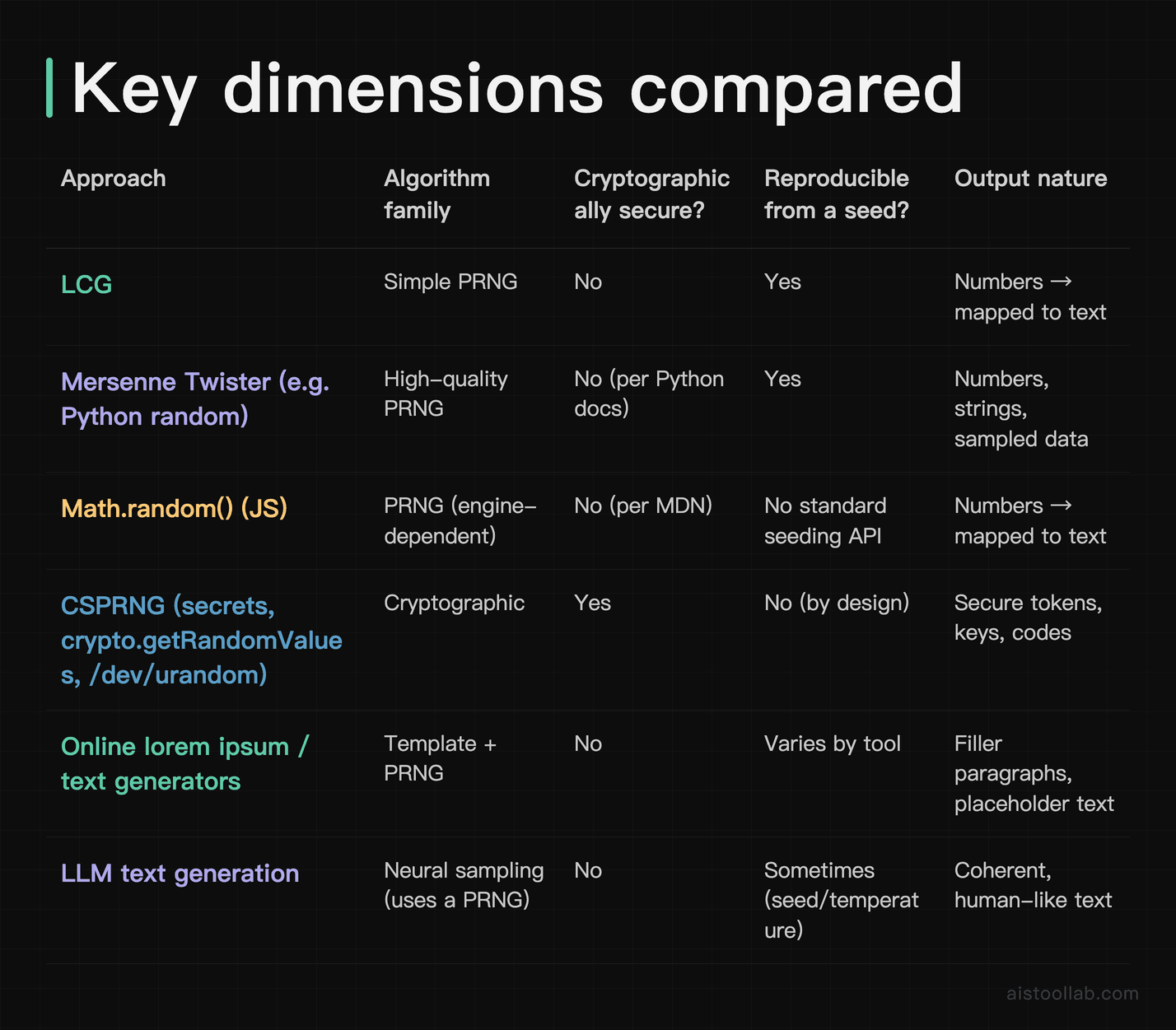
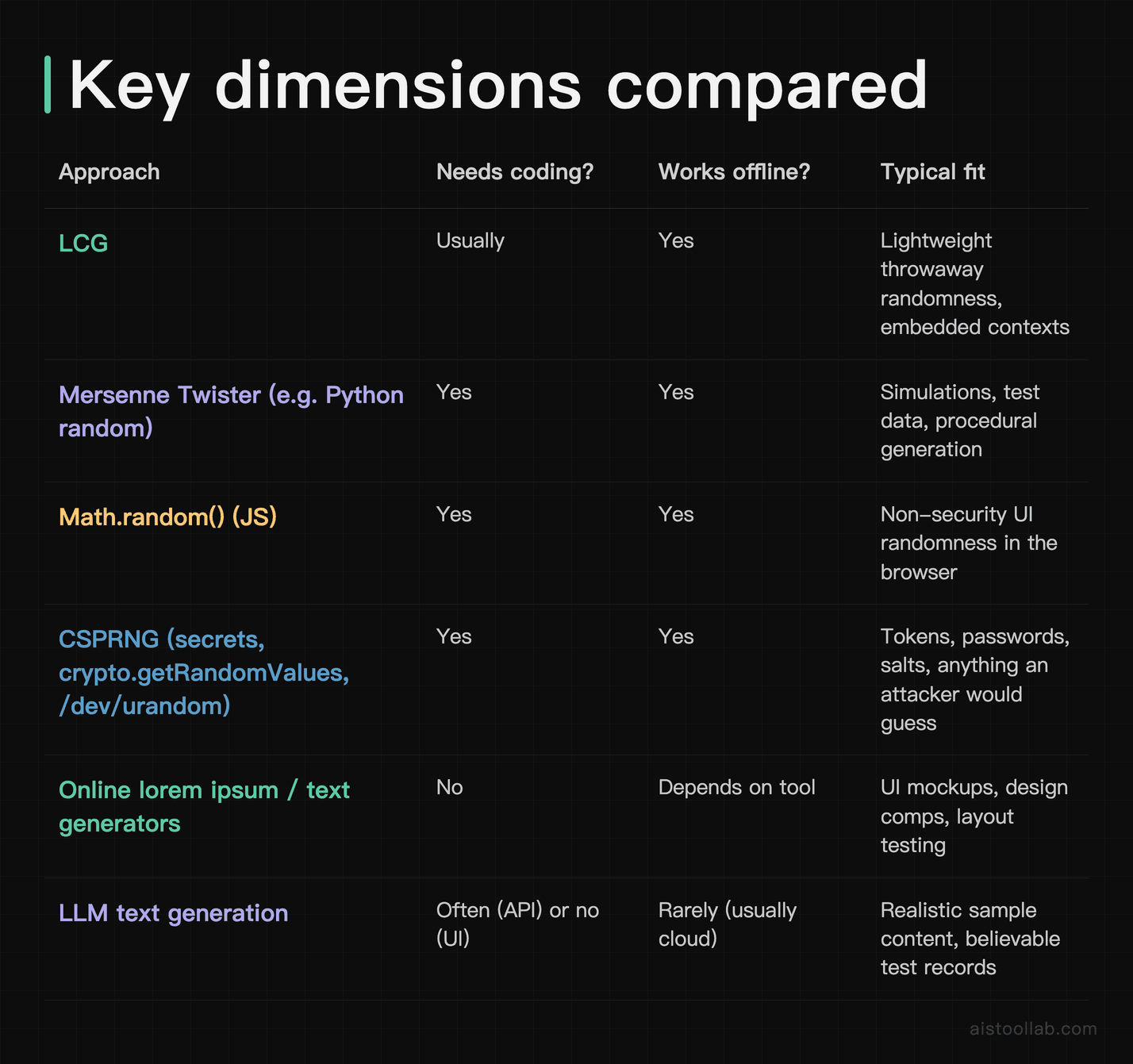
This table maps the main approaches by checkable properties — algorithm family, whether output is cryptographically secure, whether it’s reproducible from a seed, and what it’s designed for. The “typical fit” column is a condition-bound suggestion, not a ranking; pick based on which row matches your actual requirement.
Practical Applications

Filling UI mockups and testing layouts
Say you’re a front-end developer building a card component and you need to see how it behaves when a title runs long or a description is nearly empty. You don’t need meaning here — you need controllable length and shape. This is lorem ipsum territory, or a small script that emits strings of varying length. The point is to stress the layout: does text overflow gracefully, does truncation kick in, does the empty state look intentional. Reproducibility helps if you want the same mock content across screenshots, which is a reason to seed a PRNG rather than pull fresh randomness each render.
Generating test data for a pipeline
Imagine you’re the sole backend engineer on a small SaaS product and you need 50,000 fake user records to load-test a search feature. Here the Mersenne Twister behind a library like Python’s random (often paired with a data-faker library) is a natural fit: fast, reproducible so your teammate can regenerate the identical dataset from the same seed, and statistically varied enough to exercise edge cases. If the records need to read like real human writing — realistic support tickets to test a classifier — that’s where you’d bring an LLM into the loop instead, accepting the trade-off of slower generation and cloud dependency.
Minting secrets in an application
Now suppose you’re wiring up password resets. Every instinct that served you in the two cases above is now dangerous. You need a CSPRNG — Python’s secrets module, the Web Crypto API, or your platform’s equivalent — because the entire security property depends on an attacker being unable to predict the token. Reusing the same fast PRNG you used for test data here is a genuine vulnerability class, not a style preference. The mental switch is: “test and design randomness” and “security randomness” are different jobs with different tools, even when the output strings look identical.
Implementation Options: What to Actually Call
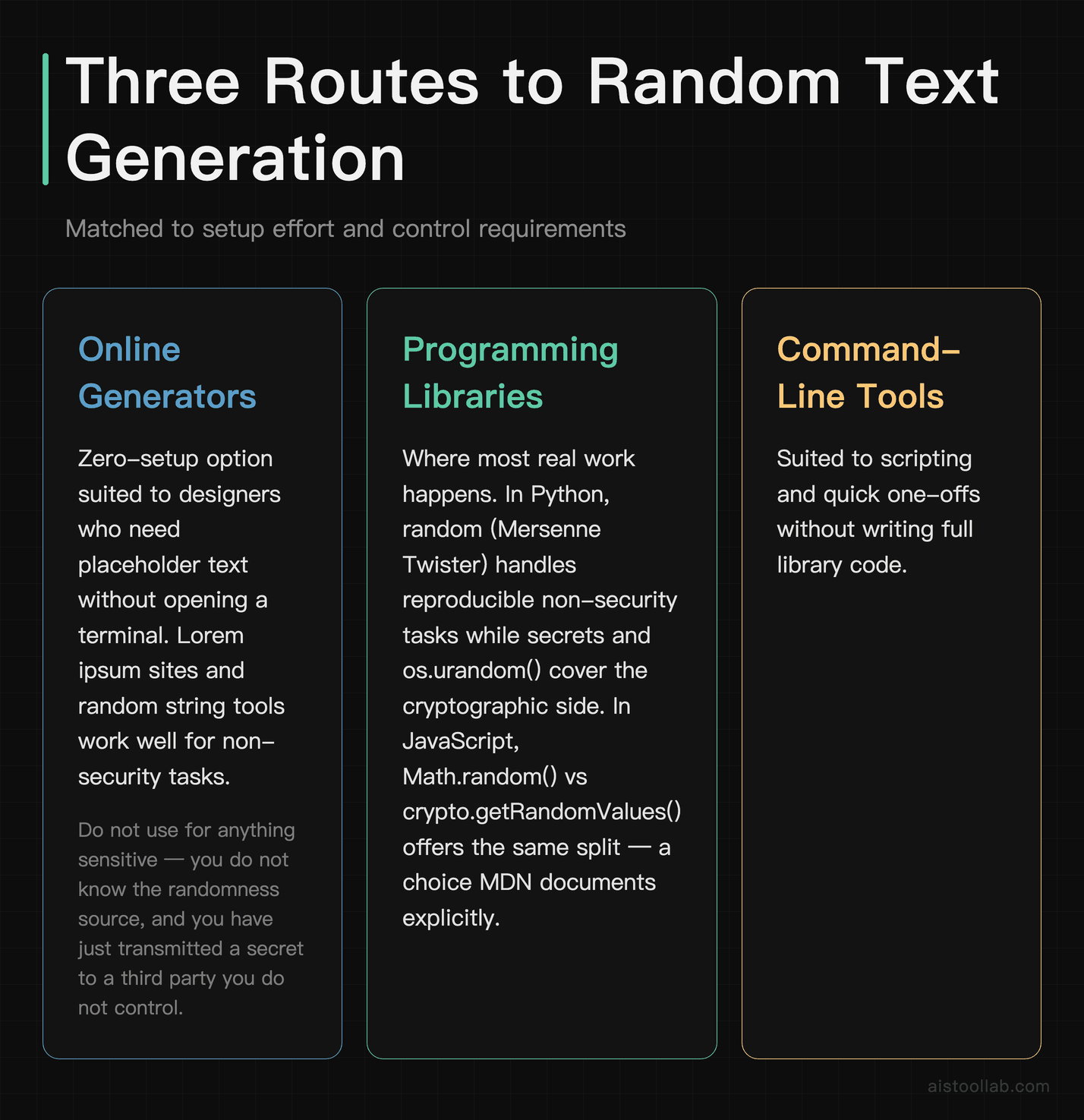
You’ve got three broad routes, and they map cleanly onto how much control you need.
Online generators are the zero-setup option. Lorem ipsum sites, random string tools, and placeholder-text generators are well suited to designers and anyone who just wants text on a canvas without opening a terminal. The caveat: for anything sensitive, generating a “random password” on a web page you don’t control is a bad habit — you don’t know its source of randomness, and you’ve just transmitted a secret to a third party. Keep online tools for the non-security jobs they’re good at.
Programming libraries are where most real work happens. In Python, random gives you the Mersenne Twister for reproducible, non-security randomness, while secrets and os.urandom() cover the cryptographic side — the standard library helpfully separates the two so you’re nudged toward the right one. In JavaScript, Math.random() handles casual browser randomness and crypto.getRandomValues() handles the secure side, a split MDN documents explicitly. The libraries make the pseudo-vs-crypto choice a matter of which function name you type, which is the whole point.
Command-line tools suit scripting and quick one-offs. On Unix-like systems you can pull secure bytes straight from /dev/urandom, and utilities like openssl rand generate random data on the spot for shell workflows and CI scripts. Handy when you want a token in a deploy script without writing a program around it.
If your work also spills into generating random colors or other developer scaffolding, I covered the color side separately in Random Color Generator & Color Name Finder Tools 2026, and the general “how these generators work” foundations in How Random Text Generators Work.
Frequently Asked Questions
Is Math.random() safe for generating passwords or tokens?
No — and this is a common mistake in this area. MDN’s documentation for Math.random() states outright that it does not provide cryptographically secure random numbers and should not be used for anything security-related. The reason is that it’s a pseudo-random generator: its output is produced by a deterministic algorithm whose internal state can, in principle, be reconstructed by an attacker who observes enough values, letting them predict future output. For a session token or reset link, predictability is a direct security hole. The correct tool in the browser and Node is the Web Crypto API’s crypto.getRandomValues(), which is designed to be unpredictable even to someone watching its output. The rule to memorize: if guessing the value would let an attacker do something they shouldn’t, use a cryptographically secure generator, never Math.random(). Use Math.random() only for things where prediction causes no harm — animations, non-security UI variety, casual sampling.
What’s the actual difference between a PRNG and a CSPRNG?
Both produce sequences that pass many statistical tests for randomness, so their output can look identical. The difference is in what they guarantee. A pseudo-random generator (PRNG) like the Mersenne Twister is optimized for speed, long period, good statistical distribution, and reproducibility from a seed — but not for resisting an adversary. Given enough output, its internal state can be recovered and future values predicted. A cryptographically secure generator (CSPRNG) is specifically designed so that even an attacker who sees part of the output cannot feasibly predict the next values or recover the state; it also draws on unpredictable entropy sources from the operating system and hardware. The trade-off is that CSPRNGs are generally not seedable for reproducibility (that would defeat the purpose) and can be slower. So you choose based on the job: reproducible test data and simulations want a PRNG; secrets want a CSPRNG.
Why does reproducibility matter if the whole point is randomness?
Because in testing, simulation, and procedural generation, you frequently want randomness that you can replay exactly. Picture a test that fails intermittently on “random” input — if you can’t reproduce the exact sequence that triggered it, debugging becomes guesswork. Seeding a PRNG solves this: record the seed, and you can regenerate the identical “random” run on demand, on any machine. The same logic applies to procedural content (two players should see the same generated world from the same seed) and to sharing datasets (a teammate reproduces your exact test corpus from the seed you noted). This is a genuine strength of pseudo-random generators, not a compromise. Cryptographic generators deliberately give this up — you can’t and shouldn’t reproduce a secret. So reproducibility is another axis on which the two families diverge: PRNGs offer it as a feature, CSPRNGs withhold it as a security requirement.
Can I use an LLM to generate random text instead of an algorithm?
You can, but only for the jobs where an LLM’s strength — coherent, human-like language — is what you need, and never for security. Algorithmic generators give you structurally random but meaningless output (gibberish, lorem ipsum, random records). An LLM gives you plausible, readable text: fake product blurbs, believable review snippets, sample bios that look like real people wrote them. That’s valuable when your test data needs to resemble genuine human writing, for instance to exercise a text-classification or search pipeline that would behave differently on nonsense. But an LLM is slower and usually cloud-dependent, so for bulk filler or simple placeholder text a lorem ipsum tool or a short script avoids that overhead. And for anything cryptographic — tokens, keys, passwords — an LLM is the wrong category of tool. Route secrets through a dedicated CSPRNG, not a language model.
What makes the Mersenne Twister so widely used?
It hit a sweet spot for general-purpose pseudo-randomness. Introduced by Matsumoto and Nishimura in their 1998 ACM Transactions on Modeling and Computer Simulation paper, it has an extremely long period before the sequence repeats and strong equidistribution across many dimensions — the exact area where simpler generators like LCGs fail (recall RANDU’s output collapsing onto a few planes in 3D). That combination of statistical quality, speed, and reproducibility made it a sensible default, which is why Python’s random module documentation states it as the core generator, and many other environments adopted it too. Its one firm limitation, also stated plainly in Python’s docs, is that it is not cryptographically secure — its state can be reconstructed from output — so it must never be used to generate secrets. Think of it as the reliable engine for simulations, sampling, and test data, with a hard boundary at anything security-sensitive.
Are online random text generators safe to use?
For their intended jobs, yes; for secrets, no. Lorem ipsum sites, placeholder-text tools, and random string generators are genuinely convenient for designers filling mockups or developers who want quick throwaway text without touching code. The problem is only when people use a web page to generate something sensitive, like a “secure password.” You have no visibility into what randomness source that page uses, and you’ve just handed a secret to a third-party server that could log it. That’s a poor security posture regardless of the site’s intentions. Keep online generators for non-security work — layout filler, design comps, sample content — where transmitting the output to a website causes no harm. When you need a real secret, generate it locally with a cryptographic tool: your language’s crypto library, openssl rand, or the operating system’s secure random interface. The convenience of an online tool isn’t worth compromising a credential.
Which programming library should I reach for in Python?
It depends entirely on whether the randomness is security-sensitive, and Python’s standard library is helpfully structured around that split. For non-security work — simulations, sampling, shuffling, test data, procedural generation — use the random module, which runs on the Mersenne Twister and supports seeding for reproducible runs. For anything an attacker would want to guess — tokens, passwords, reset links, salts — use the secrets module, whose documentation explicitly recommends it for managing secrets, or os.urandom() for raw secure bytes. The mental model is simple: random for “it doesn’t matter if someone predicts this,” secrets for “it absolutely matters.” Avoid the trap of using random for tokens just because it’s the module you already imported — the two look interchangeable but are not. Many data-generation workflows also pair random with a faker library to produce realistic-looking fake names and records on top of the underlying pseudo-random stream.
Do I ever need cryptographic randomness for test data or mockups?
Almost never, and that’s the useful insight. Test data, UI filler, procedural content, and design mockups all benefit from a fast, reproducible pseudo-random generator — reproducibility is often exactly what you want so runs and screenshots stay consistent. Cryptographic randomness is deliberately non-reproducible and can be slower, so using it for test data actively works against you by making runs harder to replay. One case where a security-grade generator fits test-adjacent work is when you’re testing the security machinery itself — for example, verifying that your token-generation code calls a proper CSPRNG. Otherwise, keep the two lanes separate: pseudo-random for everything about producing believable or bulk content, cryptographic for everything about protecting a secret. Getting this boundary right — not reaching for crypto “to be safe” in mockups, and never reaching for a fast PRNG when minting a real token — is much of what separates correct randomness handling from the sloppy kind.
The Bottom Line
Random text generation isn’t one thing; it’s at least three jobs wearing the same coat. If you’re filling layouts or designing comps, on the “just get believable filler fast” dimension, an online lorem ipsum tool or a seeded PRNG script is the sensible reach. If you’re generating test data or running simulations, on reproducibility and speed, a Mersenne Twister–backed library like Python’s random is built for it. And if you’re minting anything an attacker would love to guess, a defensible choice — per the plain warnings in MDN’s and Python’s own documentation — is a cryptographically secure generator.
The trap was never a bad algorithm. It’s using a perfectly good one in the wrong lane. Get the lane right, and the rest is just picking a suitable tool that lives in it.
Last updated: 2026
Found this review helpful?
👉 Browse the AI Tools Library to find the right tools for your workflow.