

The word “random” is doing a lot of heavy lifting here
A common assumption about random text generators is that they spit out genuinely random gibberish — that if you refresh the page, you get pure chaos, unpredictable and unrepeatable. It’s an easy thing to believe, because that’s how the output looks. Paragraph after paragraph of Lorem Ipsum, or a table of fake names and emails, feels like noise.
But most of what these tools produce isn’t random in the true, entropy-from-the-universe sense at all. It’s pseudo-random, generated by deterministic algorithms that can be seeded, replayed, and shaped to follow specific statistical patterns. And once you understand that distinction, these tools stop being a novelty and start being genuinely useful — for QA engineers building test datasets, designers filling wireframes, and developers who need to populate a demo database at 2am without hand-typing 500 fake users.
So let’s take the lid off. How does the “random” actually work, where does it earn its keep in real projects, and how do you tell a throwaway Lorem Ipsum button from a tool worth wiring into your workflow?
Contents
How random text algorithms actually work
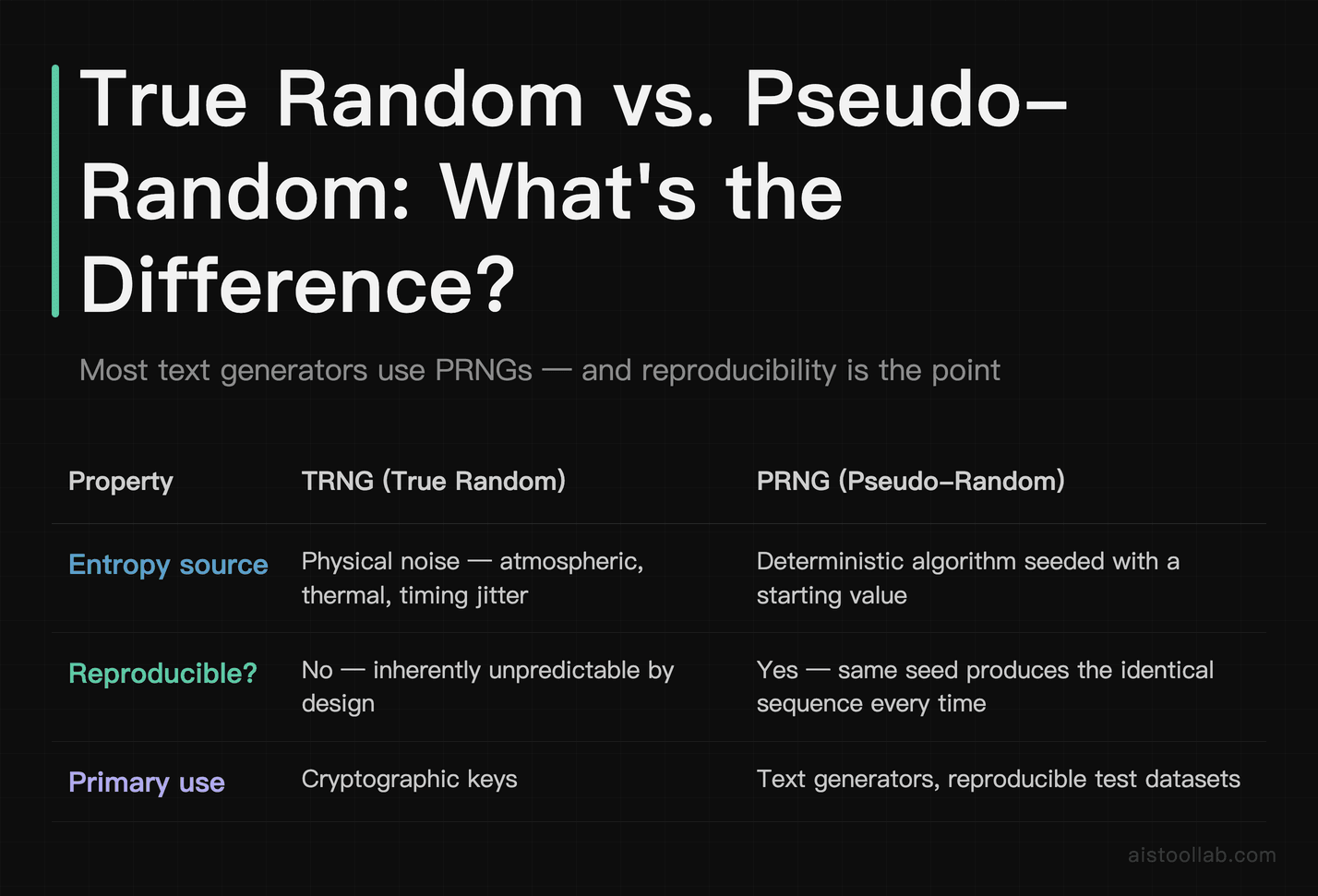
There’s a meaningful difference between true randomness and pseudo-randomness, and it’s the foundation for everything else.
True random number generators (TRNGs) pull from physical entropy sources — atmospheric noise, thermal noise in a circuit, timing jitter in hardware. Your operating system exposes some of this; on Unix-like systems it surfaces through interfaces like /dev/random. True randomness is unpredictable by design, which is exactly why it matters for cryptographic keys.
Most text generators, though, don’t need that. They use pseudo-random number generators (PRNGs) — deterministic algorithms that start from a seed value and produce a long sequence of numbers that are designed to look statistically random while remaining fully reproducible. Give the same PRNG the same seed, and you get the exact same sequence every time. That reproducibility isn’t a bug; it’s often the whole point, as we’ll get to.
Seeding: why “the same random data” is a feature
Seeding is the mechanism that turns “random” into “repeatable random.” When a test generates a dataset from seed 42, a colleague running the same generator with seed 42 gets an identical dataset. That means a bug someone hit with a specific batch of fake data can be reproduced exactly, instead of vanishing into “well, it worked on my machine.”
Libraries built for this — the Faker family across Python, JavaScript, Ruby, and other languages — expose a seed setting precisely so teams can lock their test data in place. Without a seed, the generator typically pulls its starting value from the system clock or an OS entropy source, giving you fresh output each run.
Distribution methods: shaping the randomness
Many PRNGs are designed to produce output that is close to uniform, so that each value in the range is roughly equally likely — though this depends on the specific algorithm. But real-world data isn’t uniform, and this is where generators diverge in sophistication:
- Uniform sampling — pick any word from a fixed list with equal probability. This is what basic Lorem Ipsum does: it draws from a small pool of Latin-esque words and strings them together. Fast, meaningless, and fine for its purpose.
- Weighted distributions — some values appear more often than others, mimicking real frequency. A good name generator weights common first names more heavily than rare ones, so your fake user table looks plausible rather than uniformly exotic.
- Markov chains — instead of picking words independently, the generator models the probability that one word (or character) follows another, learned from a source corpus. This is how you get text that reads almost like real language — grammatically shaky but locally coherent. It’s the classic technique behind “fake but readable” paragraph generators.
- Grammar/template-based — the generator fills structured templates (a valid email is
word@word.tld, a phone number follows a regional format) so the output is syntactically correct for its type, which matters enormously for testing. - Large language models — the newest layer. An LLM can produce topically coherent, context-aware placeholder text on demand. It’s far heavier than a PRNG and generally non-deterministic, and pinning parameters doesn’t by itself guarantee reproducible output, but it’s the option when you need placeholder copy that actually reads like it belongs.
Honestly, the algorithm surprised me here: the “smartest” method isn’t always the right one. A cryptographic-grade TRNG is overkill for filling a wireframe, and an LLM is overkill for stress-testing a form field. Matching the method to the job is most of the skill.
QA testing: diverse datasets without the manual grind
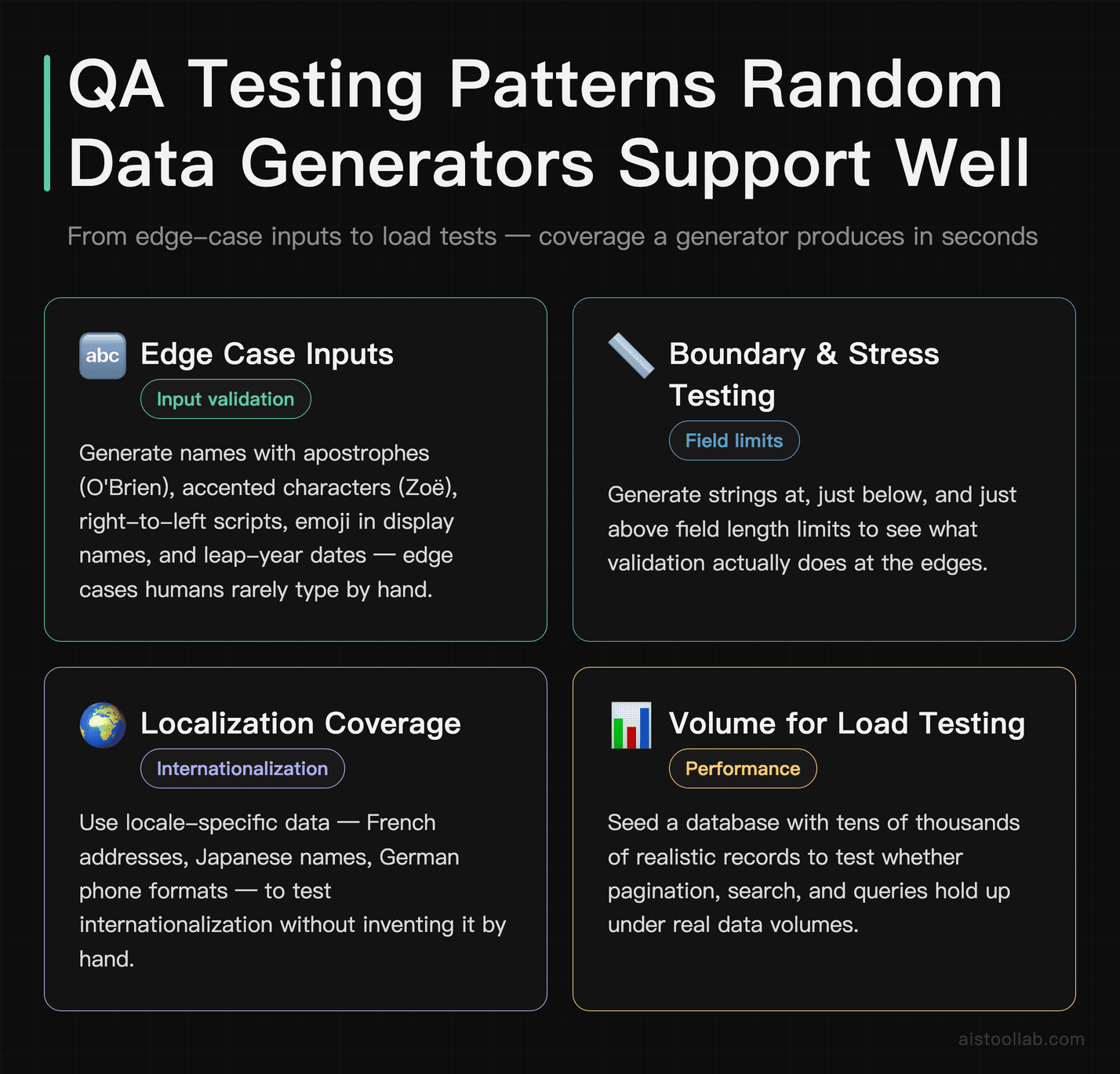
This is where random text generators pull real weight. Manually authoring test data is slow and, worse, biased — humans tend to type “clean” inputs that match how they expect the software to be used. Software breaks on the inputs nobody expected.
Structured fake-data generators solve both problems. Say you’re QA on a signup flow. You need hundreds of accounts with varied names, emails, addresses, and dates of birth — including the awkward edge cases: names with apostrophes and accents (O’Brien, Zoë), very long strings, right-to-left scripts, emoji in a display name, dates that land on leap years. A generator can produce that spread in seconds, and with a fixed seed, the exact failing dataset is reproducible for the bug ticket.
A few concrete testing patterns generators support well:
- Boundary and stress inputs — generate strings at, just below, and just above your field length limits to see what the validation actually does.
- Localization coverage — many libraries offer locale-specific data (French addresses, Japanese names, German phone formats) so you can test internationalization without inventing it by hand.
- Volume for load testing — seed a database with tens of thousands of realistic-looking records to see how list views, search, and pagination behave under weight.
The honest caveat: random data finds unexpected failures, but it doesn’t replace deliberate test cases for known requirements. You still hand-write the test that proves a coupon code works. Random generation complements that; it doesn’t retire it.
Comparison: the main approaches, by what they’re built for
These aren’t ranked — different jobs want different tools, and “best” depends entirely on your task. The table describes what each approach focuses on and the checkable facts about how it behaves, so you can match it to your situation.
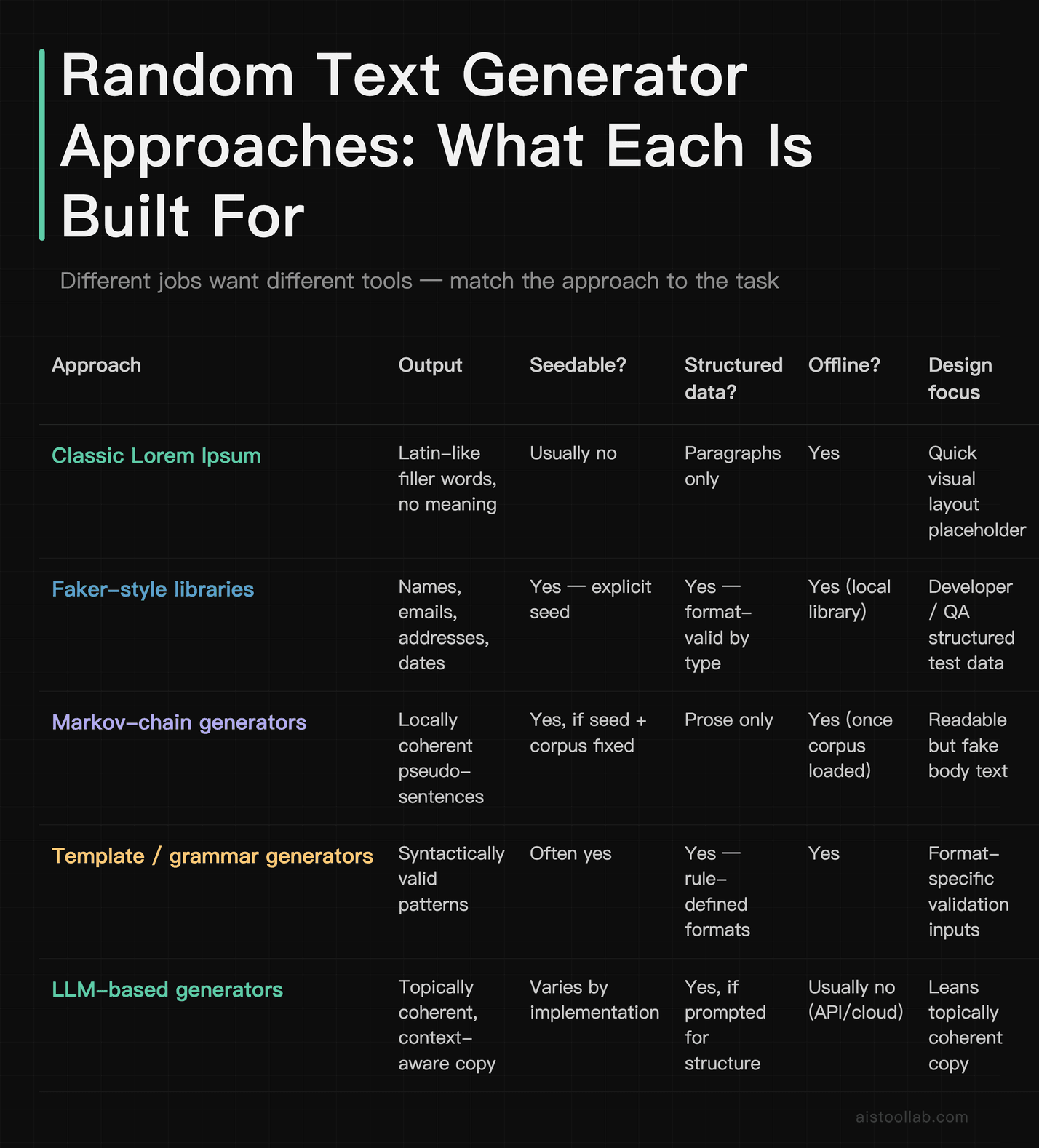
If you want the broader landscape of small utilities like this — text, hashing, color — I dug into that in the AI Developer Utility Tools Compared roundup, which covers where these free tools genuinely save time and where they’re just filler.
Design prototyping: placeholder content that doesn’t lie to you

Designers have leaned on Lorem Ipsum for decades, and there’s a real reason: meaningless text stops stakeholders from reading the copy and reacting to words instead of the layout. When a client sees “Buy our amazing product now!” in a mockup, they critique the slogan. When they see Lorem Ipsum, they look at the hierarchy, spacing, and flow — which is what a wireframe review is for.
But there’s a well-known trap: placeholder text that’s too tidy hides real problems. English runs shorter than German. A name field that looks perfect with “John Smith” overflows with a long real name. A card designed around three neat lines of Lorem Ipsum breaks when the actual content is one word or forty.
Smarter generators help here by letting you shape the placeholder to reality:
- Variable length — generate content at realistic minimum and maximum lengths, not just a comfortable average, so you catch overflow and awkward truncation before build.
- Type-appropriate content — real-looking names in name fields, plausible product titles in product cards, valid-format dates in date fields. It makes usability tests more honest, because testers react to something resembling real content.
- Localized filler — testing a multilingual UI with only Latin placeholder is how you ship a layout that falls apart in the first translated release.
My take, based on how these behave: for pure layout review, boring old Lorem Ipsum is still the right call precisely because it’s unreadable. The moment you’re testing whether a component survives real content, switch to a structured or context-aware generator. Different jobs, different tools.
Development: seeding databases and populating demo environments
If you’ve ever spun up a fresh environment and stared at empty tables, you know the problem. Empty apps demo badly and test worse — you can’t tell whether pagination works with zero rows, and a client is not impressed by a dashboard showing nothing.
This is the developer’s bread-and-butter use for random text generators, usually via a Faker-style library wired into a seed script. A typical flow:
- Write a seed script that loops N times, generating a realistic record each pass — user, order, comment, whatever your schema needs.
- Fix the PRNG seed so every teammate’s local environment materializes the same data, which keeps “works on my machine” bugs honest and reproducible.
- Respect referential integrity — generate parent records first, then children that point to real foreign keys, so the fake data is actually queryable rather than a pile of orphans.
Beyond local dev, the same approach fills staging and demo environments with content that looks legitimate on screen — which can reduce a genuine privacy concern with copying production data down to lower environments. Data that is genuinely generated, rather than derived from or coinciding with real records, avoids carrying a real person’s details into those environments; that assumption is worth verifying rather than taking for granted.
One nuance worth flagging: realistic and valid aren’t the same thing. A generator can hand you a syntactically perfect email that routes nowhere, or a plausible credit-card-shaped number that isn’t a real card. That’s usually exactly what you want for testing — valid format, no real-world consequence — but it means you can’t treat generated data as functional for anything that reaches an external system.
Use cases: matching the tool to the moment

You’re a solo QA engineer on a startup team
Say you’re the only person testing a growing app and you need broad input coverage fast. A seedable Faker-style library is the natural fit: generate varied, format-valid records across locales, lock the seed so any failure is reproducible in a ticket, and layer your hand-written requirement tests on top. The dimension that matters most for you is reproducibility, and that points to a seedable generator over a refresh-for-chaos web toy.
You’re a product designer prepping a client wireframe review
Imagine you’re presenting layout options and you don’t want the client fixating on copy. Classic Lorem Ipsum earns its place because unreadable text keeps attention on structure. When you move to a higher-fidelity mockup for usability testing, switch to type-appropriate placeholder so testers react to something realistic. Here the deciding dimension is readability — and notably, you want low readability early and high realism later.
You’re a developer standing up a demo environment
If you’re wiring a staging environment for a sales demo, you want tables that look full and credible without touching production data. A library-based seed script that respects your schema’s relationships fills orders, users, and comments that render convincingly on screen. The dimension in play is structural validity — you need data that survives real joins and queries, which rules out plain prose generators.
Choosing the right tool: what actually varies
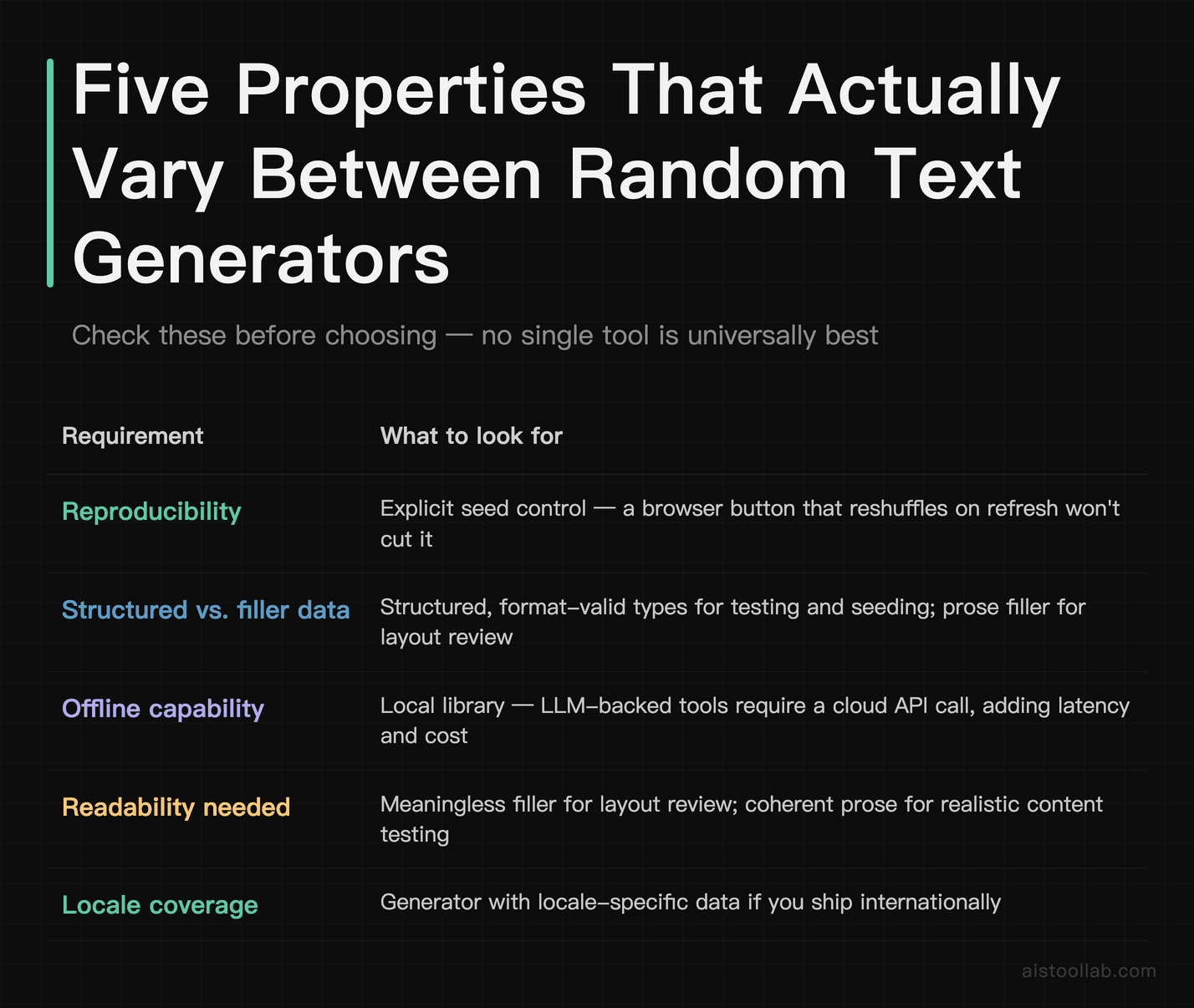
When people ask which random text generator to use, the useful answer depends on a few concrete properties rather than a single “best” pick:
- Do you need reproducibility? If yes, you need explicit seed control — a browser button that reshuffles on refresh won’t cut it.
- Do you need structured, format-valid data or just filler prose? Testing and seeding want structured; layout review wants prose.
- Does it need to run offline? Local libraries do; LLM-backed tools generally call a cloud API, which adds latency, cost, and a network dependency.
- How readable does the output need to be? Meaningless is a feature for layout, a liability for realistic content tests.
- Locale coverage? If you ship internationally, a generator with locale-specific data saves you from inventing it.
Output quality “varies” in a specific sense: a Markov generator’s coherence depends entirely on its source corpus; an LLM’s coherence depends on the prompt and model; a template generator is only as valid as its rules. None of these is universally superior — they optimize for different things. The tool that gives you readable fake blog posts is the wrong tool for stress-testing a numeric field, and vice versa.
Frequently Asked Questions
Is a random text generator actually random?
Usually not in the strict sense. Most generators use pseudo-random number generators (PRNGs) — deterministic algorithms that start from a seed and produce sequences intended to look statistically random but that are fully reproducible if you know the seed. True randomness, drawn from physical entropy sources like hardware noise, is reserved for use cases like cryptography where predictability would be dangerous. For generating test data, placeholder text, or demo records, pseudo-randomness is not just acceptable — it’s preferable, because reproducibility lets you replay the exact same “random” dataset later. So when a tool says “random,” read it as “statistically random-looking but controllable.” That control is the whole reason these tools are useful for engineering work rather than just novelty. If you specifically need unpredictable output that can never be reproduced, you’d want a generator seeded from an OS entropy source with no fixed seed, and you’d lose the reproducibility benefit in exchange.
What’s the difference between Lorem Ipsum and a data generator like Faker?
They solve different problems. Lorem Ipsum produces meaningless Latin-like filler whose entire purpose is to occupy visual space without carrying meaning — ideal for layout and typography review, where you don’t want anyone reading the words. A structured data generator like the Faker libraries (available across Python, JavaScript, Ruby, and more) produces format-valid, type-appropriate values: real-looking names, syntactically correct emails, regionally formatted phone numbers and addresses, dates, and so on. That structure is what makes it suitable for QA and database seeding, where you need data that behaves like the real thing when it passes through validation and storage. A rough rule of thumb: if the output is meant to be looked at (layout), Lorem Ipsum is often enough; if the output is meant to be processed by your code (testing, seeding), you want a structured generator. Many teams use both — filler for the design phase, structured data once real functionality is under test.
Why would I want reproducible random data?
Because reproducibility is what makes bugs findable and fixable. Imagine a test run fails against a batch of generated records, but the data was different every run — you’d never reliably recreate the failure, and “it happened once” is a terrible bug report. By fixing the PRNG seed, everyone on the team generates the identical dataset, so a failure one person hits can be reproduced exactly by another, and by CI. It also keeps test suites stable over time: a test that passes today because it happened to get friendly random data, then fails next week on unlucky data, is a flaky test that erodes trust in the whole suite. Seeding removes that variance. The trade-off is that fixed-seed data can hide edge cases the seed never happens to produce, so some teams run mostly with a fixed seed for stability plus occasional unseeded “fuzz” runs to surface new surprises. Both have their place.
Can I use generated fake data safely in production or demos?
For demos and staging, yes — that’s one of its best uses, because fake data is synthesized rather than copied from production, so it generally avoids carrying a real customer’s details into a lower environment the way copying production data down can. That privacy benefit is genuine and worth taking seriously — though you shouldn’t assume generated values can never coincide with real personal data. For production functionality, be careful: generated data is typically valid in format but not in fact. A generated email is shaped correctly but routes nowhere; a card-shaped number isn’t a real payment instrument. That’s exactly what you want for testing that doesn’t touch external systems, but it means you must never let generated data reach anything that tries to actually use it — don’t send email to fake addresses, don’t attempt charges on fake cards. Treat generated data as useful only where fake is acceptable, without assuming “fake” automatically means it can never resemble real personal data. The moment a workflow needs the data to do something real in the outside world, generated data is the wrong input.
What are Markov chains and when are they useful for text generation?
A Markov chain generator models the probability that one unit of text follows another — for example, given the current word, what word tends to come next — based on patterns learned from a source corpus. Stringing those probabilities together produces text that’s locally coherent: adjacent words fit together like real language, even though the overall passage doesn’t mean anything. That makes Markov output feel more “real” than random word soup, which is handy when you want placeholder body text that reads convincingly at a glance — mock blog posts, sample comments, filler articles in a CMS demo. The catch is that coherence is entirely dependent on the corpus it learned from, and the output rarely holds together over long stretches or makes actual sense. For layout review where meaning is a distraction, that’s fine; for anything needing genuine topical relevance, a large language model is often the better fit today, at the cost of running heavier and usually needing a network connection.
Do I need an AI/LLM-based generator, or is a simple tool enough?
Most of the time, a simple tool is enough — and often a good fit. If you’re filling a wireframe, stress-testing a form, or seeding a database, a lightweight PRNG-based or Faker-style generator runs instantly, offline, for free, and gives you reproducible, format-valid output. LLM-based generators earn their keep in a narrower band: when you need placeholder content that’s topically coherent and reads like it genuinely belongs in context — say, realistic-sounding product descriptions for a category page mockup, or sample support tickets that echo how your users actually write. The trade-offs are real: LLM tools generally call a cloud API, adding latency, potential cost, and a network dependency, and their output is often non-deterministic — and pinning parameters does not by itself guarantee reproducibility. So the honest answer is to start simple and only reach for an LLM when “coherent and contextual” is a hard requirement the cheaper tools genuinely can’t meet.
How do I generate test data that covers edge cases?
The trick is to deliberately push a generator toward the uncomfortable inputs, not just the comfortable middle. Configure lengths at your field boundaries — empty, one character, the maximum, and one over — to see how validation behaves at the edges rather than only in the easy center. Pull in locale-specific data so you exercise non-Latin scripts, accented characters, apostrophes in names, and right-to-left text, all of which routinely break naive assumptions. Include unusual-but-valid formats: plus-addressed emails, international phone formats, leap-year dates, and time zones. If your generator supports it, mix in intentionally messy values like leading/trailing whitespace or emoji in text fields. Combine this with a fixed seed so any failure is reproducible, and pair it with occasional unseeded runs to surface fresh surprises. Random generation is well-suited to finding failures you didn’t think to look for, but it complements rather than replaces the hand-written tests that verify your known requirements — you still need both.
Are free random text generators good enough, or should I pay?
For the vast majority of testing, prototyping, and seeding work, free tools and open-source libraries cover the need — the Faker family and standard PRNGs are open-source, mature, and widely used, and plenty of browser-based Lorem Ipsum and data generators are available at no cost. What you’d typically pay for isn’t the randomness itself but surrounding conveniences: a hosted service with a UI, team features, larger-scale generation, or an LLM backend for context-aware copy (which carries the usual API costs of the underlying model). Before paying, I’d ask whether you actually need those extras or whether a free library wired into a small script does the job — for most solo developers and small teams, it does. If your workflow genuinely benefits from context-aware placeholder content at scale, a paid LLM-backed option may be worth the spend, but that’s a specific need, not a default. Match the cost to the requirement rather than assuming paid means better.
Where this leaves you
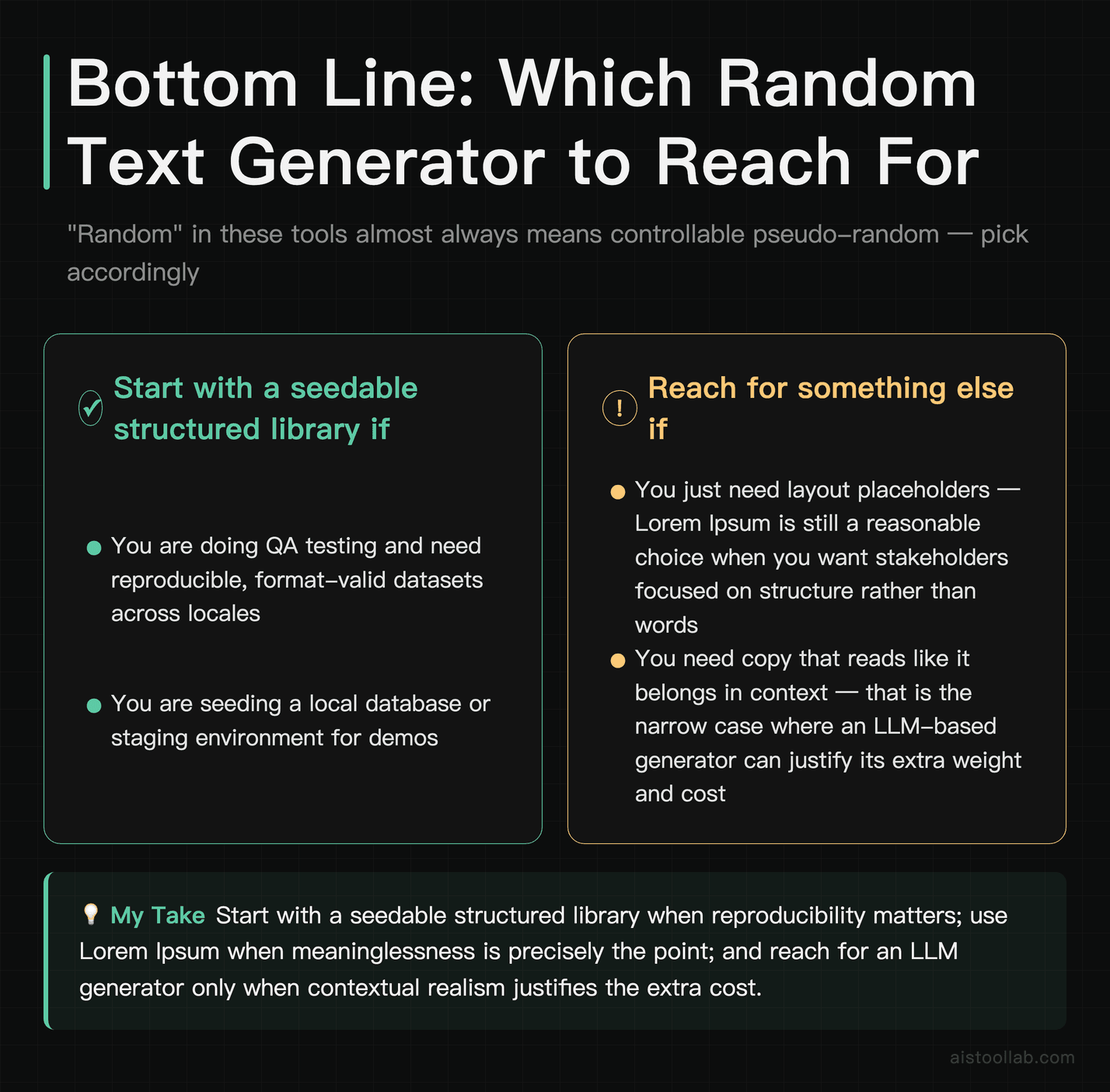
The one idea worth carrying away: “random” in these tools almost always means “controllable pseudo-random,” and that control is exactly what makes them useful rather than gimmicky. Seeding gives you reproducibility, distribution methods give you realism, and the right method depends entirely on the job.
If you’re doing QA or database seeding and reproducibility matters most, I’d start with a seedable, structured library over a refresh-for-chaos web button. If you’re reviewing pure layout and want stakeholders looking at structure rather than words, plain Lorem Ipsum is still a reasonable choice precisely because it’s unreadable. And if you need placeholder copy that reads like it belongs in context, that’s the narrow case where an LLM-based generator can justify its extra weight and cost. Adjacent utilities like a Random Color Generator follow the same logic — pick the tool that matches the specific thing you’re actually testing, not the flashiest one on the page.
Last updated: 2026
Found this review helpful?
👉 Browse the AI Tools Library to find the right tools for your workflow.
Related reading: Random Text Generation Explained: Algorithms, Methods, and Applications in 2026