The Voice AI Race Just Got Uncomfortably Close
Here’s something that would have sounded absurd two years ago: text-to-speech has become so convincing that most listeners can no longer reliably tell a cloned voice from a real recording in a blind test. That’s not marketing spin — it’s the uncomfortable reality that podcast editors, audiobook narrators, and localization teams are all grappling with right now. And no single company has done more to push audio AI into that “wait, that’s not a human?” territory than ElevenLabs.
But “impressive demos” and “worth your money” are two very different questions. The synthetic voice space in 2026 is crowded — you’ve got established readers, developer-first API platforms, open-source models you can self-host for free, and even Google quietly turning research documents into slick two-host audio conversations. So the real question isn’t whether ElevenLabs sounds good. It does. The question is whether it justifies premium pricing when Play.ht, Natural Reader, Google NotebookLM, and open-source Coqui are all fighting for the same use cases.
This review is compiled from ElevenLabs’ official documentation, published feature specs, and the consensus that shows up across public reviews on G2, Trustpilot, and Reddit threads where actual users vent and praise in equal measure. I’ll be direct about where it earns its keep and where you’d be smarter to save your cash.
This article contains affiliate links. If you buy through them I may earn a commission at no extra cost to you. All opinions are my own.
ElevenLabs vs the Field: The Quick Comparison
Let’s put the contenders on the table before diving into the weeds. These five tools overlap, but they’re genuinely built for different buyers. ElevenLabs ↗ leads on raw voice realism and cloning; the others each carve out a niche on price, simplicity, or a specific workflow.
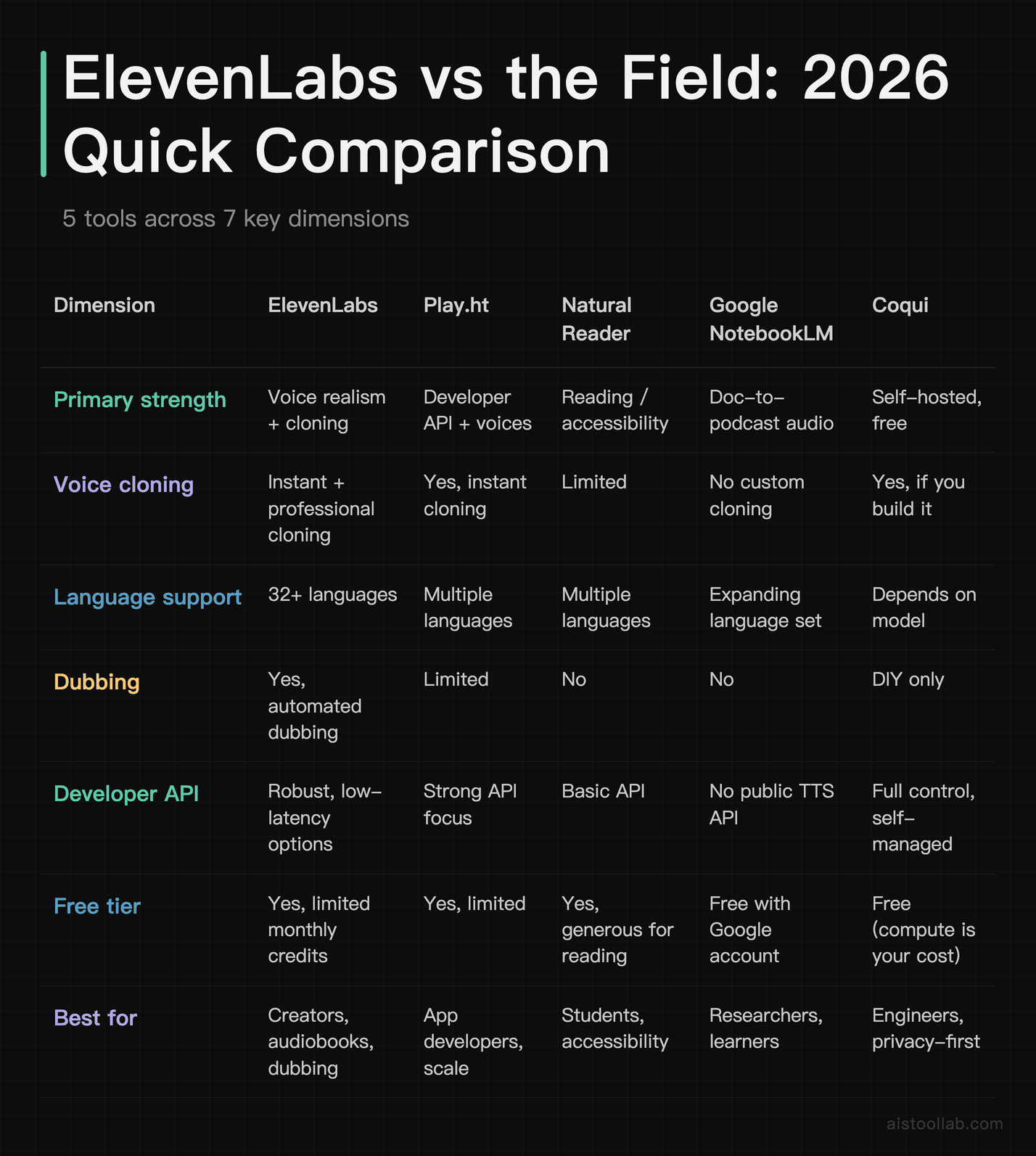
The short version: if your priority is voices that sound genuinely human across multiple languages, ElevenLabs is the reference point everyone else gets measured against. If your priority is “free” or “runs on my own servers,” the calculus changes fast. Keep that tension in mind — it’s the thread running through everything below.
Voice Cloning and Multilingual Support: The Core Draw
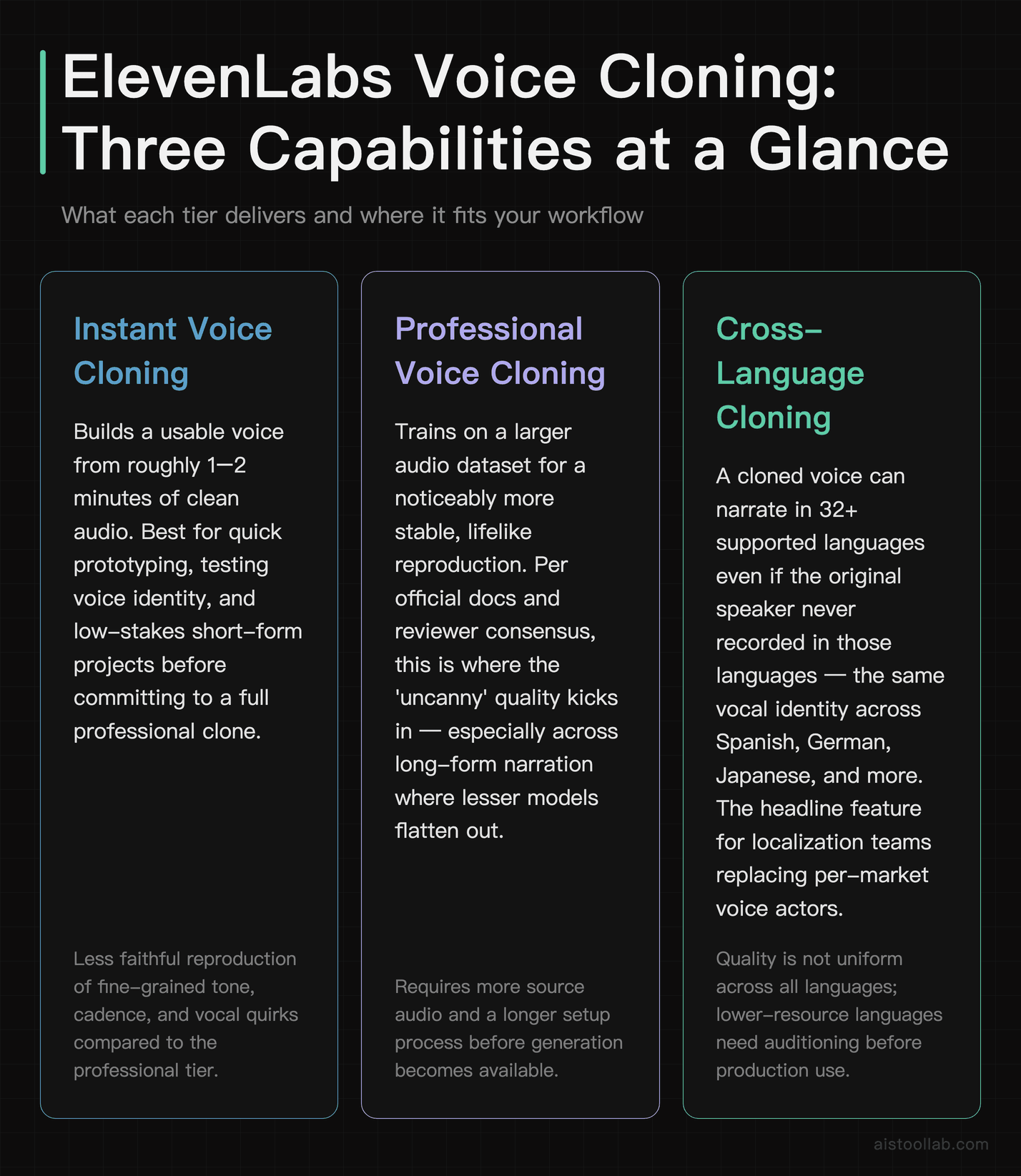
ElevenLabs offers two cloning tiers, and the distinction matters. Instant Voice Cloning builds a usable voice from a short sample — think a minute or two of clean audio — which is handy for quick prototyping. Professional Voice Cloning trains on a larger dataset and, per the official documentation, produces a noticeably more faithful and stable reproduction of tone, cadence, and quirks. Reviewers consistently note that the professional clone is where the “uncanny” quality kicks in, especially for longer-form narration where a lesser model would drift or flatten out.
The multilingual side is where ElevenLabs pulls ahead of most rivals. According to its official documentation, the platform supports 32+ languages, and — crucially — a cloned voice can speak languages the original speaker never recorded. So an English-only narrator’s voice can deliver Spanish, German, or Japanese lines while keeping the same vocal identity. For localization teams, that’s the headline feature. It’s the difference between hiring five voice actors for five markets and cloning one approved voice across all of them.
Quality isn’t uniform across every language, and it’s fair to flag that. Public reviews suggest English and major European languages sound the most polished, while some lower-resource languages can show occasional pronunciation stumbles or unnatural stress patterns. That’s not unique to ElevenLabs — it’s a limitation of training data availability across the whole industry — but you should audition your specific target language before committing a big project to it. Don’t assume flawless output in every one of the 32+ just because the marketing lists them.
The Dubbing Tool Is Quietly One of Its Best Features
ElevenLabs’ automated dubbing deserves its own mention because it bundles several hard problems into one workflow: it transcribes source audio, translates it, and regenerates speech in the target language while attempting to preserve the original speaker’s voice character. For a video creator localizing a back catalog, that collapses a multi-vendor pipeline — transcription service, translator, voice actor, audio engineer — into a single upload. It’s not flawless; timing and lip-sync alignment still need human review for polished output, and idiomatic translation can be clumsy. But as a first-pass draft that gets you most of the way there, reviewer consensus is that it’s a genuine time-saver rather than a gimmick.
API Reliability, Latency, and the Developer Reality
If you’re a developer wiring voice into a product — a voice assistant, an interactive NPC, an accessibility layer — the demo quality is only half the story. What matters is latency, uptime, and whether the API behaves predictably under load.
ElevenLabs offers low-latency streaming options aimed specifically at real-time applications, which is a meaningful differentiator over batch-oriented tools. According to its official documentation, there are settings and model variants that trade a small amount of audio richness for faster time-to-first-byte — important when a user is waiting for a voice agent to respond and every extra 200 milliseconds feels like an eternity. For conversational use cases, that tuning flexibility is exactly what you want.
The honest caveat from public developer discussions: real-world integration is rarely plug-and-play. Common friction points that surface in reviews and forum threads include managing credit consumption on higher-volume workloads, handling rate limits gracefully, and the fact that streaming implementations require more careful client-side handling than a simple request-response call. None of this is unusual for a production-grade audio API — but budget engineering time for it rather than assuming a weekend integration. If you’ve worked with other generative APIs, the pattern will feel familiar; I touched on similar integration realities in my What Makes an AI Tool Effective breakdown, where “great demo, harder production” is a recurring theme across the category.
One more practical note: because pricing is credit-based, costs scale with usage in a way that can surprise you at volume. A hobby project stays cheap; a consumer app generating thousands of hours of audio needs a proper cost model before launch. Run the numbers against your projected volume, not the free tier.
Who Actually Gets Value From This
Podcasters and Solo Audio Creators
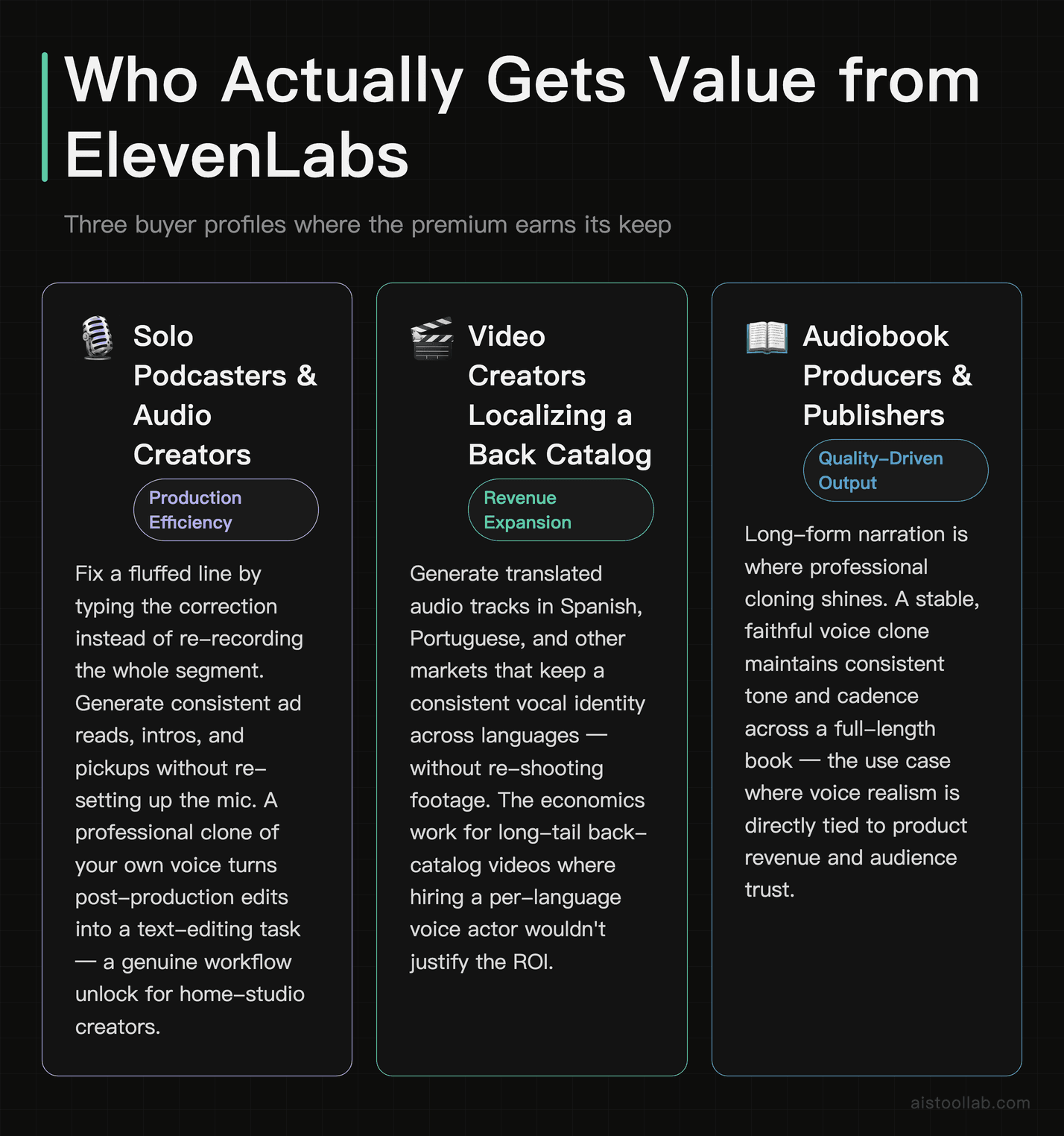
Picture a solo podcaster who records in a home office and hates re-recording. With a professional clone of their own voice, they can fix a fluffed line by typing the correction instead of re-tracking the whole segment. For intro/outro consistency, ad reads, or generating a polished pickup without setting up the mic again, it’s a real workflow unlock. The ethical and disclosure considerations matter here — cloning your own voice is clean; using it to fake spontaneity is a listener-trust question you’ll want to think through — but for production efficiency, this is one of the strongest fits.
Video Creators Localizing a Back Catalog
A YouTube creator with a library of English tutorials wants to open Spanish and Portuguese-speaking markets without re-shooting anything. The dubbing tool lets them generate translated audio tracks that keep a consistent vocal identity across languages. It won’t fully replace a skilled human localizer for flagship content, but for the long tail of a back catalog — videos that would otherwise never get localized because the ROI doesn’t justify a voice actor — it makes the economics work. That’s the sweet spot: content that was previously “not worth localizing” suddenly becomes viable.
Audiobook and Long-Form Narration Producers
Independent authors and small publishers face a brutal math problem: professional narration is expensive and slow. ElevenLabs’ stability on long-form content — where cheaper TTS tends to fall apart over hours of audio — makes it a credible option for producing listenable audiobooks at a fraction of studio cost. Reviewers note it handles pacing and consistency far better across long stretches than most alternatives. It’s still worth a human editing pass for emphasis and emotional beats, but as a foundation, it’s viable in a way earlier TTS never was.
Accessibility and Assistive Reading
For readers with visual impairments, dyslexia, or reading fatigue, natural-sounding narration isn’t a luxury — it’s the difference between content being usable or not. This is also, notably, where Natural Reader competes hard and often wins on price and simplicity for pure “read this document to me” needs. ElevenLabs shines when the accessibility layer needs to be embedded in a product with high-quality, branded voices; Natural Reader shines when an individual just wants an affordable, no-fuss reader.
The Premium Pricing Question: When Is It Worth It?
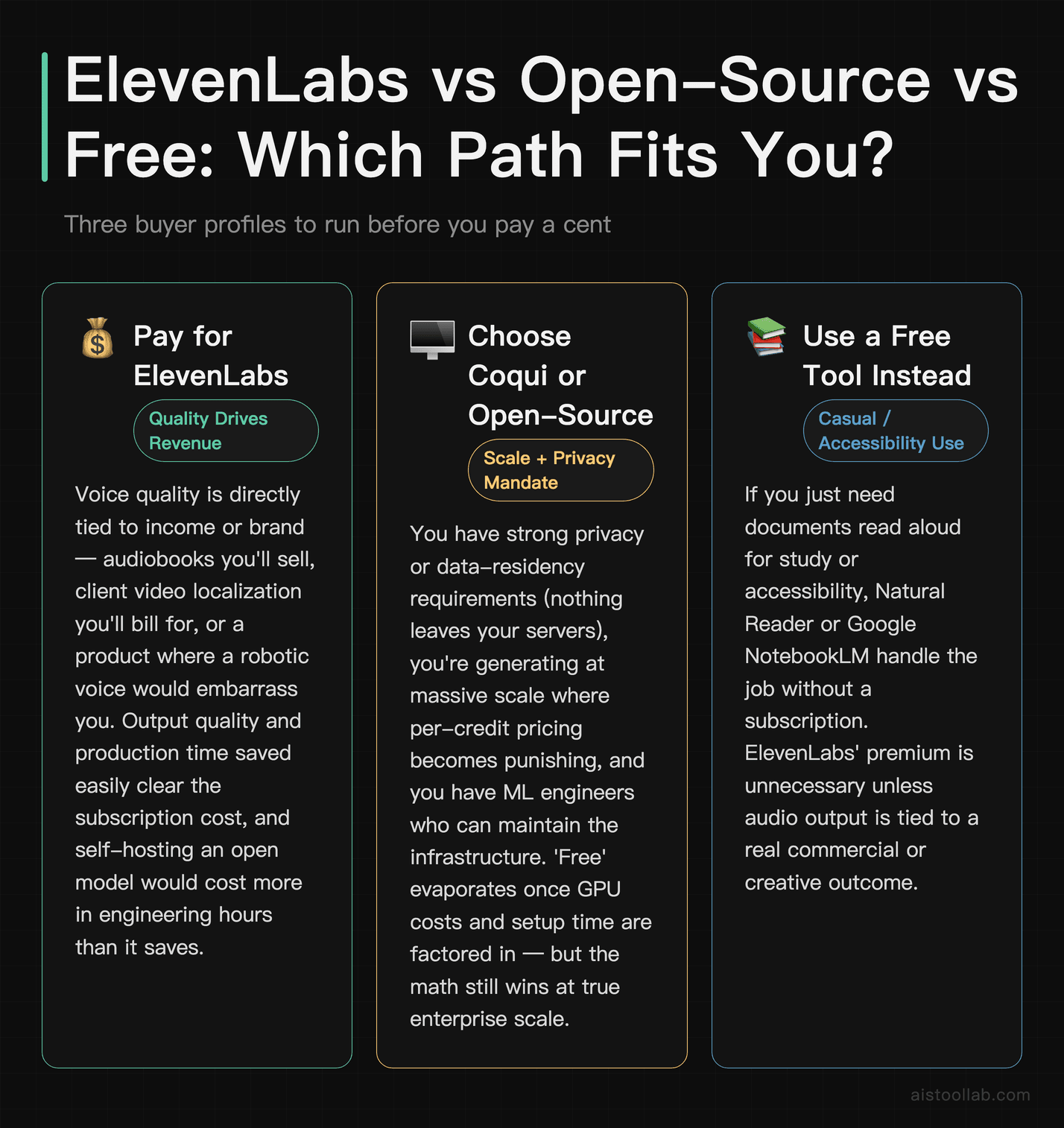
Let’s address the elephant. ElevenLabs is not the cheapest option, and Coqui — the open-source alternative — is effectively free if you have the technical chops and hardware to run it. So when does paying make sense?
Pay for ElevenLabs when voice quality is directly tied to your revenue or brand: audiobooks you’ll sell, client video localization you’ll bill for, a product where a robotic voice would embarrass you. In those cases the output quality and the time saved easily clear the cost bar, and self-hosting an open model would cost you more in engineering hours than you’d save in subscription fees.
Choose Coqui or another open-source model when you have strong privacy or data-residency requirements (nothing leaves your servers), when you’re generating at massive scale where per-credit pricing becomes punishing, or when you have ML engineers who can maintain the infrastructure. The catch is real, though: open-source voice quality generally trails the top commercial models, and “free” evaporates once you factor in GPU costs, setup time, and ongoing maintenance. For most solo creators and small teams, that trade isn’t worth it. For a well-resourced engineering org with specific compliance needs, it absolutely can be.
For pricing specifics, check ElevenLabs’ official pricing page directly — it offers a free tier with limited monthly credits plus several paid subscription levels that scale by character/credit allowance and cloning capabilities. I’m deliberately not quoting exact figures here because credit-based plans shift, and you should verify the current numbers against the source before you budget. The structural point stands regardless of the exact dollar amount: you’re paying for quality and time saved, not for features you could easily replicate for free.
Pros and Cons
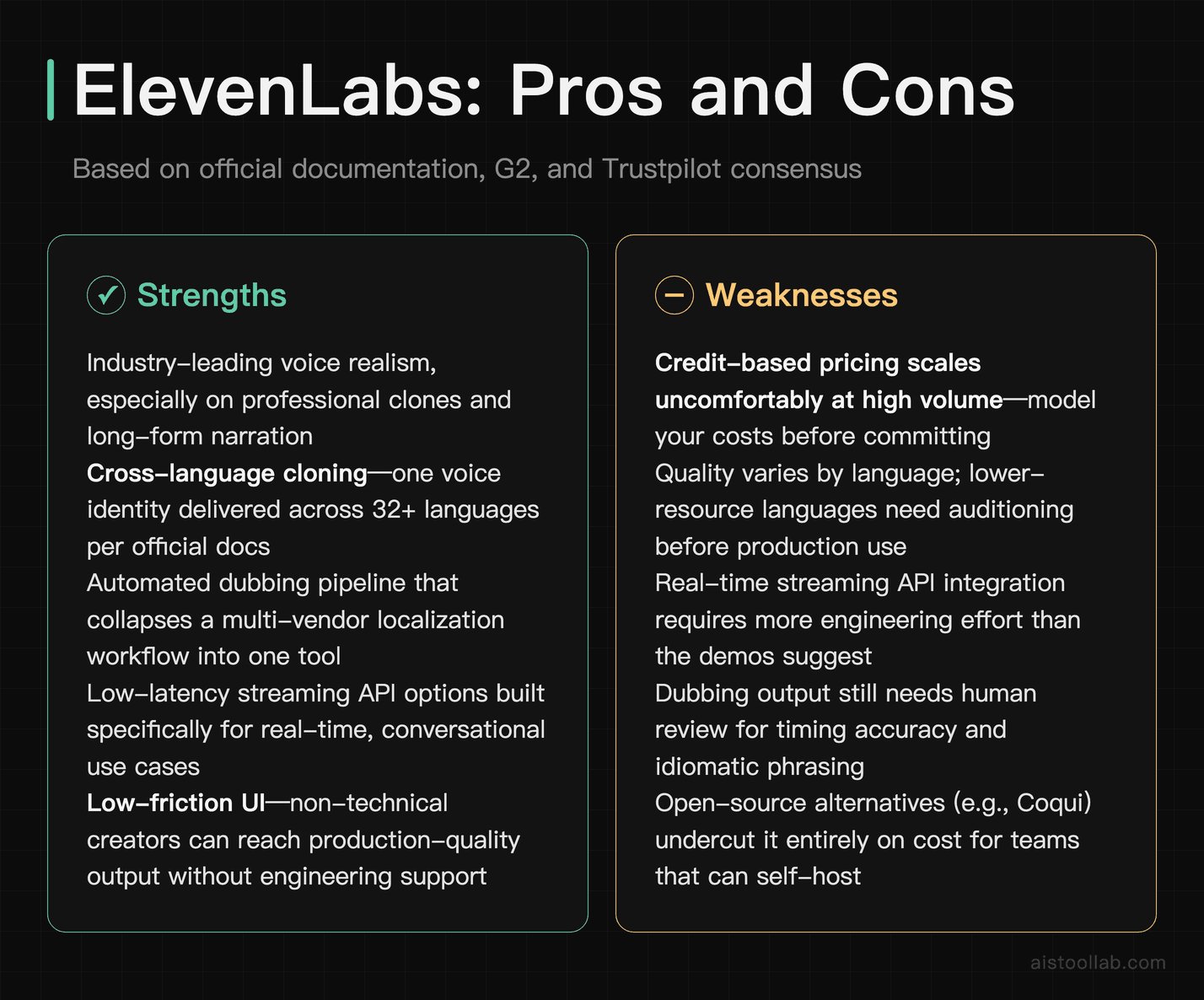
What ElevenLabs does well:
- Industry-leading voice realism, especially on professional clones and long-form narration
- Cross-language cloning — one voice identity across 32+ languages per official docs
- An automated dubbing pipeline that collapses a multi-vendor workflow into one tool
- Low-latency streaming API options built for real-time, conversational use cases
- A genuinely low-friction UI for non-technical creators to get results fast
Where it falls short:
- Credit-based pricing scales uncomfortably at high volume — model your costs early
- Quality varies by language; lower-resource languages need auditioning first
- API integration for real-time streaming takes more engineering effort than the demos suggest
- Dubbing output still needs human review for timing and idiomatic accuracy
- Open-source alternatives undercut it entirely on cost if you can self-host
The Verdict: Who Should Actually Buy It
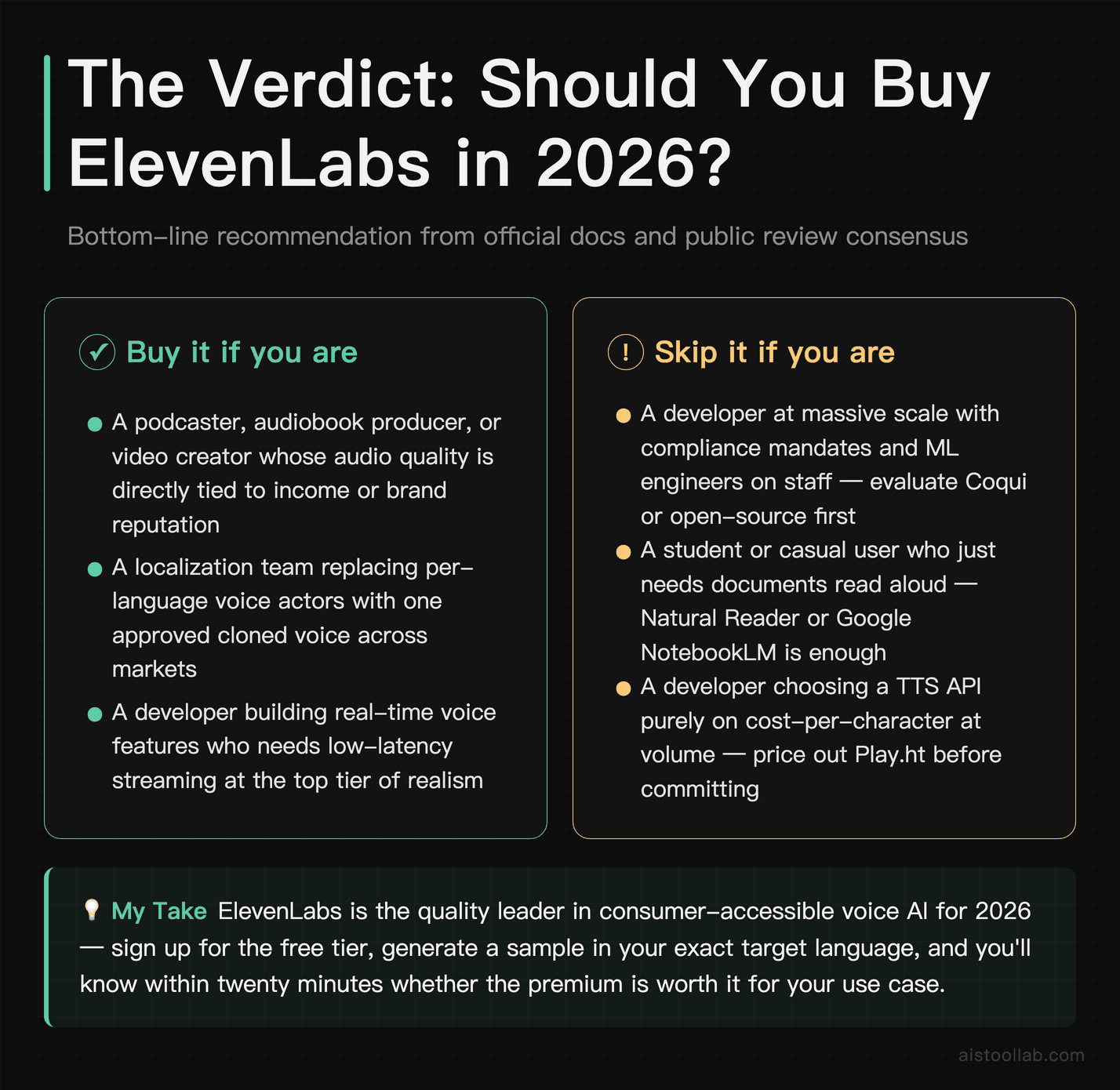
If you’re a podcaster, audiobook producer, or video creator whose audio quality is tied to income or brand — go with ElevenLabs. Its voice realism, cross-language cloning, and dubbing pipeline are the strongest in the consumer-accessible market right now, and the time it saves on production genuinely justifies the premium. The reviewer consensus and the documented capabilities line up: this is the quality leader, and for professional creative work that’s what matters most.
If you’re a developer building at massive scale with a compliance mandate and ML talent on staff, seriously evaluate Coqui or another open-source model first — the cost and privacy math can favor self-hosting even if the quality trails. If you just want documents read aloud for study or accessibility, Natural Reader or Google NotebookLM will do the job without the subscription. And if you’re a developer picking an API purely on cost-per-character at volume, price out Play.ht alongside it before you commit.
The best next step costs you nothing: sign up for the free tier, generate a sample in your exact target language, and clone your own voice. You’ll know within twenty minutes whether ElevenLabs is the tool for your specific project — no review, including this one, beats hearing your own use case come out of it. If you’re also weighing where synthetic voice fits into a broader content pipeline, it pairs naturally with video work covered in my Runway AI Gen-3 tutorial.
Frequently Asked Questions
Is the free tier actually usable, or just a teaser?
The free tier is useful for evaluation and light personal projects, but it’s genuinely a teaser in the sense that it caps your monthly generation credits and typically attaches attribution requirements to commercial use. According to ElevenLabs’ official documentation, free accounts get a limited monthly character allowance — enough to clone a voice, test multilingual output, and generate short clips to judge quality, but nowhere near enough to produce an audiobook or run a product. Think of it as an extended trial rather than a permanent free solution. That said, it’s the right way to evaluate: spend your free credits stress-testing the exact voices and languages your project needs before you pay a cent. Generate a paragraph in your target language, listen critically for pronunciation issues, and clone your own voice to judge fidelity. If the free-tier output already impresses you, the paid tiers only get better. If it disappoints in your specific language, you’ve saved yourself a subscription. Don’t skip this step.
How does ElevenLabs compare to Play.ht for developers?
Both are serious contenders for developers, and the choice often comes down to what you’re optimizing for. ElevenLabs is generally regarded in public reviews as the leader on raw voice realism and cloning fidelity, with strong low-latency streaming for conversational applications. Play.ht has historically positioned itself as a developer-and-scale-friendly platform with a large voice library and a strong API focus. For a real-time voice agent where audio quality is the product, ElevenLabs tends to be the reviewer favorite. For high-volume applications where you’re weighing cost-per-character and voice variety, Play.ht is worth pricing out directly. Honestly, the smartest move is to build a small proof-of-concept on both using your actual use case — the same script, the same target languages, the same latency requirements — and compare. API ergonomics, documentation quality, and how each handles your specific edge cases matter more than any general “which is better” verdict. Both have free tiers that make this side-by-side test cheap to run before you commit engineering resources.
Can I legally clone my own voice or someone else’s?
Cloning your own voice is straightforward and clearly within acceptable use — it’s your voice, your consent. Cloning someone else’s voice is where you need to be careful, both legally and per ElevenLabs’ own terms. The platform requires that you have the rights and consent to clone any voice you upload, and professional cloning typically involves a verification step precisely to discourage unauthorized use. Beyond the platform’s rules, voice is increasingly protected under likeness and publicity laws in various jurisdictions, and the legal landscape is evolving quickly as synthetic media becomes mainstream. The safe practice: only clone voices you own or have explicit written permission to use. For commercial projects involving another person’s voice — a client, a hired narrator, a deceased public figure — get proper licensing and consent documented in writing. Ethically, disclosure to your audience matters too, especially for content where listeners might assume they’re hearing a genuine human performance. When in doubt, treat a voice like any other piece of intellectual property.
How good is the multilingual support really?
It’s genuinely strong for major languages and merely decent for some others — and pretending otherwise would do you a disservice. According to official documentation, ElevenLabs supports 32+ languages, and the standout capability is that a cloned voice can speak languages the original speaker never recorded while retaining vocal identity. In practice, public reviews suggest English and widely-spoken European languages produce the most natural results, with excellent prosody and pronunciation. Lower-resource languages can show occasional issues — awkward stress placement, mispronounced proper nouns, or slightly unnatural rhythm. This isn’t an ElevenLabs-specific failing; it reflects the uneven availability of high-quality training data across the world’s languages, and every competitor faces the same constraint. The practical takeaway: never assume flawless output in a given language just because it’s on the supported list. Before committing a project, generate a representative sample in your exact target language — ideally with the specific vocabulary and names you’ll use — and have a native speaker review it. For high-stakes localization, budget for a human editing pass regardless.
What’s the deal with Google NotebookLM — is it a competitor?
NotebookLM is a competitor for a very specific slice of the market, not a head-to-head rival across the board. Google’s tool can turn documents and source material into a surprisingly natural two-host audio “conversation” — great for turning a dense research paper, a set of meeting notes, or study material into something you can listen to on a walk. It’s free with a Google account and requires zero setup. But it does not offer custom voice cloning, a general-purpose TTS API, or dubbing. So if your goal is “make my source documents into an engaging audio summary,” NotebookLM is fantastic and costs nothing. If your goal is “clone a specific voice,” “localize my videos,” or “embed high-quality narration in my product,” it simply doesn’t do those things. They overlap only in that both produce natural-sounding audio. For learners and researchers, NotebookLM is a delight and worth trying immediately. For creators and developers with cloning or integration needs, it’s not the tool — ElevenLabs and the others are.
Is Coqui or another open-source model a realistic replacement?
For the right team, yes — for most people, no. Open-source models like Coqui let you run text-to-speech and voice cloning entirely on your own infrastructure, which means zero per-use fees and full data privacy. That’s genuinely compelling for organizations with strict data-residency requirements or massive generation volumes where commercial per-credit pricing becomes painful. The honest trade-offs: output quality generally trails the top commercial models, especially for expressive long-form narration and multilingual cloning; and “free” is misleading once you account for GPU compute, engineering setup, model maintenance, and troubleshooting. A solo creator who just wants great-sounding audio will lose more in time and frustration than they’d ever save. A well-resourced engineering team with ML expertise and a compliance mandate might find it the correct choice. Frame it as a build-versus-buy decision: buy (ElevenLabs) when quality and speed matter and your team’s time is valuable; build (open-source) when control, privacy, or extreme scale economics outweigh the maintenance burden. Both are valid — for different buyers.
Does ElevenLabs work for real-time voice applications?
Yes, and this is actually one of its stronger positioning points versus batch-oriented competitors. According to official documentation, ElevenLabs offers low-latency streaming options and model variants tuned for speed, which is exactly what real-time and conversational applications need — voice agents, interactive characters, live assistive reading. The lower-latency configurations trade a small amount of audio richness for faster time-to-first-byte, and for a back-and-forth conversation that trade is usually worth it. The caveat, echoed across developer discussions, is that real-time streaming integration takes more engineering care than a simple request-response call: you’ll handle chunked audio on the client, manage rate limits, and account for credit consumption at conversational volume. It’s production-grade capability, not a weekend hack. If you’re building something where a user waits for a spoken response, ElevenLabs is a credible foundation — but scope the integration work realistically and prototype your latency-sensitive path early rather than discovering bottlenecks near launch.
Is it worth the money compared to cheaper TTS tools?
It depends entirely on whether voice quality touches your revenue or reputation. If you’re selling audiobooks, billing clients for localized video, or shipping a product where a robotic voice would undermine trust, ElevenLabs’ quality and time savings clear the cost bar comfortably — the alternative is either lower quality that hurts your product or hiring humans at far greater expense. If you just want to occasionally hear an article read aloud, a cheaper reader like Natural Reader or even a free option covers that fine, and paying premium would be overkill. The middle ground is where you have to think: a hobby project with modest quality needs probably doesn’t justify it, while a growing creator business likely does. Run this test — estimate what the same output would cost you in human labor or in lost quality, then compare to the subscription. For professional and semi-professional use, ElevenLabs usually wins that math. For casual use, it often doesn’t, and that’s a perfectly fine reason to pick something lighter.
Last updated: 2026
Found this review helpful?
👉 Browse the AI Tools Library to find the right tools for your workflow.