The Emoji Nobody Meant to Send
Here’s a scenario that plays out thousands of times a day in Slack threads and group chats: someone types “wow, great job on that launch” and reaches for an emoji. They pick 🙃 — the upside-down smiley — thinking it reads as playful. Half the recipients read it as sarcasm. The message lands wrong, and now there’s a passive-aggressive subtext in a compliment that was meant to be genuine.
That gap — between what an emoji feels like to the sender and what it signals to the reader — is exactly the problem AI emoji recommendation tools claim to solve. Instead of you guessing which little glyph fits the mood, an engine reads your text, runs sentiment and context analysis, and suggests the emoji most people would interpret the way you intend. Simple idea. The execution, though, involves natural language processing, transformer models, training datasets scraped from millions of real messages, and a surprising amount of disagreement about what any given emoji even means.
I’ve been digging through the official documentation, public reviews, and the published research these tools lean on, and the honest takeaway is that “emoji recommendation” is a much deeper data-science problem than it looks. The 😂 vs 💀 debate isn’t just generational — it’s a genuine semantic drift problem that machine-learning models struggle with. Let’s compare how the main tools actually approach it, where they diverge, and which one earns the recommendation.
Quick Verdict: The Comparison Table
Since most readers want the bottom line before the deep dive, here’s how the leading approaches stack up across the dimensions that actually matter. I’ve compared Emoji Finder against the two broad alternatives you’ll run into: general-purpose LLM assistants used for emoji suggestions (think ChatGPT-style prompting), and the built-in predictive emoji features baked into keyboards and platforms (Apple, Google Gboard, and similar).
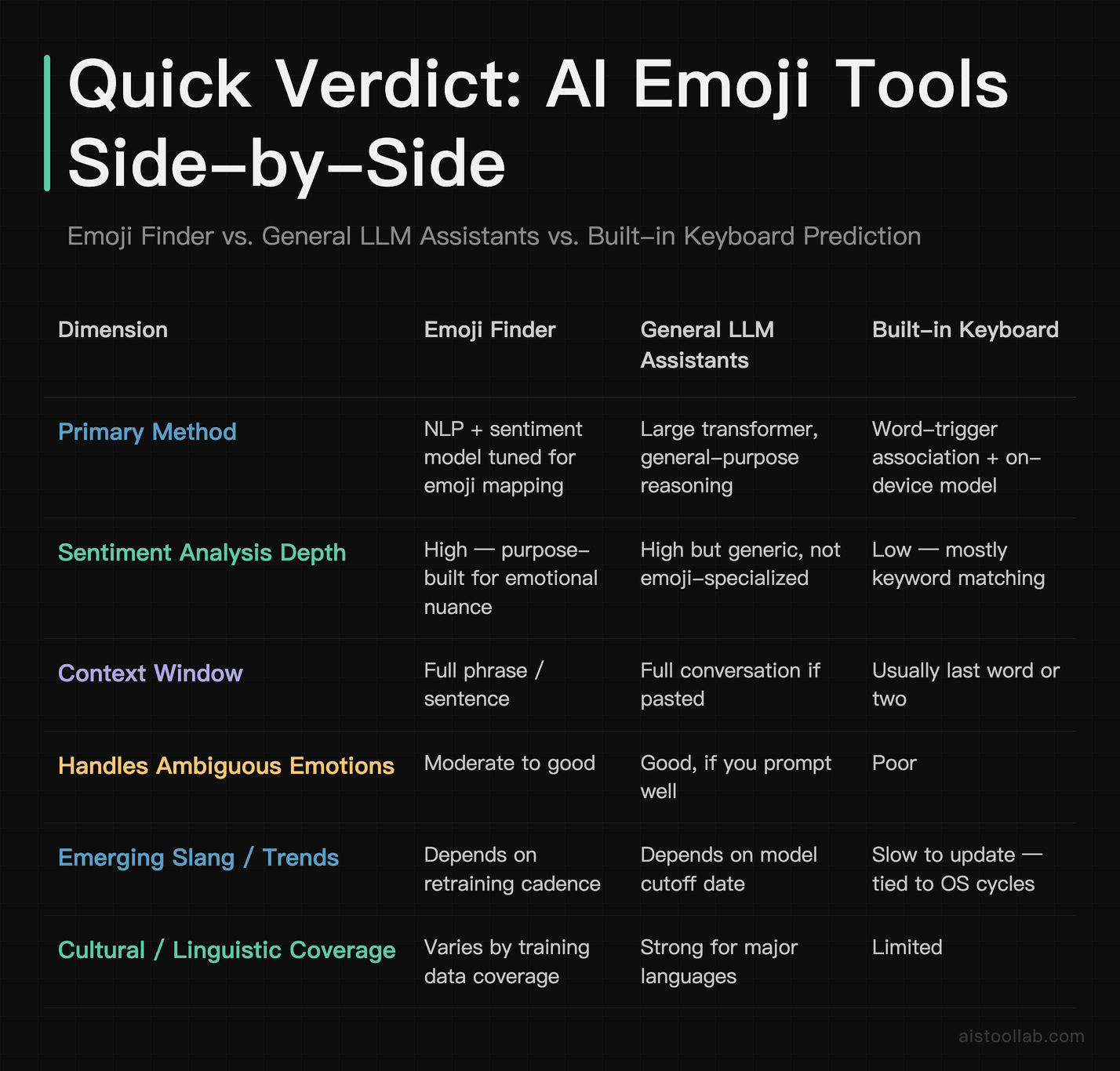
The short version: dedicated engines like Emoji Finder win on speed and focus, general LLMs win on deep reasoning when you’re willing to prompt carefully, and keyboard prediction wins on convenience but loses badly on nuance. Now let’s unpack why — dimension by dimension — because the interesting part is how these systems disagree.
How Emoji Recommendation Engines Actually Read Your Text
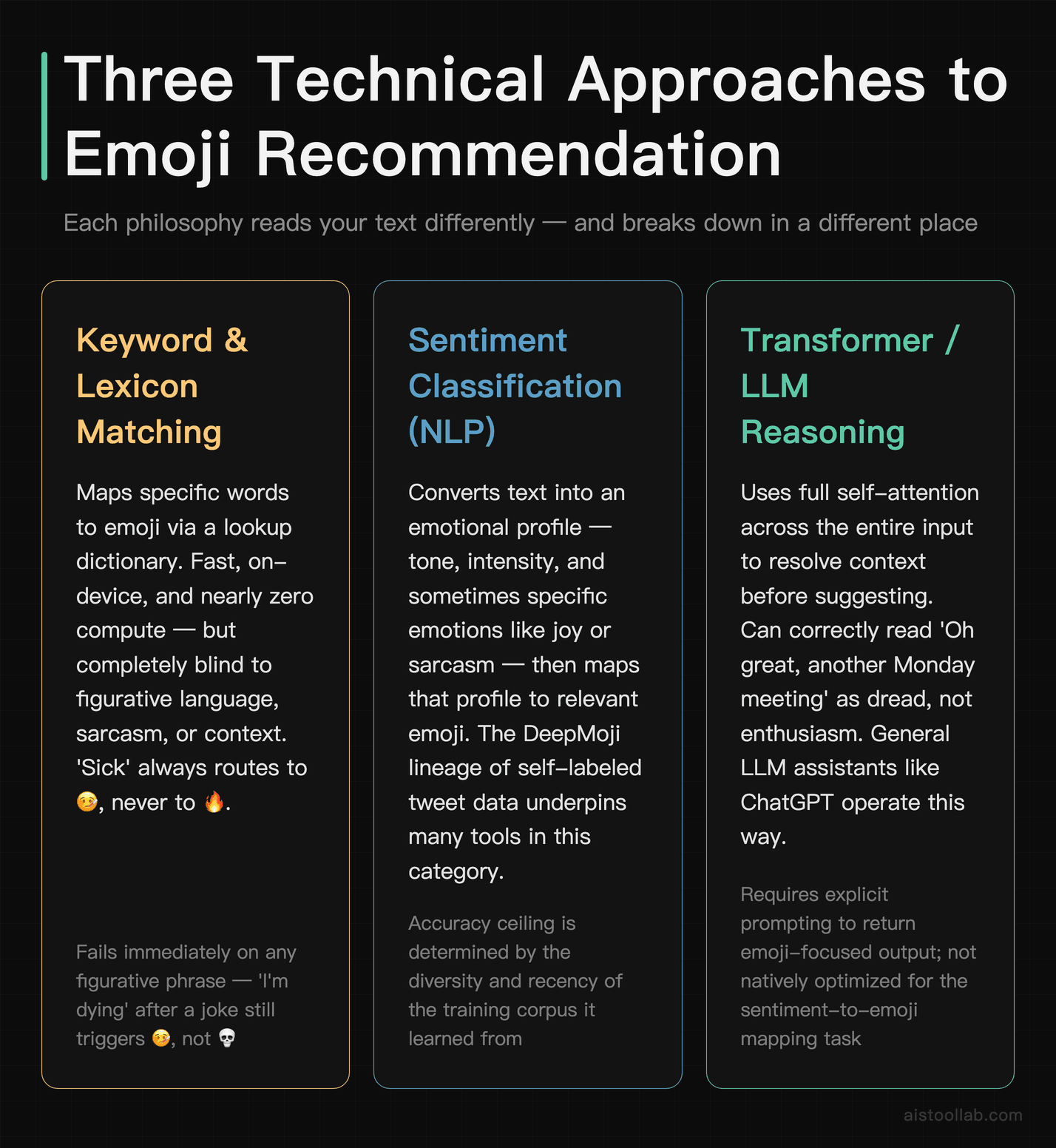
At the core, every one of these tools is doing some version of sentiment analysis: converting a chunk of text into a representation of emotional tone, then mapping that tone to emoji. But the “how” splits into three quite different technical philosophies, and the differences explain almost every quality gap you’ll notice in practice.
Keyword and lexicon matching (the old guard)
The simplest approach — and the one most built-in keyboards still lean on heavily — is lexicon matching. You type “pizza,” it suggests 🍕. You type “love,” it offers ❤️. This is fast, runs on-device, and needs almost no compute. It’s also brittle. The word “sick” maps to 🤒 when you’re ill and 🔥 when you mean “that’s awesome,” and a pure keyword lookup has no way to tell which you meant. There’s no sentiment understanding, just a dictionary of triggers.
This is why keyboard suggestions feel dumb the moment your sentence gets even slightly figurative. “I’m dying” after a joke doesn’t mean you need medical help, but a lexicon model doesn’t know that. It’s a reasonable trade-off for instant, private, on-device prediction — just don’t expect it to catch tone.
Sentiment classification with NLP (the specialist approach)
Dedicated tools like Emoji Finder sit a level up. Instead of matching individual words, they run the full phrase through a sentiment and context model that classifies emotional valence (positive/negative), intensity, and often a more granular emotion category — joy, anger, sarcasm, affection, and so on. That classification then maps to a ranked set of emojis rather than a single literal match.
The advantage shows up with sentences that have no obvious “emoji keyword” at all. Take “I can’t believe you actually pulled that off.” There’s no noun to hook a 🍕-style match onto — the meaning lives entirely in tone. A sentiment model can recognize the mix of surprise and admiration and surface 🎉, 👏, or 😮 accordingly. That’s the whole reason a specialized engine exists: it’s optimized for the emotional-mapping task rather than treating emoji as an afterthought. I walked through the mechanics of this in the Emoji Finder explainer, and the gist is that purpose-built sentiment tuning is what separates it from a generic autocomplete.
Transformer-based semantic understanding (the heavy machinery)
The most capable approach uses transformer models — the same architecture family behind modern large language models. Transformers don’t just classify a sentence into a bucket; they build a contextual representation where every word’s meaning is influenced by every other word around it. The technical term is self-attention, and it’s why these models handle context so much better than anything that came before.
Why does that matter for emoji? Because emoji meaning is almost entirely contextual. Consider 😭. In one message it’s genuine grief; in another it’s “I’m laughing so hard I’m crying”; in a third it’s mock despair over a minor inconvenience. A transformer that has seen millions of examples of 😭 in context learns those distributions statistically. When a general LLM assistant nails an emoji suggestion for a tricky sentence, this is why — it’s leveraging an enormous, richly contextual training signal. The catch is that this power is generic, not emoji-specialized, and it comes with a speed and cost penalty for a task that’s ultimately pretty small.
The Training Data Problem Nobody Talks About
Here’s where the research gets genuinely interesting, and where I’d push back on the marketing gloss around all these tools. An emoji recommender is only as good as the data it learned emotion-to-emoji mapping from, and that data is messy in ways that directly affect accuracy.
The academic backbone here is worth naming. A widely cited MIT project called DeepMoji, published around 2017, trained on an enormous corpus of tweets containing emoji — using the emoji themselves as labels for the emotional content of the text. The insight was clever: people voluntarily annotate their own emotions with emoji all day long, so you get a massive, self-labeled sentiment dataset for free. DeepMoji demonstrated that a model trained this way could pick up on sarcasm and subtle emotional cues better than many models trained on hand-labeled sentiment data. A lot of modern emoji and sentiment tooling descends, conceptually, from that lineage.
But that free labeling introduces bias. Twitter/X users skew toward certain demographics, certain languages, and a particular flavor of online humor. A model trained predominantly on English-language social posts will absorb the emoji conventions of that community — which is why 💀 (meaning “I’m dead / that killed me / hilarious”) reads as funny to one group and morbid to another. The training distribution is the tool’s worldview. There’s no neutral, universal emoji dictionary hiding underneath; there’s just whatever the data happened to contain.
This is the honest limitation across every tool in this comparison. When a recommender confidently suggests an emoji, it’s telling you what its training population would have used — not what’s objectively “correct,” because emoji don’t have objective meanings. Keep that in mind whenever a tool feels weirdly confident about a borderline case.
Ambiguous Emotions and the Sarcasm Wall
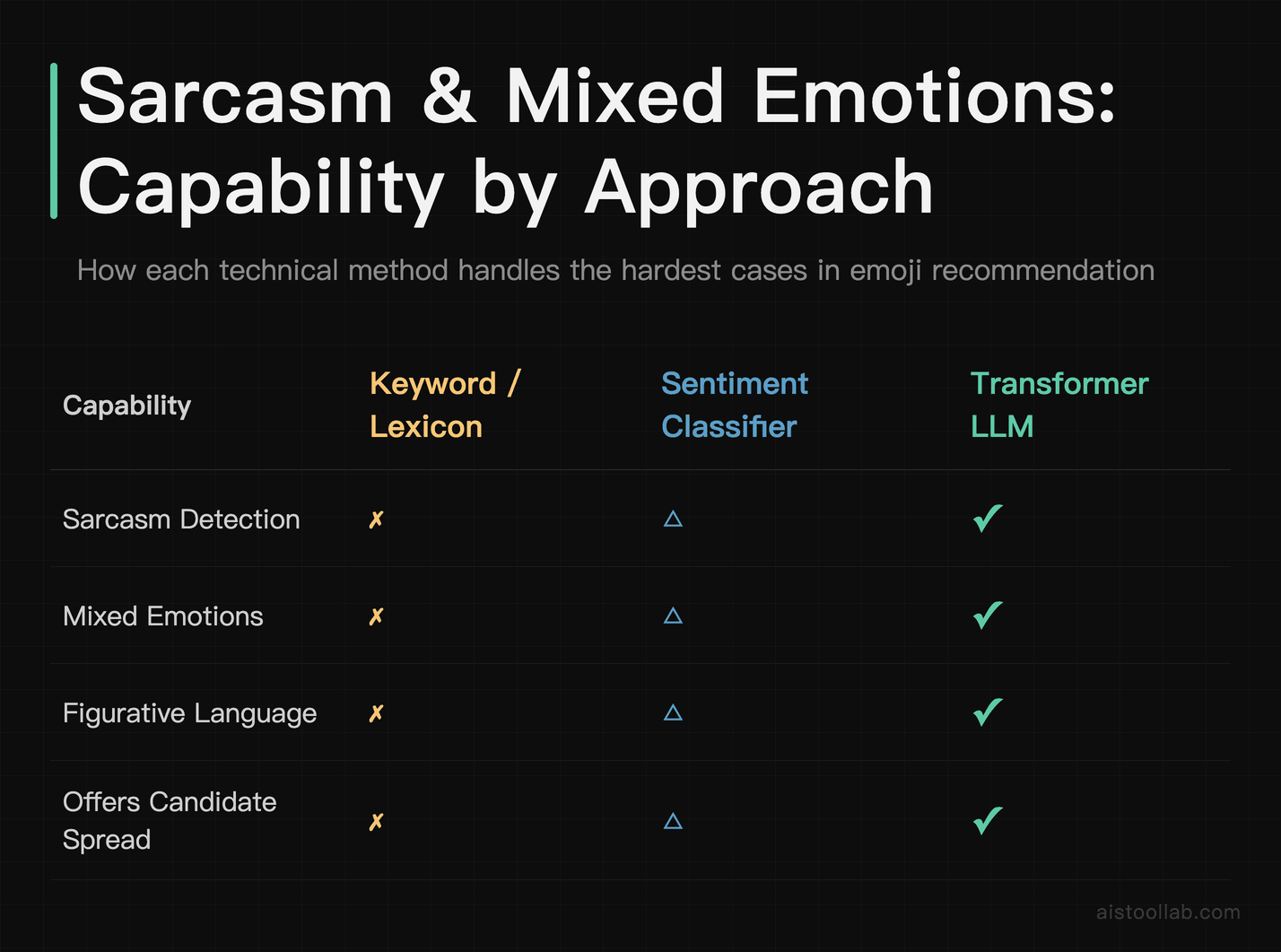
If there’s one place where these systems collectively hit a wall, it’s sarcasm and mixed emotions — and it’s worth understanding why, because it shapes which tool you should trust for what.
Sarcasm is hard because the literal sentiment and the intended sentiment are opposites. “Oh great, another Monday meeting” is lexically positive (“great”) but emotionally negative. Lexicon models fail this completely — they see “great” and suggest 😊. Sentiment classifiers do somewhat better if they were trained on sarcastic examples with their true emotional labels, which is exactly the DeepMoji-style advantage. Transformer LLMs do best of all, because they can use surrounding context (“another Monday meeting” carries dread) to override the literal reading — but even they get fooled, especially without conversational context.
Mixed emotions are a different beast. “I’m so proud of you but also kind of jealous, honestly” contains two competing sentiments in one breath. Most engines resolve this by picking the dominant emotion and suggesting for that, which flattens the nuance. A few will offer a spread of options spanning both feelings, which is arguably the more useful behavior — it hands the ambiguity back to you, the human, instead of pretending it’s resolved. Offering a ranked spread rather than a single confident guess is the more trustworthy design in principle — but only when the candidates in that spread are actually on target. As the hands-on test right after this section shows, a keyword-based engine can hand you a “spread” that is mostly noise for exactly this kind of emotionally shaded input, so a spread only earns your trust when the tool understood the sentiment in the first place.
✋ Hands-On: I Fed a Real Emoji Finder Three Queries — Watch It Nail the Easy One and Break on the Rest
The section above argues, from documented behavior, that a ranked spread of candidates is the more trustworthy design. I wanted to see that claim survive contact with a real tool, so I took a common no-login keyword-style emoji finder — emojidb.org — and fed it three queries, from easy to deliberately hard. Read this as a concrete spot-check of one keyword-style tool, not a verdict on every engine: the semantic-embedding and LLM-backed approaches this article compares against can behave differently.
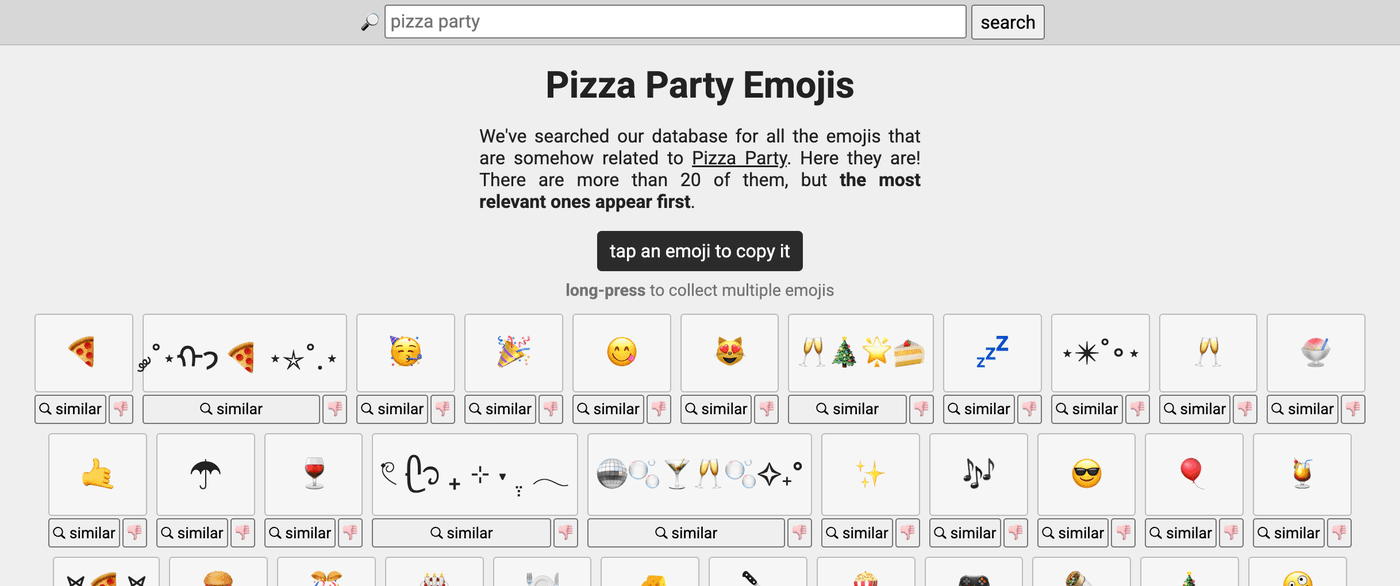
A concrete concept: it nails it. Search “pizza party” and the most relevant results really are relevant — 🍕 leads, with 🥳, 🎉, 😋 and a spread of food-and-celebration emoji (🍔 🍿 🧀 🥂 🍰) clustered near the top. For a literal noun phrase, keyword matching against emoji labels works fine. This is the approach at its most useful.
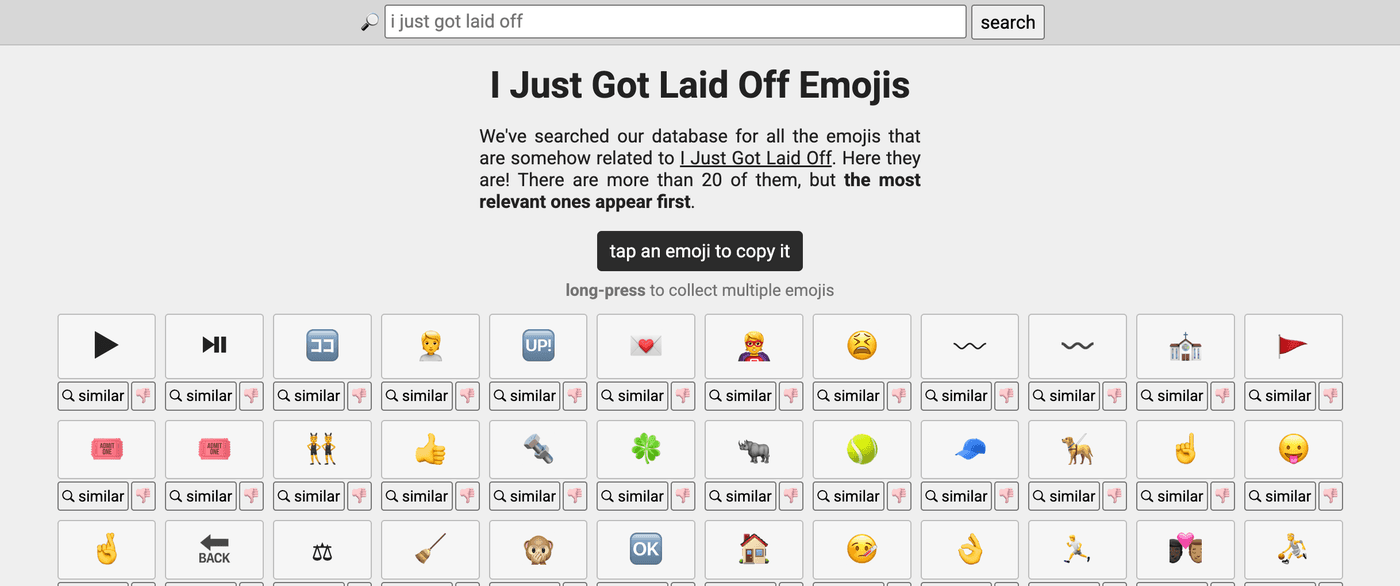
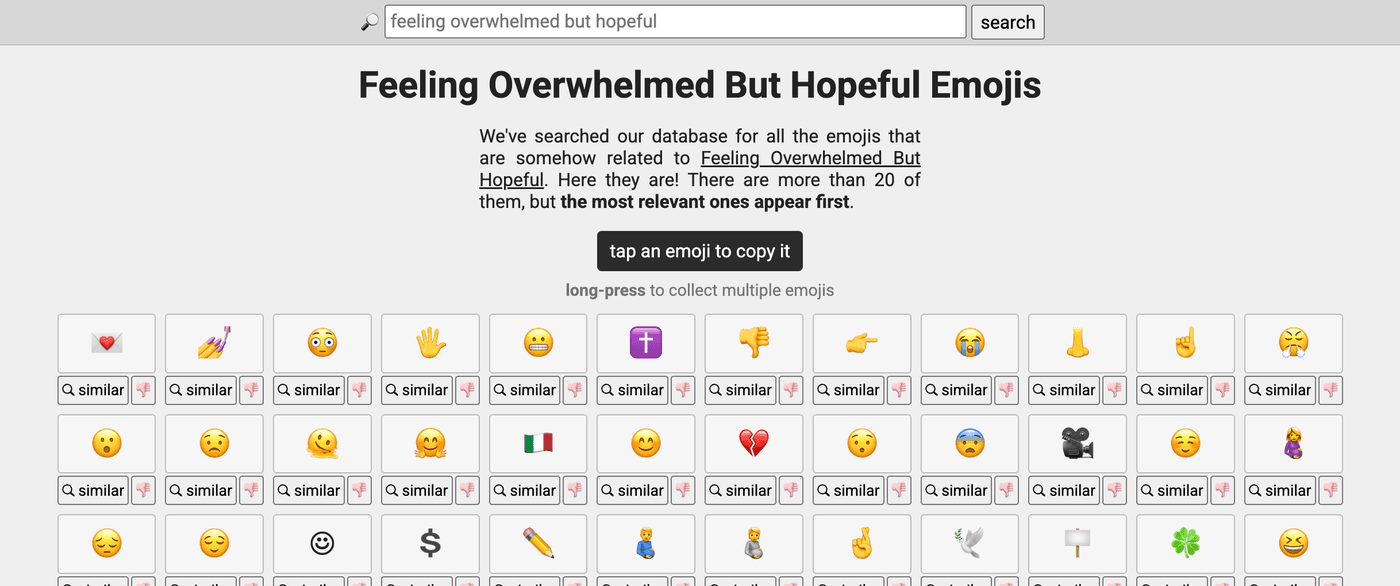
The EmojiDB screenshots below come from the same 2026-07-13 hands-on session as our emoji finder comparison — the same batch of captures, not a separate run for this article.
A contextual sentence: it falls apart. Now search “i just got laid off” — a moment of real distress. The page confidently promises “the most relevant ones appear first,” and the results it serves up include ▶️ and ⏸️ (play / pause controls) and 🆙 right near the top, with an 🎟️ ticket, a 🍀 four-leaf clover, a 🎾 tennis ball and a 🧢 cap scattered through the visible spread. None of these reflect the job-loss sadness of “laid off”; the one obvious fit for distress, 😫 (tired face), appears only after several irrelevant controls and symbols. That “ranked spread” the section above called trustworthy is, here, mostly noise.
Mixed, nuanced sentiment: it scatters. Search “feeling overwhelmed but hopeful” and you get a genuine grab-bag: it does surface some anxious faces (😳 😭 😔) and a couple of hope tokens (🤞 fingers crossed, 🕊️ dove, 🍀), but they’re mixed in with noise — an 🇮🇹 Italian flag, a 👃 nose, a 💲 dollar sign. The visible results show no reliable balance between “overwhelmed” and “hopeful” — real distress faces sit right next to an Italian flag and a nose. For anything with emotional shading, the ranking is untrustworthy.
What this actually tells you (and its limits): a keyword-style emoji finder is genuinely good for simple literal lookups — “find me the taco emoji,” “party emoji,” “sad face” — and it’s instant and free with no account. It collapses on a contextual sentence, an emotion with nuance, or anything figurative. That’s the ceiling this tool hits, and it’s the kind of ceiling keyword-matching designs are prone to — which is exactly why the semantic and LLM-backed routes this article compares against exist for higher-stakes tone work. Caveat on my test: this is one keyword-style tool and three queries — a reproducible spot-check you can run yourself in ten seconds, not a benchmark across every emoji finder on the market.
Emerging Slang: The Moving Target
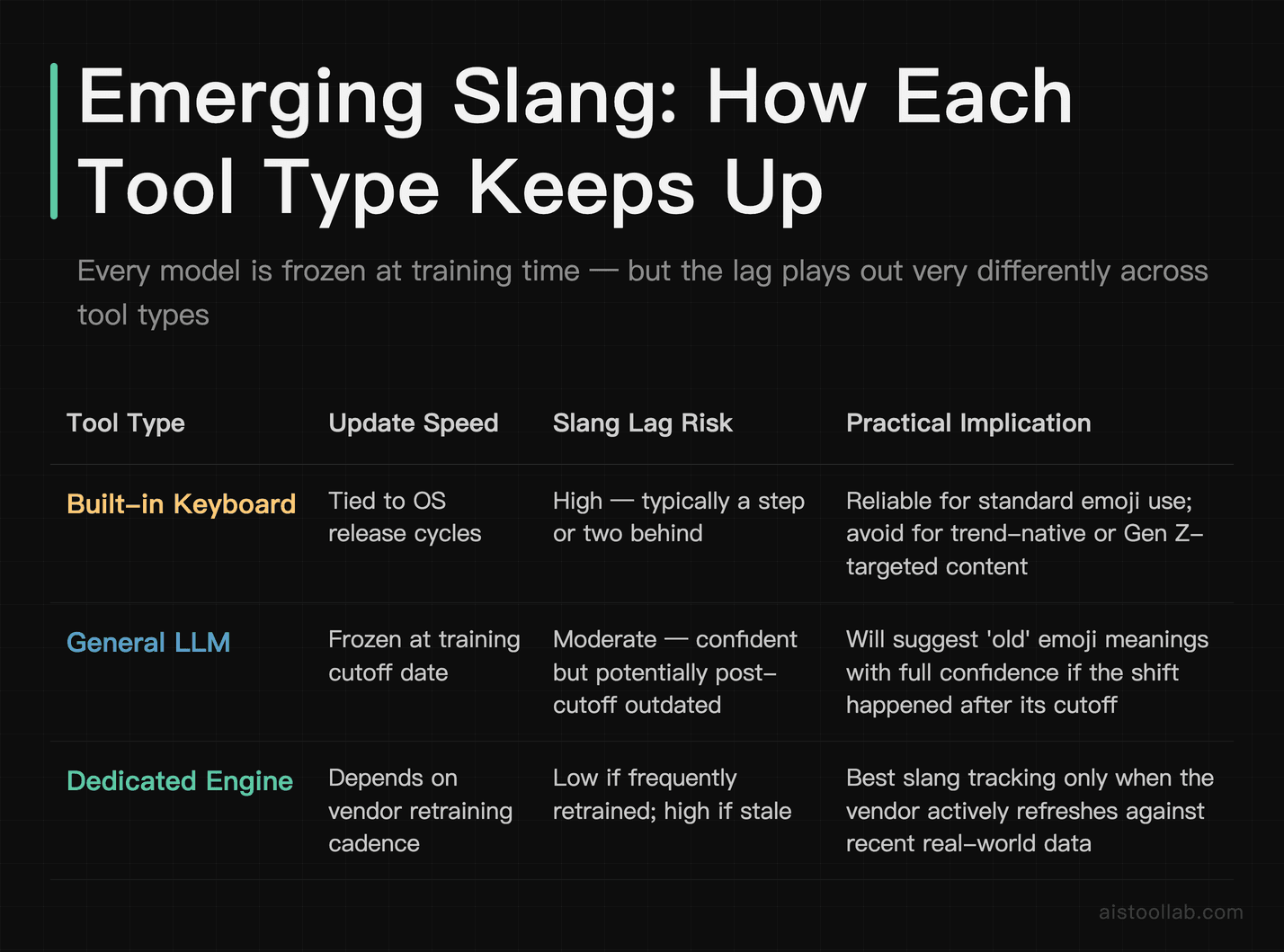
Internet language mutates fast. 😭 shifted from sadness to laughter. 💀 went from death to comedy. The “crying laughing” 😂 got branded as uncool by younger users who moved to 💀 and 😭, and that shift happened over months, not years. For an emoji recommender, this is a nightmare, because a model’s understanding is frozen at whatever moment its training data was collected.
This is the single biggest structural weakness of any static model — and it plays out differently across the three approaches. Built-in keyboards update slowly, tied to OS release cycles, so they’re often a step or two behind. General LLMs are pinned to their training cutoff; if the model was trained before a slang shift, it’ll suggest the “old” meaning with total confidence. Dedicated engines live or die by their retraining cadence — a tool that refreshes its model frequently against recent data will track trends better than one that shipped two years ago and never updated.
The practical implication: no tool is permanently “current.” If you’re a marketer trying to sound native to Gen Z on TikTok, treat any emoji recommendation as a starting point, not gospel, and sanity-check it against what people are actually posting this week. The algorithms are always slightly behind the culture — that’s not a bug you can engineer away, it’s the nature of learning from historical data.
Cultural and Linguistic Variation
Emoji are supposedly universal, which is a lovely idea and mostly untrue in practice. The same glyph carries different weight across cultures. 👍 is friendly agreement in much of the US and UK, but it’s read as dismissive or even rude in some other cultures and, increasingly, among younger Western users who find it passive-aggressive. 🙏 means “please/thank you” or “prayer” to some and “high five” to others. Color, gesture, and even flower emoji carry region-specific connotations.
For recommendation engines, this creates a coverage problem. A model trained mostly on English-language data will confidently apply English-language emoji conventions to everyone, which can misfire badly for other linguistic communities. General LLMs tend to do better here simply because they’re trained on many languages at scale and can, when prompted, account for cultural context. Dedicated emoji tools vary enormously depending on how multilingual their training corpus was — some handle major world languages gracefully, others quietly assume you’re writing casual American English.
My read from the available documentation and reviews: if your audience is culturally or linguistically diverse, don’t outsource the final call to any single engine. Use it to generate candidates, then apply human judgment about your specific audience. The tech is a helpful assistant here, not an authority on cross-cultural nuance — and honestly, anyone who’s worked on a global team already knows emoji etiquette is a minefield no algorithm has fully mapped.
Who Should Use Which Tool
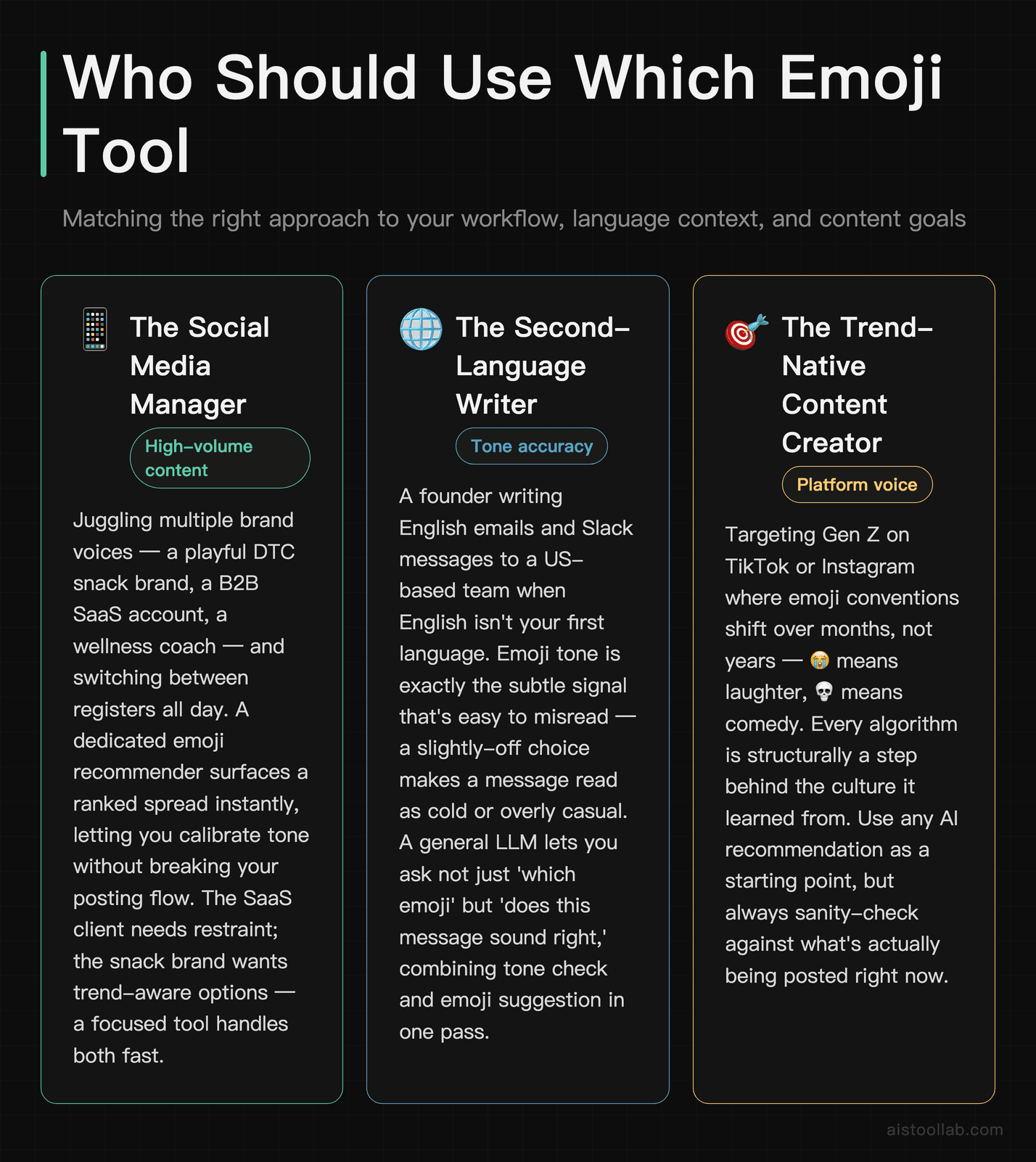
The social media manager juggling multiple brand voices
Picture a freelance social media manager running accounts for three different clients — a playful DTC snack brand, a B2B SaaS company, and a wellness coach. Each has a distinct emoji personality, and switching between them all day is exhausting. A dedicated emoji recommender is genuinely useful here: paste the draft caption, get context-aware suggestions, and pick the ones that fit the brand’s register. The speed matters when you’re producing dozens of posts a week. For the snack brand you want the playful, trend-aware options; for the SaaS account you want restraint. A focused tool that surfaces a ranked spread lets you calibrate fast without breaking flow.
The startup founder writing in a second language
Consider a founder whose first language isn’t English, writing customer emails and Slack messages to a US-based team. Emoji tone is exactly the kind of subtle signal that’s easy to get wrong when you’re operating in a second language — a slightly-off emoji can make a message read as cold or overly casual. Here, a general LLM assistant often shines, because you can ask it not just “which emoji” but “does this message sound friendly and professional to a native English reader?” That conversational reasoning ability is worth the slower round-trip. The founder isn’t just picking a glyph; they’re pressure-testing tone, and a broad transformer model is better suited to that open-ended judgment.
The content creator chasing platform-native voice
A YouTuber or TikTok creator writing titles, community posts, and comment replies lives and dies by sounding native to the platform. For them, the emerging-slang problem is front and center — using last year’s emoji conventions is a fast way to look out of touch. No tool solves this perfectly, but a creator is best served by treating recommendations as a brainstorm and cross-referencing against what’s currently trending in their niche. The tool speeds up ideation; the creator’s own cultural radar makes the final call. This is the use case where I’d trust the human most and the algorithm least.
The Verdict: What I’d Actually Use
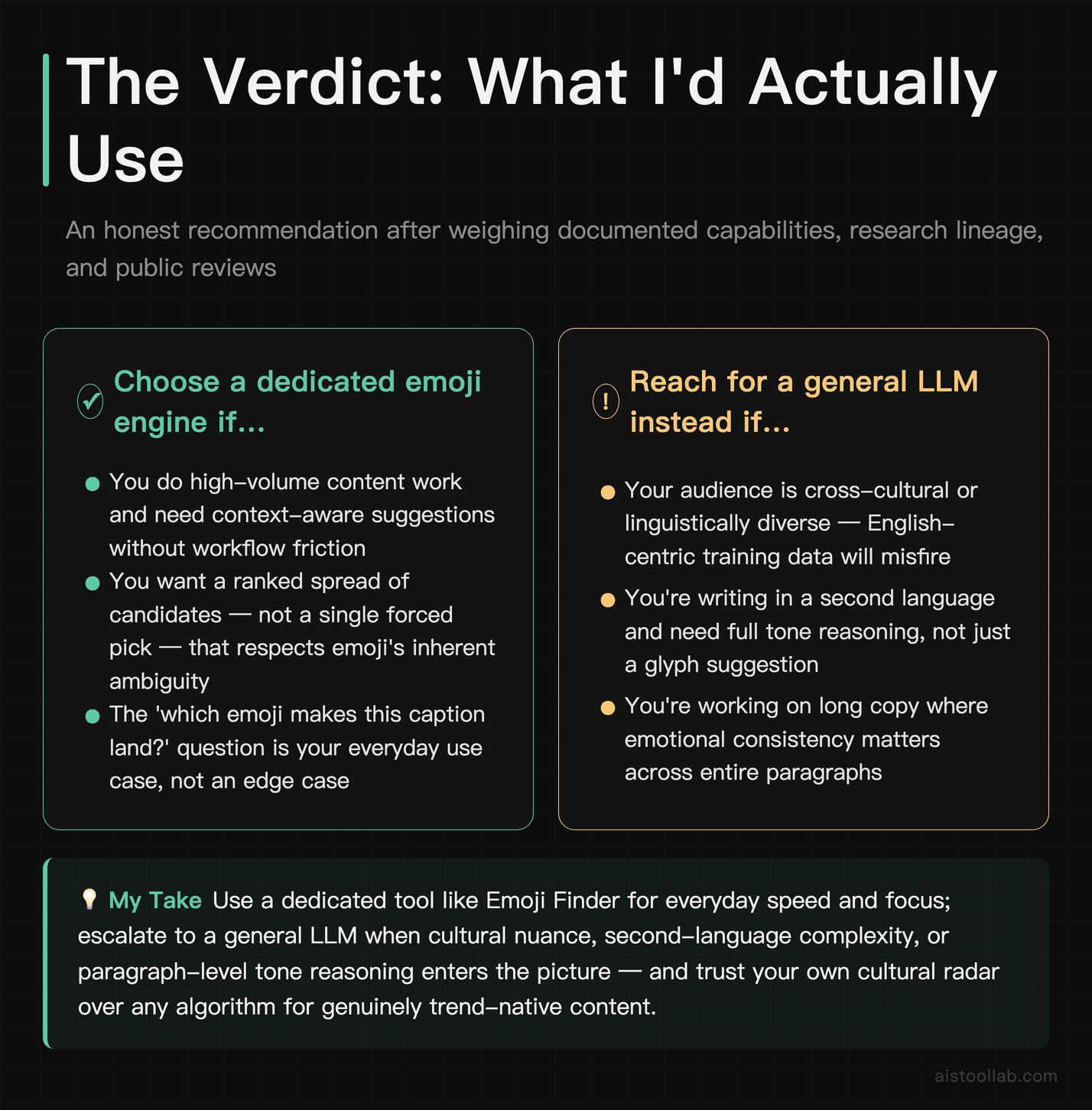
After weighing the documented capabilities, the research lineage, and the consistent themes in public reviews, here’s my honest recommendation — and it’s not a cop-out “they’re all fine” answer.
If you’re doing high-volume content work and you want fast, caption-ready emoji suggestions without breaking your flow, a dedicated engine like Emoji Finder is the right default. It’s fast, it’s purpose-built for the sentiment-to-emoji mapping task, and surfacing a ranked spread of candidates fits the fact that emoji meaning is ambiguous. Just mind the ceiling the hands-on section documents: the keyword-matching kind nails concrete captions (“pizza party”) but can break on abstract, emotionally mixed lines (“i just got laid off”), so lean on it for literal, high-volume work and hand the nuanced calls to a reasoning model. For the everyday “which emoji makes this caption land right” question, it beats both the dumb keyword prediction in your keyboard and the friction of prompting a general chatbot.
If your stakes are higher — cross-cultural audiences, writing in a second language, or long copy where tone matters across whole paragraphs — reach for a general LLM assistant and actually ask it to reason about tone, not just pick a glyph. And if you’re chasing trend-native voice on TikTok or Instagram, trust your own cultural radar over any algorithm, because every model is structurally a step behind the culture it learned from. No tool escapes that lag.
The one thing I’d push back on across the whole category: don’t treat any of these as an authority on what an emoji “means.” They’re pattern-matchers reflecting their training data, and emoji meaning is a moving, culturally contested target. Use them as fast, well-informed assistants that hand you good options — then make the human call. That’s not a limitation of these specific tools; it’s the honest reality of teaching machines to read feelings from tiny pictures. Grab a free emoji tool, run your next few messages through it, and you’ll know within a handful of tries whether its suggestions match your instincts.
Frequently Asked Questions
How does an AI emoji recommender actually decide which emoji fits my text?
Most tools run your text through a sentiment and context analysis pipeline. First, the text is tokenized and converted into a numerical representation the model can process. Then a sentiment model — ranging from a simple lexicon lookup to a full transformer with self-attention — estimates the emotional tone: whether it’s positive or negative, how intense, and sometimes a specific emotion like joy, anger, or sarcasm. That emotional profile is mapped against a database of emoji, each associated with the emotions and contexts it typically expresses in the training data. The tool then ranks candidates and shows you the top matches. The sophistication varies enormously: keyword tools just match nouns to literal emoji, while sentiment-tuned engines like Emoji Finder and general LLMs can read tone in sentences that contain no obvious “emoji word” at all. The key thing to understand is that the model is predicting what people statistically use in similar contexts, not consulting an objective rulebook — because emoji don’t have objective, fixed meanings.
Are dedicated emoji tools better than just asking ChatGPT?
It depends on what you’re optimizing for. A general LLM assistant has deeper reasoning ability and a broader, more multilingual training base, so for complex tasks — matching emoji tone across a long paragraph, checking whether a message reads as friendly in a second language, or reasoning about cultural nuance — it often produces better, more explainable results. The trade-off is speed and friction: you have to open the tool, write a prompt, and wait for a response. Dedicated emoji engines are purpose-built and lightweight, so they’re much faster for the common case of “I’ve got one sentence and I want the right emoji right now.” They also tend to surface a ranked spread of options instantly, which suits rapid content work. My honest take from comparing the documented behavior: use a dedicated tool for volume and speed, and reach for a general LLM when the tone stakes are high or the text is long and nuanced. They’re complementary rather than strictly competitive.
Why do these tools sometimes suggest emoji that feel outdated?
Because machine-learning models learn from historical data, and their understanding is frozen at the moment that data was collected. Internet emoji conventions shift fast — 😂 fell out of favor among younger users who moved to 💀 and 😭, and 🙃 developed strong sarcastic connotations that weren’t there originally. If a model was trained before a shift, it’ll confidently suggest the older convention. Built-in keyboards update on slow OS cycles; general LLMs are pinned to their training cutoff date; dedicated engines depend on how often their creators retrain. There’s no way to fully engineer around this, because you can’t train on data that doesn’t exist yet — the culture is always slightly ahead of the algorithm. The practical fix is human oversight: if you’re targeting a trend-sensitive audience, treat any suggestion as a first draft and check it against what people are actually posting this week. For lower-stakes, everyday messaging, the lag rarely matters.
Can these tools handle sarcasm and mixed emotions?
Partially, and this is genuinely the hardest problem in the space. Sarcasm is difficult because the literal words and the intended meaning are opposites — “oh great, another meeting” is lexically positive but emotionally negative. Lexicon-based tools fail this completely. Sentiment classifiers trained on sarcastic examples do better, and this is exactly where the DeepMoji research lineage shines: by training on real social posts where people labeled their own emotions with emoji, those models absorbed sarcasm patterns that hand-labeled datasets often miss. Transformer LLMs do best because they use surrounding context to override literal readings, though they still get fooled without conversational history. Mixed emotions — “proud but also jealous” — are usually resolved by picking the dominant feeling, which flattens nuance. The better-designed tools offer a spread of options spanning both emotions instead of one confident guess, handing the ambiguity back to you. If nuance matters, favor tools that show multiple ranked candidates rather than a single answer.
Do emoji recommendations work the same across different languages and cultures?
No, and assuming they do is a common mistake. Emoji carry culturally specific connotations: 👍 reads as friendly in much of the US and UK but as dismissive or rude in some other cultures and among some younger Western users; 🙏 means “thank you” to some and “high five” to others. Recommendation engines inherit the biases of their training data, so a model trained mostly on English-language social posts will apply English-language conventions to everyone. General LLMs tend to handle multilingual and cross-cultural contexts better because they’re trained on many languages at scale, especially when you explicitly prompt for cultural awareness. Dedicated emoji tools vary widely depending on how multilingual their corpus was. If your audience spans cultures or languages, don’t let any single engine make the final call — use it to generate candidates and apply your own knowledge of the specific audience. The technology is a useful assistant for cross-cultural communication, but it’s nowhere near an authority on it.
Is there any privacy concern with sending my messages to an emoji tool?
It’s worth thinking about, yes. On-device keyboard prediction processes your text locally, so nothing leaves your phone — that’s the privacy-friendly option, at the cost of weaker context understanding. Web-based emoji tools and cloud LLMs, by contrast, send your text to a server for processing. For casual social captions this is usually a non-issue, but if you’re pasting sensitive internal messages, customer data, or confidential drafts, you should check the tool’s privacy policy and data-retention practices before pasting anything you wouldn’t want stored. Reputable tools state clearly whether they log inputs and for how long. As a general rule, treat any cloud-based text tool the way you’d treat any SaaS handling your content: fine for low-sensitivity work, worth scrutiny for anything confidential. When in doubt, keep genuinely sensitive text out of third-party tools entirely and rely on on-device options, even if the suggestions are less clever. This same principle applies to most AI tools, which I’ve written about in the context of evaluating AI tool effectiveness.
Are these emoji tools free, or do they cost money?
Most dedicated web-based emoji recommendation tools are free or freemium — you can use the core feature without paying, and any premium tiers tend to add convenience rather than fundamentally better suggestions. Built-in keyboard prediction is bundled free with your operating system. General LLM assistants have both free tiers and paid subscriptions, and the paid plans buy you access to more capable models and higher usage limits rather than emoji-specific features. Because emoji recommendation is a relatively small task computationally, you rarely need to pay specifically for it — the free options cover the common use cases well. I’d be cautious about any tool charging a meaningful subscription purely for emoji suggestions, since the underlying capability is widely available at no cost. Spend money on a general-purpose AI subscription if you’ll use it broadly across writing and reasoning tasks; don’t spend it on emoji picking alone. Always confirm current pricing on the official pricing page of whichever tool you choose, since plans change and I won’t quote figures I can’t verify.
How accurate are emoji recommendations, really?
Accuracy is genuinely hard to measure, because “correct” is subjective — emoji don’t have fixed meanings, so there’s no perfect answer key. What we can say from the research and reviews is that sentiment-tuned and transformer-based approaches substantially outperform simple keyword matching on tone-sensitive text, and that all approaches struggle with sarcasm, mixed emotions, and emerging slang. Any tool claiming a precise accuracy percentage should be treated skeptically, because such a number depends heavily on the test set, the language, and whose interpretation counts as “right.” In practice, the useful mental model isn’t “how often is it correct” but “how good are its top few suggestions as a starting point.” A strong tool consistently puts a genuinely fitting emoji in its top three candidates, even when its single best guess misses. That’s the realistic bar. Treat these tools as fast, informed brainstorming partners rather than oracles, and you’ll get real value without being misled by borderline cases where the model is confidently wrong.
Last updated: 2026
Found this review helpful?
👉 Browse the AI Tools Library to find the right tools for your workflow.
Related reading: Emoji Finder Tools Comparison 2026: Sentiment Analysis Accuracy, Context Understanding, and Performance Ranked