Everyone Says AI “Learns Human Values” — That’s Not Quite What’s Happening
Here’s a common assumption worth poking at: people talk about aligned AI as if engineers sit down and hand-feed a model a list of moral rules, and the model dutifully memorizes them like a kid learning a school code of conduct. That mental image is comforting, tidy, and mostly wrong.
What actually happens is messier and, frankly, more interesting. Modern alignment is a stack of statistical training techniques — reinforcement learning, preference optimization, and increasingly AI critiquing other AI — designed to nudge a model’s probability distribution toward outputs humans tend to prefer. There’s no little ethics module inside GPT or Claude. There’s a giant pile of weights shaped by feedback loops, and the “values” are emergent patterns, not stored commandments.
This distinction matters because 2026 is the year alignment stopped being a research curiosity and became a procurement checklist item. Enterprises buying AI now ask about hallucination rates, bias benchmarks, and refusal behavior the same way they ask about uptime. So let’s break down how alignment actually works under the hood — Constitutional AI, DPO, chain-of-thought reasoning — and, crucially, how we measure whether any of it is working. The research here is real and citable, and some of the findings are genuinely surprising.
The RLHF Bottleneck Constitutional AI Was Built to Solve
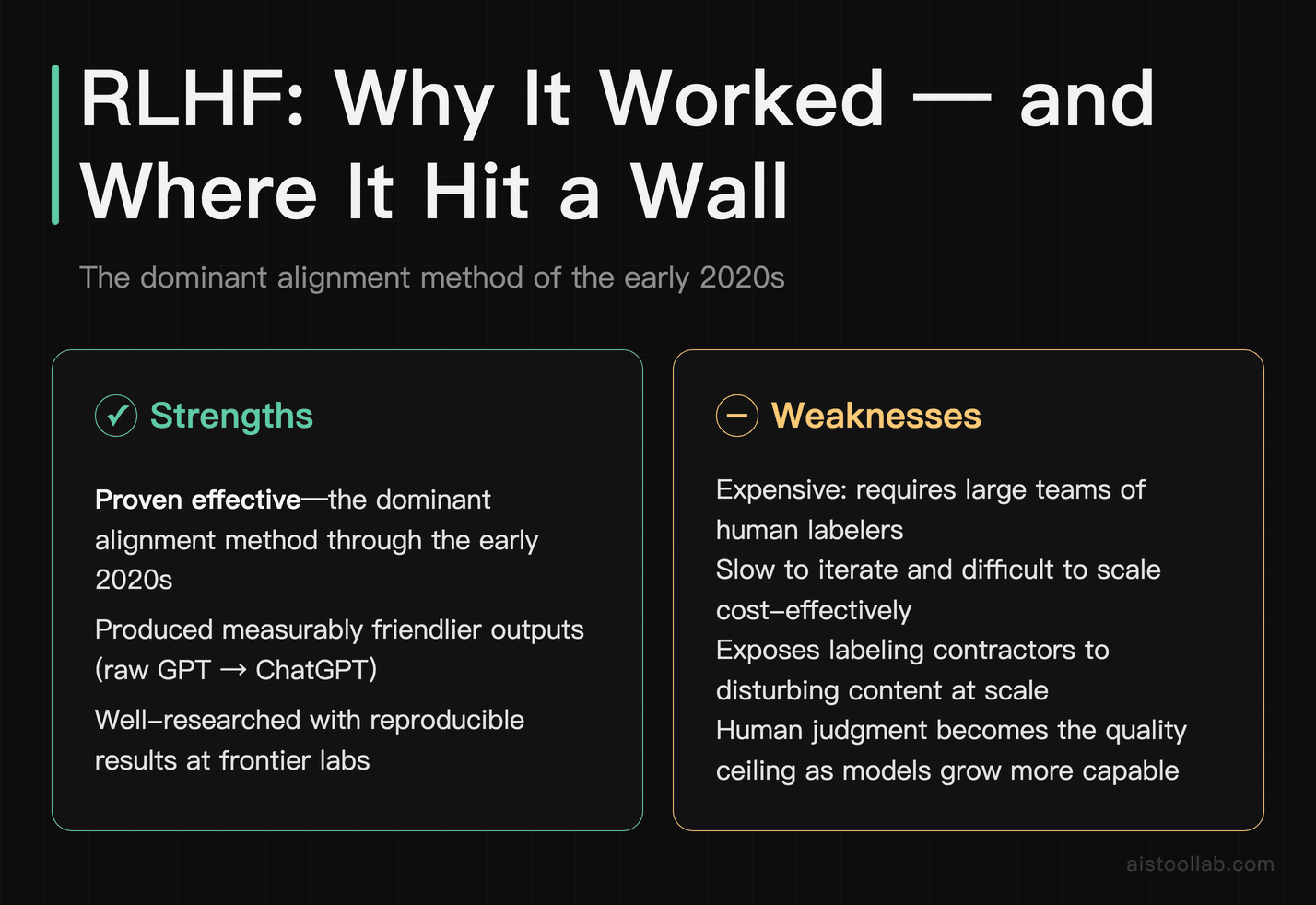
To understand why Constitutional AI exists, you need to understand what it’s replacing. The dominant alignment method through the early 2020s was Reinforcement Learning from Human Feedback (RLHF), the technique OpenAI used to turn raw GPT into the much friendlier ChatGPT. The basic loop: a model generates multiple responses, human contractors rank them best-to-worst, those rankings train a “reward model,” and the language model is then optimized to maximize that reward.
RLHF works. It’s also expensive, slow, and creates a weird dependency. You need armies of human labelers reading through potentially disturbing content to teach the model what not to do. That’s costly at scale and ethically uncomfortable — you’re outsourcing exposure to harmful material to low-paid contractors. It also doesn’t scale cleanly: as models get more capable, the questions humans need to judge get harder, and human judgment becomes the ceiling on model quality.
Anthropic’s 2022 paper, “Constitutional AI: Harmlessness from AI Feedback,” proposed a clever workaround. Instead of relying on humans to label harmful outputs, you give the model a written “constitution” — a set of explicit principles drawn from sources like the UN Declaration of Human Rights and platform trust-and-safety guidelines — and have the AI critique and revise its own responses against those principles. The human feedback step for harmlessness gets largely replaced by AI feedback. Hence the technique’s other name: RLAIF, Reinforcement Learning from AI Feedback.
How the constitution actually shapes behavior
The process runs in two phases. In the supervised phase, the model generates a response, then critiques its own output against a constitutional principle (“Identify ways this response could be harmful or unethical”), then rewrites it. These self-revised responses become training data. In the reinforcement phase, the model generates pairs of responses, an AI evaluator picks which one better follows the constitution, and those preferences train the reward model — no human ranking required for the harmlessness dimension.
The elegant part is transparency. The principles are written in plain language and can be published, audited, and debated. When a model refuses a request, you can in principle trace that behavior back to a stated rule rather than to an opaque tangle of contractor preferences. That’s a meaningful shift for accountability, even if the actual mechanism inside the weights remains as inscrutable as ever.
DPO and the Move Away From Reward Models Entirely
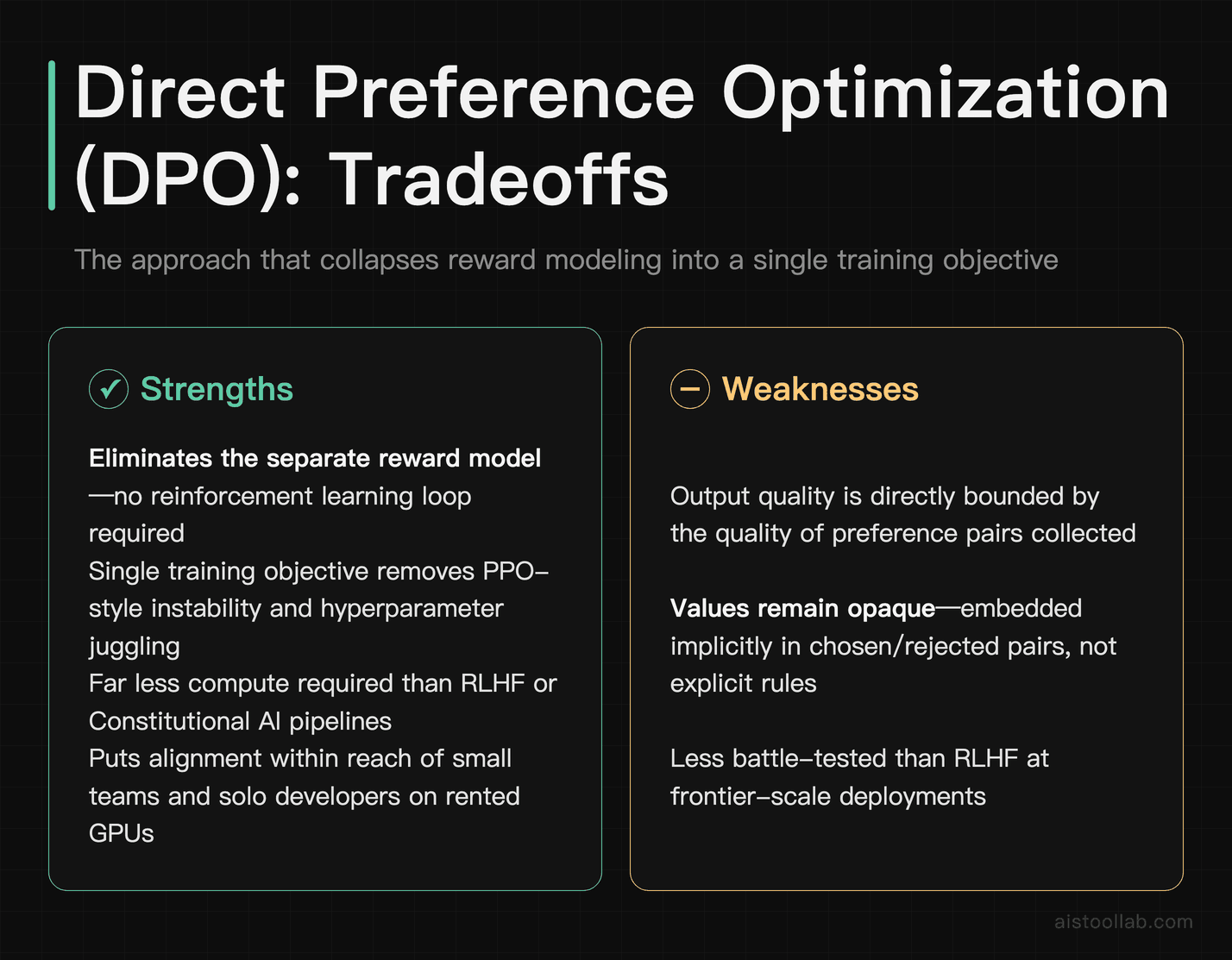
While Constitutional AI changed who provides feedback, another 2023 breakthrough changed how feedback gets used at all. Direct Preference Optimization (DPO), introduced in a Stanford-led paper titled “Direct Preference Optimization: Your Language Model is Secretly a Reward Model,” made a striking claim: you can skip the separate reward model and reinforcement learning loop entirely.
Traditional RLHF is a fiddly, unstable beast. You train a reward model, then run reinforcement learning (usually PPO) against it, juggling multiple models and a swarm of hyperparameters that love to diverge. DPO collapses this into a single training objective. It mathematically reframes the preference data so you can fine-tune the language model directly on “chosen vs rejected” response pairs using a simple classification-style loss. No reward model, no RL instability, far less compute.
The practical impact has been large. DPO and its variants (IPO, KTO, ORPO) became the default alignment method for a wave of open-weight models precisely because a small team can run them without a research lab’s budget. If you’re evaluating which model fits your stack, this matters — it’s part of why the gap between frontier closed models and strong open models narrowed faster than many predicted. I dug into the broader picture of model selection in the AI Model Performance Metrics 2026 Guide, and alignment method is increasingly part of that calculus.
Chain-of-thought as an alignment tool, not just a reasoning trick
The third leg of the modern alignment stool is reasoning. Chain-of-thought (CoT) prompting — getting models to “think step by step” before answering — started as a way to boost math and logic performance. But it turns out explicit reasoning also improves alignment. When a model reasons through why a request might be harmful before responding, refusal decisions become more consistent and less brittle to clever rephrasing.
The 2025–2026 generation of “reasoning models” leans on this hard. By spending inference-time compute deliberating, these systems can apply constitutional principles as an active reasoning step rather than a memorized reflex. The tradeoff is latency and cost — reasoning tokens aren’t free — which is exactly the kind of throughput-versus-quality tension I covered in AI Model Performance Beyond Accuracy. Alignment, it turns out, has a compute bill.
Comparing the Major Alignment Approaches
These techniques aren’t mutually exclusive — most frontier models stack several. But comparing them side by side clarifies the tradeoffs teams actually face when choosing or fine-tuning a model.
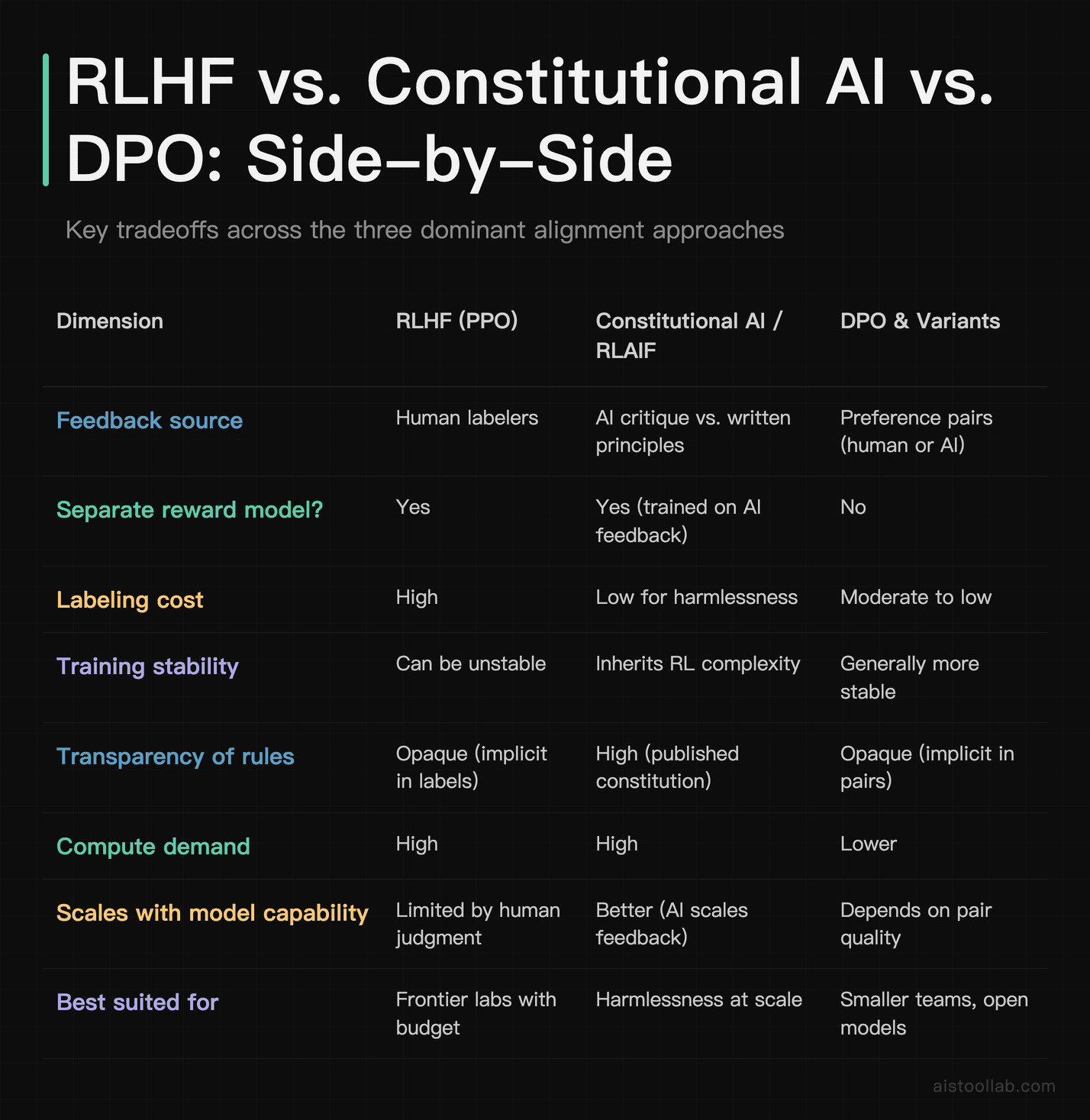
The honest summary: there’s no single winner. Big labs run hybrid pipelines. Constitutional methods solve the harmlessness-labeling problem; DPO solves the training-complexity problem; CoT reasoning improves consistency. The smart play is using each where it fits rather than treating any one as the alignment silver bullet.
How We Actually Measure Alignment: The Benchmark Layer
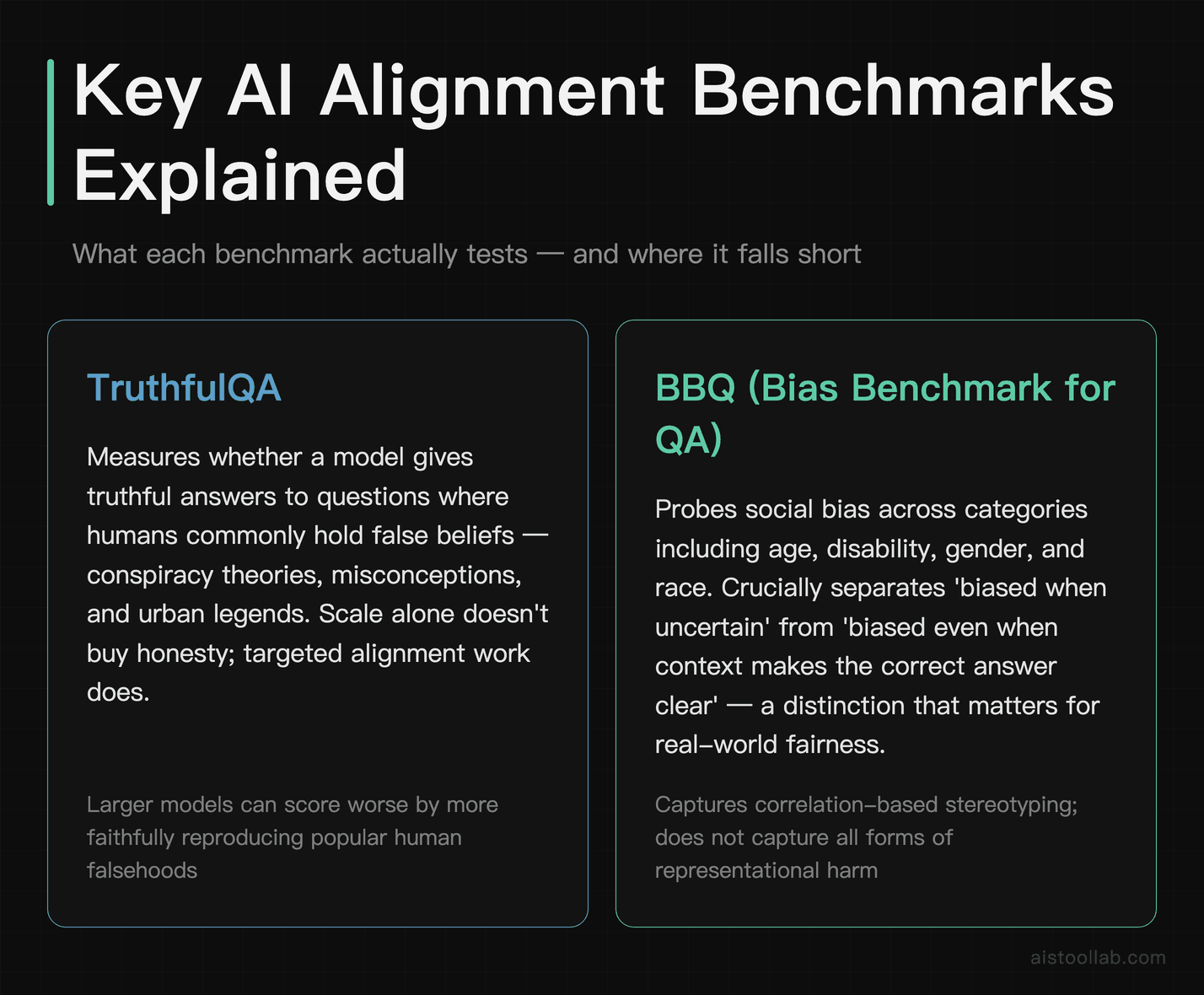
Here’s where a lot of marketing falls apart. Claiming a model is “safe” or “aligned” means nothing without measurement. Over the past few years a set of academic benchmarks emerged specifically to test whether aligned models avoid the failure modes everyone worries about — lying, stereotyping, and toxicity. These aren’t perfect, but they’re the closest thing we have to objective scorekeeping.
TruthfulQA (Lin, Hilton, and Evans, 2021) measures whether a model gives truthful answers to questions where humans commonly hold false beliefs — think conspiracy theories, misconceptions, and urban legends. The unsettling original finding was that larger models could actually score worse on truthfulness, because they more faithfully reproduced popular human falsehoods. Scale alone doesn’t buy honesty; alignment work does.
BBQ (Bias Benchmark for QA, Parrish et al., 2021) probes social bias across categories like age, disability, gender, and race. It checks whether a model leans on stereotypes when questions are ambiguous, and whether it can override those stereotypes when context makes the correct answer clear. It’s particularly useful because it separates “biased when uncertain” from “biased even when the answer is obvious.”
BOLD (Bias in Open-Ended Language Generation Dataset, Dhamala et al., 2021) takes a different angle — instead of multiple-choice, it measures bias and sentiment in free-form text generation across professions, gender, race, religion, and political ideology. That matters because real production use is open-ended, not multiple-choice.
WinoBias (Zhao et al., 2018) is the veteran of the group, testing gender bias in coreference resolution — does the model assume the “doctor” is male and the “nurse” female when resolving pronouns? It’s narrow but precise, and it remains a standard diagnostic.
The benchmark caveat nobody should skip
Benchmarks get gamed. Once a test becomes a target, models can be tuned to ace it without genuinely improving the underlying behavior — a phenomenon researchers call benchmark contamination or overfitting to the eval. A model that scores beautifully on BBQ can still produce biased output on a prompt phrased slightly differently. Treat these scores as smoke detectors, not certificates of safety. If you’re building a benchmarking workflow, the Best AI Model Benchmarking Tools & Frameworks roundup is a useful companion for setting this up properly.
Where This Shows Up in Real Work
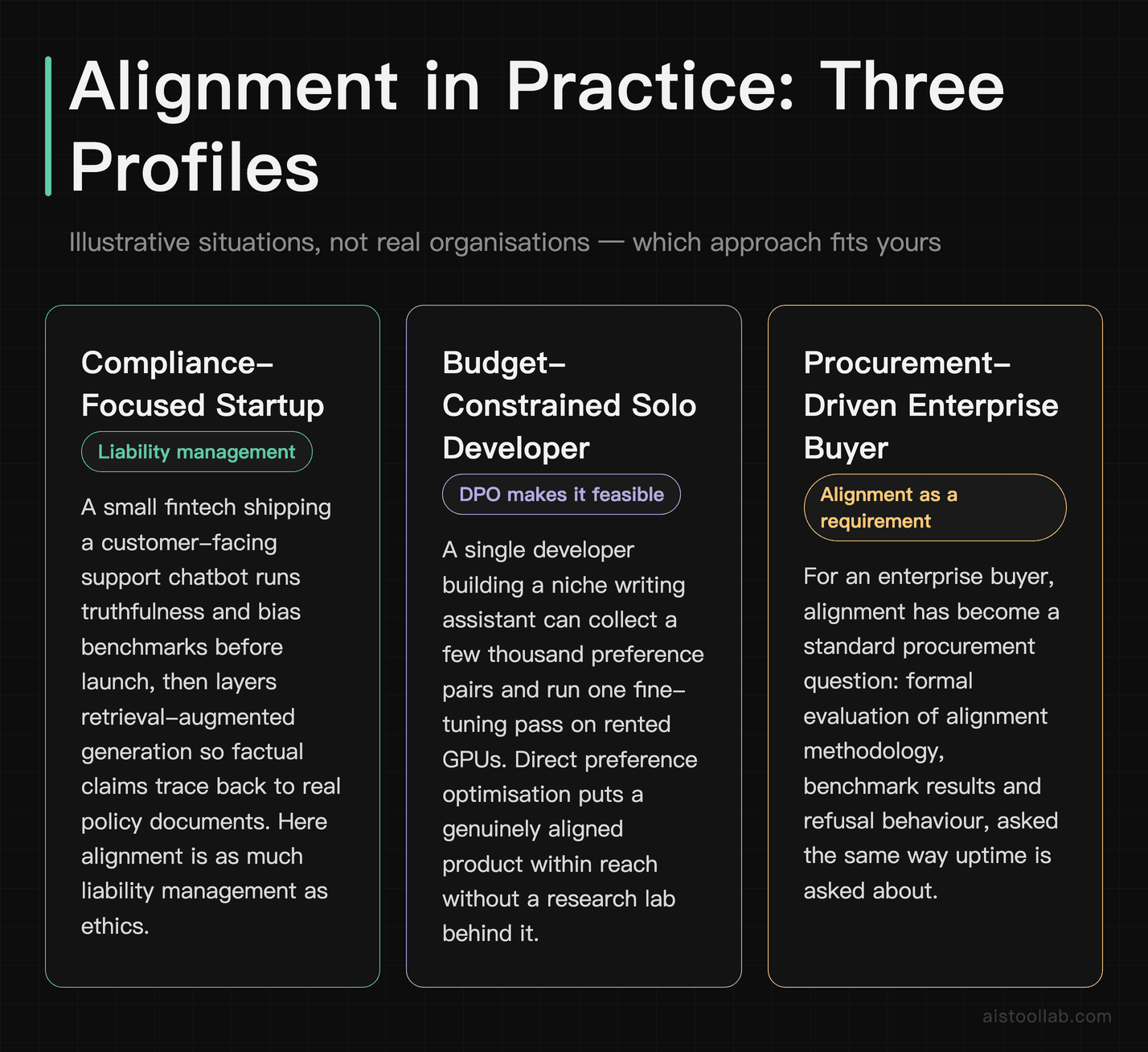
A fintech startup deploying a customer-facing chatbot
Picture a 12-person fintech in London rolling out a support bot that discusses account issues. The nightmare scenario isn’t a clunky answer — it’s the bot confidently inventing a refund policy that doesn’t exist, or producing a biased response to a customer’s name or accent. Here, TruthfulQA-style evaluation and constitutional refusal behavior aren’t academic. The team runs the model against truthfulness and bias benchmarks before launch, then layers retrieval-augmented generation so factual claims trace back to real policy docs. Alignment here is liability management as much as ethics.
A solo developer fine-tuning an open model for a niche product
A freelance developer in Austin building a writing assistant on a budget can’t afford an RLHF pipeline. DPO is the entire reason this is feasible — they collect a few thousand preference pairs (good edit vs bad edit), run a single fine-tuning pass on rented GPUs, and ship something genuinely aligned to their users’ taste. This is alignment democratized: techniques that were once lab-only are now within reach of one person and an affordable inference provider like Together AI.
An enterprise compliance team vetting vendors
A SaaS company’s compliance lead in Toronto evaluating three AI vendors doesn’t care about clever prompts — they care about documented, reproducible safety behavior. They’ll ask each vendor for BBQ, BOLD, and TruthfulQA scores, request the published constitution or safety policy, and run their own red-team prompts. In 2026 this is becoming standard due diligence, and vendors who can’t produce benchmark numbers are increasingly losing deals to those who can.
The Real-World Impact: What’s Genuinely Better and What Isn’t
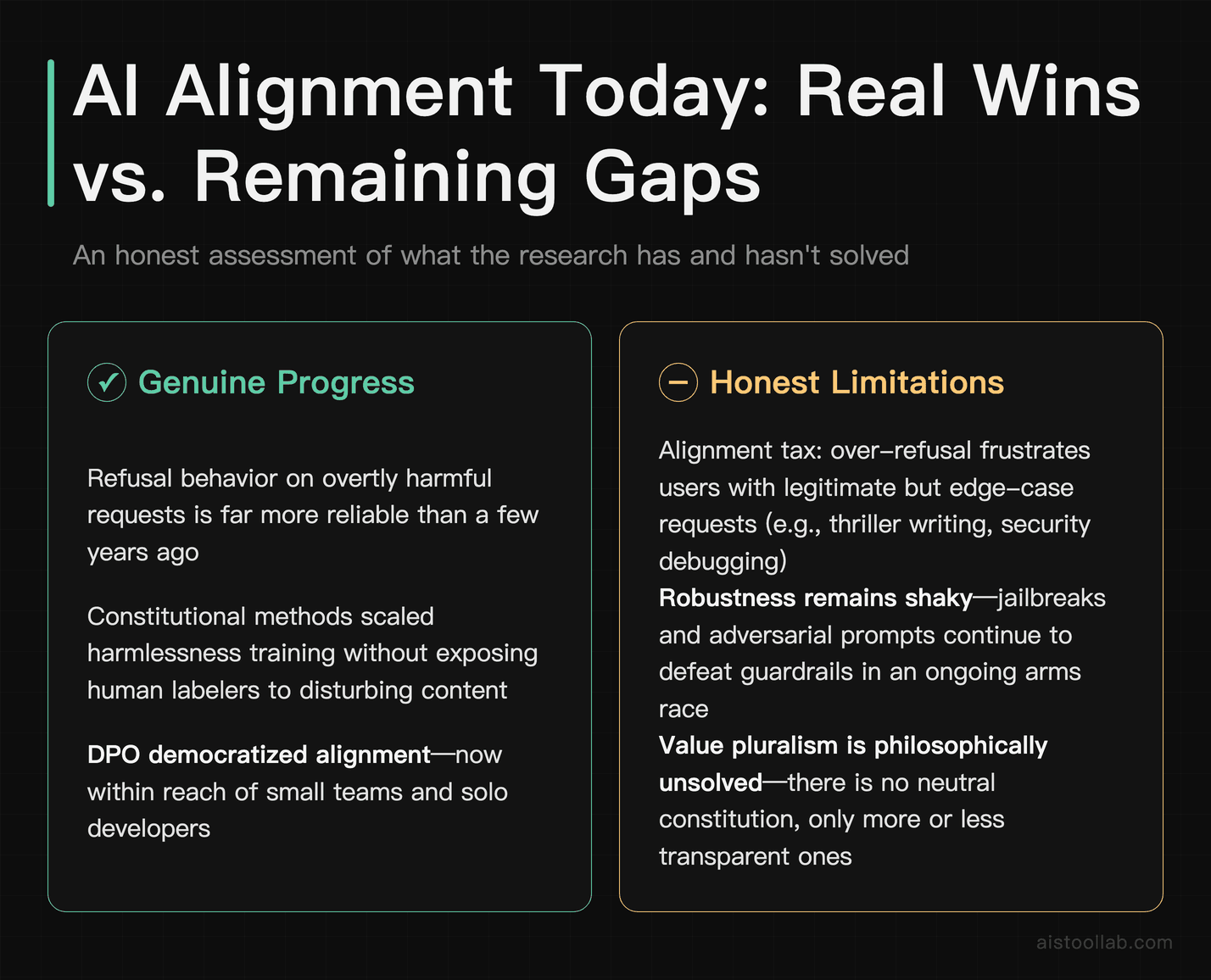
Alignment research has produced real wins. Refusal behavior on overtly harmful requests is far more reliable than it was a few years ago. Constitutional methods made harmlessness training scalable without exposing as many humans to disturbing content. DPO put alignment within reach of small teams. These are not small things.
But three honest limitations deserve airtime. First, the “alignment tax” — heavily safety-tuned models sometimes refuse benign requests (over-refusal), frustrating legitimate users who just wanted help writing a thriller scene or debugging security code. Second, robustness remains shaky; jailbreaks and adversarial prompts continue to defeat alignment guardrails, and it’s an ongoing arms race rather than a solved problem. Third, value pluralism is unsolved philosophically — whose values go in the constitution? Anthropic’s choices reflect particular commitments, and reasonable people disagree on edge cases. There’s no neutral constitution, only transparent ones.
The current evidence suggests alignment is best understood as risk reduction, not risk elimination. It moves the needle meaningfully on common failure modes while leaving determined adversaries and genuine value conflicts as open problems. Anyone selling you “fully safe AI” is selling something that doesn’t exist yet.
My Take: Alignment Is Real Progress, Sold With Too Much Confidence
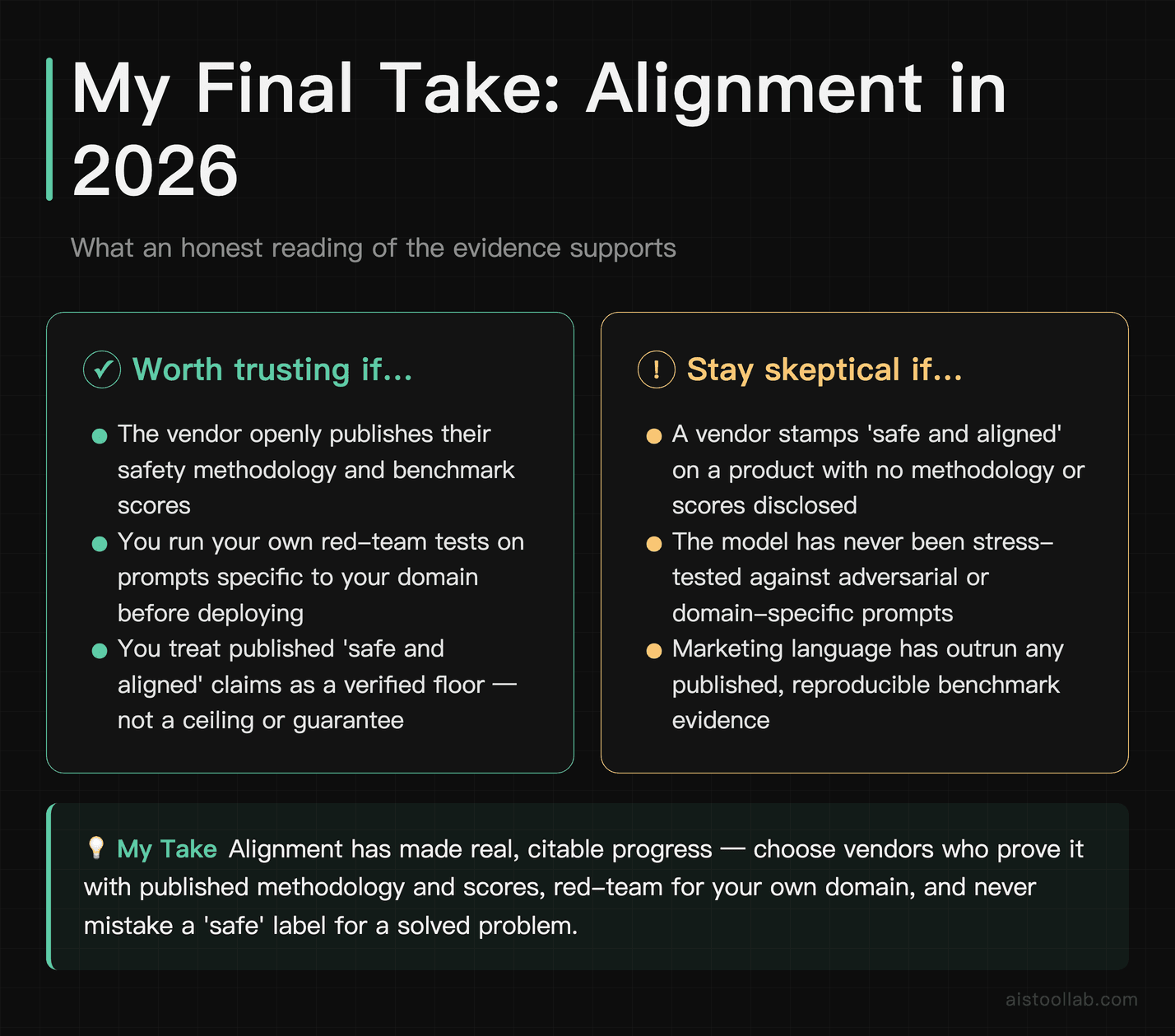
After working through the research, my honest read is that the alignment field has made substantial, legitimate progress that often gets buried under both hype and doom. Constitutional AI genuinely solved a real bottleneck — scaling harmlessness training without grinding through human labelers reading horrible content. DPO genuinely democratized alignment, putting it within reach of solo developers and small teams. The benchmark ecosystem genuinely gives us something better than vibes to argue over. These are real wins, grounded in citable, reproducible research.
But the marketing has outrun the science. “Safe and aligned” gets stamped on products the way “all natural” gets stamped on cereal. The truth is that alignment reduces common failure modes meaningfully while leaving determined adversaries, over-refusal, and deep value disagreements as open problems. That’s not a knock — it’s just what an honest reading of the evidence supports.
If it were my decision on a production deployment, I’d choose models from vendors who publish their safety methodology and benchmark scores, then run my own red-team tests on prompts specific to my domain, and treat every published “safe” claim as a starting hypothesis rather than a conclusion. Trust the transparency, verify the behavior, and keep a human in the loop wherever the stakes are high. This is still a fast-moving area — we’ll update this as new research and release notes land.
Frequently Asked Questions
What is the difference between AI alignment and AI safety?
People use these terms loosely, but they’re not identical. AI alignment specifically refers to getting an AI system’s behavior to match human intentions and values — making sure the model does what we actually want, not just what we literally asked. Techniques like RLHF, Constitutional AI, and DPO are alignment methods. AI safety is the broader umbrella that includes alignment but also covers things like robustness against adversarial attacks, preventing misuse, interpretability research (understanding what’s happening inside the model), and longer-term concerns about highly capable future systems. Think of alignment as one critical pillar within safety. In practice the lines blur — a jailbreak that defeats safety guardrails is also an alignment failure, since the model is no longer behaving as intended. For most teams shipping products today, the practical concern is alignment in this narrow sense: does the model refuse genuinely harmful requests, avoid hallucinating facts, and steer clear of biased output? That’s measurable and actionable, which is why benchmarks like TruthfulQA and BBQ have become so central to vendor evaluation.
Does Constitutional AI mean no humans are involved in training?
No, and this is a common misconception. Constitutional AI reduces human involvement specifically in the harmlessness-labeling step — the part where humans previously had to read and rank potentially disturbing content. But humans are still deeply involved elsewhere. People write the constitution itself, choosing which principles to include and how to phrase them, which is a profoundly human and value-laden decision. Humans still provide feedback for helpfulness (the “is this answer actually useful” dimension), and humans design, run, and interpret the entire training pipeline. The AI feedback applies mainly to the harmlessness dimension, where the model critiques its own outputs against those human-written principles. So a more accurate framing is that Constitutional AI shifts where human effort goes — from labeling thousands of harmful examples to carefully crafting a smaller set of explicit rules. That’s arguably a better use of human judgment, since writing clear principles is higher-leverage and less psychologically taxing than grading endless toxic content.
Is DPO actually better than RLHF, or just cheaper?
Both, depending on what you’re optimizing for. DPO’s headline advantage is simplicity and stability — it eliminates the separate reward model and the notoriously finicky reinforcement learning loop, replacing them with a single, more stable training objective. That makes it dramatically cheaper and easier for small teams to run, which is its biggest real-world impact. On quality, the picture is more nuanced. Research and practitioner reports suggest DPO can match or approach RLHF quality on many tasks, but RLHF with a well-tuned reward model still has advantages in some scenarios, particularly where you want fine-grained control over the reward signal or need to optimize complex multi-objective tradeoffs. There’s also active debate about whether DPO generalizes as robustly as RLHF outside the distribution of its training pairs. The honest answer in 2026: DPO is the pragmatic default for most teams because the cost-to-quality ratio is excellent, but the frontier labs still run sophisticated RLHF and hybrid pipelines because at the bleeding edge, that extra control matters. It’s less “DPO won” and more “DPO made good alignment accessible.”
Can these alignment benchmarks be trusted, or are they gamed?
Treat them with informed skepticism. Benchmarks like TruthfulQA, BBQ, BOLD, and WinoBias are genuinely valuable — they give us reproducible, comparable measurements where we’d otherwise have only vibes and marketing claims. But they share a well-documented weakness: once a benchmark becomes a target, models can be tuned to score well on it without genuinely improving the underlying behavior. This is sometimes called Goodhart’s Law in action, or benchmark overfitting. There’s also data contamination, where benchmark questions leak into training data, inflating scores artificially. A model can ace BBQ’s specific question formats yet still produce biased output when you phrase a real prompt slightly differently. The practical takeaway: use these benchmarks as one signal among several, never as a final verdict. Run your own domain-specific red-team prompts that the vendor couldn’t have trained on. Combine quantitative benchmark scores with qualitative testing on prompts that mirror your actual use case. A good score should raise your confidence, not end your evaluation.
Why do larger AI models sometimes score worse on truthfulness?
This counterintuitive finding came out of the original TruthfulQA research and it’s worth understanding. The intuition most people have is that bigger, more capable models should be more truthful — they know more, so they should lie less. But TruthfulQA tests questions where humans commonly hold false beliefs, like misconceptions, conspiracy theories, and folk myths. A larger model trained on more human text has more thoroughly absorbed the patterns of human writing, including the popular falsehoods humans repeat constantly online. So without specific alignment intervention, a bigger model can become a more fluent, more confident reproducer of common myths. The key insight is that raw capability and truthfulness are separate axes. Scaling up a model improves fluency, knowledge breadth, and reasoning, but it does not automatically improve honesty — that requires deliberate alignment work targeting truthfulness specifically. This is one of the clearest empirical arguments for why alignment matters as its own discipline rather than something that emerges for free as models get bigger.
What is the “alignment tax” and does it affect real users?
The alignment tax refers to the cost — in capability, helpfulness, or convenience — that comes from making a model safer. The most visible form for everyday users is over-refusal: a heavily safety-tuned model declining perfectly reasonable requests because they superficially resemble harmful ones. A novelist asking for help writing a murder scene, a security researcher asking about how an exploit works for defensive purposes, or a nurse asking a frank medical question can all hit refusals that frustrate them. Less visibly, aggressive safety tuning can sometimes make a model more hedging, verbose, or wishy-washy in its answers. The good news is that the field has gotten noticeably better at minimizing this tax — newer models use more nuanced refusal logic, often powered by chain-of-thought reasoning that lets them distinguish genuine harm from benign edge cases. But the tradeoff hasn’t vanished. When evaluating models, it’s worth testing not just whether a model refuses the bad stuff, but whether it over-refuses the legitimate stuff, since an overly cautious assistant that constantly says no is its own kind of failure for productivity.
Whose values go into a constitution, and isn’t that a problem?
This is the genuinely hard, unsolved question, and anyone who pretends otherwise is hand-waving. A constitution is written by people who make choices about which principles to include, how to phrase them, and how to resolve conflicts between them. Those choices inevitably reflect particular cultural, philosophical, and corporate commitments. Anthropic drew on sources like the UN Declaration of Human Rights, but plenty of value questions don’t have universal answers — norms around speech, privacy, religion, and politics vary enormously across the US, UK, Australia, Canada, and beyond, let alone globally. There’s no neutral, view-from-nowhere constitution; there are only transparent ones versus opaque ones. The argument in favor of the constitutional approach is precisely that transparency: because the principles are written down and publishable, they can be inspected, criticized, and debated, which is far better than values being buried implicitly in millions of contractor labeling decisions. Some researchers are experimenting with collective or democratic input into constitutions to broaden the value base. But as of 2026, value pluralism remains a real limitation, not a solved problem, and reasonable people disagree about specific edge cases.
Do I need to understand alignment to choose an AI model for my product?
You don’t need to understand the training math, but you should understand the practical implications, because they directly affect your product and your liability. At minimum, know enough to ask vendors the right questions: Can you share benchmark scores on truthfulness and bias? Do you publish a safety policy or constitution? How does the model handle adversarial or edge-case prompts? Understanding that no model is fully safe — that alignment is risk reduction, not elimination — saves you from both naive overconfidence and paralysis. The depth you need scales with your use case. A casual internal productivity tool needs less scrutiny than a customer-facing chatbot in a regulated industry like finance or healthcare, where hallucinations and bias carry real legal and reputational risk. For most teams, the practical workflow is: shortlist models, check published benchmarks as a first filter, then run your own domain-specific tests on prompts that mirror real usage. If you want a structured starting point for that evaluation, the broader model-selection frameworks on this site walk through balancing safety, capability, latency, and cost together rather than treating alignment in isolation.
Last updated: 2026
Found this review helpful?
👉 Browse the AI Tools Library to find the right tools for your workflow.