
The “It’s Just ChatGPT With a Costume” Myth
Here’s an assumption I see constantly in Reddit threads and Hacker News comments whenever a niche, persona-driven AI bot starts trending: “It’s just a general-purpose LLM with a system prompt slapped on top.” Sometimes that’s true. Often it isn’t. And with the surge of search interest around the Pleasure Lab AI Bot heading into 2026, that lazy shortcut is worth challenging — because the difference between a thin wrapper and a genuinely specialized system shows up the moment you use one at scale.
Let me be upfront about something, because integrity matters more than hype: detailed, officially published architecture documentation for the Pleasure Lab AI Bot specifically is not broadly available the way it is for, say, an open-source model on GitHub. So rather than invent spec sheets I can’t verify, this breakdown does two honest things. It explains how specialized conversational AI bots in this category actually differ from general-purpose LLMs at an architectural level — using well-established, verifiable concepts — and it maps those mechanics onto the real reasons a tool like this attracts adoption and search interest.
If you came here expecting a confident recitation of “it runs on a 47-billion-parameter custom transformer,” you won’t get fabricated numbers from me. What you’ll get is a clear mental model of how these systems are built, where they genuinely outperform a raw chatbot, and how to judge whether one is worth your time. That’s the more useful article anyway.
Contents
What “Specialized AI Bot” Actually Means Architecturally
A general-purpose LLM — think the models behind the big assistants — is trained to be a generalist. It’s optimized to answer coding questions, summarize legal documents, write poetry, and explain photosynthesis with roughly equal competence. That breadth is the product. The trade-off is that a generalist model, out of the box, has no persistent personality, no domain memory, and safety guardrails tuned for the broadest possible audience.
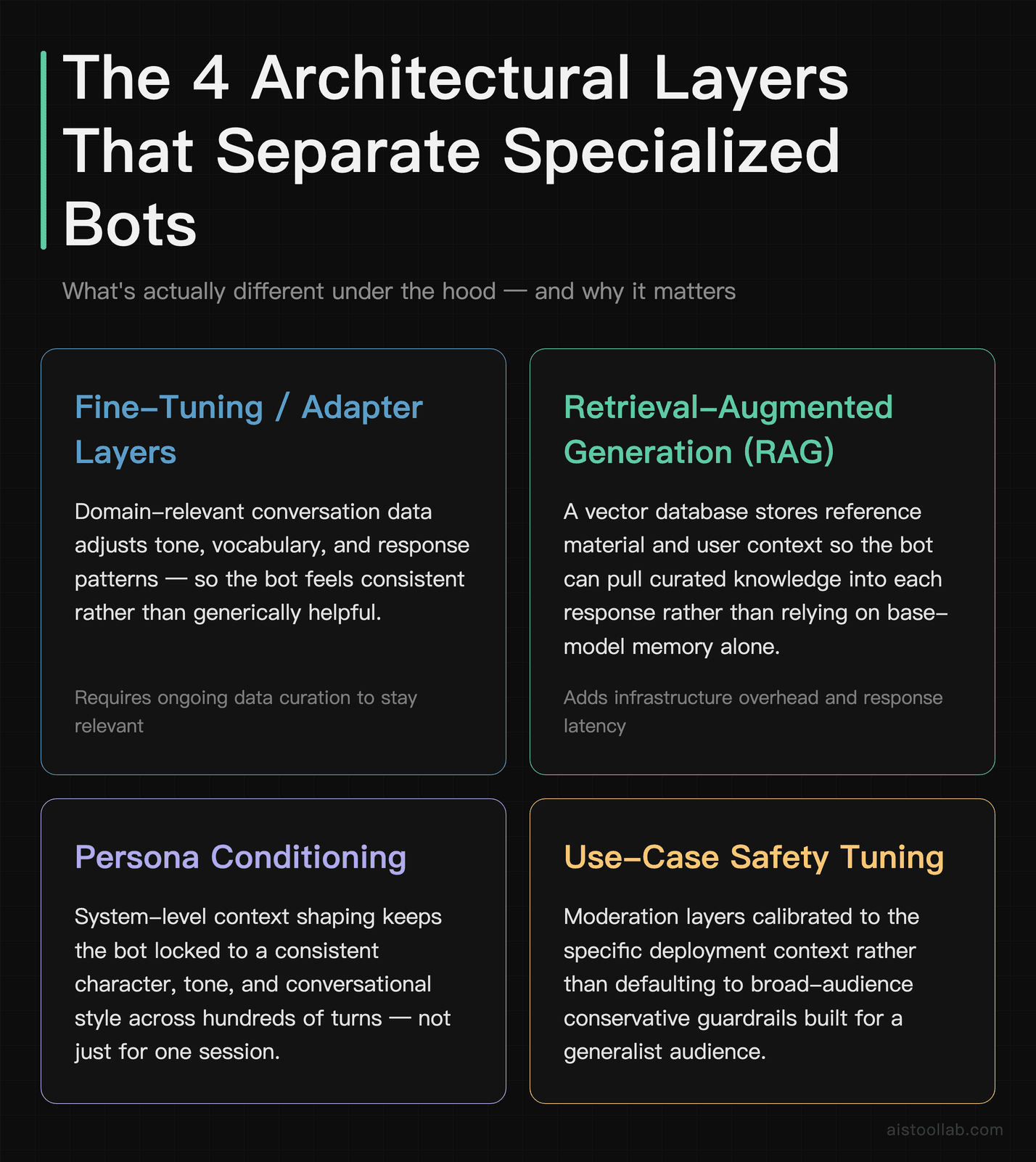
A specialized conversational bot like the Pleasure Lab AI Bot sits on top of, or alongside, that kind of foundation model but adds several engineering layers that change the experience materially. To my knowledge, the meaningful differences in this product category typically come down to four things, and none of them are exotic — they’re standard techniques applied deliberately:
- Fine-tuning or adapter layers — instead of relying purely on a generic base model, specialized bots are usually adjusted on domain-relevant conversation data so tone, vocabulary, and response patterns feel consistent rather than generic.
- Retrieval-augmented generation (RAG) — a vector database stores reference material, user context, or curated knowledge so the bot can pull in relevant information at query time instead of relying solely on what the base model memorized.
- Persistent memory and state — general LLM chat sessions are stateless by default. Persona-driven bots layer in conversation memory so the assistant “remembers” earlier exchanges within (and sometimes across) sessions.
- Custom safety and moderation policies — a category-specific bot needs guardrails tuned to its actual use case, not the conservative one-size-fits-all defaults of a general assistant.
That last point is where alignment work matters most, and it’s deeper than a content filter. I went into the mechanics of how modern systems learn boundaries in my Constitutional AI and AI Alignment Explained piece — the short version is that good guardrails are trained into the system’s behavior, not just bolted on as a blocklist. A specialized bot lives or dies on getting this layer right.
Why the Architecture Choice Drives Real Value
The reason any of this matters to an actual user is consistency and context. A general-purpose model is brilliant but forgetful and tonally inconsistent — ask it the same thing two different ways and you can get two different personalities. For a single coding question, that’s fine. For a sustained, ongoing conversational relationship with an AI — which is exactly what bots in this category are built for — inconsistency breaks the entire experience.
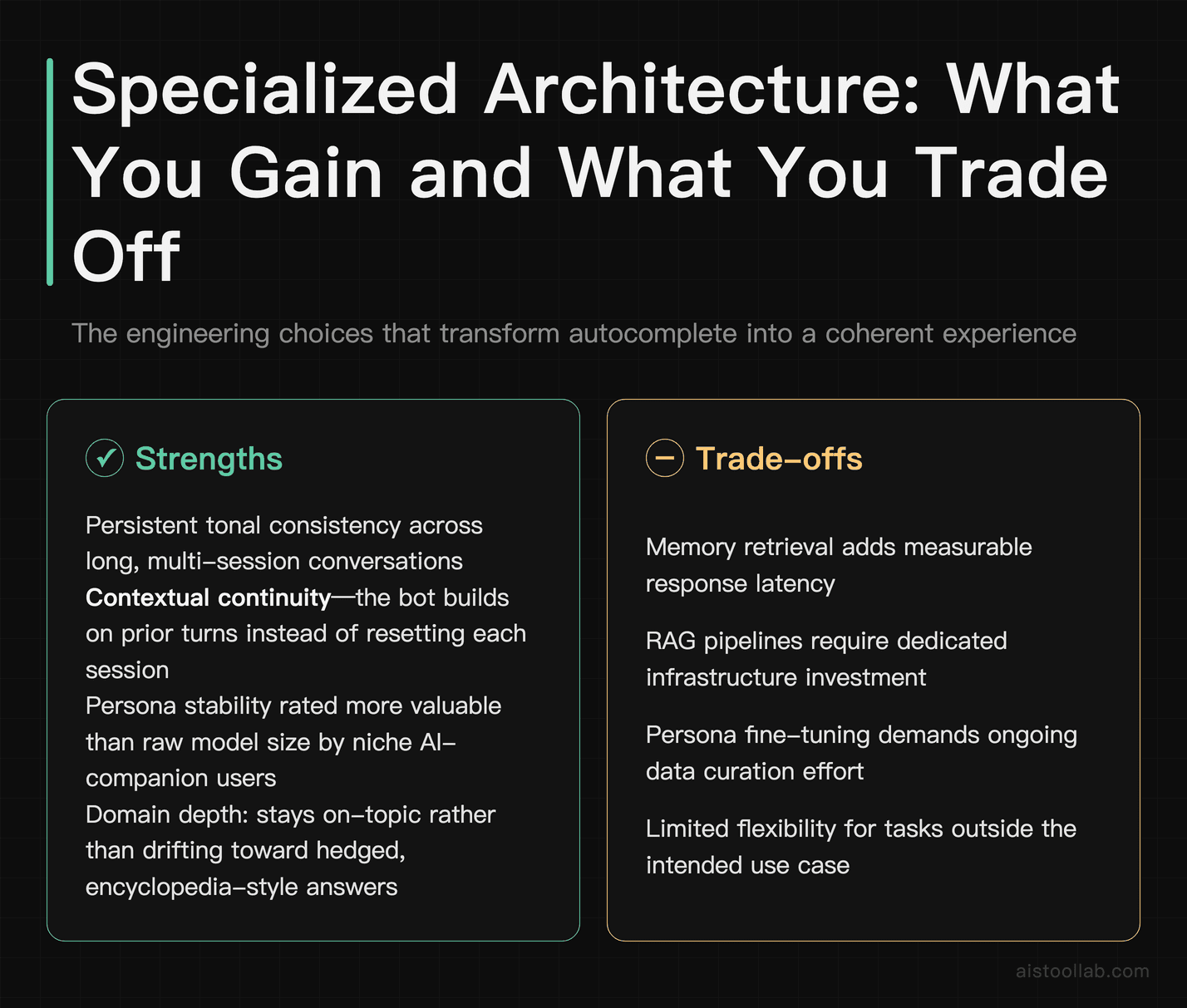
This is the core of why “it’s just a wrapper” misses the point. Yes, the underlying token prediction is similar. But the engineering around it — memory architecture, retrieval pipeline, persona conditioning, and safety tuning — is what transforms a clever autocomplete into something that feels coherent over hundreds of turns. Reviewer consensus across niche AI-companion communities consistently rates persistence and tonal stability as the features that separate a “good” bot from a frustrating one, far more than raw model size.
There’s a measurable engineering cost to this, too. Memory retrieval adds latency. RAG pipelines add infrastructure. Persona fine-tuning requires ongoing data curation. If you want to understand the trade-offs that go into serving these systems efficiently — latency versus throughput versus cost — that’s exactly the territory I mapped in the AI Model Performance Metrics 2026 Guide. The metrics that matter for a chatty, stateful bot are not the same ones that matter for batch document processing.
How a Specialized Bot Compares to the Alternatives
Here’s where the categories actually diverge. The comparison below is framed by approach rather than by unverifiable internal specs — because that’s the honest, decision-useful way to look at it. Think of it as “what you get from each strategy.”
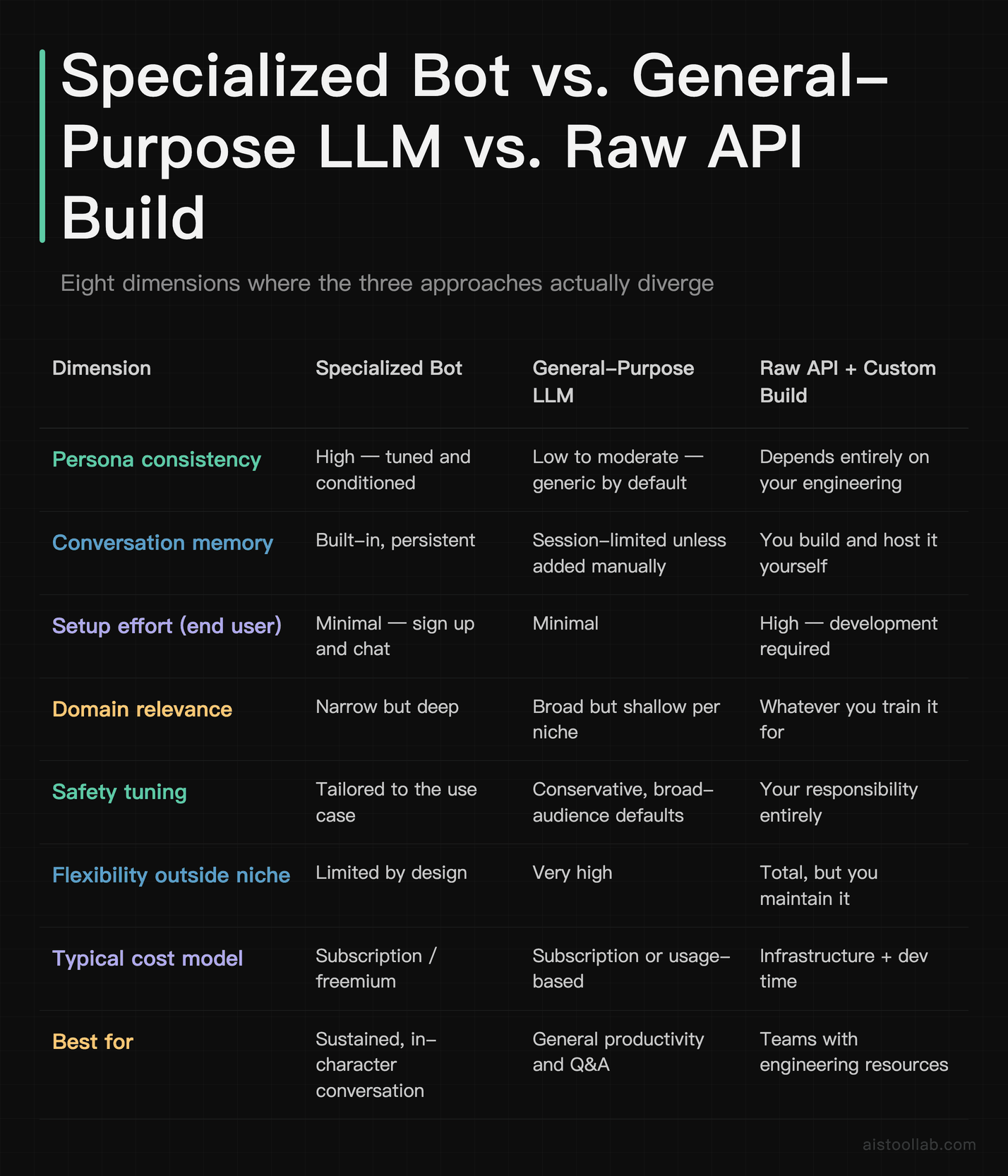
The pattern is clear: a specialized bot trades breadth for depth and convenience. If your need lives squarely inside its niche, that trade is a great deal. If you want one tool to also write your sales emails and debug Python, it isn’t — and you’d be better served by a general assistant or, if you have the team for it, a custom build on a raw API. I broke down where the strong general-purpose options land in my roundup of the 10 Essential AI Models Every Developer Should Know in 2026.
The Technical Features Driving 2026 Search Interest
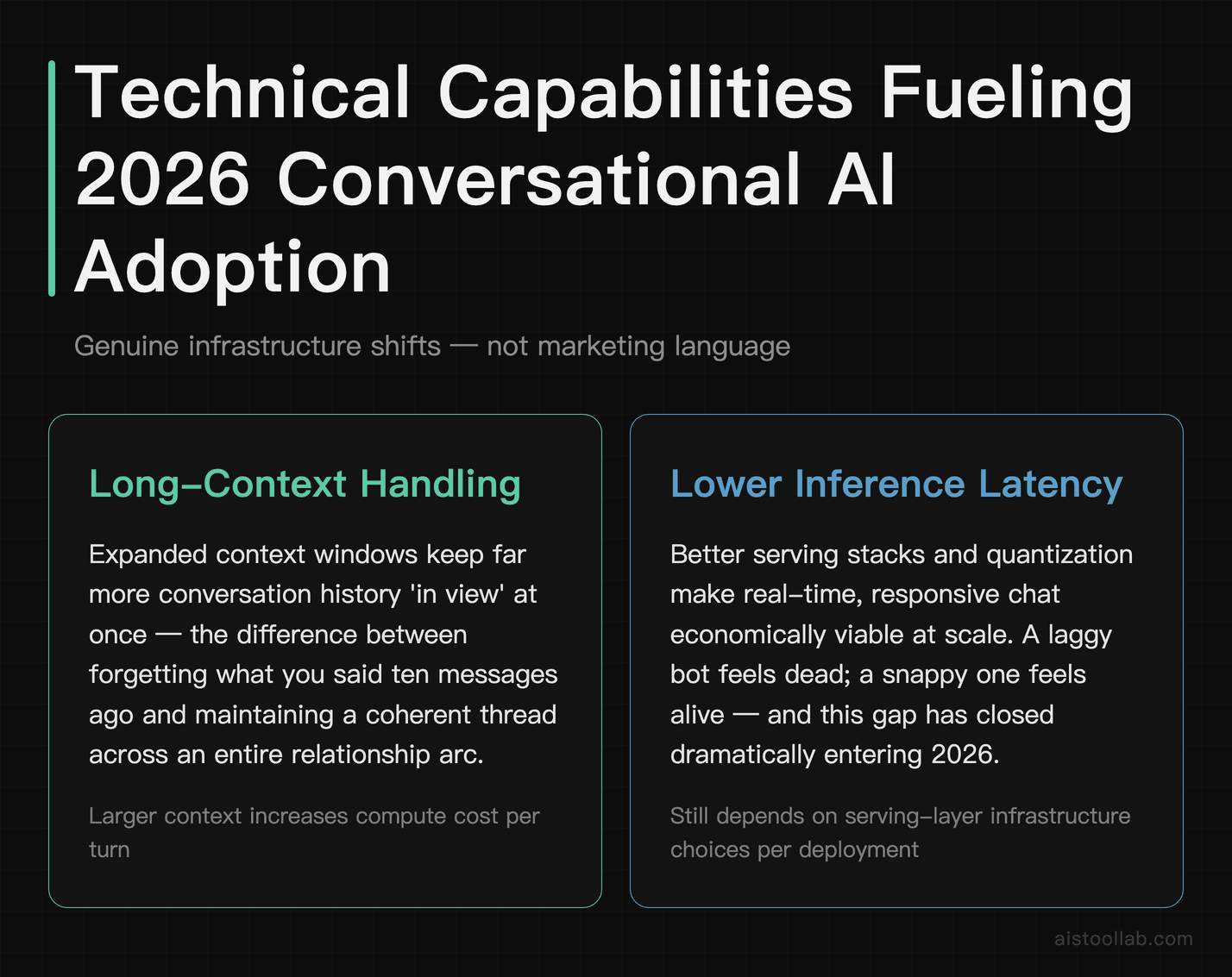
Search interest in tools like this has grown alongside a broader trend: AI products are moving from “ask a question, get an answer” toward ongoing, stateful, character-driven interaction. Several technical capabilities tend to drive that adoption curve, and they’re worth naming plainly.
Long-context handling
The jump in context window sizes across the industry over the past couple of years means a bot can keep far more of a conversation “in view” at once. For a persona-driven experience, that’s the difference between an assistant that forgets what you said ten messages ago and one that maintains a coherent thread. This is a genuine, industry-wide improvement, not marketing fluff — larger usable context is one of the most consequential shifts in deployed conversational AI.
Lower inference latency
Faster, cheaper inference — driven by better serving stacks and quantization — makes real-time, responsive chat economically viable at scale. A laggy bot feels dead; a snappy one feels alive. The serving-layer advances I covered in my AI Model Serving Platforms Compared 2026 writeup are a big part of why conversational products feel dramatically more responsive in 2026 than they did even a year or two ago.
Better personalization plumbing
Retrieval and memory systems have matured to the point where personalization is a configuration choice rather than a research project. That lowers the barrier for any specialized bot to feel tailored to the individual user — which is precisely the kind of stickiness that drives word-of-mouth growth.
Real-World Deployment Scenarios
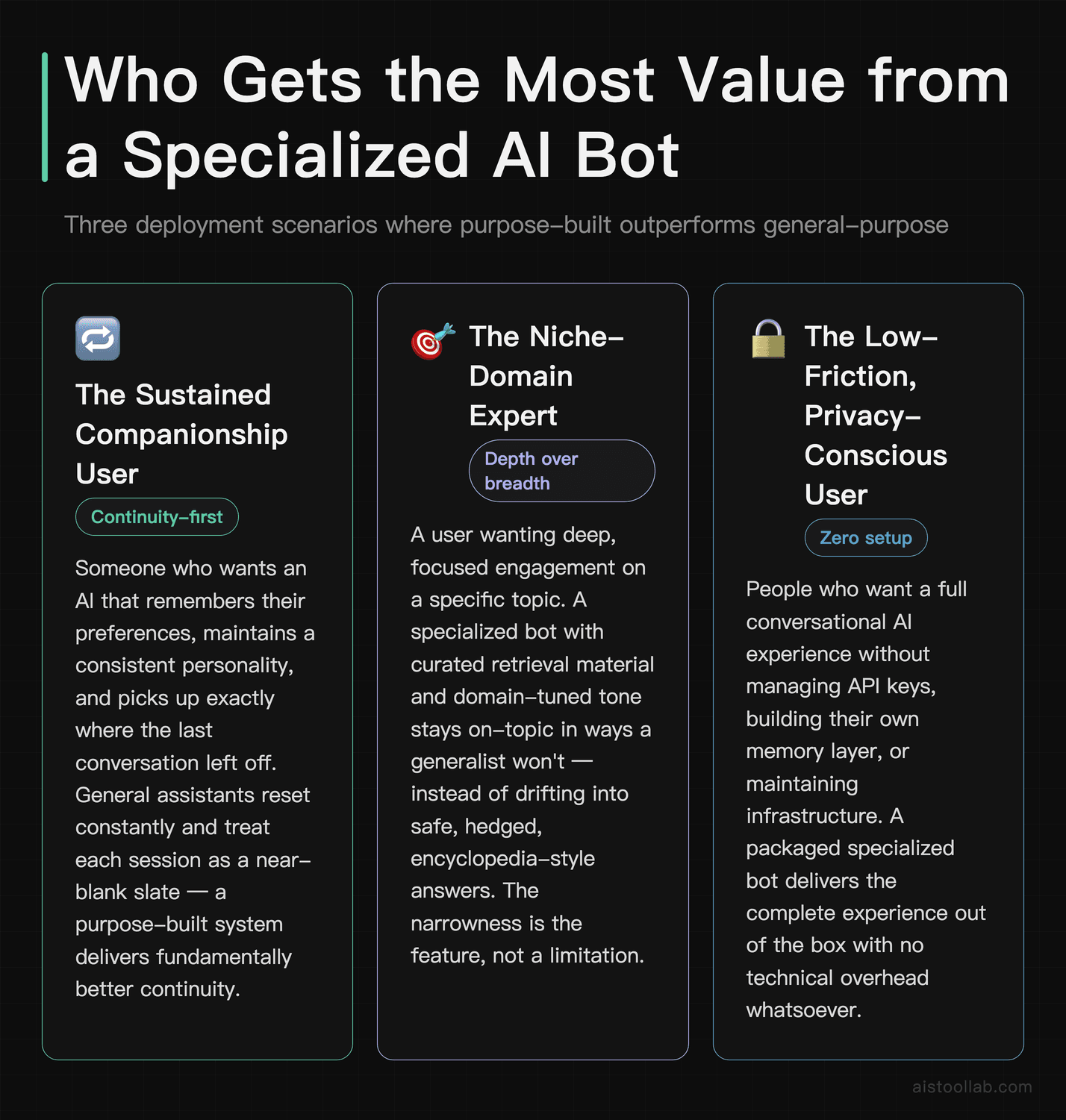
The sustained companionship use case
The clearest scenario where a specialized, memory-equipped bot outperforms a general assistant is any interaction that benefits from continuity. Someone who wants an AI that remembers their preferences, maintains a consistent personality, and picks up where the last conversation left off gets a fundamentally better experience from a purpose-built system. A general assistant, by contrast, resets its “personality” constantly and treats each session as a near-blank slate unless you manually feed it context every time.
The niche-domain expert
Consider a user who wants deep, focused engagement on a specific topic area. A specialized bot with curated retrieval material and domain-tuned tone will stay on-topic and relevant in ways a generalist won’t — the generalist keeps drifting toward safe, hedged, encyclopedia-style answers. The narrowness that looks like a limitation is actually the feature: by not trying to do everything, it does its one thing more convincingly.
The privacy-conscious, low-friction user
Plenty of people want a conversational AI experience without building anything, managing API keys, or wiring up their own memory layer. A packaged specialized bot delivers the whole stack — model, memory, persona, moderation — behind a sign-up form. For a solo user with no engineering background, that convenience is the entire value proposition, and it’s a scenario where a raw API simply isn’t an option.
Frequently Asked Questions
How is the Pleasure Lab AI Bot different from using ChatGPT directly?
The honest, architecture-level answer is that a general assistant like ChatGPT is optimized for breadth — it’s deliberately a generalist with conservative, broad-audience safety defaults and no persistent personality across sessions. A specialized bot in this category is engineered for a narrow, sustained use case: it typically layers persona conditioning, persistent conversation memory, and use-case-specific moderation on top of a foundation model. In practice that means more tonal consistency and continuity over long conversations, at the cost of flexibility outside its niche. If you ask a specialized bot to debug code or write a quarterly report, it’ll be far weaker than a generalist. If you want a coherent, ongoing, in-character interaction, the specialized system usually wins. Neither is “better” in the abstract — they’re tuned for different jobs. The “it’s just ChatGPT with a prompt” critique is only fair for the laziest wrappers; a genuinely engineered specialized bot involves memory architecture, retrieval, and safety tuning that a bare prompt can’t replicate.
Does it run on its own custom model or a third-party LLM?
I won’t pretend to verifiable inside knowledge here, because publicly confirmed architecture documentation for this specific product isn’t broadly available, and fabricating a spec sheet would do you a disservice. What I can tell you is how the category generally works: many specialized conversational bots are built on top of existing foundation models — whether open-source or accessed via API — with fine-tuning, adapter layers, retrieval pipelines, and custom moderation added around them. A smaller number train more substantial custom components. From a user’s perspective, the underlying base model matters less than the engineering around it: the memory system, the persona consistency, and the safety tuning are what you actually experience. If the architecture details matter to your decision, look for official documentation or a published technical post from the provider rather than relying on third-party guesses — including mine.
Is there a free version, and is the paid tier worth it?
Specialized AI bots in this category commonly use a freemium model: a free tier with usage limits or reduced features, and a paid subscription that unlocks longer memory, faster responses, or fewer restrictions. Whether the paid tier is worth it depends almost entirely on usage frequency. If you’re a casual user dipping in occasionally, the free tier usually suffices and there’s no reason to pay. If you use the bot daily and the memory and responsiveness limits on the free plan genuinely get in your way, the upgrade can be worth it — these subscriptions typically sit in a range comparable to other consumer AI subscriptions, roughly Netflix-tier monthly pricing. My honest advice: never subscribe on day one. Use the free tier hard for a week, hit the actual ceilings, and only then decide. You’ll know quickly whether the limitations are dealbreakers or non-issues for how you actually use it. Pricing varies and changes, so confirm current figures on the official site before paying.
How good is the conversation memory really?
Memory quality is the single biggest differentiator in this category, and it varies a lot between products. The underlying capability depends on context window size and the retrieval architecture: a bot with a large usable context and a well-built memory-retrieval system will maintain continuity across long conversations convincingly, while a weaker implementation will start contradicting itself or “forgetting” details after a while. Industry-wide, context windows and retrieval tooling have improved substantially over the past couple of years, which has raised the floor for everyone. That said, no current system has perfect, unlimited recall — there are always trade-offs between memory depth, latency, and cost. The practical test is simple: have a genuinely long conversation, reference something you mentioned much earlier, and see if it holds up. That single experiment tells you more about a bot’s memory than any spec claim, because it surfaces exactly where the retrieval system starts to fray.
What are the main limitations I should expect?
Three predictable ones. The narrowness is the first — a bot tuned for a specific conversational niche will be noticeably weaker at general tasks, and that’s by design, not a bug. The second is the inherent unpredictability of generative models: even well-tuned systems occasionally produce off-tone, repetitive, or inconsistent responses, because the underlying technology is probabilistic, not deterministic. The third is the memory ceiling — no matter how good the retrieval system is, there are practical limits to how much context can be maintained, and you may hit them in very long sessions, especially on a free tier. There are also the usual considerations any cloud AI service carries: review the provider’s privacy policy and data-handling practices, since conversational data is sensitive by nature. None of these are unique failings of any one product — they’re structural realities of the category. Going in with realistic expectations rather than marketing-fueled ones makes the experience far more satisfying.
Can I self-host or run something like this locally?
If you have the technical skills, building a comparable system yourself is genuinely possible — and increasingly accessible. You’d combine an open-source foundation model with a serving stack, a vector database for retrieval, a memory layer, and your own persona conditioning and moderation. The components are all available, and tooling has matured considerably. The catch is that you’re taking on real engineering and ongoing maintenance: infrastructure costs, latency tuning, safety design, and the work of keeping it all running. For a developer who enjoys that and wants full control over data and behavior, it’s a viable path and arguably the most private one. For everyone else, the packaged product exists precisely because assembling and maintaining this stack is non-trivial. The trade-off is the classic build-versus-buy question: total control and privacy versus convenience and zero maintenance. Most casual users land firmly on the “buy” side, and reasonably so.
How do I evaluate whether one bot is better than another?
Skip the spec-sheet marketing and test the things that actually shape the experience. Run a long conversation and check memory continuity. Probe tonal consistency by approaching the same topic from different angles and seeing whether the personality holds. Notice response latency, because a sluggish bot feels lifeless no matter how smart it is. Check how the safety guardrails behave — are they sensibly tuned to the use case, or clumsy and frustrating? Finally, weigh the free-tier limits against your real usage. These behavioral tests reveal far more than parameter counts or model names ever will. The broader framework for judging AI systems beyond surface-level benchmarks is something I dug into in my guide on AI Model Performance Metrics 2026 Guide — the same principle applies here: the metric that matters is the one tied to your actual use case, not the biggest number on a comparison chart.
Is this kind of specialized bot a passing trend or here to stay?
My read is that the broad category — specialized, persona-driven, memory-equipped conversational AI — is structurally here to stay, even though individual products will come and go. The shift from stateless Q&A toward sustained, stateful interaction is one of the clearest directional trends in deployed AI, and it’s enabled by genuine technical improvements: bigger usable context, cheaper and faster inference, and mature personalization tooling. Those forces aren’t reversing. What’s less certain is which specific products win, because this is a crowded, fast-moving space with low switching costs and uneven quality. So I’d treat any individual bot — including this one — as something to evaluate on its current merits rather than a long-term commitment. Use the free tier, judge it on the behavioral tests above, and stay flexible. The category has staying power; brand loyalty in it doesn’t need to.
My Take
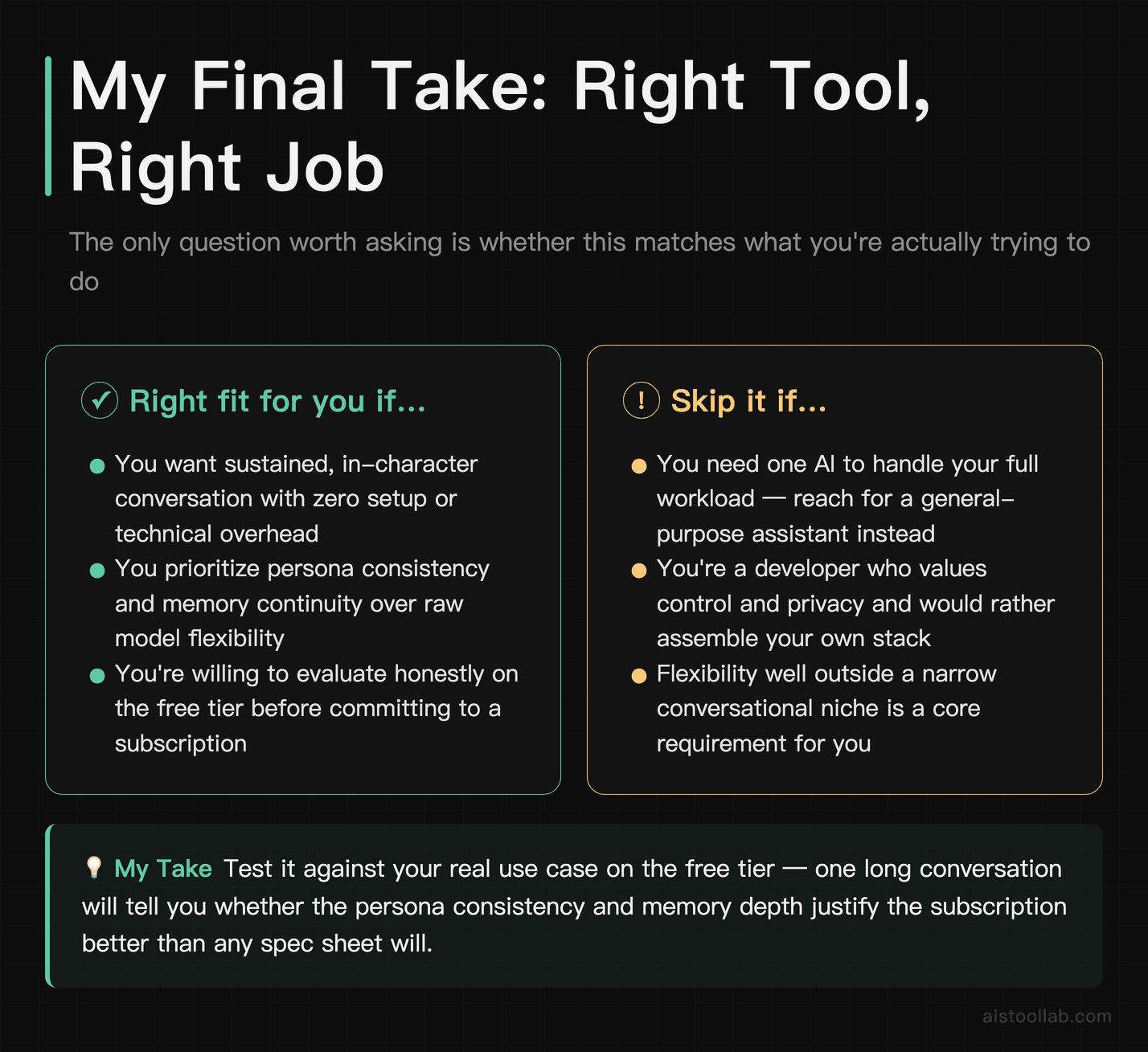
The “it’s just a wrapper” dismissal is the wrong lens. The interesting question isn’t whether the Pleasure Lab AI Bot uses a general-purpose model underneath — most things in this category do, and that’s fine. The interesting question is how well the engineering around the model is done: the memory system, the persona consistency, the retrieval pipeline, and the safety tuning. That’s where a forgettable bot and a genuinely good one diverge, and it’s where your evaluation effort should go.
If you’re a casual user who wants sustained, in-character conversation with zero setup, a packaged specialized bot like this is the right tool — just judge it on the free tier first and confirm current pricing before paying. If you’re a developer who values control and privacy and enjoys the build, assembling your own stack is more achievable than ever. And if you need one AI to handle your whole workload, this isn’t it — reach for a general-purpose assistant instead. There’s no universal winner here; there’s only the right tool for what you’re actually trying to do. Test it against the behavioral checklist above, and you’ll know within a single long conversation whether it earns a spot in your routine.
Last updated: 2026
Found this review helpful?
👉 Browse the AI Tools Library to find the right tools for your workflow.