Who this is for: you have decided what to measure and need to choose where to run it. The sections are organised by need rather than by league-table position.
What comes before and after this decision:
- Which benchmark suites still discriminate — choosing the exam before choosing the platform
- Building your own evaluation — when none of the platforms fit your task
- The Hugging Face Model Hub route — the hands-on path for open-weights models
The Leaderboard You’re Trusting Probably Doesn’t Measure What You Think It Does
Here’s an uncomfortable truth that anyone who’s spent time staring at AI model rankings eventually bumps into: two reputable benchmarking tools can look at the same model and put it in completely different positions. One framework crowns it the top open model of the quarter. Another buries it in the middle of the pack. Neither is “wrong” — they’re just measuring different things, often in ways the marketing screenshots conveniently leave out.
That matters more than ever in 2026, because the cost of picking the wrong model isn’t academic. If you’re a startup founder routing customer support through an LLM, or a developer deciding which open-weights model to self-host, a leaderboard that doesn’t correlate with your actual workload can send you down a very expensive path. You optimize for a number, ship to production, and discover the model that “won” on a reasoning benchmark falls apart on your messy real-world inputs.
So instead of asking “which model is best?” — a question every other article answers — this ranking asks a different one: which benchmarking tool or framework should you actually trust, and for what? I’ve compiled the comparison from official documentation, published methodology papers, and the running consensus across Reddit’s r/LocalLLaMA, Hacker News, and ML practitioner threads. No personal lab results — just a clear-eyed read of what the evidence says.
How each platform was assessed (the criteria matter more than the order)

Ranking benchmarking tools is a bit like ranking measuring tapes — the “best” one depends on what you’re measuring. To keep this honest, I scored each framework across six dimensions that map to how teams actually use them.
Usability covers how quickly a non-specialist can get a meaningful result — does it require a cluster and a config file, or a browser tab? Accuracy and reproducibility asks whether running the same eval twice gives you the same number, and whether the methodology is documented enough to trust. Real-world correlation is the big one: does a high score predict the model will actually perform on production tasks, or is it measuring test-taking ability? Coverage looks at breadth — single capability or holistic. Transparency rewards open methodology, public data, and contamination controls. And cost factors in whether you need expensive compute or it’s free to read.
One caveat worth stating up front, which I’ve dug into more in my Production vs Synthetic: Why AI Model Benchmark Metrics Don’t Predict Real-World Performance piece: no public leaderboard correlates perfectly with your specific use case. The best you can do is pick the tool whose methodology is closest to your reality, then validate on your own data.
The seven platforms at a glance
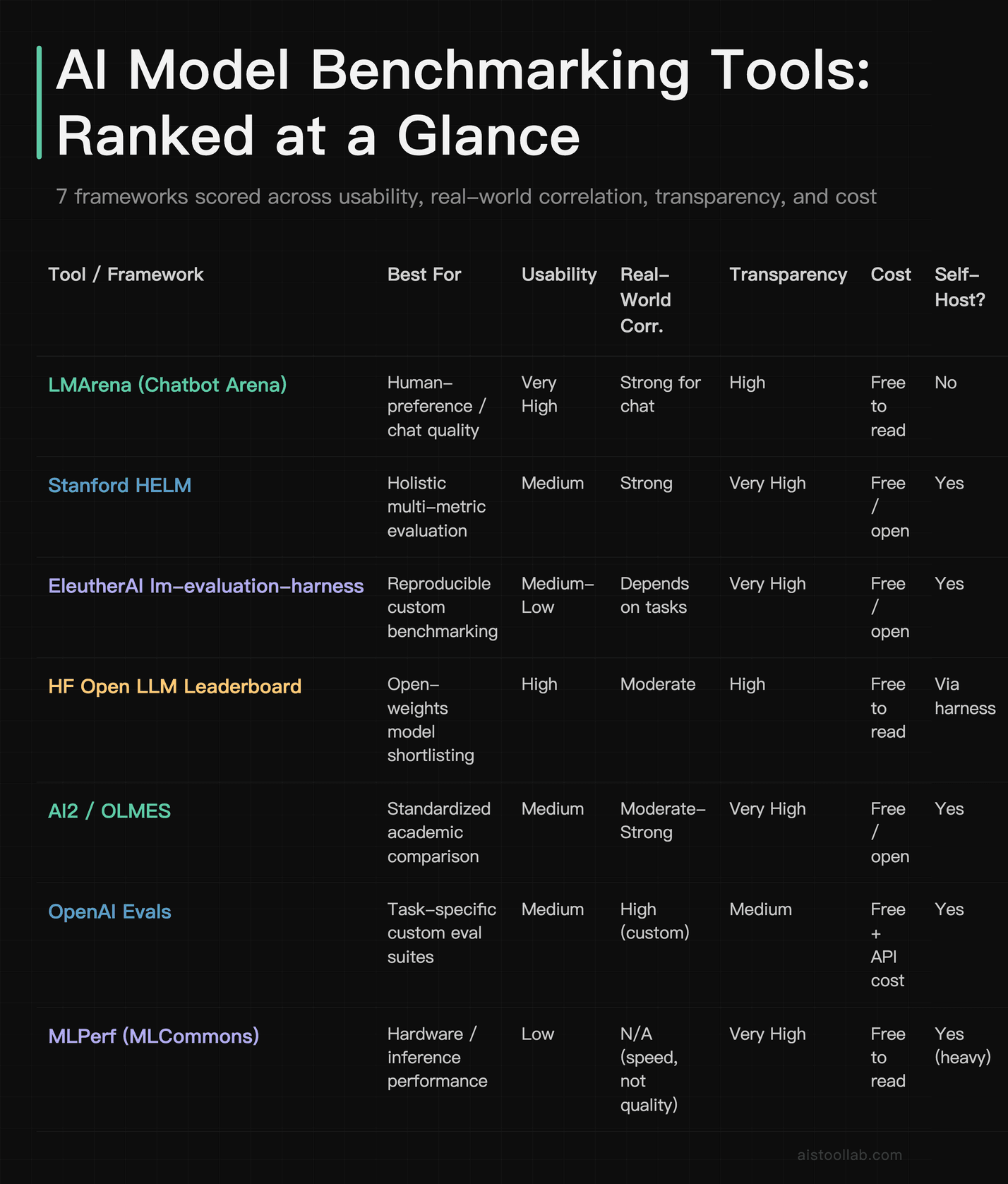
A quick note on that table: MLPerf sits at the bottom not because it’s bad — it’s exceptional — but because it answers a fundamentally different question. More on that below.
Need: what humans actually prefer in a chat product → LMArena
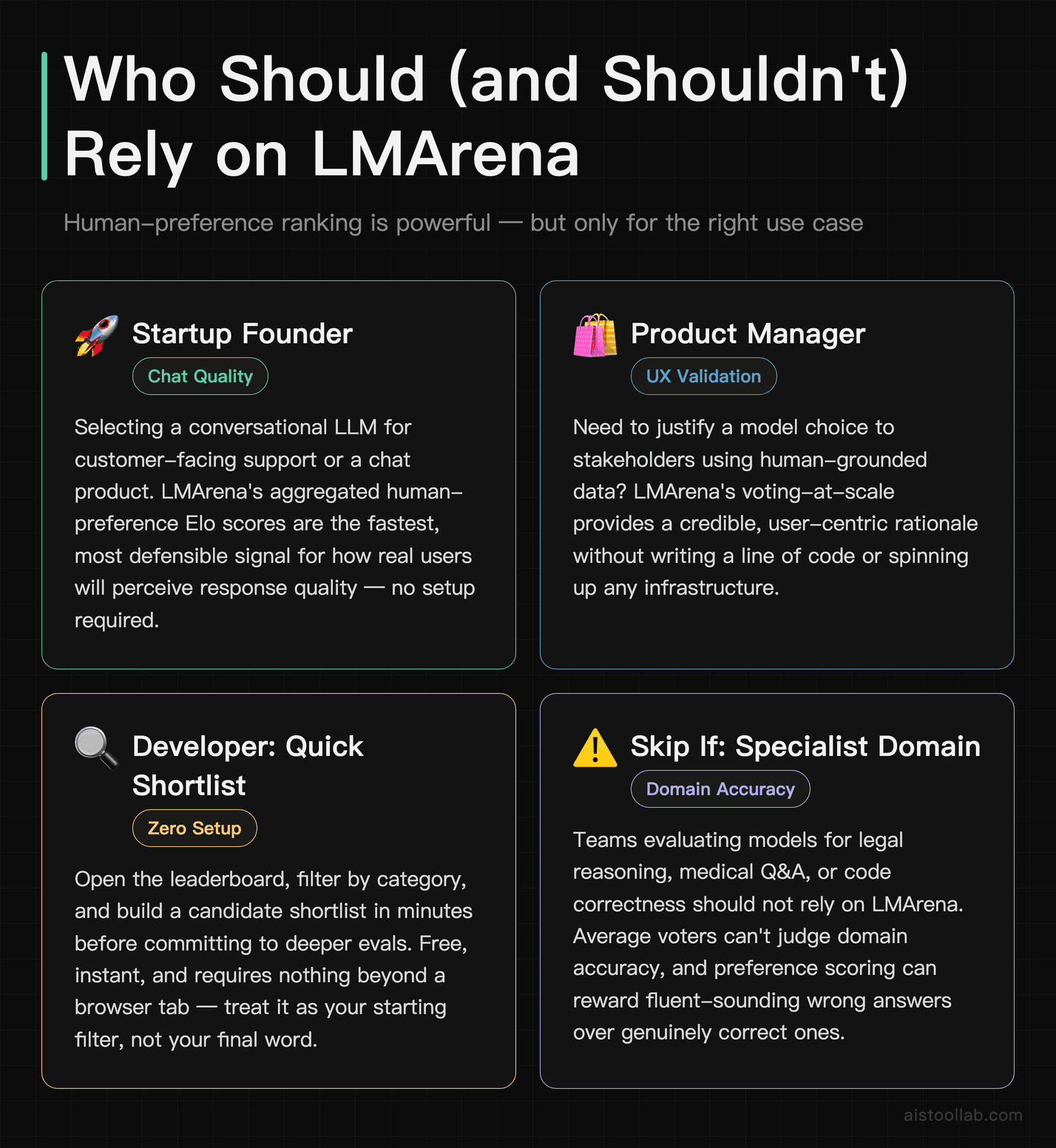
If you only check one leaderboard before picking a chat-facing model, the LMSYS-originated Chatbot Arena — now operating as LMArena — is the most defensible choice. Its approach is refreshingly direct: real people are shown two anonymous model responses to the same prompt, pick the better one, and those votes feed an Elo-style rating system borrowed from chess. No multiple-choice trivia, no contamination-prone static test set — just aggregated human preference at scale.
Why it tops the usability ranking: you don’t run anything. You open the page, read the ranking, done — all before your coffee cools. And because it measures preference on open-ended prompts, it tends to correlate with the “does this feel good to use?” quality that drives actual product satisfaction.
The honest limitations: preference voting can reward responses that look authoritative or are pleasantly formatted over ones that are strictly correct, and it’s weaker for specialized domains like legal reasoning or code correctness where the average voter can’t judge accuracy. It also can’t tell you anything about latency or cost. Treat it as your starting filter for conversational quality, not your final word.
Need: trade-offs spelled out rather than collapsed into one score → Stanford HELM
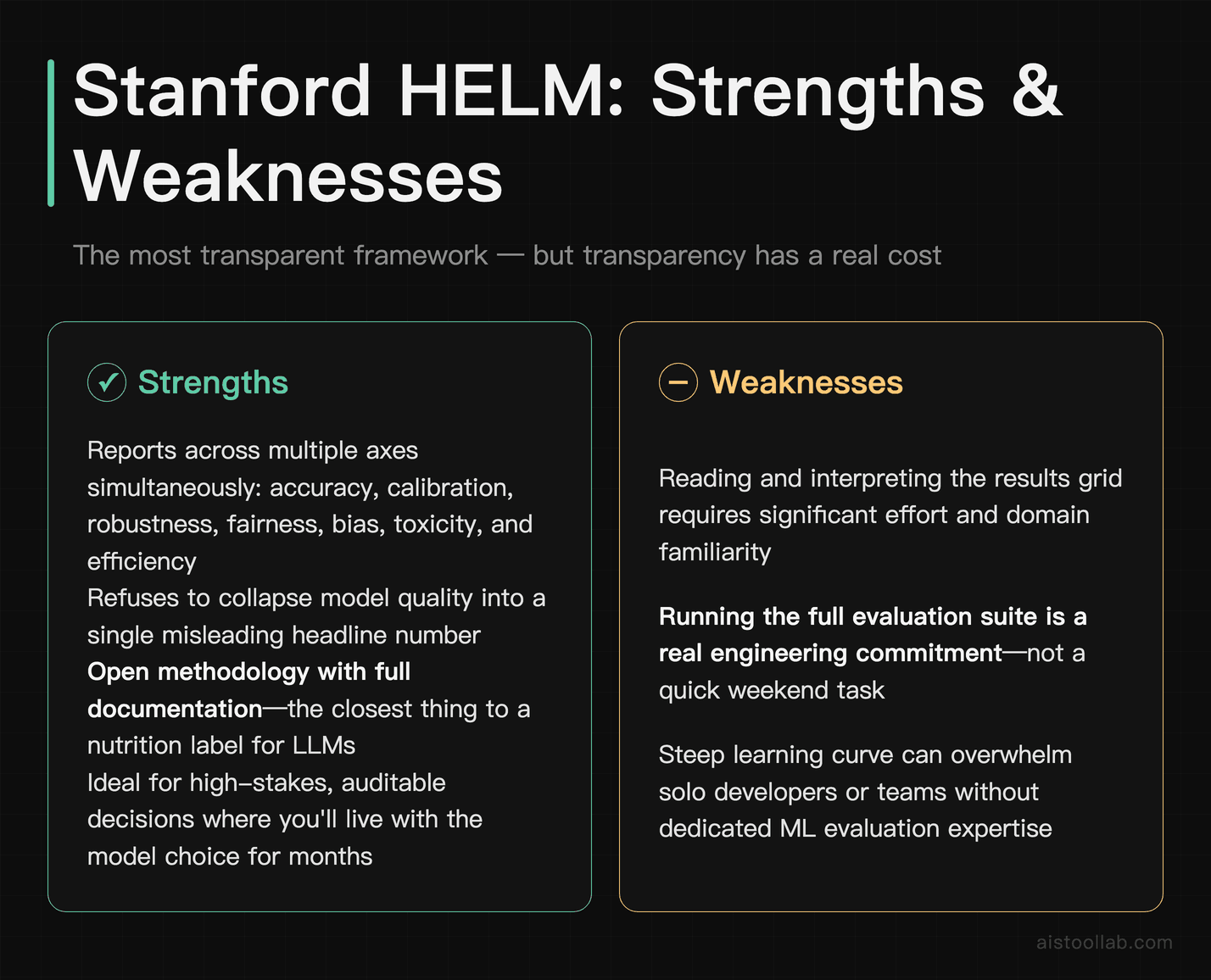
HELM, the Holistic Evaluation of Language Models project from Stanford’s Center for Research on Foundation Models, earns its high ranking by refusing to collapse a model into a single number. Its whole philosophy is that one score hides too much — so it reports across many scenarios and multiple metrics simultaneously: accuracy, calibration, robustness, fairness, bias, toxicity, and efficiency. You see not just whether a model is good, but where it trades one virtue for another.
That transparency is exactly why serious evaluators love it. When a vendor waves a single headline benchmark at you, HELM’s multi-axis view is the antidote — it forces the conversation about robustness and calibration that single-number leaderboards quietly skip.
The cost is usability. Reading a HELM results grid takes effort, and running the full suite yourself is a real engineering commitment. For a solo developer it can be overwhelming. But if you’re at a company making a strategic model decision — the kind you’ll live with for a year — the depth is worth the learning curve. It’s the closest thing the field has to a nutrition label for language models.
Need: reproducible plumbing you run yourself → EleutherAI’s lm-evaluation-harness
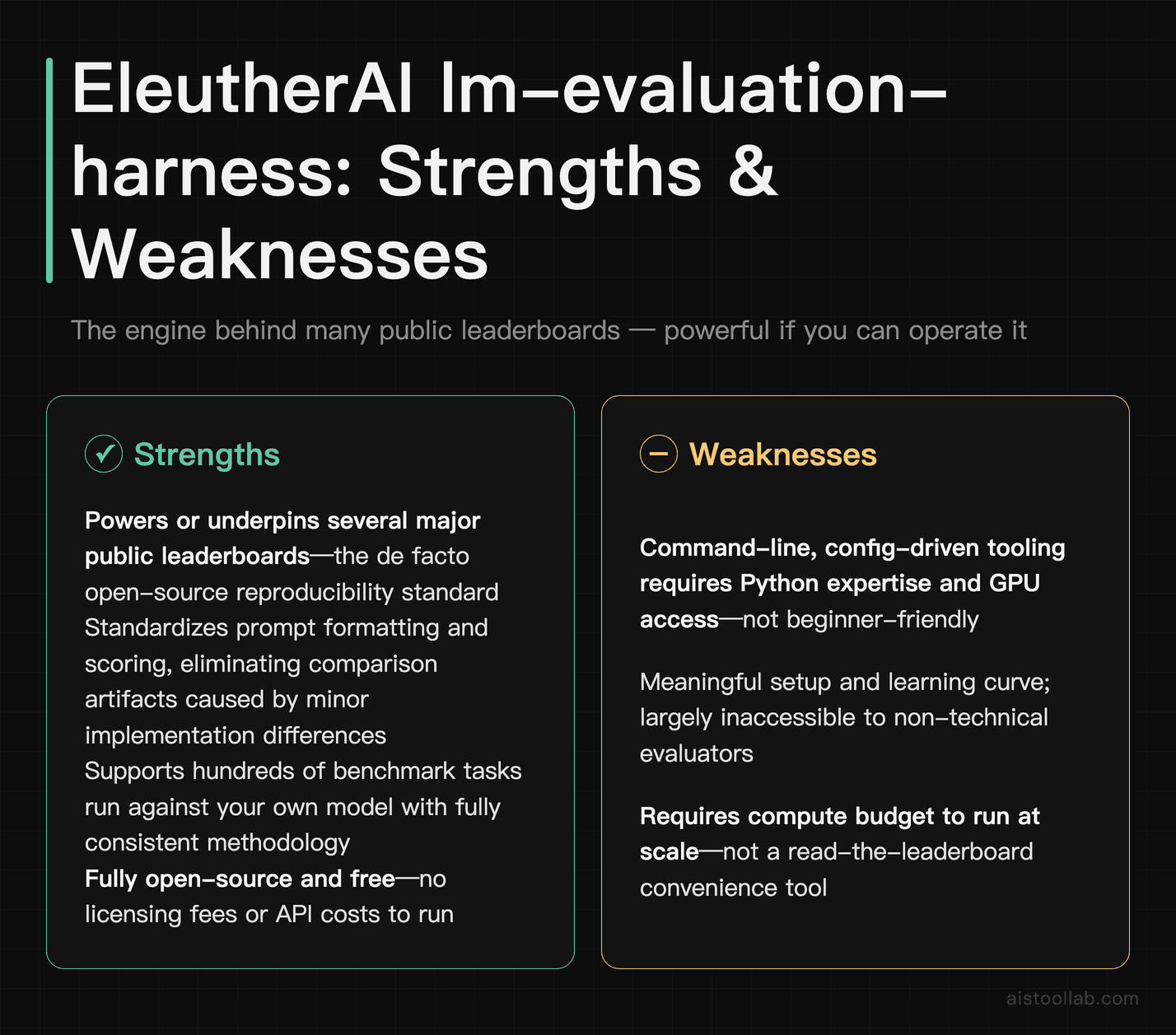
Here’s something most casual leaderboard-readers don’t realize: a large share of the numbers they’re comparing were generated by the same underlying tool. EleutherAI’s lm-evaluation-harness is the de facto open-source engine for running standardized LLM benchmarks, and it powers or underpins several public leaderboards including past versions of Hugging Face’s.
Its strength is reproducibility and control. You can run hundreds of tasks against your own model with consistent prompting and scoring, which matters enormously because tiny differences in prompt formatting can swing a model’s reported score noticeably. The harness standardizes that. If you want to compare Model A and Model B on identical footing rather than trusting two different vendors’ self-reported figures, this is the responsible way to do it.
The trade-off lands on usability again: it’s a command-line, config-driven tool aimed at people comfortable with Python and GPUs. There’s a learning curve, and you’ll need compute. But for anyone serious about the “run your own benchmarks” approach — which I argue you should be — this is the foundation. I touch on the prompt-sensitivity issue more in MMLU vs GPQA vs GSM8K: Why Different Benchmarks Rank AI Models Differently.
Need: a free first shortlist of open-weights models → Hugging Face Open LLM Leaderboard
For open-weights models specifically, Hugging Face’s Open LLM Leaderboard remains the most convenient first stop. It runs a standardized battery of academic benchmarks across submitted models and presents them in a sortable, filterable table. Want to find the strongest 7B-parameter model you can run on a single consumer GPU? Filter by size, sort by average score, and you’ve got a shortlist in minutes.
The 2024 revamp to its second version was a meaningful improvement, swapping in harder, less saturated benchmarks after the original set became too easy and too contaminated to discriminate between top models. That’s a credit to the team’s transparency — they publicly acknowledged the saturation problem rather than papering over it.
Where it earns only a “moderate” real-world correlation rating: academic multiple-choice benchmarks reward a narrow slice of capability. A model can ace these and still write clunky production code or hallucinate on your domain data. Use it to narrow your candidate list, never to make the final call. The leaderboard tells you which models deserve a closer look — your own eval on your own data tells you which one to ship.
Need: results that are comparable across labs → AI2’s OLMES standard
The Allen Institute for AI (AI2) has pushed hard on a problem the field badly needed solved: benchmark results often aren’t comparable because everyone runs them slightly differently. Their OLMES (Open Language Model Evaluation Standard) effort documents exact, reproducible evaluation procedures so that a reported number actually means the same thing across labs. Combined with AI2’s broader open-model and leaderboard work, it’s a strong pick for anyone who values methodological rigor and full openness.
This is academic-grade infrastructure, and it shows in the transparency score — methodology, data, and rationale are all public. For researchers and teams who need to defend their model choices with reproducible evidence, AI2’s tooling is hard to beat.
It ranks fifth here mainly because its audience skews toward the research community rather than the time-pressed practitioner who wants an answer now. The usability is medium, and the ecosystem assumes some familiarity with evaluation methodology. If you live in that world, bump it up your personal list — it may be the most intellectually honest option on this entire ranking.
Need: a test that matches your own task → OpenAI Evals
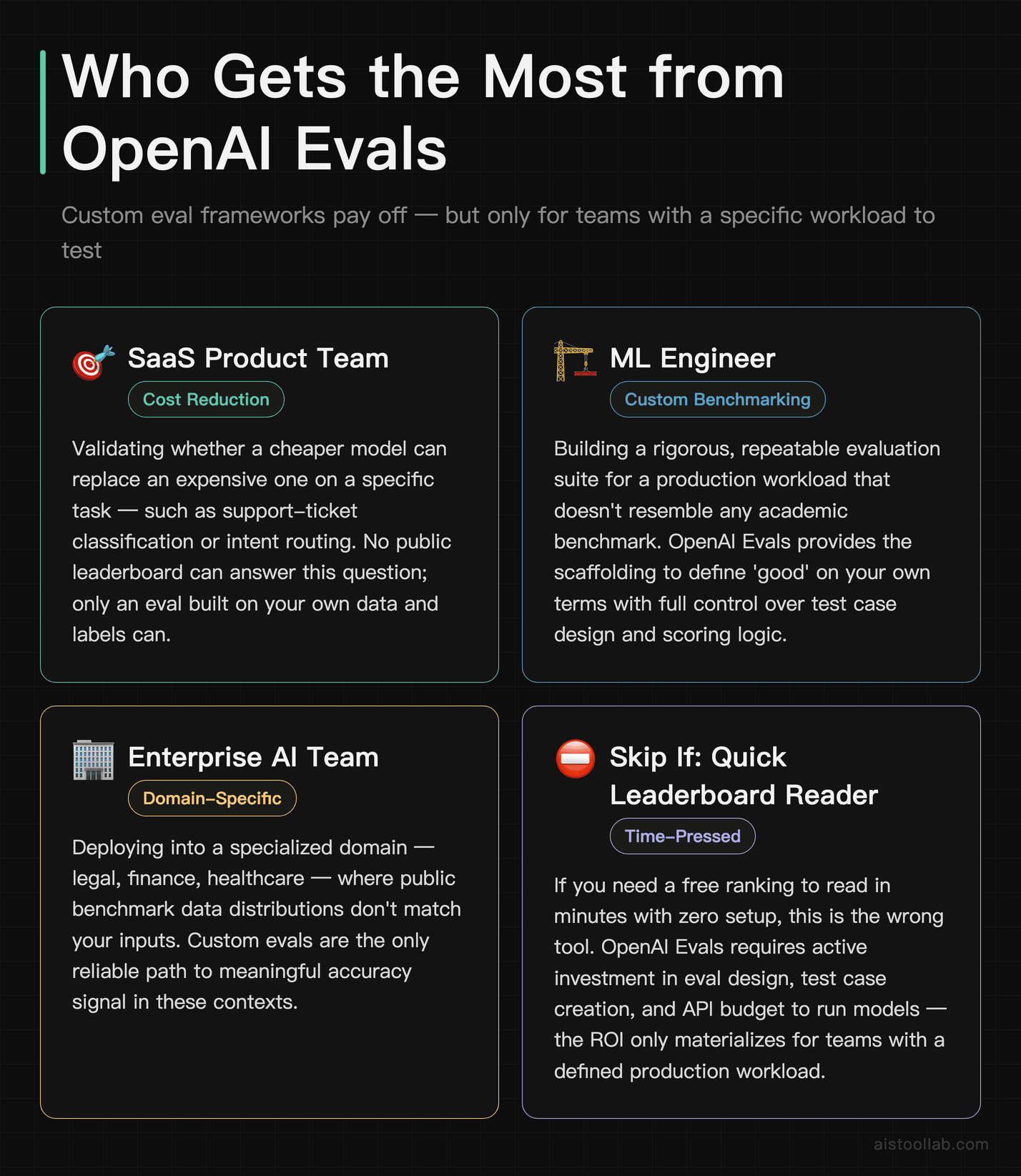
OpenAI Evals takes a different stance: instead of giving you a universal leaderboard, it gives you a framework to build evaluations tailored to your specific task. You define what “good” looks like for your use case, assemble test cases, and run models against them. For teams whose real workload doesn’t resemble any public benchmark — which is most teams — this custom-first approach often produces the highest real-world correlation of anything on this list, because you’re literally measuring your own job.
The catch is in the name of the work: you have to do it. There’s no free ranking to read; you invest time designing the eval and you pay API costs to run models through it. It’s also historically oriented around OpenAI’s ecosystem, though the framework concept generalizes.
For a SaaS team validating whether a cheaper model can replace an expensive one on their specific support-ticket classification task, this is exactly the right tool. The published leaderboards can’t answer that question — only an eval built on your data can.
Need: hardware throughput rather than model quality → MLPerf
MLPerf, run by the industry consortium MLCommons, is genuinely world-class — it’s just answering a question the other six don’t. It benchmarks performance: training time, inference throughput, latency, and efficiency across standardized hardware and model configurations. If you’re deciding which GPU, accelerator, or serving setup to buy, MLPerf’s audited, vendor-submitted results are the gold standard.
What it does not tell you is whether a model gives good answers. It measures how fast, not how smart. That’s why it ranks last in a list framed around accuracy and usability — but it would rank first in a list about deployment performance. If your bottleneck is serving cost and latency rather than answer quality, MLPerf is your framework, and you’ll want to pair it with serving-layer analysis like my AI Model Serving Platforms Compared: vLLM vs TensorRT vs Ollama comparison.
The Verdict: There’s No Single Winner, But There Is a Right Workflow

If you force me to crown one tool, LMArena takes the top spot for the broadest set of users — it measures what people actually prefer, costs nothing, and requires no setup. But that’s only the headline, and headlines are exactly what this article warns against trusting.
The real recommendation is a workflow, not a winner. If you’re choosing a chat-facing model, start at LMArena. If you’re shortlisting open-weights models to self-host, filter on the Hugging Face Open LLM Leaderboard. If you need to defend a high-stakes decision, go deep with Stanford HELM or AI2’s reproducible standards. If your bottleneck is serving speed and cost, MLPerf is your framework. And in every single case, finish by running your own evaluation — with EleutherAI’s harness or a custom suite — on data the model has never seen. That last step is the one nobody can do for you, and it’s the one that actually predicts whether you’ll be happy in production.
The leaderboards are a map. Your own eval is the territory. Use the map to plan the route, but don’t mistake it for the ground under your feet — that’s how teams end up shipping the model that won on paper and lost in the wild.
Frequently Asked Questions
Why do different benchmarking tools rank the same model so differently?
Because they measure different capabilities with different methods, and small implementation choices have outsized effects. A human-preference system like LMArena rewards conversational quality and helpfulness, while an academic multiple-choice suite rewards knowledge recall and reasoning under a fixed format. A model tuned to be a warm, articulate chat assistant can top one and underperform on the other without changing a single weight. On top of that, prompt formatting, few-shot example counts, answer-parsing logic, and scoring rules all vary between frameworks, and these can shift a reported number meaningfully. Benchmark contamination — where test questions leak into training data — distorts things further, inflating scores on older, widely-circulated benchmarks. The practical takeaway is to never compare a number from one leaderboard against a number from another; they’re in different units even when they look the same. If you want an apples-to-apples comparison, run both models through the same tool yourself.
Which benchmark correlates best with real-world performance?
Current evidence points to human-preference systems like LMArena correlating best for general conversational and assistant-style tasks, because they measure exactly what end users care about — which response is more helpful. But “best correlation” is conditional on your use case. For code, execution-based evals that actually run the generated code and check whether it passes tests correlate far better than any multiple-choice score. For domain-specific work like medical or legal reasoning, no general leaderboard correlates well, and you genuinely need a custom evaluation on representative data. The honest answer, which I expand on in my piece on why benchmark metrics don’t predict real-world performance, is that public leaderboards are filters, not verdicts. The single highest-correlation evaluation you can run is always the one built from your own production inputs. Treat published rankings as a way to narrow seven candidates to two, then let your own data break the tie.
Should I run my own benchmarks or just trust published leaderboards?
Both, in sequence. Published leaderboards are excellent for the cheap, fast first pass — use Hugging Face’s Open LLM Leaderboard or LMArena to eliminate clearly weak candidates and assemble a shortlist of two or three models. That costs you nothing and takes minutes. Then, before committing to production, run your own evaluation on a representative slice of your actual workload using a tool like EleutherAI’s harness or a custom OpenAI Evals suite. This second step is where real money is saved or lost, because it surfaces failure modes no general benchmark captures — your specific edge cases, your formatting requirements, your domain jargon. A few hundred well-chosen test cases from your real traffic will tell you more than any leaderboard. The mistake teams make is treating “trust the leaderboard” and “run your own” as either/or. They’re a pipeline: public benchmarks for breadth and speed, private evals for the decision that actually matters.
Is MLPerf useful for choosing which model to use?
Not for answer quality, no. MLPerf measures performance characteristics — how fast a model trains, how many inferences a system handles per second, latency under load, and energy efficiency — across standardized hardware. It’s the right tool when your question is “which accelerator or serving configuration gives me the best throughput per dollar?” rather than “which model gives better answers?” That said, it can absolutely shape your model choice indirectly: if a slightly less capable model serves at a fraction of the cost and latency, MLPerf-style performance data helps you make that trade-off intelligently. For most product teams, you’ll use a quality benchmark to pick the model and MLPerf-style metrics to pick the deployment. The two are complementary. Just don’t expect MLPerf to tell you whether a model hallucinates or reasons well — that’s outside its scope entirely, and reading it as a quality signal would be a category error.
Are free leaderboards good enough, or do I need paid tools?
For the vast majority of use cases, the free options are not just good enough — they’re the best available. LMArena, Hugging Face’s Open LLM Leaderboard, Stanford HELM, EleutherAI’s harness, and AI2’s tooling are all free to read or open-source to run, and they represent the most credible evaluation work in the field. There is no paid leaderboard that meaningfully outclasses them on methodology. Where you’ll spend money is compute and API costs when you run your own evaluations — running a large benchmark suite against several models burns GPU hours or API tokens, and that adds up. But the frameworks themselves are free. If a vendor is selling you a proprietary “model quality score” as a premium product, be skeptical and ask exactly what it measures and whether the methodology is public. Opaque scoring is a red flag regardless of price. Open, reproducible, and free is the gold standard here.
What’s the difference between HELM and the Open LLM Leaderboard?
They optimize for different goals. The Open LLM Leaderboard prioritizes convenience and breadth of model coverage — it runs a standardized set of benchmarks against a huge number of submitted open-weights models and gives you a sortable table, ideal for quickly finding strong candidates in a given size class. HELM prioritizes depth and honesty about trade-offs, reporting many metrics across many scenarios for a more curated set of models, so you can see not just accuracy but calibration, robustness, and bias. Think of the Open LLM Leaderboard as a fast filter across many options and HELM as a detailed report card on the finalists. If you’re shortlisting from hundreds of open models, start with Hugging Face. If you’re making a high-stakes decision between two or three and need to understand their weaknesses, move to HELM. Using both in sequence — wide filter, then deep dive — is the workflow I’d recommend for any serious model selection.
How much does benchmark contamination affect these rankings?
More than most people assume, especially on older, widely-published benchmarks. When test questions appear in a model’s training data — which happens easily when benchmarks are scraped from the public web — the model can effectively memorize answers, inflating its score without any genuine capability gain. This is a major reason the original Open LLM Leaderboard had to be overhauled: several of its benchmarks became saturated and contaminated to the point of no longer distinguishing top models. The frameworks that hold up best against contamination are human-preference systems like LMArena, where prompts are dynamic and largely novel, and benchmarks that are private, freshly generated, or held out. When you read any static benchmark score, mentally discount it for possible contamination, particularly for the most famous test sets that have been circulating for years. It’s one more reason your own private evaluation, built from data the model has never seen, is the most trustworthy signal you can get.
Which tool should a small startup with no ML team actually use?
Start with the lowest-effort, highest-signal combination: LMArena to gauge general quality, and the Hugging Face Open LLM Leaderboard if you’re considering open-weights models to self-host. Both require zero engineering — just reading. From that you can assemble a two-or-three model shortlist confidently. Then, even without a dedicated ML team, invest a day building a lightweight custom evaluation: collect 50 to 200 real examples from your actual use case, write down what a correct or good answer looks like, and run your shortlisted models against them. You don’t need the full OpenAI Evals framework for this — a spreadsheet and some manual scoring works at small scale. The discipline matters more than the tooling. This pragmatic approach gives you most of the benefit of a rigorous evaluation pipeline without needing specialized headcount. As you scale, you can graduate to the harness or a proper eval framework, but for an early-stage team, leaderboard-filter-plus-manual-eval is the right amount of rigor.
Last updated: 2026
Found this review helpful?
👉 Browse the AI Tools Library to find the right tools for your workflow.