
Who this is for: you have to pick a model soon and want the numbers mapped to your role rather than explained in the abstract. The organising axis here is job function.
Either side of this decision:
- Benchmark basics — what each classic exam actually asks, in plain English
- Saturation and contamination — why the classics stopped separating top models
- The production side — the metrics that only show up after you deploy
Stop Picking Models by Their MMLU Score
Here’s a habit that quietly burns budget at startups and enterprises alike: a team picks a model because it topped a leaderboard, ships it, and then watches it fumble the one job it was hired to do. The model that “scored 90 on MMLU” turns out to hallucinate citations in your legal-summary tool, or writes confident-but-broken code in your CI pipeline. The benchmark wasn’t lying. You were just reading the wrong one.
That’s the uncomfortable truth about AI model benchmarks in 2026. There are now dozens of them, each measuring something genuinely different, and a single headline number tells you almost nothing about whether a model will work for your use case. A benchmark is a lens, not a verdict. MMLU measures whether a model has broad textbook knowledge. It says nothing about whether it can follow a 12-step tool-calling workflow without losing the plot. Treating them as interchangeable is like hiring a trivia champion to do your taxes.
So let’s untangle this properly — what the major benchmarks actually test, which ones matter for engineers versus researchers versus product managers, how to translate a synthetic score into a production outcome, and which newer 2026 benchmarks expose the gaps that the old favorites consistently miss.
What Each Major Benchmark Actually Measures
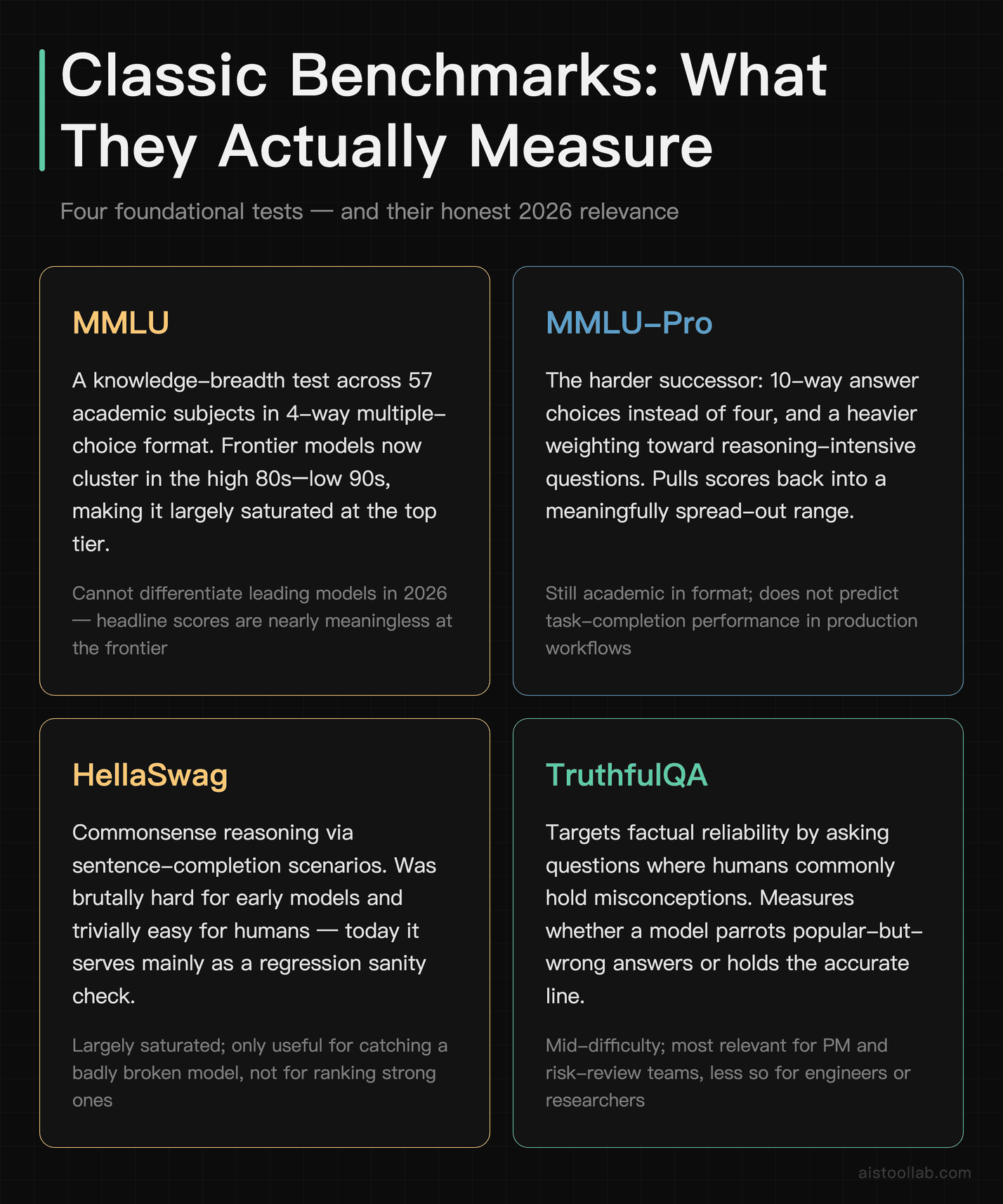
The first mistake is assuming benchmarks form a ranked ladder where higher is universally better. They don’t. They’re more like instruments on a dashboard — each one reads a different gauge, and the gauge you care about depends on what you’re flying.
MMLU (Massive Multitask Language Understanding) covers 57 subjects from US history to college medicine, in multiple-choice format. It’s a knowledge-breadth test. The catch: most frontier models have effectively saturated it, clustering in the high 80s and low 90s, which means it no longer separates the top tier. That’s exactly why MMLU-Pro appeared — harder questions, ten answer choices instead of four, and more reasoning-heavy items that pull scores back down into a usefully spread-out range.
HellaSwag tests commonsense reasoning through sentence-completion: given a scenario, pick the plausible continuation. It was brutal for early models and trivial for humans. Today it’s largely a sanity check — useful for catching a badly broken model, not for ranking strong ones.
TruthfulQA targets reliability. It deliberately asks questions where humans hold common misconceptions, measuring whether a model parrots the popular-but-wrong answer or states the truth. If your product lives or dies on factual accuracy — health, finance, legal — this is closer to the gauge you want, though it’s narrow and doesn’t capture hallucination in open-ended generation.
GPQA (Graduate-Level Google-Proof Q&A) is the expert-reasoning test. Written by domain PhDs in biology, physics, and chemistry, its questions are designed so that even skilled non-experts with web access score poorly. The “Diamond” subset is the hard core. This is where genuine reasoning depth shows up, and where weak models that coasted on MMLU fall apart.
Then there are the workhorses: GSM8K (grade-school math word problems), MATH (competition-level problems), and HumanEval (Python function generation from docstrings). Each is precise about its domain and useless outside it. I went deeper on the math-versus-knowledge split in MMLU vs GPQA vs GSM8K.
Map Benchmarks to Roles, Not to Hype
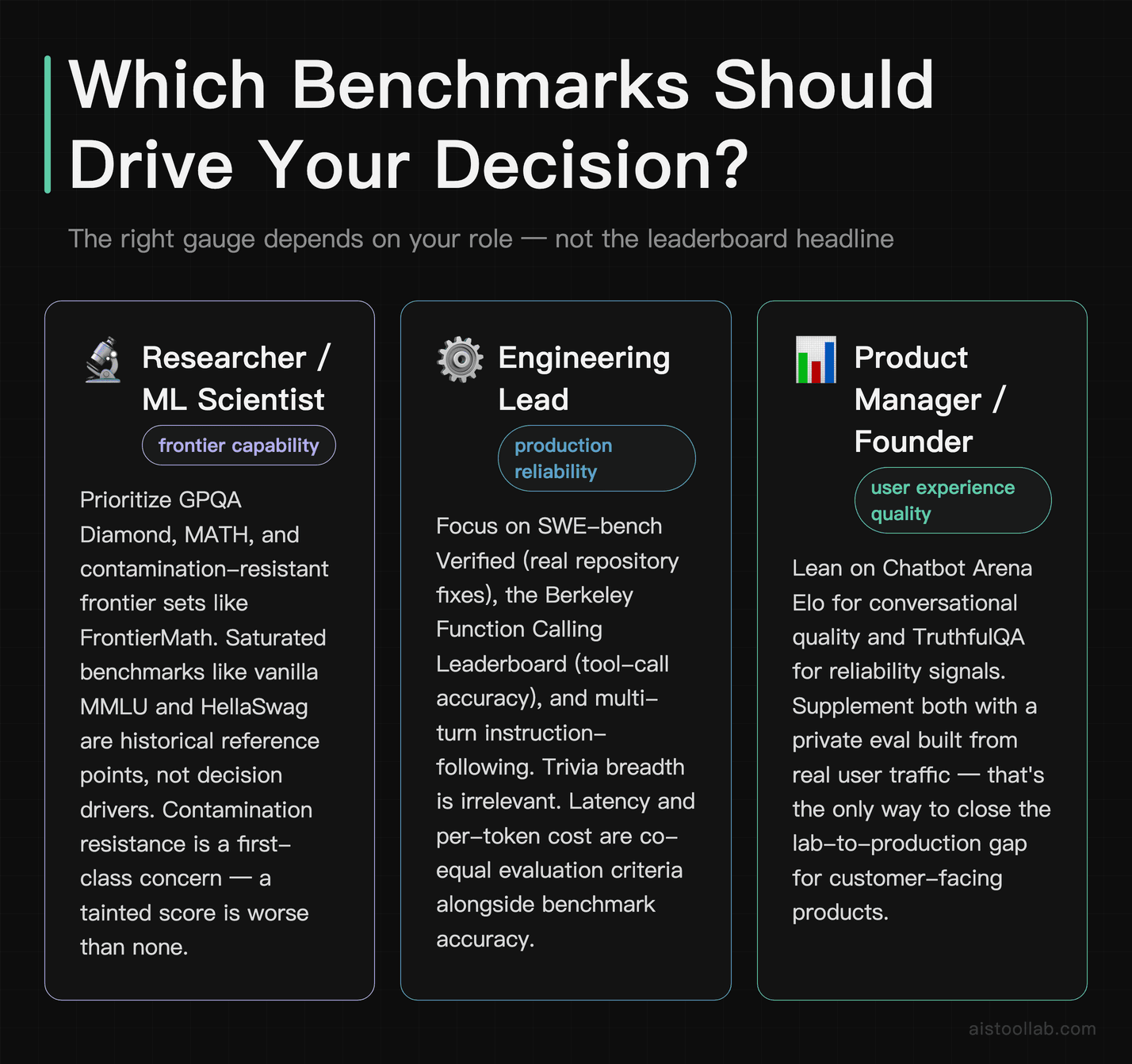
This is the part most “best model” articles skip. The benchmark that should drive your decision depends almost entirely on your job. A researcher, an engineer, and a product manager are looking at the same leaderboard and should walk away with three different shortlists.
If you’re a researcher or ML scientist
You care about ceiling-pushing capability and contamination resistance. GPQA Diamond, MATH, and frontier reasoning sets like FrontierMath (maintained by Epoch AI) tell you where the genuine frontier sits — the problems models still can’t crack. You also care deeply about whether a benchmark has leaked into training data, because a contaminated score is worse than no score. Saturated tests like vanilla MMLU and HellaSwag are mostly historical reference points for you, not decision drivers.
If you’re an engineering lead shipping a product
Trivia breadth is nearly irrelevant. What matters is task completion under realistic conditions: can the model resolve a real GitHub issue (SWE-bench), call the right function with the right arguments (the Berkeley Function Calling Leaderboard), follow multi-turn instructions, and stay cheap and fast enough to deploy? A model two points behind on MMLU but meaningfully better at tool-calling and latency is the correct pick. Serving characteristics matter as much as raw quality — I broke down the deployment side in vLLM vs TensorRT vs Ollama.
If you’re a product manager or founder
You’re translating capability into user-facing value, so human-preference signals and reliability metrics carry the most weight. Chatbot Arena (LMArena) Elo, which ranks models by blind head-to-head human votes, tells you which model people actually prefer talking to — often a better proxy for satisfaction than any academic test. Pair it with TruthfulQA and your own domain-specific eval, and you’re far closer to predicting churn than you’d be staring at GPQA.
Benchmark Cheat Sheet by Capability and Role
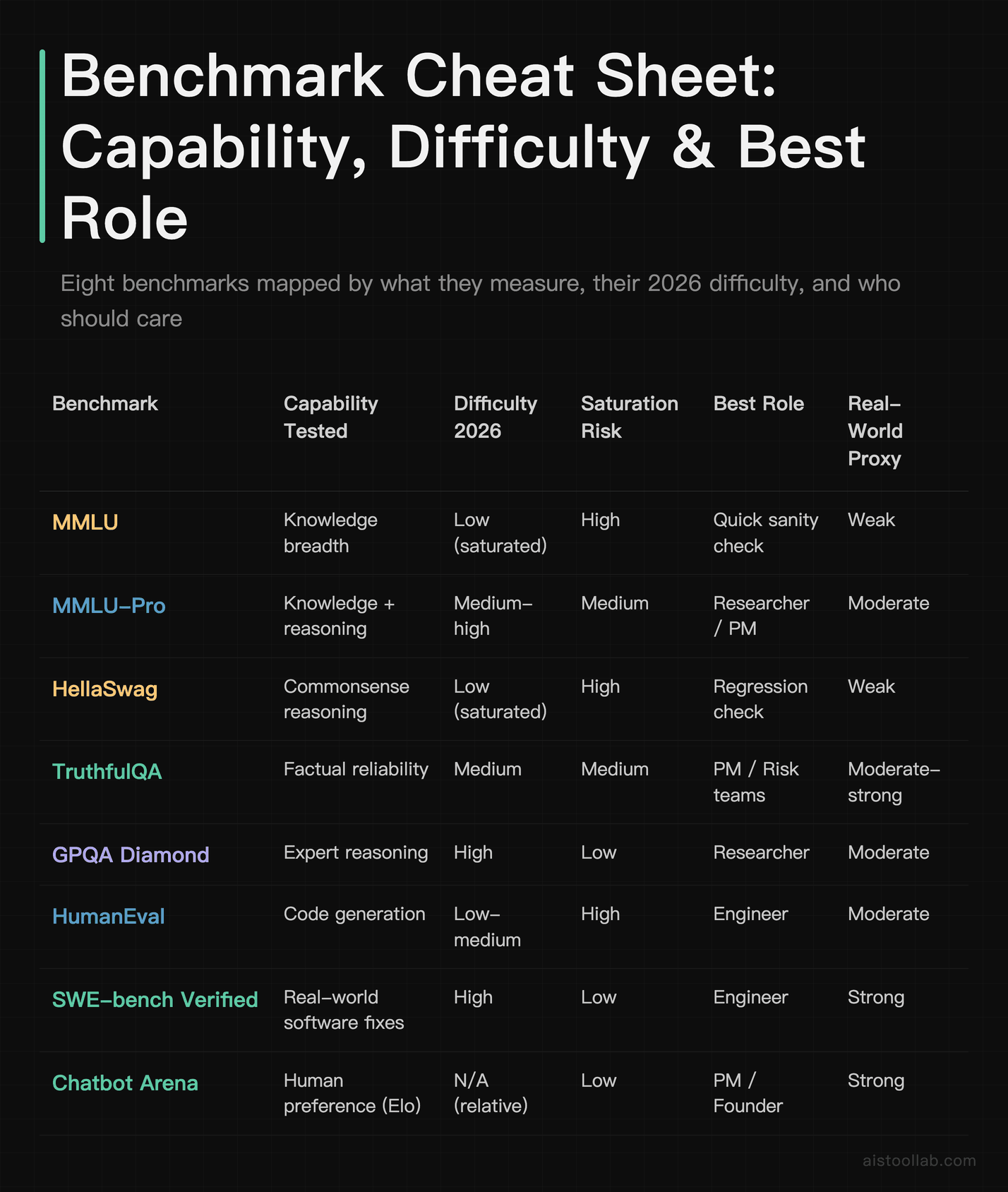
Notice the pattern: the benchmarks with the strongest real-world proxy strength (SWE-bench, Chatbot Arena) are also the hardest to game and the least saturated, while the famous textbook tests sit at the weak end. That inversion is the single most useful thing to internalize this year.
Why Synthetic Scores Lie — and How to Catch It
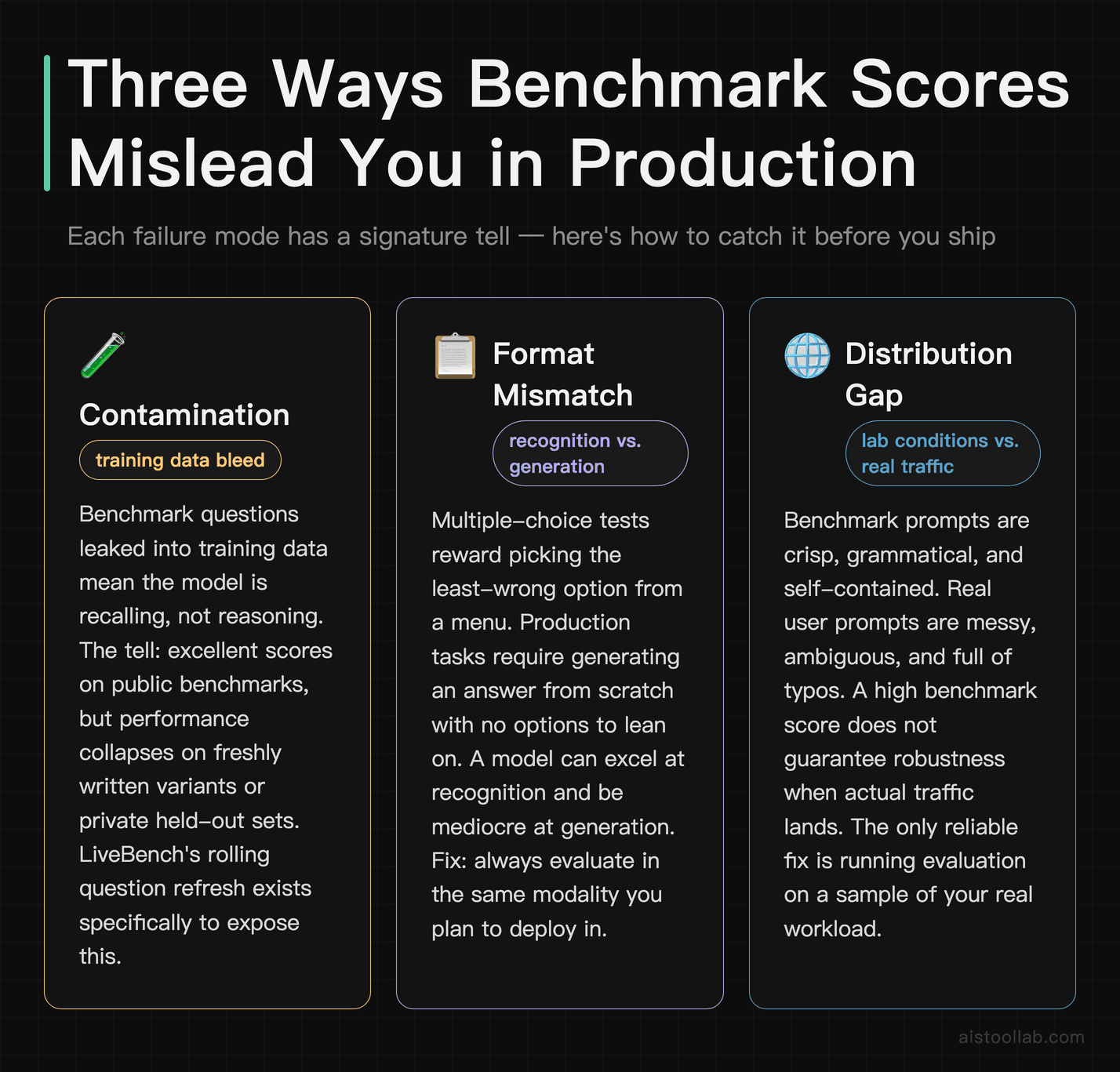
A benchmark score is a measurement under lab conditions. Production is not a lab. Three failure modes turn an impressive number into a disappointing deployment, and each has a tell.
Contamination. If a benchmark’s questions and answers appeared anywhere in the training corpus, the model is recalling, not reasoning. The signature is a model that aces a static public benchmark but stumbles on freshly written variants of the same problem. This is precisely why contamination-resistant suites like LiveBench — which refreshes its questions on a rolling basis — have gained traction in 2026. If a model’s score collapses when you swap the public test set for a private held-out one, you’ve found contamination.
Format mismatch. Multiple-choice tests reward a model for picking the least-wrong option among four. Your product probably asks the model to generate an answer from scratch, with no options to lean on. A model can be excellent at recognition and mediocre at generation. The fix is to evaluate in the same modality you’ll deploy in.
Distribution gap. GPQA questions are crisp, self-contained, and grammatical. Real user prompts are messy, ambiguous, full of typos, and arrive with half the context missing. A model tuned to clean inputs can wilt under real ones. I went deep on this exact disconnect in Production vs Synthetic — the short version is that the only benchmark that fully predicts your production performance is a private eval built from your own real traffic.
The practical defense is a two-layer approach: use public benchmarks to build a shortlist of three or four candidates, then run your own domain eval — a few hundred real examples scored by humans or a strong judge model — to make the final call. The public numbers narrow the field; your private eval picks the winner.
Use Cases: Three Teams, Three Different Shortlists
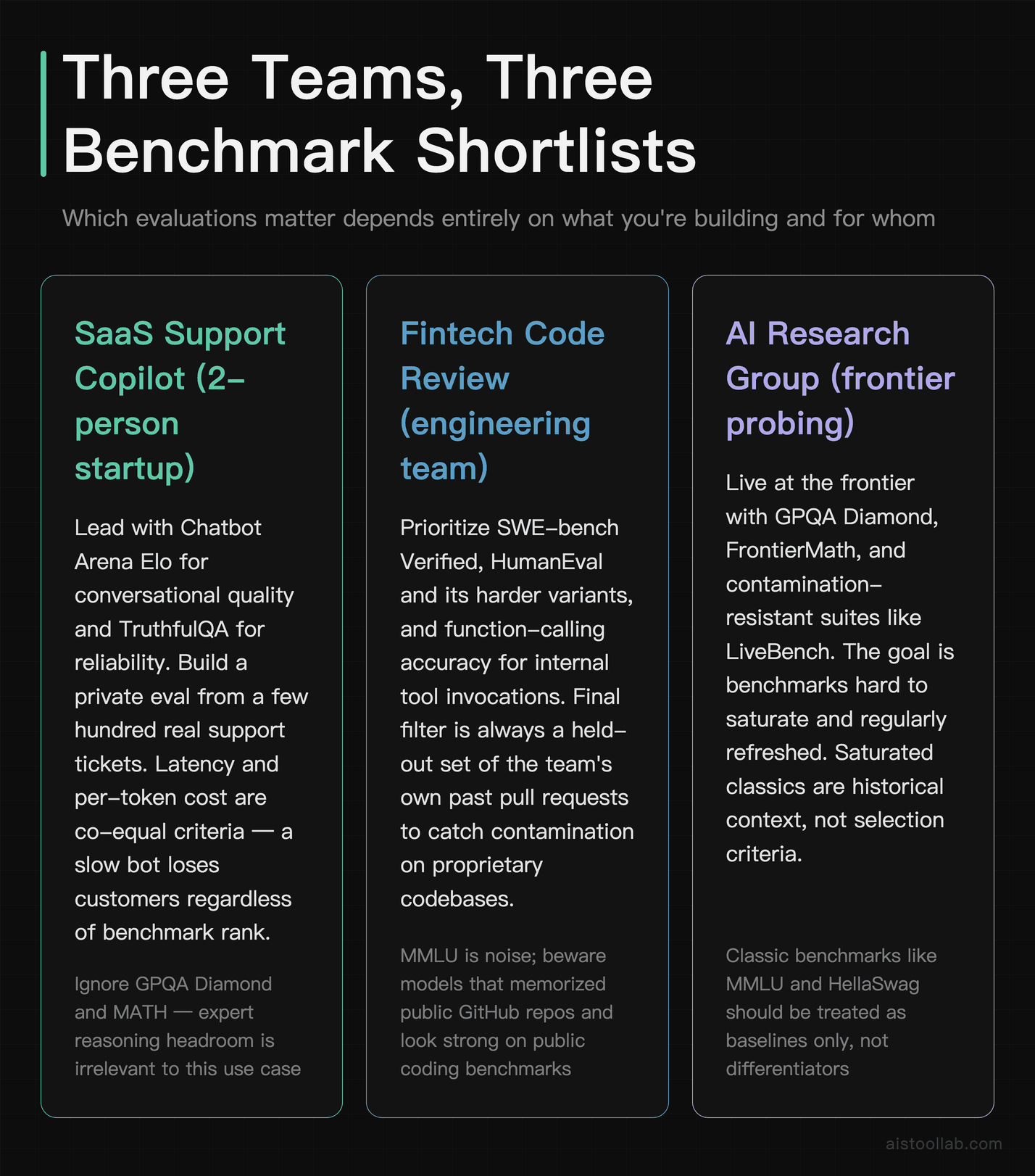
A two-person SaaS startup building a customer-support copilot
This team should almost ignore GPQA and MATH. Their model needs to be reliable on factual product questions, pleasant in tone, fast, and cheap at scale. Their decision stack: Chatbot Arena Elo to gauge conversational quality, TruthfulQA for reliability, and then a private eval built from a few hundred real support tickets. Latency and per-token cost are co-equal criteria, because a support bot that takes eight seconds to reply costs them customers regardless of how smart it is.
A fintech engineering team automating code review
Here the relevant gauges are SWE-bench Verified (can it actually fix real issues?), HumanEval and its harder cousins (code generation correctness), and function-calling accuracy if the agent invokes internal tools. MMLU is noise to them. They also need contamination awareness — a model that memorized public GitHub repos may look great on public coding benchmarks and then fail on their proprietary codebase. Their final filter is always a held-out set of their own past pull requests.
An AI research group probing reasoning limits
This group lives at the frontier, so they reach for the hardest, least-saturated tests: GPQA Diamond, FrontierMath, ARC-AGI-style abstraction tasks, and Humanity’s Last Exam, a deliberately brutal multi-domain set assembled to resist saturation. Saturated benchmarks are useless to them by definition. Their north star isn’t “which model is best” but “where does even the best model still break” — a fundamentally different question that the textbook benchmarks can no longer answer.
The 2026 Benchmarks Worth Watching
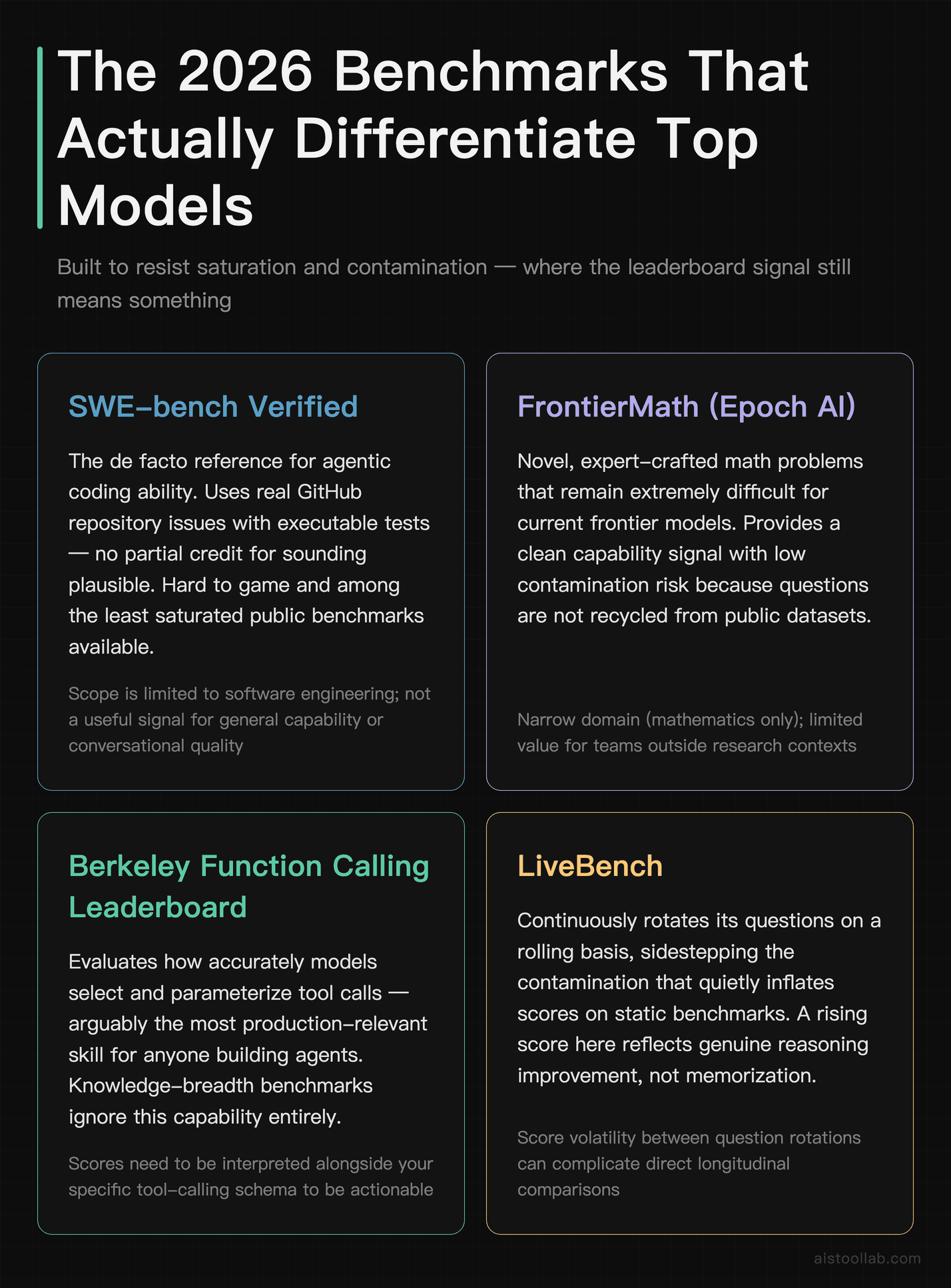
Several newer benchmarks exist specifically because the classics stopped discriminating between top models. SWE-bench Verified has become the de facto reference for agentic coding ability, precisely because it uses real repository issues with executable tests — there’s no partial credit for sounding right. FrontierMath, from Epoch AI, consists of novel, expert-crafted math problems that remain extremely hard for current models, making it a clean frontier signal. Humanity’s Last Exam spans thousands of expert questions across many disciplines and was built explicitly to be saturation-resistant.
On the reliability and agent side, the Berkeley Function Calling Leaderboard evaluates how accurately models select and parameterize tool calls — arguably the most production-relevant skill for anyone building agents, and one the knowledge benchmarks completely ignore. LiveBench deserves a spot on your radar too: by continuously rotating its questions, it sidesteps the contamination problem that quietly inflates static benchmarks. ARC-AGI and its successors continue to probe fluid, abstract reasoning that frontier models still find surprisingly hard despite their textbook brilliance.
The throughline across all of these: they test things you can’t fake by memorizing the internet. If you want a model that performs in the wild, these emerging benchmarks correlate far better with real outcomes than another point on MMLU. For a structured method of reading them, see How to Evaluate AI Model Performance Like a Pro.
The Bottom Line

There’s no single “best model,” and chasing the top of a leaderboard is the fastest way to ship the wrong one. If you’re an engineer, weight SWE-bench, function-calling accuracy, and your own codebase eval — and let MMLU go. If you’re a product manager or founder, lean on Chatbot Arena, TruthfulQA, and a private eval drawn from real user traffic. If you’re a researcher, ignore the saturated classics and live at the frontier with GPQA Diamond, FrontierMath, and contamination-resistant suites like LiveBench.
The benchmarks aren’t the problem — using the wrong one for your job is. Pick the gauge that matches your cockpit, confirm it against your own data, and you’ll make far better model decisions than anyone squinting at a single headline number. Next step: build a 200-example private eval from your real workload this week. It’ll teach you more about your candidate models than every public leaderboard combined.
Frequently Asked Questions
What’s the actual difference between MMLU and MMLU-Pro?
Both test broad academic knowledge, but they differ in difficulty and design. The original MMLU uses four-option multiple-choice questions across 57 subjects, and frontier models have largely saturated it — top systems cluster so tightly in the high 80s and low 90s that the benchmark can no longer tell them apart. MMLU-Pro was created to fix that. It expands answer choices from four to ten, which sharply reduces the odds of guessing correctly, and it weights toward reasoning-heavy questions rather than pure recall. The result is a benchmark that pulls scores back down into a meaningfully spread-out range, restoring its ability to discriminate between strong models. If you see a model reported only on classic MMLU in 2026, treat the number skeptically — it’s a saturated metric. MMLU-Pro is the more informative gauge for knowledge plus light reasoning, though for genuinely hard reasoning you’d still want GPQA or domain-specific evaluations.
Why do models score high on benchmarks but fail in production?
Three reasons, usually in combination. First, contamination: if benchmark questions leaked into training data, the model is recalling answers rather than reasoning, so the score reflects memorization that won’t transfer to novel inputs. Second, format mismatch — most academic benchmarks are multiple-choice, which only requires recognizing the best of a few options, whereas production typically demands open-ended generation from scratch, a much harder skill. Third, distribution gap: benchmark questions are clean, self-contained, and grammatical, while real user prompts are messy, ambiguous, and missing context. A model tuned for tidy inputs can struggle badly with real ones. The defense is to never make a final decision on public scores alone. Use them to build a shortlist, then run a private evaluation drawn from your own real traffic, scored in the same generation modality you’ll actually deploy. That private eval is the only benchmark guaranteed to reflect your specific production reality.
Which benchmark should engineering teams prioritize?
For teams shipping software, SWE-bench Verified is the most informative single benchmark because it uses real GitHub issues with executable test suites — a patch either passes the tests or it doesn’t, leaving no room for answers that merely sound plausible. Pair it with code-generation benchmarks like HumanEval (and its tougher variants) for raw function-writing ability, and the Berkeley Function Calling Leaderboard if your system relies on tool or API invocation. Beyond capability scores, engineering teams must weight latency, throughput, and cost, since a marginally smarter model that’s twice as slow or expensive often loses on total value. Crucially, run candidates against a held-out set of your own past pull requests or tickets, because public coding benchmarks can be inflated by training-data contamination from open-source repositories. Knowledge benchmarks like MMLU are essentially noise for this use case and should not drive the decision in any way.
Is Chatbot Arena (LMArena) a reliable benchmark?
Chatbot Arena is one of the more trustworthy signals available because it measures blind human preference — users compare two anonymous model responses to the same prompt and vote, and the results feed an Elo ranking. Since it’s based on real human judgment of open-ended responses rather than multiple-choice recall, it correlates well with what users actually like, which makes it especially valuable for product managers and founders. That said, it has limits. It rewards qualities like helpfulness, formatting, and tone, which can favor models tuned to be agreeable over models that are strictly more accurate. It doesn’t isolate domain-specific skills, so a model with the highest Elo isn’t necessarily best at, say, medical reasoning or code. And popular models attract more votes, which can introduce sampling effects. Use it as a strong proxy for general conversational satisfaction, but combine it with reliability tests and your own domain eval before committing.
What is benchmark contamination and how do I detect it?
Contamination occurs when a benchmark’s questions or answers appear in a model’s training data, so the model effectively recalls the answer rather than reasoning to it. This inflates scores in a way that won’t generalize to new problems. It’s a pervasive issue with older public benchmarks whose contents have circulated online for years. The clearest detection method is to test the model on freshly written variants of the same problems — change the numbers, rephrase the wording, or use a private held-out set. If performance collapses on the variants while staying high on the public version, contamination is the likely cause. This is exactly why rolling benchmarks like LiveBench, which continuously refresh their questions, have gained credibility in 2026: a model can’t memorize questions it has never seen. For your own evaluations, always keep a private test set that has never been published, and rotate it periodically so it can’t leak through future training cycles.
Are coding benchmarks like HumanEval still useful in 2026?
HumanEval remains useful as a baseline check but is no longer sufficient on its own. It tests whether a model can write a correct Python function from a docstring, scored by executing the code against test cases — an objective, execution-based measure, which is a genuine strength. The problem is twofold: top models now score very high on it, compressing the differences between them, and its open-source nature raises contamination concerns. Real software work also looks nothing like writing isolated functions; it involves navigating large codebases, understanding context, and fixing issues across multiple files. That’s why SWE-bench Verified has become the more meaningful benchmark for agentic coding — it reflects real engineering tasks. The pragmatic approach is to use HumanEval as a quick regression check that a model hasn’t badly degraded at basic code generation, then rely on SWE-bench plus your own codebase evaluation for the decision that actually matters.
How much should I trust vendor-reported benchmark scores?
Treat vendor numbers as a starting point, not gospel. Labs have an obvious incentive to present their models favorably, and there’s wide latitude in how benchmarks are run — prompt formatting, number of reasoning attempts, few-shot examples, and which subset is reported can all shift results by several points. A score reported under generous conditions may not reproduce in your setup. The safeguards: prefer third-party leaderboards that run all models under identical conditions, look for benchmarks with public methodology and reproducible harnesses, and be especially skeptical when a vendor highlights a saturated benchmark or one where everyone scores similarly. Most importantly, verify the claim that matters most to you with your own evaluation. If a vendor says their model excels at reasoning, run it against GPQA-style problems yourself, or better, against your real workload. Vendor scores tell you what a model can do under ideal conditions; your eval tells you what it’ll do for you.
Do benchmarks matter for non-technical product managers?
Yes, but you should read a different set than your engineers do. As a PM, your job is translating model capability into user value, so the most relevant signals are human-preference rankings like Chatbot Arena Elo, reliability measures like TruthfulQA, and — above all — a domain-specific evaluation built from your actual users’ requests. You don’t need to parse GPQA or MATH; those are engineering and research concerns. What you do need is a clear mental model of which gauge predicts user satisfaction and churn, so you can push back when an engineer wants to ship a model purely because it topped an academic leaderboard. The framework in AI Model Performance Metrics 2026 Guide is written with exactly this audience in mind. Knowing enough to ask “but how does it do on our real tickets?” is often the single most valuable contribution a PM makes to a model-selection decision.
Last updated: 2026
Found this review helpful?
👉 Browse the AI Tools Library to find the right tools for your workflow.