

Contents
Should You Pay More for GPT-5? The Upgrade Question
Model currency note (2026-08-02): the comparisons below were written when Claude Opus 4.8 was Anthropic’s flagship. Per Anthropic’s official model overview (checked 2026-08-02) the current family is Fable 5, Opus 5, Sonnet 5 and Haiku 4.5, with Opus 4.8 the previous generation. Nothing below has been re-run on the newer models — read it as a record of that comparison, not of today’s.
The moment OpenAI dropped GPT-5, the same question showed up across discussion threads: “My team uses ChatGPT Plus every day. Should we upgrade? Is it actually better or is it the usual hype cycle?” The sensible answer is to hold off on any decisions for at least a week — because the first 48 hours after any major model launch are basically useless for getting a real read. Early takes skew either euphoric or cynical, and neither extreme is helpful.
GPT-5 spans a wide range of use cases — writing, coding, research, long document summarization, reasoning tasks, API calls — the full gamut. The reality is genuinely interesting, occasionally impressive, and sometimes a little disappointing given the marketing buildup. This is that breakdown.
Fair warning: I’m not going to just parrot OpenAI’s benchmark slides at you. The distinction I care about is between a number that looks good on a press release and a capability that actually changes how you work. Let’s get into it.
Update: this review covers GPT-5; OpenAI’s current flagship is now GPT-5.6 — the upgrade logic and verdict below still apply, with GPT-5.6 widening the gains described here.
What Is GPT-5, Exactly? (Quick Background)
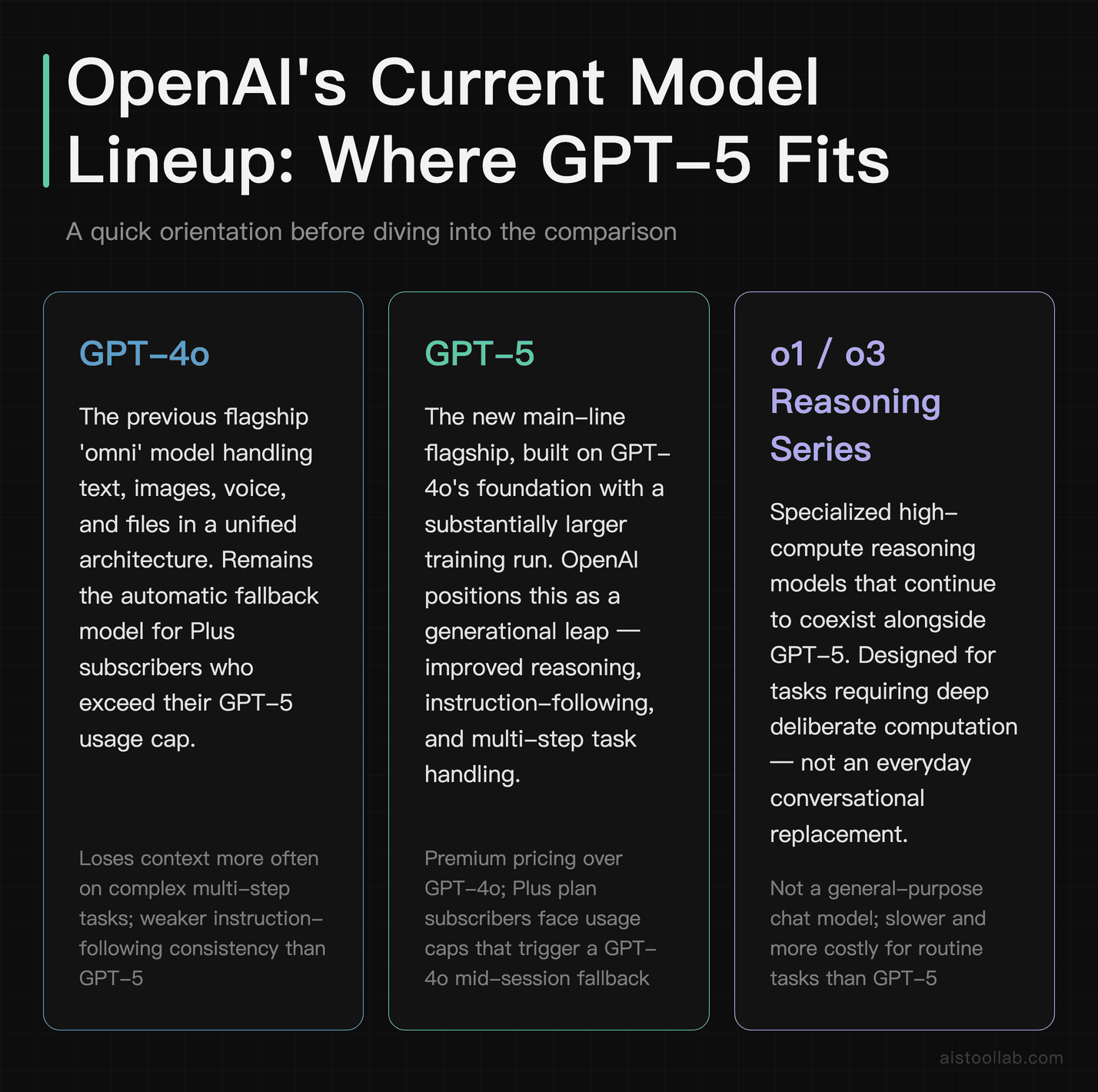
GPT-5 launched as OpenAI’s flagship successor to GPT-4o — which itself was already a significant step up from the original GPT-4 — and the line has since iterated to GPT-5.6. If you’re not keeping track of OpenAI’s naming conventions (and honestly, who could blame you), GPT-4o was the “omni” model that handled text, images, voice, and files in a unified architecture. GPT-5 builds on that foundation but with a substantially larger training run, improved instruction-following, better reasoning, and what OpenAI describes as meaningfully better performance on complex, multi-step tasks.
OpenAI has been positioning this release as a genuine generational leap rather than an incremental update — think GPT-3 to GPT-4 territory, not GPT-4 to GPT-4 Turbo. That’s a bold claim. The model is available through ChatGPT for subscribers and through the OpenAI API platform for developers, though the access tiers are a bit more nuanced than they were before, and we’ll get into the pricing details shortly.
One thing worth noting: GPT-5 is not a separate “reasoning model” in the way o1 or o3 were. It’s the main-line chat and API model. The reasoning improvements are baked in rather than being a distinct mode you have to switch to, which is actually a meaningful UX improvement over the awkward toggle between GPT-4o and o1 that Plus subscribers had to deal with before.
Core Capability Improvements: Real Benchmarks vs. Marketing Claims
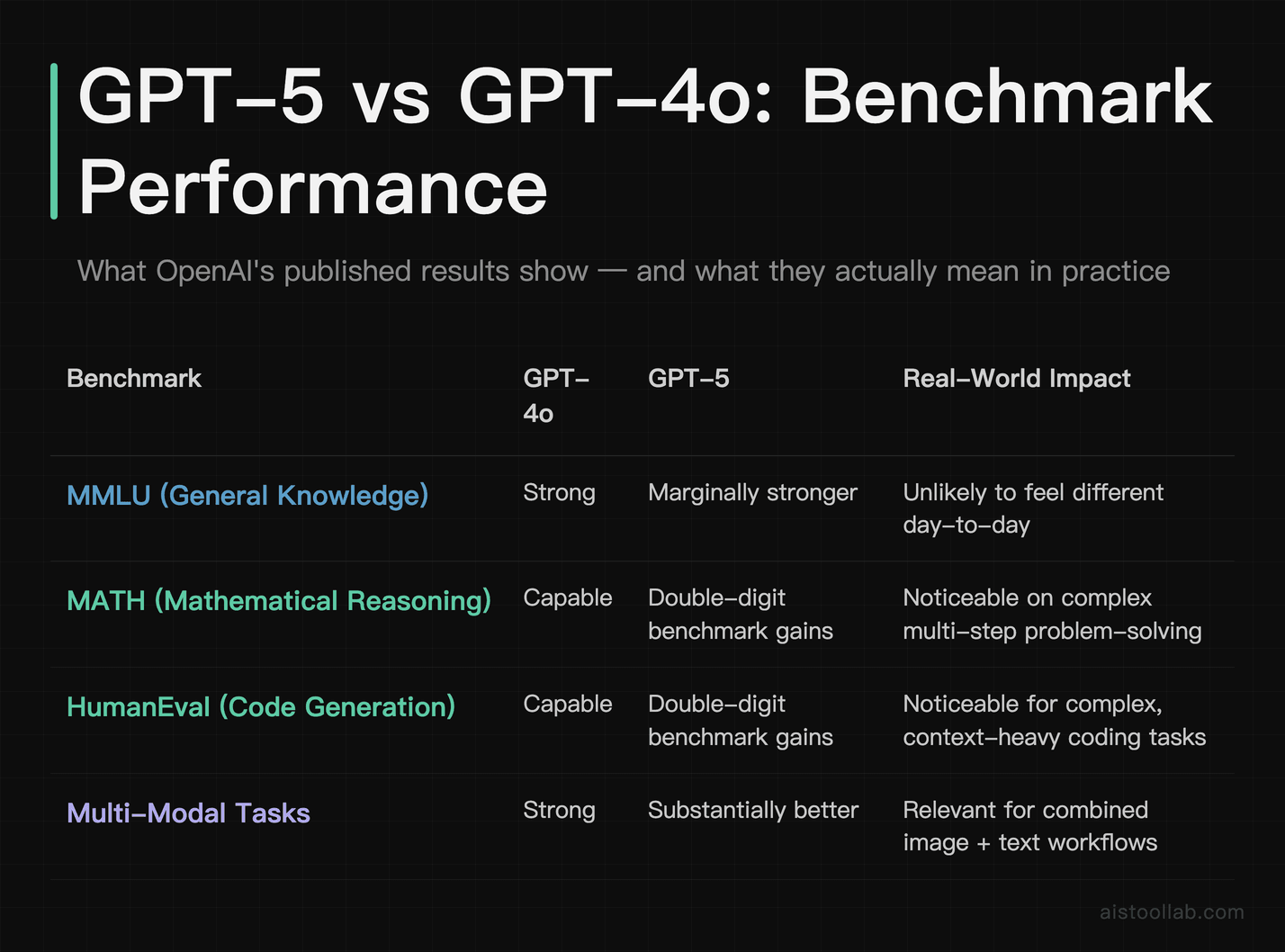
Let’s talk numbers first, then I’ll tell you what they actually mean in practice. OpenAI published benchmark results showing GPT-5 outperforming GPT-4o across MMLU (general knowledge), MATH (mathematical reasoning), HumanEval (coding), and various multi-modal benchmarks. The improvements range from modest (a few percentage points on MMLU) to substantial (double-digit gains on harder math and coding benchmarks).
Here’s my read on those numbers: on OpenAI’s own charts the biggest gaps show up on hard reasoning and coding, while the general-knowledge gains are there on paper but likely won’t change your day-to-day. If you’re using ChatGPT to draft emails, summarize PDFs, or brainstorm ideas — tasks earlier models were already very good at — a benchmark bump like this usually isn’t something you’d feel. Where the published deltas are largest is multi-step problems, complex code, and anything requiring sustained logical consistency across a long context — so that’s where I’d put GPT-5 to the test on your own work.
Long-form reasoning — say, analysing a legal document and flagging clauses that could be problematic for a freelance contractor — is exactly the kind of task OpenAI’s benchmarks target for more thoroughness and internal consistency. Still not a substitute for an actual lawyer, and worth checking against your own documents before you lean on it.
On multi-step probability problems, OpenAI’s reported improvements center on fewer errors and better mid-solution self-correction. That self-correction behavior — catching a mistake partway through rather than committing to it — is one of the more underrated things they highlight: it’s not just about getting the right answer, it’s about being less confidently wrong.
Where GPT-5 Genuinely Outperforms GPT-4o
Hands-on: does it actually hold a strict format?
Instruction-following is the headline claim, so I ran a quick format-obedience check on the current ChatGPT (a GPT-5-generation model on the logged-in account). The prompt: “summarise this in exactly three bullet points, each starting with a verb and under 10 words, then add one line beginning with Risk:”. It held the format cleanly — three short, verb-first bullets plus the Risk line — after a brief “thought for 2 seconds” pass. It’s one small task on one day, not a benchmark — and I’m not stretching it into a verdict on every prompt. Precise-constraint prompts like this are the kind of thing OpenAI highlights the newer generation for, and this one clean pass is consistent with that framing rather than proof of it.

Complex Reasoning and Multi-Step Tasks
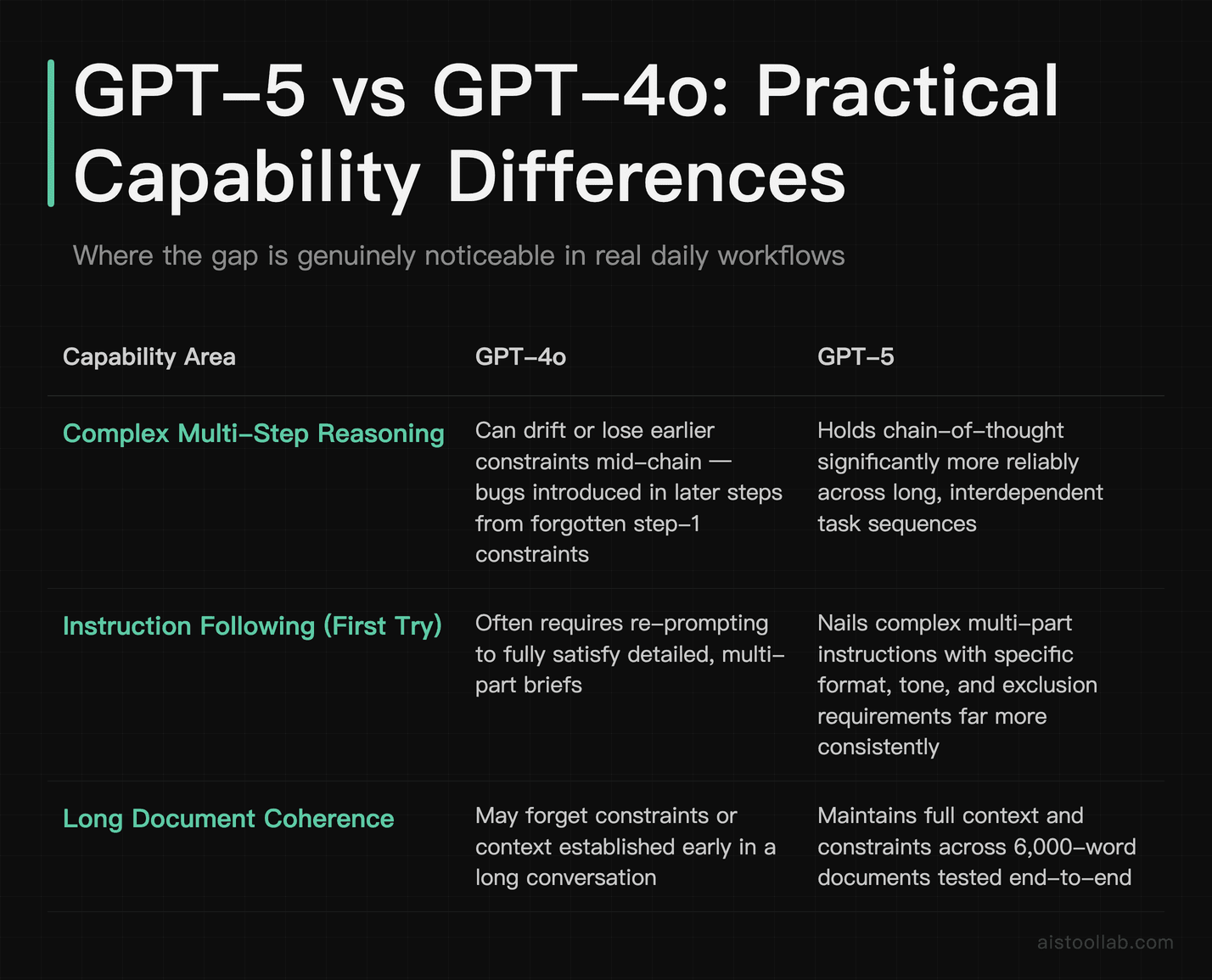
This is where OpenAI positions the biggest win. For work with multiple interdependent steps — financial modeling, debugging complex code, analyzing research papers, strategic planning — GPT-5 is designed to handle the chain-of-thought better: staying on track longer, losing context less frequently in long conversations, and drifting into plausible-sounding nonsense less often when things get complicated. On multi-step work like building a data pipeline, the goal is to hold earlier constraints more reliably across later steps — worth confirming on your own workflows rather than taking on faith.
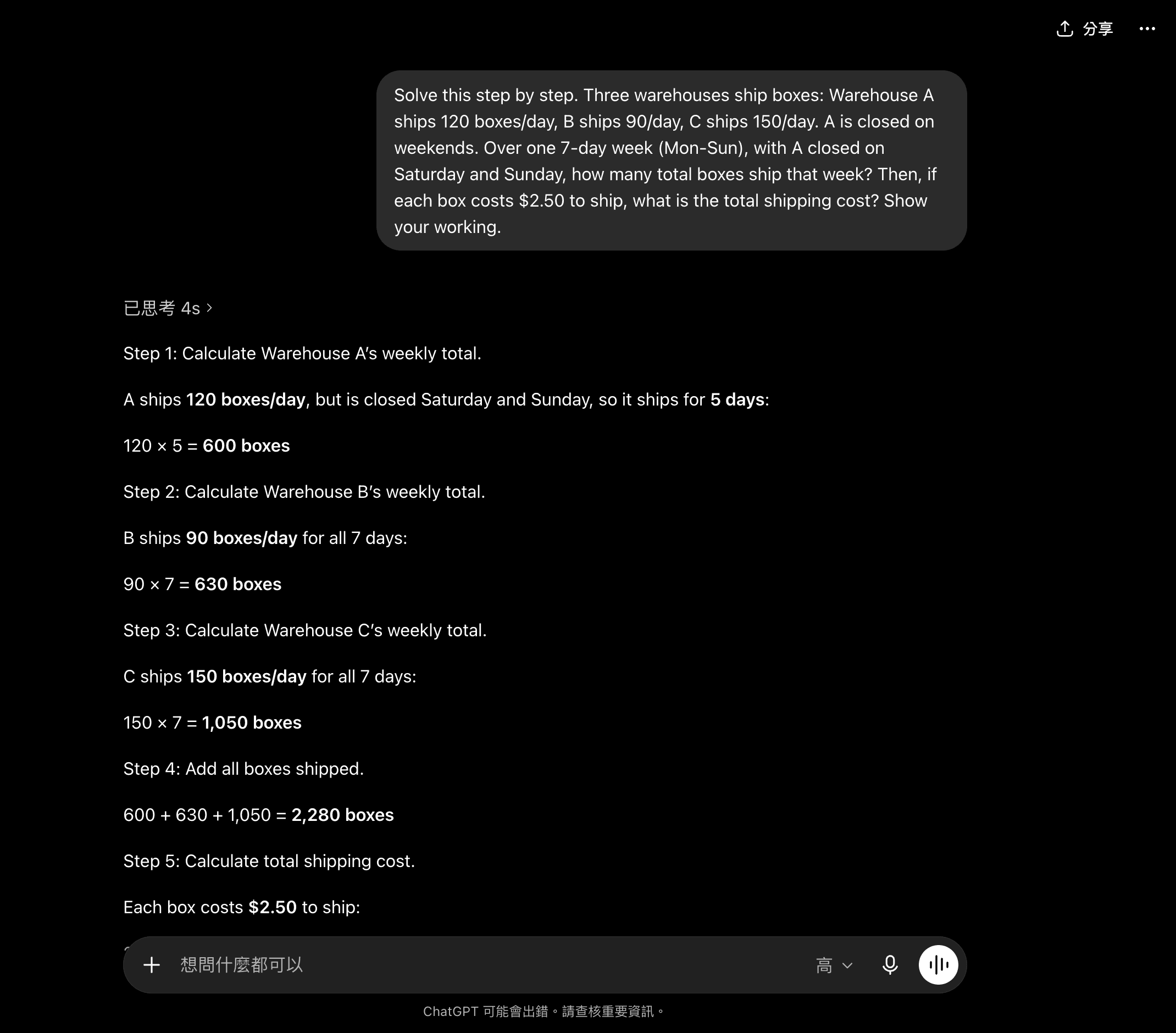
So I put a small version of that to the test on the logged-in ChatGPT. The prompt bundled a deliberate trap — three warehouses shipping boxes at different daily rates, but one closed on weekends, followed by a cost calculation. It worked through it cleanly: 120×5 for the weekend-closed warehouse, 90×7 and 150×7 for the other two, summed to 2,280 boxes, then $5,700 at $2.50 each. It didn’t trip over the weekend catch, and it laid out each step instead of jumping to a number. One problem on one day isn’t proof of anything sweeping, but this is exactly the sort of multi-step arithmetic-with-a-catch where you want a model to stay careful — and here it did.
Instruction Following and Output Format Consistency
OpenAI positions GPT-5 as better at following detailed, multi-part instructions on the first try. Ask it to write a report in a specific format, with specific sections, with a specific tone, excluding specific content — the design goal is to nail the brief more consistently than GPT-4o did (my one format-obedience test above is consistent with that, but it’s a single data point). For anyone doing high-volume content production or automated workflows, that would not be a small improvement. If it holds up on your own prompts, fewer failures mean fewer retries, which means lower API costs and less babysitting — worth measuring before you count on it.
Coding Assistance on Real-World Codebases
HumanEval benchmarks are all well and good, but real-world coding assistance is messier. For tasks like refactoring components in a moderately complex React application, identifying performance bottlenecks, or writing unit tests for specific functions, GPT-5 handles this kind of work capably, and tends to ask clarifying questions before diving in rather than making assumptions that send the work in the wrong direction. If you’re interested in the coding AI landscape more broadly, I covered similar ground in my Claude API Tutorial — worth reading alongside this for a fuller picture.
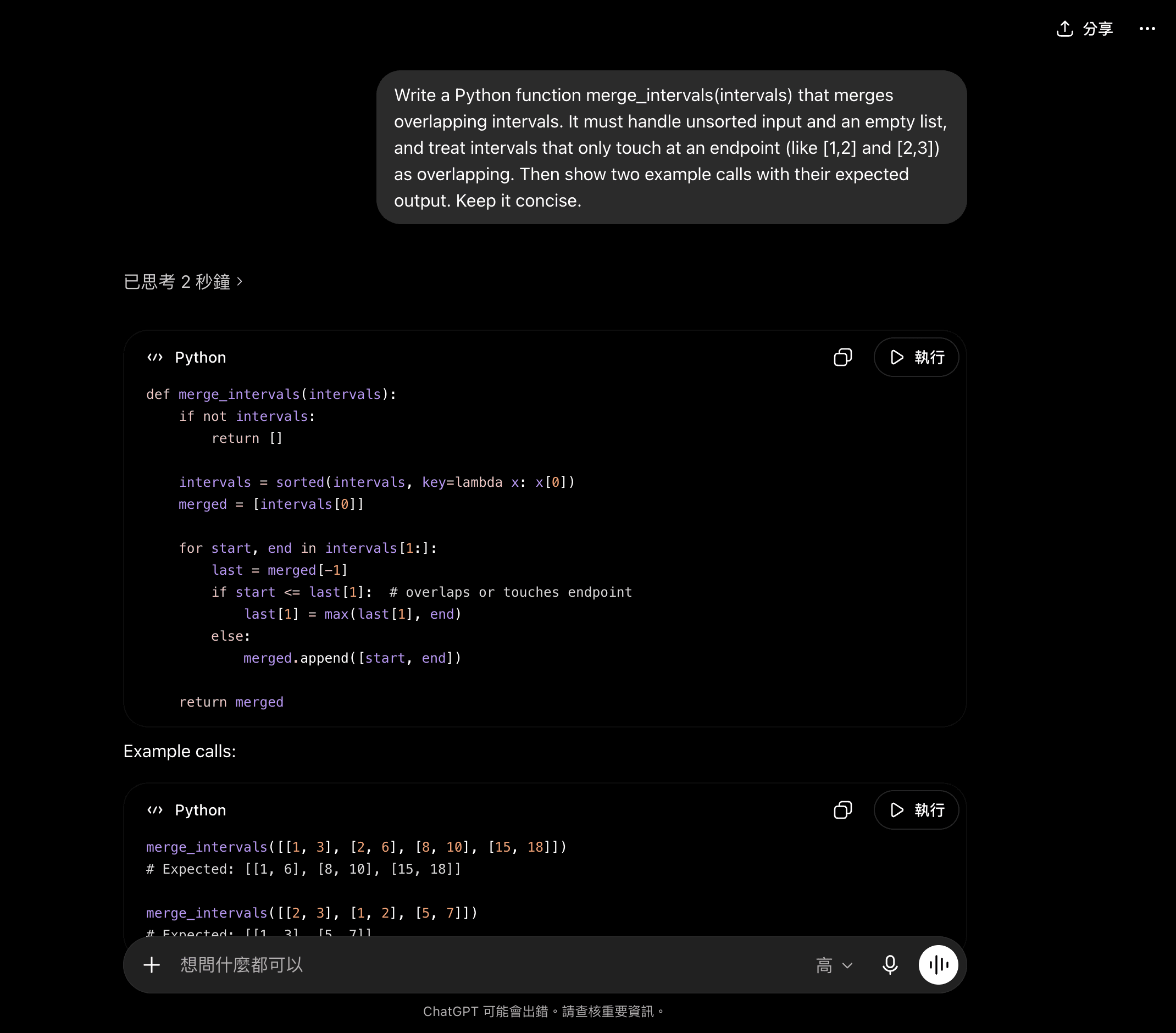
To put a slice of that to the test, I asked the logged-in ChatGPT for a classic edge-case function: merge overlapping intervals, but explicitly handle unsorted input, an empty list, and intervals that only touch at an endpoint. It got all three right — it sorted first (so unsorted input is fine), returned early on the empty list, and used start <= last[1] so touching intervals like [1,2] and [2,3] merge into [1,3] — and it threw in two example calls with the expected output. Nothing exotic, but it’s the kind of “did you remember the edge cases” prompt that trips up rushed answers, and here it didn’t cut corners.
Multimodal Understanding
Image understanding is one of OpenAI’s highlighted improvements. On complex charts and infographics — the kind where models often misread axes or miss data relationships — GPT-5 is designed to read more accurately and with more nuance, and to grasp the intent behind an image in context rather than just describing what it literally shows. For anyone doing document intelligence work or using vision in production, that’s worth testing on your own assets.
Where the Improvement Is Smaller Than Advertised
Alright, let’s be real about the areas where GPT-5 doesn’t quite live up to the hype machine.
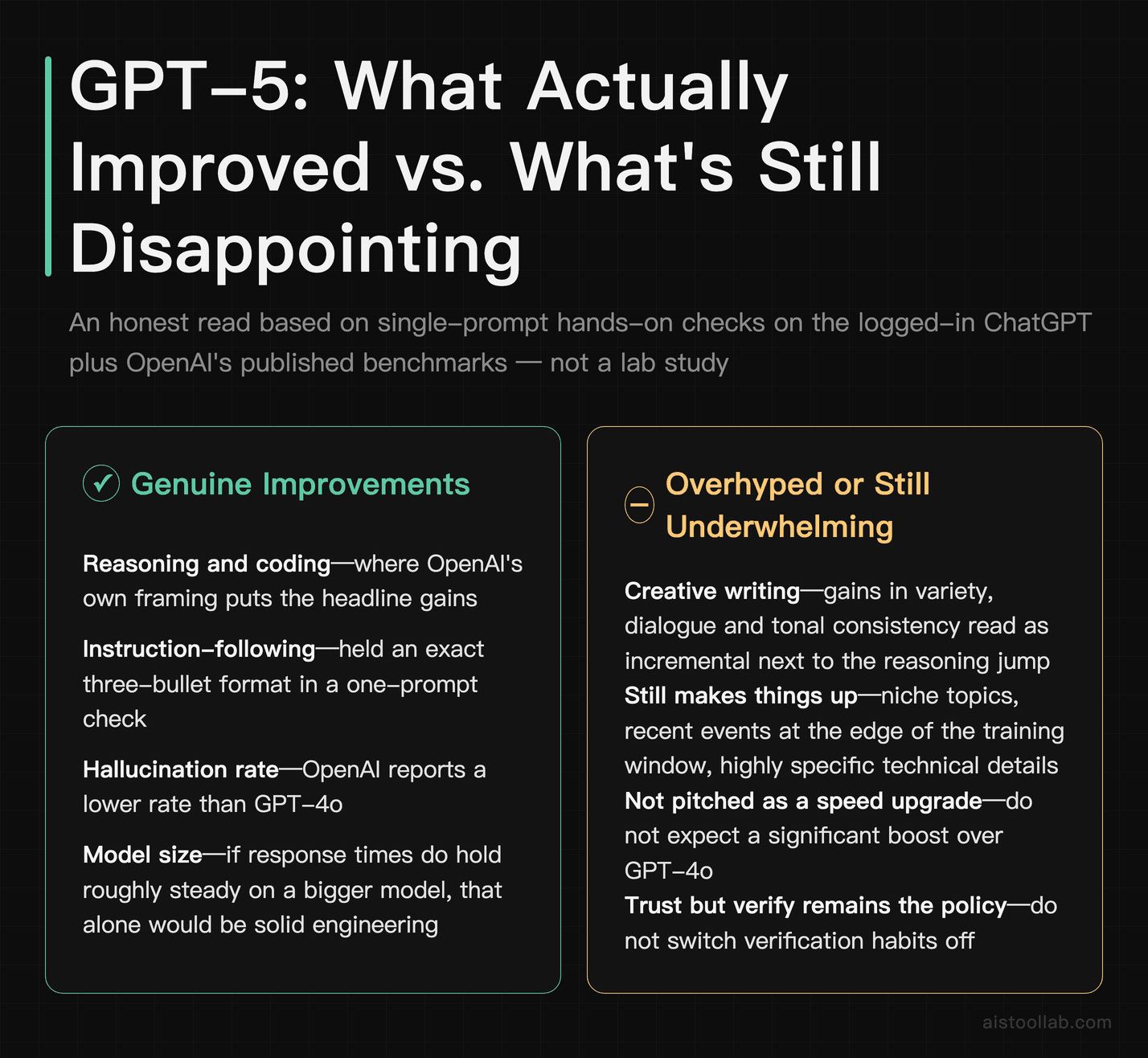
Creative writing is where I’d temper expectations. OpenAI’s own framing puts the headline gains in reasoning and coding, not prose — so if you’re a novelist or screenwriter hoping GPT-5 would finally nail your voice, my honest guess is you’ll be underwhelmed. Whatever gains land in variety, dialogue, or tonal consistency read to me as incremental next to the jump in logical reasoning. It’s still a tool to augment your creative process, not replace it.
Factual hallucination is reduced but not eliminated. OpenAI has made genuine progress here, but GPT-5 still makes things up sometimes — especially when asked about niche topics, recent events at the edge of its training window, or highly specific technical details. OpenAI reports a lower hallucination rate than GPT-4o, but I wouldn’t flip my verification habits off. Trust but verify remains the policy.
On speed, I wouldn’t expect a big shift. OpenAI hasn’t pitched GPT-5 as a speed upgrade, and given it’s a bigger model, holding response times roughly steady would itself be solid engineering. If you were hoping for a significant boost over GPT-4o, that doesn’t look like the headline here — I’d plan for generation times in the same ballpark as the previous generation and confirm on your own usage.
Context window length is expanded on paper, but the practical quality of reasoning at the far end of a very long context is still imperfect. It handles large (50,000-token) contexts more comfortably than earlier models, but if you’re stuffing 100,000+ tokens in there and expecting perfect recall and reasoning throughout, you’ll still hit rough patches. This is an industry-wide limitation, not a GPT-5-specific failure — but worth flagging if your use case depends on very long context fidelity.
Pricing and API Availability: What Changed for Developers
This section is going to matter most to the developers and builders in the audience. The API pricing structure for GPT-5 reflects its position as a flagship model, which means it’s not cheap. Based on OpenAI’s published pricing, GPT-5 comes in at a premium over GPT-4o — input tokens are more expensive, output tokens are more expensive, and if you’re running high-volume workloads, you’ll feel that difference in your billing.
That said, the improved instruction-following I mentioned earlier has a real economic implication: if GPT-5 completes tasks correctly on the first call more often than GPT-4o did, you’re burning fewer tokens on retries and follow-up corrections. For some workflows, the per-token cost increase might be partially offset by the reduction in failed calls. That’s going to be highly dependent on your specific use case, though. I’d strongly recommend running a cost-comparison experiment on your actual workload before committing.
Developer access is available through the standard OpenAI API documentation and platform, and the model is available to API users with billing set up, not just enterprise accounts. That’s a welcome change from the early access rollouts we’ve seen before. Rate limits at launch were tighter than GPT-4o’s mature limits, which is expected and will presumably loosen over time. For teams already building on the OpenAI stack, the migration path is clean — the API interface is consistent with what you’re already using.
One thing to flag: the older GPT-4o remains available via API and isn’t being deprecated immediately. So you don’t have to migrate. For cost-sensitive applications that are already working well on GPT-4o, there’s no urgent reason to switch everything over right now. GPT-5 makes the most sense as an upgrade for the parts of your stack where reasoning quality is the bottleneck, not for blanket replacement.
Impact on ChatGPT Plus Subscribers: Is the Upgrade Automatic?
For the non-developer crowd — people who just use ChatGPT as a productivity tool — this is probably the most practically important question. The short answer is: yes, ChatGPT Plus subscribers get access to GPT-5, but the how and what-you-get depends on the plan.
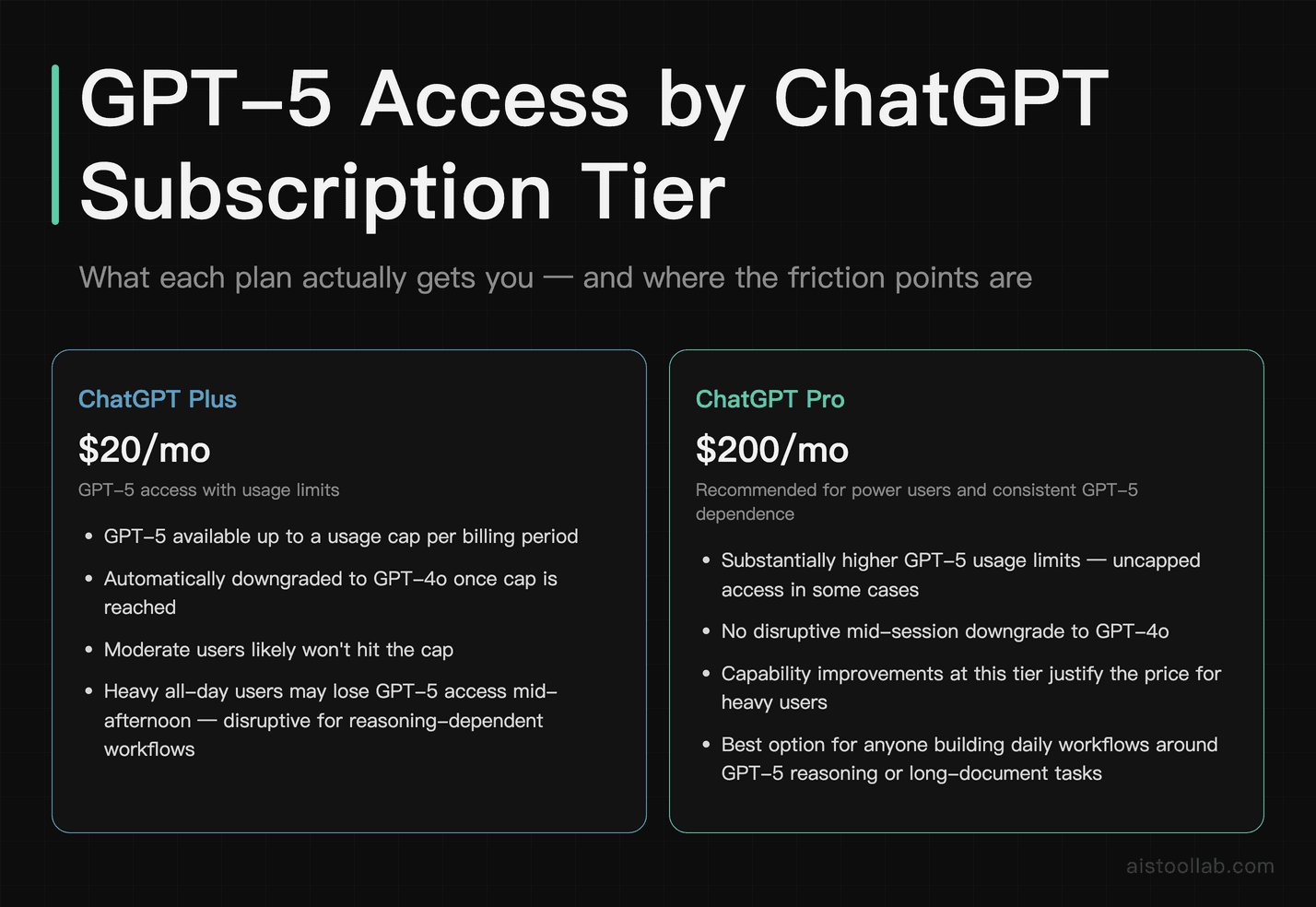
Plus subscribers ($20/month) get access to GPT-5 with usage limits — meaning you can use it for a set number of interactions or tokens per period before being bumped down to a lighter model. This is consistent with how OpenAI has handled previous model rollouts. If you’re a moderate user, you’re unlikely to hit the cap often. If you’re using ChatGPT heavily throughout the workday, you might find yourself getting downgraded to GPT-4o mid-afternoon, which is… fine, but not ideal if you’ve been relying on GPT-5’s improved reasoning for specific tasks.
ChatGPT Pro subscribers (the $200/month tier) get substantially higher limits and in some cases uncapped access, which is the right tier for power users and teams that need consistency. If you’re already on Pro and wondering whether GPT-5 justifies the price tag, I’d say yes — the capability improvements at the high end are real enough to make that tier feel more clearly differentiated than it did before.
Free tier users will get limited or no access to GPT-5 at launch, which is consistent with OpenAI’s historical tiering. If you’re comparing what free users get across different platforms, I did a full breakdown in my AI chatbot comparison — it’s a useful reference for anyone budget-conscious.
GPT-5 vs. The Competition: Where Does It Actually Stand?
You can’t evaluate GPT-5 in isolation in 2026 because the competition is genuinely strong. Anthropic’s Claude lineup, Google’s Gemini, and others have all made significant strides. Here’s my read on where GPT-5 sits in that landscape.
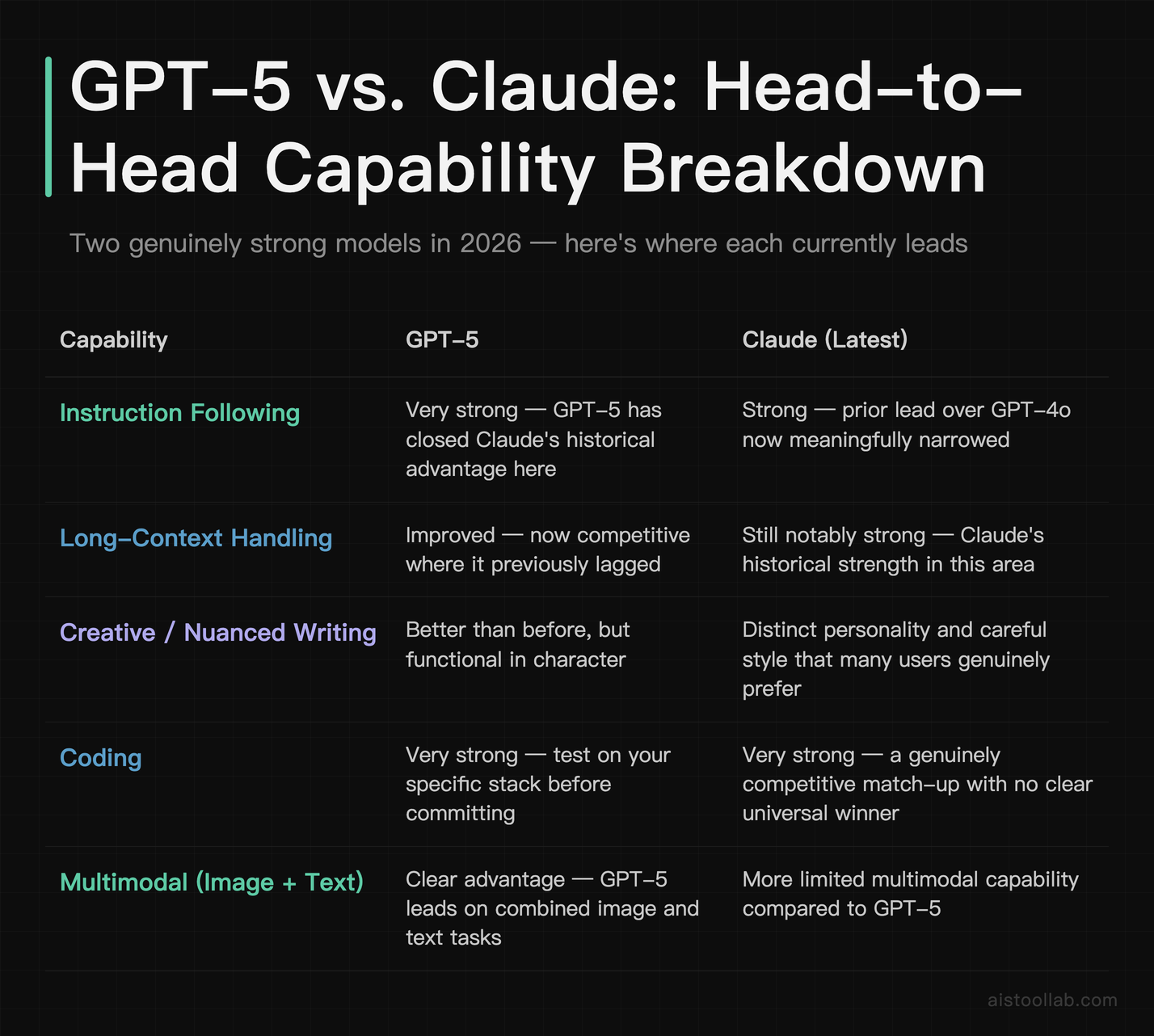
Versus Claude: GPT-5 closes some of the gap on instruction-following and long-context handling where Claude had an edge, but Anthropic hasn’t been standing still either. For nuanced writing tasks and careful, safety-conscious responses, Claude still has a distinct personality that some users genuinely prefer. I wrote a detailed head-to-head in my Claude vs ChatGPT comparison comparison — while that was the previous generation, the dynamics I identified there remain broadly relevant. GPT-5 vs. Claude Opus 4.8 is a genuinely competitive matchup with no clear universal winner; it depends on what you’re doing.
In terms of coding specifically, GPT-5 is strong, but so is Claude’s latest. Developers would do well to test both on their actual use cases rather than relying on benchmarks that may not reflect their specific stack or problem types.
On the multimodal side, GPT-5’s vision capabilities are broader than Claude’s on paper, and competitive with Gemini’s. If image and document understanding is central to your use case, GPT-5 is a serious contender.
Our Verdict: When to Upgrade and When to Wait
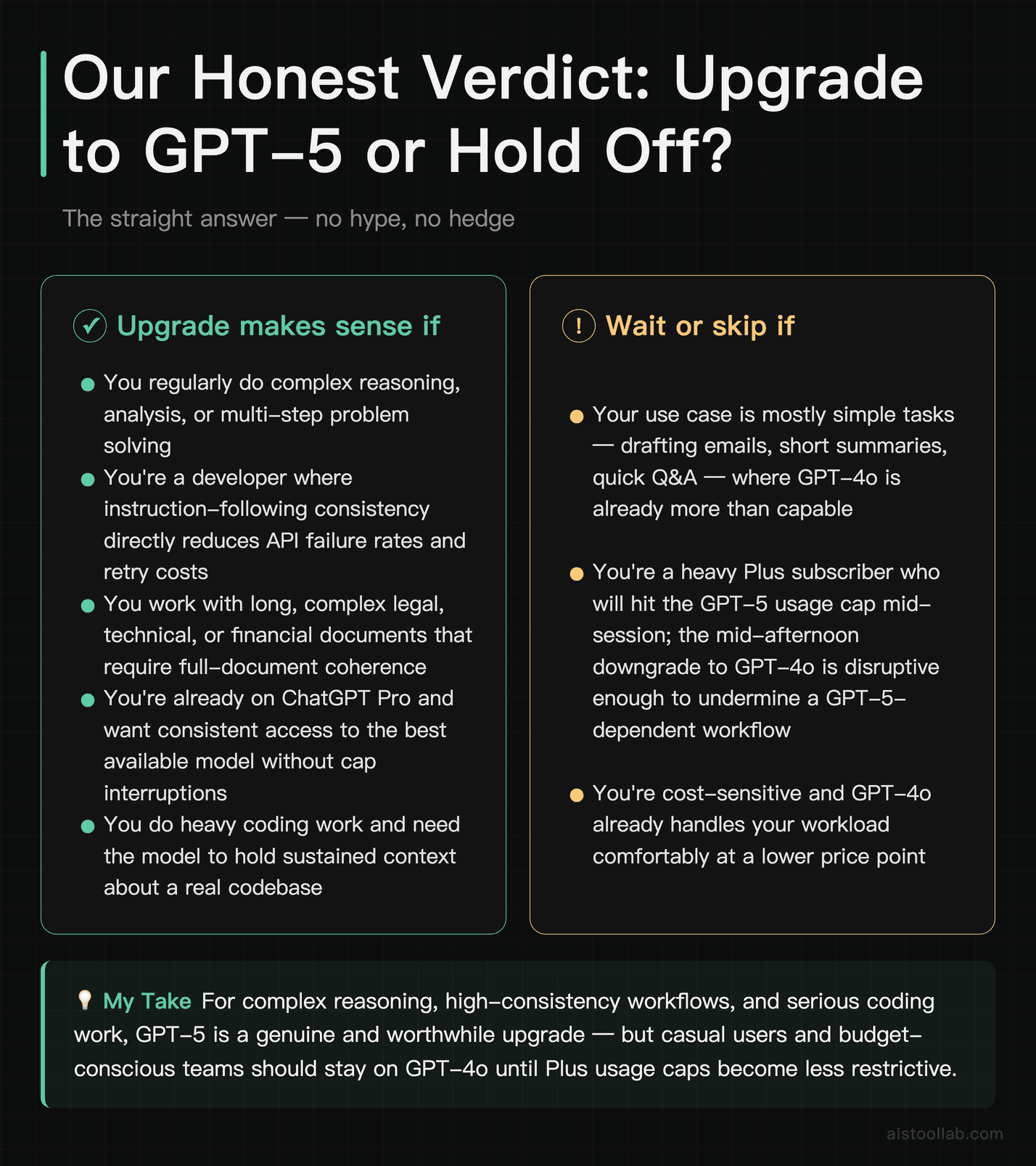
So here’s the straight answer.
Upgrade makes sense if:
- You do complex reasoning, analysis, or multi-step problem solving regularly and you’ve been hitting the ceiling on GPT-4o’s logic fidelity.
- You’re a developer building applications where instruction-following consistency translates directly to reduced failure rates and API costs.
- You work with long, complex documents — legal, technical, financial — and need the model to maintain coherence across the full document.
- You’re a ChatGPT Pro subscriber who wants the best available model without thinking about caps.
- You do heavy coding work and want a coding assistant that can hold more context about a real codebase without losing the thread.
Wait or skip if:
- Your use case is mostly simple tasks — drafting emails, summarizing short documents, quick Q&A — where GPT-4o is already more than capable.
- You’re on the Plus plan and you’re a heavy user who will hit the usage caps. The downgrade to GPT-4o mid-session is disruptive enough that it might not be worth building your workflow around GPT-5 yet.
- You’re extremely cost-sensitive and running high-volume API workloads where the price increase isn’t offset by quality improvements for your specific task type.
- You’re genuinely happy with a competitor’s model right now. GPT-5 is excellent, but if Claude or Gemini is already working well for you, this isn’t a “drop everything and switch” situation.
The bottom line, and this is my read after years of covering these launches: GPT-5 is the strongest GPT release yet, and the improvements OpenAI leads with — reasoning and instruction-following — look genuine and meaningful on the published benchmarks, not just marketing. But it’s not a magic leap that makes everything else obsolete. In my view the delta between GPT-5 and GPT-4o is real but situational. For power users and developers working on hard problems, it’s worth it. For casual users doing light work, you probably won’t notice enough difference to justify the higher tier cost or the complexity of planning around usage limits.
For most people, the sensible move is to stay on Plus and see how often you hit the usage cap before deciding whether to go Pro. That’s a perfectly reasonable approach. The model will be there when you’re ready.
Use Cases
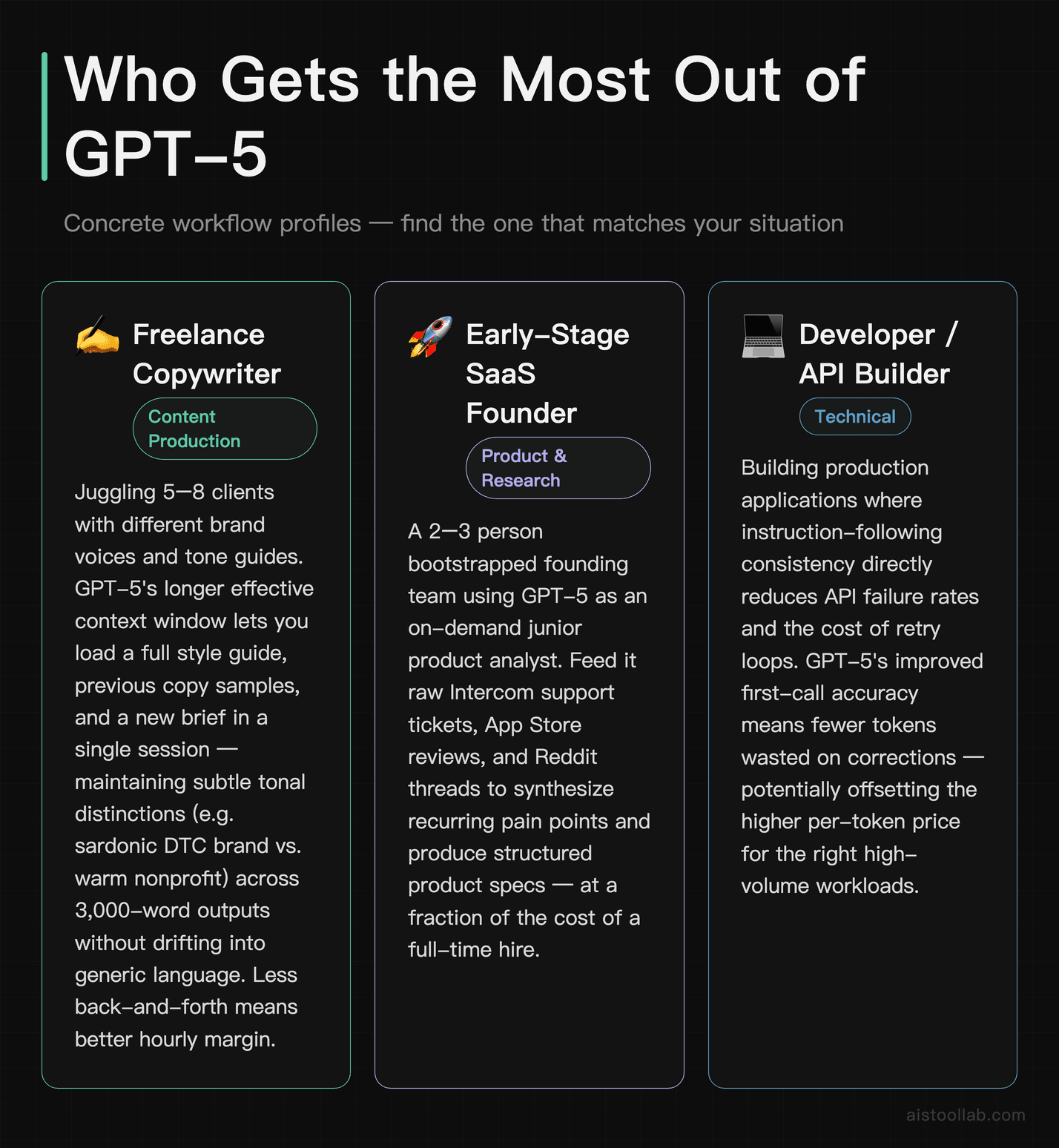
Freelance Copywriter Managing Multiple Client Campaigns
If you’re a freelance copywriter juggling five to eight clients at once — each with different brand voices, tone guides, and deliverable formats — GPT-5’s improved instruction-following and longer effective context window could be a genuine workflow upgrade. The idea is that you paste in a full brand style guide, a batch of previous copy samples, and a new brief all in one conversation, and GPT-5 holds that context coherently across a 3,000-word output without drifting into generic language. Improved instruction-following is exactly the kind of gain OpenAI positions GPT-5 around, and it should show up here as steadier tone control across, say, a sardonic DTC skincare brand versus a warm, community-focused nonprofit (verify it on your own brand voices before relying on it). For freelancers billing by the hour, if that reduced back-and-forth actually materializes on your briefs, it translates directly into margin.
Early-Stage SaaS Startup Doing Customer Research and Product Spec Writing
For a two- or three-person founding team at a bootstrapped SaaS startup, GPT-5 functions almost like a junior product analyst you don’t have to pay a salary. Feed it a raw dump of Intercom support tickets, App Store reviews, and Reddit threads, and ask it to synthesize recurring pain points into a prioritized feature backlog — messy, unstructured synthesis like this is exactly what OpenAI positions the newer generation to handle more capably. Beyond research, GPT-5 is pitched as producing cleaner, more logically structured early product requirement documents and API documentation drafts on the first pass. Startups operating lean stand to save the most time if a single prompt lands closer to finished than they’re used to — worth trying on your own briefs before you build a workflow around it.
In-House Marketing Manager at a Mid-Size E-Commerce Brand
An in-house marketing manager running paid social, email, and SEO for a mid-size e-commerce brand lives inside a content production loop that never stops. GPT-5 is positioned to earn its keep here in a few specific ways: it’s meant to be well-suited to writing platform-native copy, so a Meta ad headline can read like a Meta ad headline rather than a generic sentence with an exclamation point slapped on. The pitch also covers multi-format repurposing — give it a long-form blog post and ask for a five-email nurture sequence, three tweet variations, and a 90-second video script, and the goal is outputs that read as written for each channel rather than copy-pasted and lightly trimmed. For someone managing a content calendar alone or with a small team, that kind of specificity could cut editing time noticeably — try it on a real campaign before you bank on it.
Independent Software Developer Building and Debugging Production Code
For a solo developer or a small engineering team at a startup, GPT-5’s coding improvements are where the upgrade case is strongest. The model is designed to reason better through multi-file codebases when you provide sufficient context, aiming to catch logical errors that older models would sometimes miss or paper over with plausible-looking but incorrect fixes — worth verifying on your own stack rather than taking on faith. OpenAI also positions it as better at explaining why a bug exists rather than just patching it, which matters for developers who want to learn from the interaction rather than just ship a fix. In practical terms, that would show up on work like an async issue in a Node.js backend or a messy Python data pipeline, where the payoff depends on the model holding the original problem in view across a long chain of reasoning — time it on your own stack before you count on it.
Research Analyst at a Boutique Consulting Firm
A research analyst at a ten- to thirty-person consulting firm often faces the same core problem: an enormous volume of source material — PDFs, earnings call transcripts, market reports, academic papers — that needs to be synthesized into a tight, client-ready deliverable under deadline pressure. This is the use case GPT-5’s extended context handling and summarization improvements are aimed at. OpenAI’s framing is that it preserves more nuance when compressing dense material, hallucinates specific figures less often (you still verify everything), and follows structured output instructions like “give me a SWOT framework” or “organize findings by geography” more reliably. Whether that adds up to a meaningful difference on your own source material is the thing to test — run one real deliverable through it and compare against what you were getting before.
Frequently Asked Questions
Is GPT-5 available to free ChatGPT users?
At launch, GPT-5 access is primarily for Plus and Pro subscribers. Free users may get limited access over time as OpenAI typically rolls out previous-generation models to free tiers after new flagships launch, but there’s no firm timeline on that. If you’re on the free tier and need GPT-5-level capability now, an upgrade to Plus is the path forward — or you can explore competitors like Claude, which has a capable free tier covered in my comparison pieces.
Does GPT-5 replace o1 and o3 reasoning models?
Not exactly. GPT-5 has improved reasoning baked into the base model, which reduces the need to switch between a “standard” model and a separate “reasoning” model. However, OpenAI’s o-series models still exist and serve specialized high-compute reasoning tasks. Think of GPT-5 as a much smarter everyday model rather than a replacement for every specialized variant in OpenAI’s lineup.
How does GPT-5 compare to Claude Opus 4.8?
Both are genuinely excellent. OpenAI’s positioning puts GPT-5 ahead on certain multimodal tasks, and it is strong on coding. Claude Opus 4.8 has a distinct writing style that many users prefer for creative and nuanced text tasks. I’d recommend trying both on your specific workflow rather than picking based on benchmarks alone. Check out my OpenAI’s official GPT-5 page for technical specs, and run your own tests — that’s genuinely the most useful thing you can do.
Should developers migrate from GPT-4o to GPT-5 on the API immediately?
Not necessarily immediately. If your current GPT-4o implementation is working well and meeting quality requirements, there’s no urgent reason to migrate. Consider running A/B tests on GPT-5 for your most quality-sensitive endpoints while keeping GPT-4o running elsewhere. That gives you real data on whether the improvement justifies the higher token cost for your specific use case.
Will GPT-5 eventually be available without usage caps on Plus?
Historically, OpenAI has loosened limits as infrastructure scales up. I’d expect Plus users to get progressively more generous access over the months following launch. If you need uncapped access right now, the Pro tier is the reliable path.
Last updated: 2026