

The Benchmark Trophy Nobody Asked For
Here’s a confession that should make every leaderboard-watcher uncomfortable: the model with the highest MMLU score is almost never the one running in production at scale. Walk into any engineering team shipping AI features to real users — a customer support copilot, a code completion engine, a document summarizer handling thousands of requests a minute — and ask them why they chose their model. You’ll rarely hear “it topped the accuracy charts.” You’ll hear about p99 latency, tokens per second, and the monthly cloud bill that almost gave the CFO a heart attack.
The industry has spent years treating accuracy benchmarks like MMLU, MATH, and HellaSwag as the scoreboard that matters. And they do matter — for understanding raw capability. But capability and deployability are different sports. A model that answers a question 2% more accurately but takes four seconds longer to respond, costs three times as much per call, and chokes under concurrent load is, for most production systems, the worse choice. Not slightly worse. Often disqualified.
So let’s talk about the metrics that actually decide whether your AI feature delights users or quietly bankrupts your runway: latency, throughput, and cost-per-inference. This is the advanced operator’s view of model performance — the stuff that doesn’t fit neatly on a leaderboard but determines everything once you leave the demo and hit real traffic.
Contents
Why Latency and Throughput Beat Accuracy in Production
Accuracy is a property of the model. Latency and throughput are properties of the experience. That distinction is the whole ballgame.
Consider what users actually feel. Research into web and application responsiveness has long suggested that perceived performance degrades sharply once response times stretch past roughly a second — attention wanders, and the interaction starts to feel broken. For a chat interface, the relevant number is time-to-first-token (TTFT): how long the user stares at a blinking cursor before words start streaming. A model with marginally better reasoning that makes someone wait three seconds before anything appears will lose to a slightly dumber model that starts streaming in 300 milliseconds. People forgive a less elegant answer. They don’t forgive feeling like the app froze.
Throughput is the other half of the story, and it’s where unit economics live. Throughput — usually measured in tokens per second per GPU, or total requests served per second — determines how many users you can serve on a fixed pool of hardware. If Model A processes 80 tokens per second per request and Model B processes 160, and they’re roughly comparable in quality, Model B effectively halves your infrastructure footprint for the same user load. At scale, that’s not a rounding error; it’s the difference between profitable and underwater.
The uncomfortable truth is that accuracy benchmarks are measured in a vacuum — single prompt, no concurrency, no cost ceiling, no SLA. Production is the opposite of a vacuum. I’ve broken down the accuracy side of this in the AI Model Performance Metrics Comparison 2026: MMLU vs MATH vs HellaSwag vs TruthfulQA piece, but the moment you deploy, a second scoreboard appears, and it’s the one your users and your finance team actually read.
How to Actually Measure Inference Speed

If you only remember one thing from this section: a single average latency number is nearly useless. You need the distribution and you need the right sub-metrics.
The three measurements that matter most for generative models:
- Time-to-first-token (TTFT) — the delay before the first output token appears. This is dominated by the prefill phase, where the model processes your entire input prompt. Long prompts (think RAG with stuffed context windows) inflate TTFT dramatically. This is the metric users feel most directly in a streaming chat UI.
- Inter-token latency (ITL) or time-per-output-token — how fast tokens stream once generation starts. This governs the perceived “typing speed.” Anything above roughly the human reading rate feels instant; below it feels sluggish.
- Total request latency — end-to-end time for the full response. This matters most for non-streaming, batch, or agentic workloads where the user waits for the complete output before anything happens downstream.
Now the part people skip: measure percentiles, not averages. The mean latency might look great while your p95 and p99 are quietly ruining the experience for thousands of users. A median of 400ms with a p99 of 6 seconds means one in a hundred requests is a disaster — and under load, those tail latencies compound. When you benchmark a provider, fire concurrent requests at realistic load levels and watch what happens to the tail, not just the happy path.
Be deeply skeptical of vendor-published numbers. They’re typically generated under ideal conditions: a single request, a warm cache, a short prompt, an empty queue. Your production reality includes cold starts, variable prompt lengths, batching delays, and noisy neighbors on shared infrastructure. The only benchmark you can trust is the one you run against your own representative prompts at your own expected concurrency. Tools and serving frameworks vary widely here — I went deeper on the infrastructure layer in the AI Model Serving Platforms Compared 2026: vLLM vs TensorRT vs Ollama comparison.
The Performance Dimensions That Actually Decide Deployments
Here’s how the metrics that matter stack up against the accuracy-first worldview most leaderboards push. Notice how few of these rows show up in a typical benchmark headline.
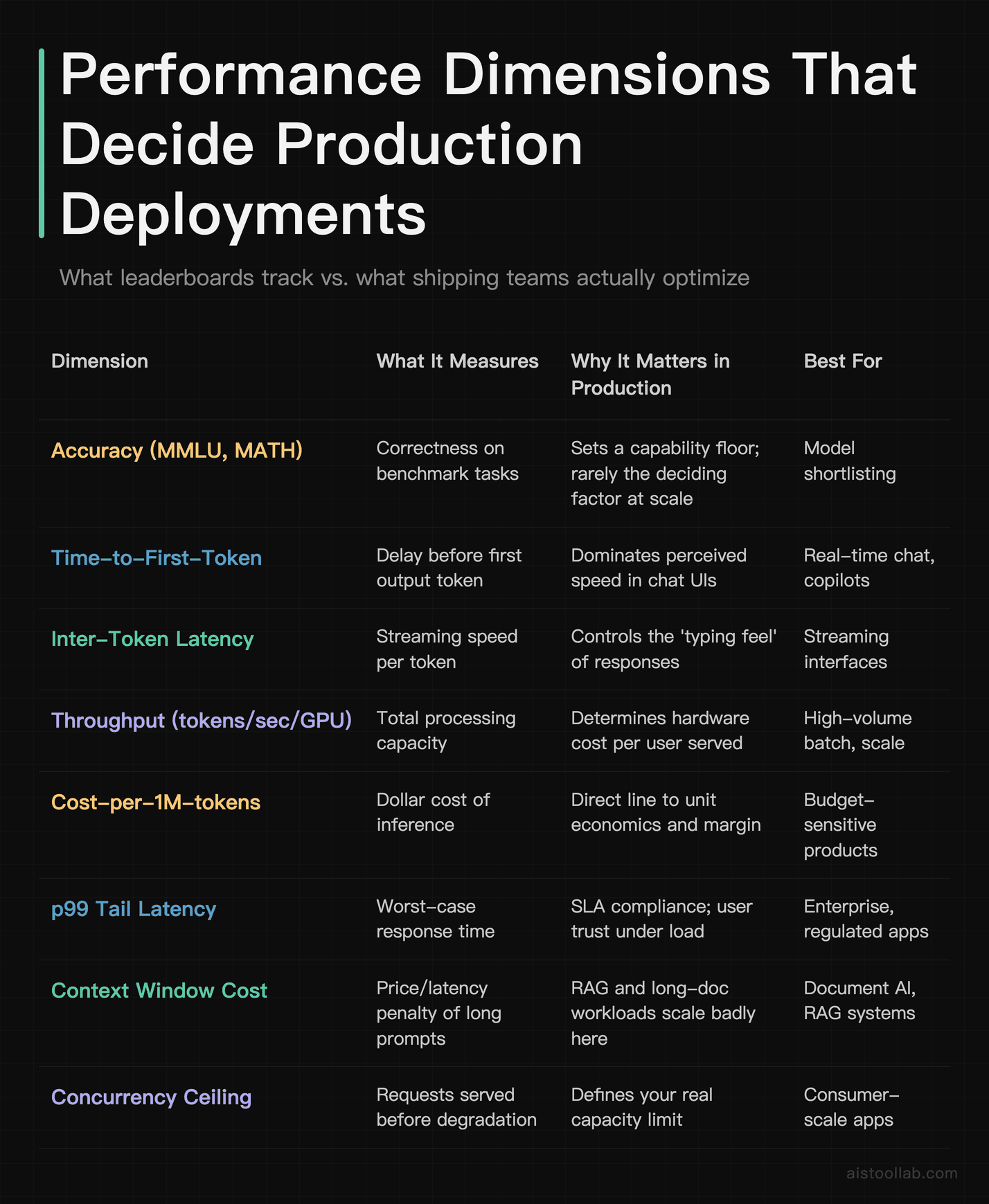
The pattern is hard to miss. Accuracy gets you onto the shortlist. Everything below it decides which model you actually ship — and which one you can afford to keep running once real traffic shows up.
Throughput Optimization: Batch vs. Real-Time
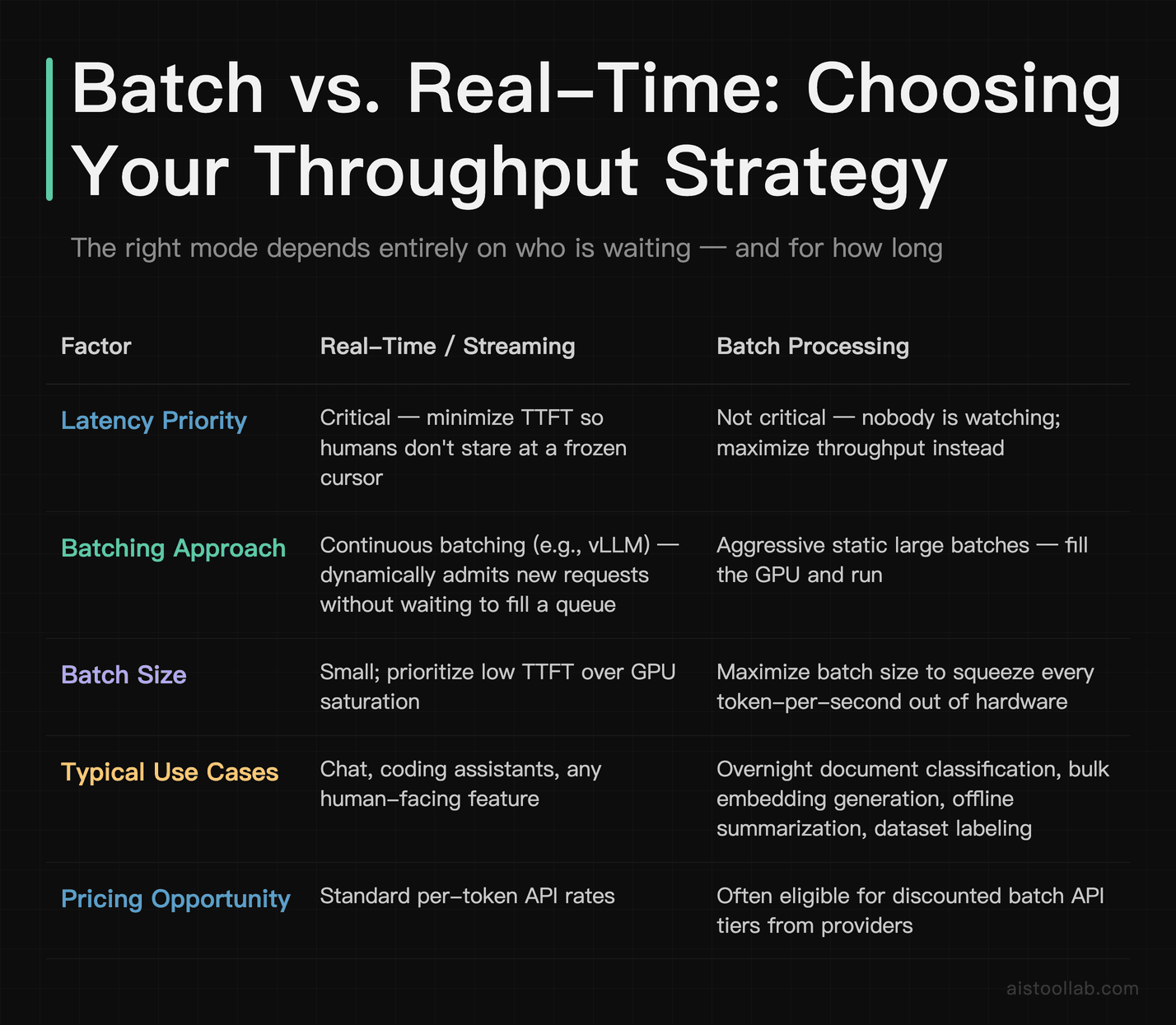
The single biggest lever on throughput is batching — processing multiple requests together so the GPU stays saturated instead of idling between calls. But batching forces a genuine trade-off against latency, and how you resolve it depends entirely on your workload.
For real-time applications — chat, coding assistants, anything a human is actively waiting on — you want low TTFT, which means small batches or continuous batching that admits new requests without waiting to fill a queue. Continuous batching (popularized by serving frameworks like vLLM) is the modern default here: it dynamically adds and removes requests from the running batch as they arrive and complete, keeping utilization high without making early requests wait for a full batch. The result is much better throughput than naive static batching while keeping latency acceptable.
For batch processing — overnight document classification, bulk embedding generation, dataset labeling, offline summarization — latency barely matters. Nobody’s watching a cursor. Here you maximize batch size aggressively, accept higher per-request latency, and squeeze every last token-per-second out of the hardware. Many providers offer discounted “batch” API tiers precisely because asynchronous, latency-insensitive work lets them schedule it efficiently. If your workload can tolerate a results-in-24-hours SLA, these tiers can cut costs substantially compared to real-time endpoints.
Other throughput levers worth knowing: quantization (running models at lower numerical precision like INT8 or FP8) trades a small, often negligible accuracy hit for meaningful speed and memory gains. Speculative decoding uses a small fast model to draft tokens that a larger model verifies in parallel, accelerating generation. And right-sizing your model to the task — using a 7B or 8B model where it suffices instead of reflexively reaching for the biggest frontier model — is frequently the highest-ROI optimization nobody wants to do because it feels like settling.
Cost-Per-Inference: Where Performance Becomes Money
This is the metric that turns abstract benchmark debates into board-meeting decisions. Cost-per-inference is where latency, throughput, and pricing collide into a single number you can actually budget against.
The basic calculation for hosted APIs is straightforward: cost = (input_tokens × input_price) + (output_tokens × output_price), with prices typically quoted per million tokens. The trap is that this scales with usage in ways that surprise teams. A feature that costs a fraction of a cent per call feels free in testing. Multiply by a few million daily active interactions, and you’re looking at real money — sometimes more than the salaries of the people who built it.
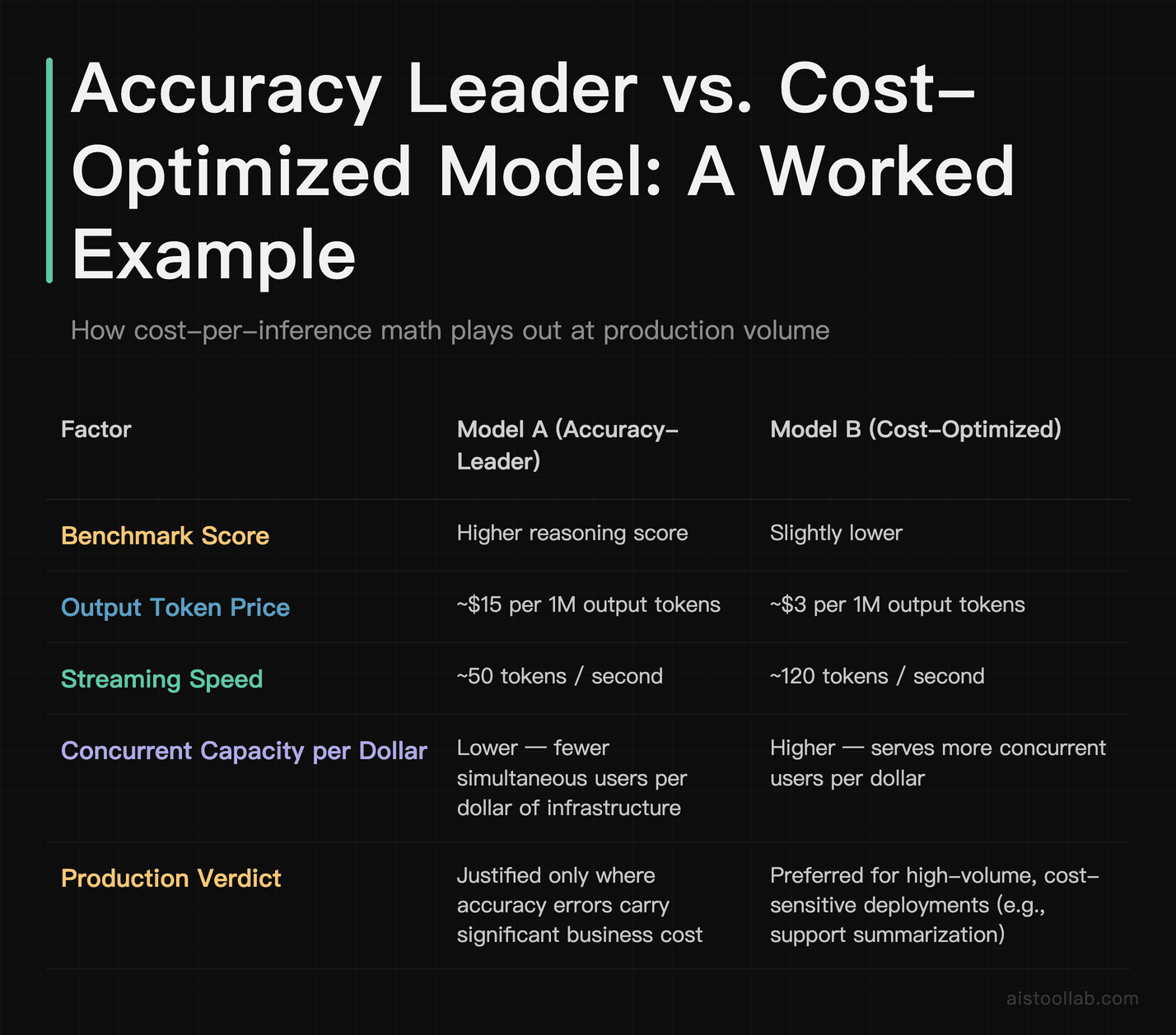
Where it gets interesting is the interaction with performance. Consider a worked example. Suppose Model A scores a few points higher on reasoning benchmarks but costs, say, $15 per million output tokens and streams at 50 tokens/second. Model B scores slightly lower but costs $3 per million output tokens and streams at 120 tokens/second. For a customer-support summarizer generating millions of responses a month, Model B isn’t just cheaper — it’s faster and serves more concurrent users per dollar of infrastructure. The accuracy gap would need to translate into a measurable business outcome (fewer escalations, higher resolution rate) large enough to justify a 5x cost premium and a slower experience. In most real deployments, it doesn’t.
For self-hosted models, the math shifts to GPU economics: cost_per_request = (GPU_hourly_rate ÷ requests_per_hour). This is why throughput optimization is really cost optimization in disguise — doubling your requests-per-hour on the same GPU literally halves your unit cost. Platforms built around affordable, high-throughput open-model inference, like Together AI, exist precisely because this equation drives so many production decisions. The right framing isn’t “which model is best?” It’s “which model delivers acceptable quality at the lowest total cost of ownership for my actual traffic pattern?”
Three Deployment Stories Where Accuracy Lost
The Customer Support Copilot
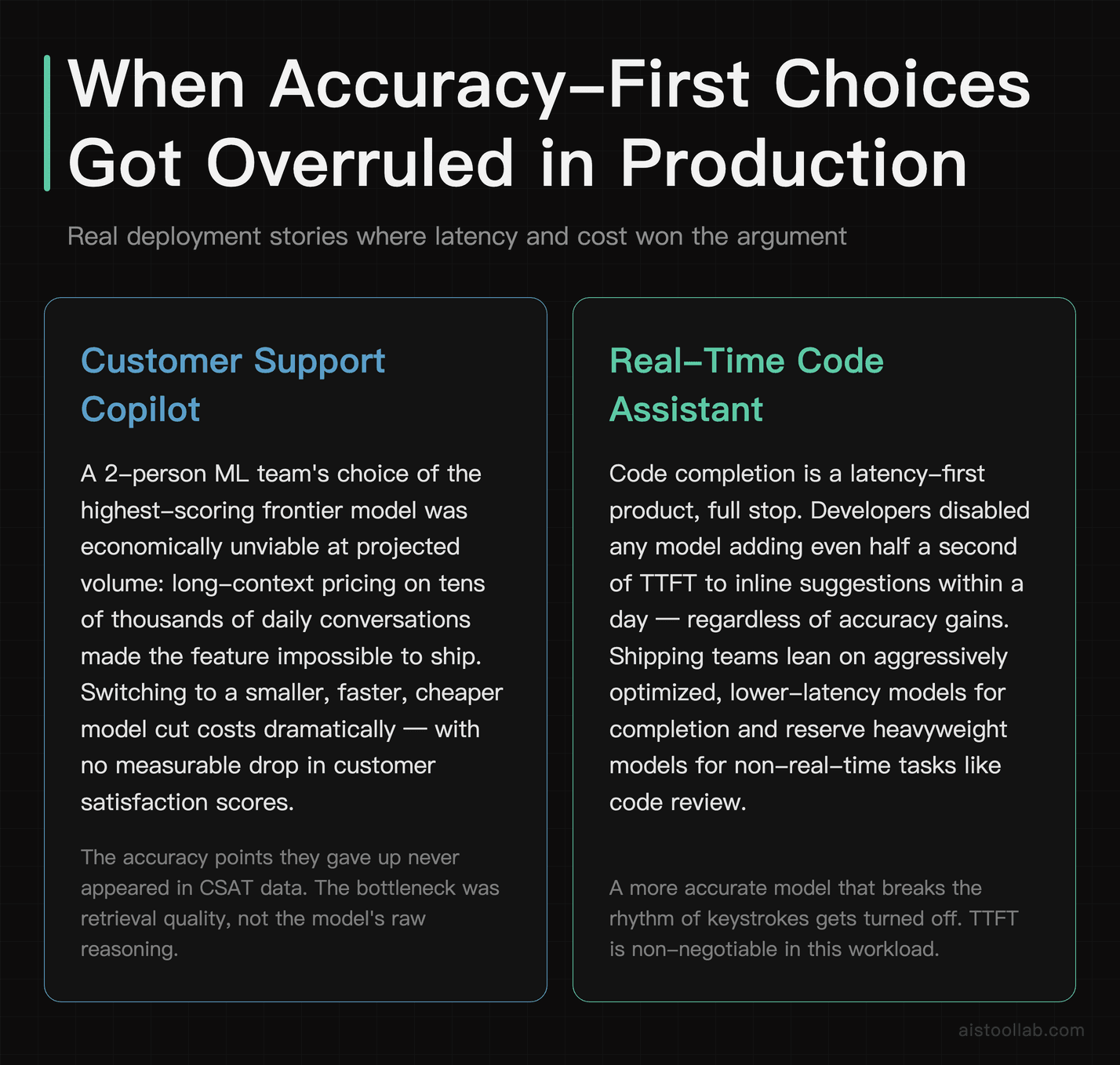
Picture a SaaS company with a 2-person ML team building an in-app support assistant. Their first instinct was the highest-scoring frontier model available. It worked beautifully in the demo. Then they modeled the cost at projected volume — tens of thousands of daily conversations, each with retrieved knowledge-base context stuffed into the prompt — and the long-context pricing made the feature economically impossible. Switching to a smaller, faster, cheaper model with solid-but-not-leading benchmark scores cut costs dramatically. The handful of accuracy points they gave up never showed up in customer satisfaction scores, because the bottleneck for support quality was retrieval quality, not the model’s raw reasoning.
The Real-Time Code Assistant
Code completion is a latency-first product, full stop. A developer typing in their editor expects suggestions to appear in the rhythm of their keystrokes. A more accurate model that adds even half a second of TTFT breaks flow and gets disabled within a day. This is why so many shipping coding tools lean on aggressively optimized, lower-latency models for inline completion and reserve the heavyweight models only for explicit, user-initiated “explain this” or “refactor this” actions where a slight wait is acceptable. I touched on this latency-vs-capability balance in the Cursor AI Code Editor Review 2026 writeup — the editor’s responsiveness matters as much as the underlying model’s smarts.
The High-Volume Content Pipeline
A content platform generating product descriptions for a large catalog ran the numbers on a top-tier model versus a mid-tier open model served on their own GPUs with continuous batching and quantization. The open model, at lower per-token cost and far higher throughput, processed the entire catalog overnight at a fraction of the API cost. Because this was a batch job with no human waiting, latency was irrelevant and throughput was everything. The “worse” model won decisively on the only axis that mattered for that use case.
Frequently Asked Questions
Does accuracy ever actually win over speed and cost?
Absolutely — context decides everything. In high-stakes domains where a wrong answer carries real consequences, accuracy rightly dominates. Medical decision support, legal contract analysis, financial risk modeling, and safety-critical systems are domains where paying for a slower, more expensive, more accurate model is not just justified but mandatory. The cost of an error dwarfs the cost of inference. The framework I’d suggest: estimate the business cost of a wrong answer versus the marginal cost of the more accurate model. When errors are cheap and recoverable (a slightly awkward marketing draft, a support reply a human reviews anyway), optimize for speed and cost. When errors are expensive or irreversible, optimize for accuracy and treat latency and cost as secondary. Most consumer and productivity applications fall into the first bucket, which is exactly why speed and cost win so often in practice — but the genuinely high-stakes minority is real, and treating those use cases like a chatbot would be a serious mistake.
How do I benchmark latency for my own use case?
Start by collecting a representative sample of your real prompts — not toy examples, but actual production-shaped inputs including your typical context lengths and output sizes. Then run a load test that mimics your expected concurrency, not single sequential requests. Measure TTFT, inter-token latency, and total latency, and record the full distribution: median, p95, and p99. The tail percentiles reveal how the system behaves under stress, which is where real users get hurt. Run the test against each candidate model and provider under identical conditions so the comparison is fair. Repeat at a few different concurrency levels to find where throughput plateaus and latency starts climbing — that inflection point is your practical capacity ceiling. Crucially, test at the times and on the infrastructure tier you’ll actually use; shared serverless endpoints behave very differently from dedicated capacity. Vendor-published numbers are a starting hypothesis, never a substitute for measuring against your own traffic. The whole point is that your prompts, your concurrency, and your SLA are unique.
What’s the difference between throughput and latency, in plain terms?
Latency is how long one request takes; throughput is how many requests you can handle per unit of time. They’re related but distinct, and optimizing one often hurts the other. Think of a coffee shop: latency is how long one customer waits for their drink, while throughput is how many drinks the shop serves per hour. A barista could lower individual latency by dropping everything to make your drink immediately, but that tanks throughput because the queue backs up. Batching multiple orders raises throughput but makes any single customer wait longer. In AI serving, large batches keep the GPU fully utilized (high throughput) but make early requests wait for the batch to process (higher latency). The art of serving is balancing these based on your workload: real-time apps prioritize low latency even at some throughput cost, while batch jobs maximize throughput and ignore latency entirely. Continuous batching is the modern technique that gets much closer to having both at once, which is why it’s become the default in serious serving stacks.
How is cost-per-inference actually calculated?
For hosted APIs, you multiply your input tokens by the input price and your output tokens by the output price, since most providers charge differently for each and quote prices per million tokens. Output tokens are usually more expensive than input tokens, so verbose models cost more even at the same nominal rate. For self-hosted deployments, the calculation flips to hardware utilization: take your GPU’s hourly rental or amortized cost and divide by how many requests it serves per hour. This is why throughput optimization directly reduces unit cost — every improvement in requests-per-hour proportionally lowers cost-per-request. To get total cost of ownership, layer in the often-ignored extras: engineering time to maintain the serving stack, idle GPU time during low-traffic periods, cold-start overhead on serverless tiers, and the cost of over-provisioning to handle traffic spikes. Many teams discover that a slightly pricier managed API beats self-hosting once they account for the human cost of keeping infrastructure healthy. Run both models honestly before committing.
Will a smaller, cheaper model hurt my product’s quality?
Often less than you’d fear, and the only way to know is to test against your specific task rather than trusting general leaderboards. Benchmark scores measure broad capability across diverse academic tasks, but most production applications use a narrow slice of that capability. A model that scores lower overall may be perfectly competent — even indistinguishable — on your particular workflow, whether that’s summarizing support tickets, drafting product copy, or classifying documents. The right approach is to build a small evaluation set from your real tasks, with outputs you or a domain expert can judge, and compare candidate models head-to-head on it. You’ll frequently find the quality gap on your actual task is far smaller than the benchmark gap implies, while the speed and cost gap is enormous. That’s the trade worth making. Where smaller models genuinely struggle is complex multi-step reasoning, nuanced instruction-following, and long-context coherence — so if your task leans heavily on those, test extra carefully before downgrading.
What is time-to-first-token and why does everyone obsess over it?
Time-to-first-token (TTFT) is the delay between sending a request and receiving the first token of the response. It matters disproportionately because it’s the gap users perceive as “loading” — the dead air where the interface seems frozen. In a streaming chat experience, once tokens start flowing, the response feels alive even if the full answer takes several more seconds to complete. But a long TTFT, before anything appears, reads as a broken or slow app regardless of how good the eventual answer is. TTFT is driven mainly by the prefill phase, where the model processes your entire input prompt before generating anything, so it scales with prompt length. This is exactly why RAG systems that stuff huge retrieved contexts into the prompt can feel sluggish — the model has to chew through all that context before the first word appears. Optimizing TTFT often means trimming prompt length, caching repeated context, or choosing a model and serving setup tuned for fast prefill. For any human-facing real-time interface, it’s frequently the single most important latency metric.
Should I self-host or use a managed inference API?
It depends on volume, predictability, and your team’s appetite for infrastructure work. Managed APIs win for getting started, spiky or unpredictable traffic, and small teams without ML-ops bandwidth — you pay a per-token premium but skip the operational burden entirely. Self-hosting or using a dedicated inference platform wins at high, steady volume where the per-token economics of running your own GPUs at high utilization beat API pricing, and where you need control over the model, data residency, or fine-tuned weights. The break-even point is genuinely a calculation worth doing: estimate your monthly token volume, compare managed API cost against the fully-loaded cost of dedicated GPUs (including idle time, engineering, and over-provisioning), and be honest about the hidden human costs of self-hosting. Affordable inference platforms occupy a useful middle ground — you get open-model flexibility and competitive per-token pricing without managing raw hardware yourself. For most teams below serious scale, a managed approach is the pragmatic default; the operational savings usually outweigh the per-token markup until you’re running very large, predictable volume.
How does context window length affect performance and cost?
Longer contexts hit you on both axes simultaneously, which catches a lot of teams off guard. On cost, every token in your prompt is billed, so stuffing large retrieved documents or long conversation histories into the context multiplies your input cost per call — and since this happens on every single request, it compounds fast at volume. On latency, longer prompts inflate TTFT because the model must process the entire input during prefill before generating the first output token, so a request with a massive context can feel noticeably slower to start. This is the hidden tax on naive RAG implementations that retrieve and inject far more context than the task actually needs. The fixes are practical: retrieve more selectively so you inject only genuinely relevant chunks, use prompt caching where your provider supports it to avoid reprocessing static context, and compress or summarize history rather than passing it verbatim. Treating context length as a free resource is one of the most common and expensive mistakes in production AI — every token you add has a price and a latency cost.
The Verdict: Optimize for the Job, Not the Leaderboard
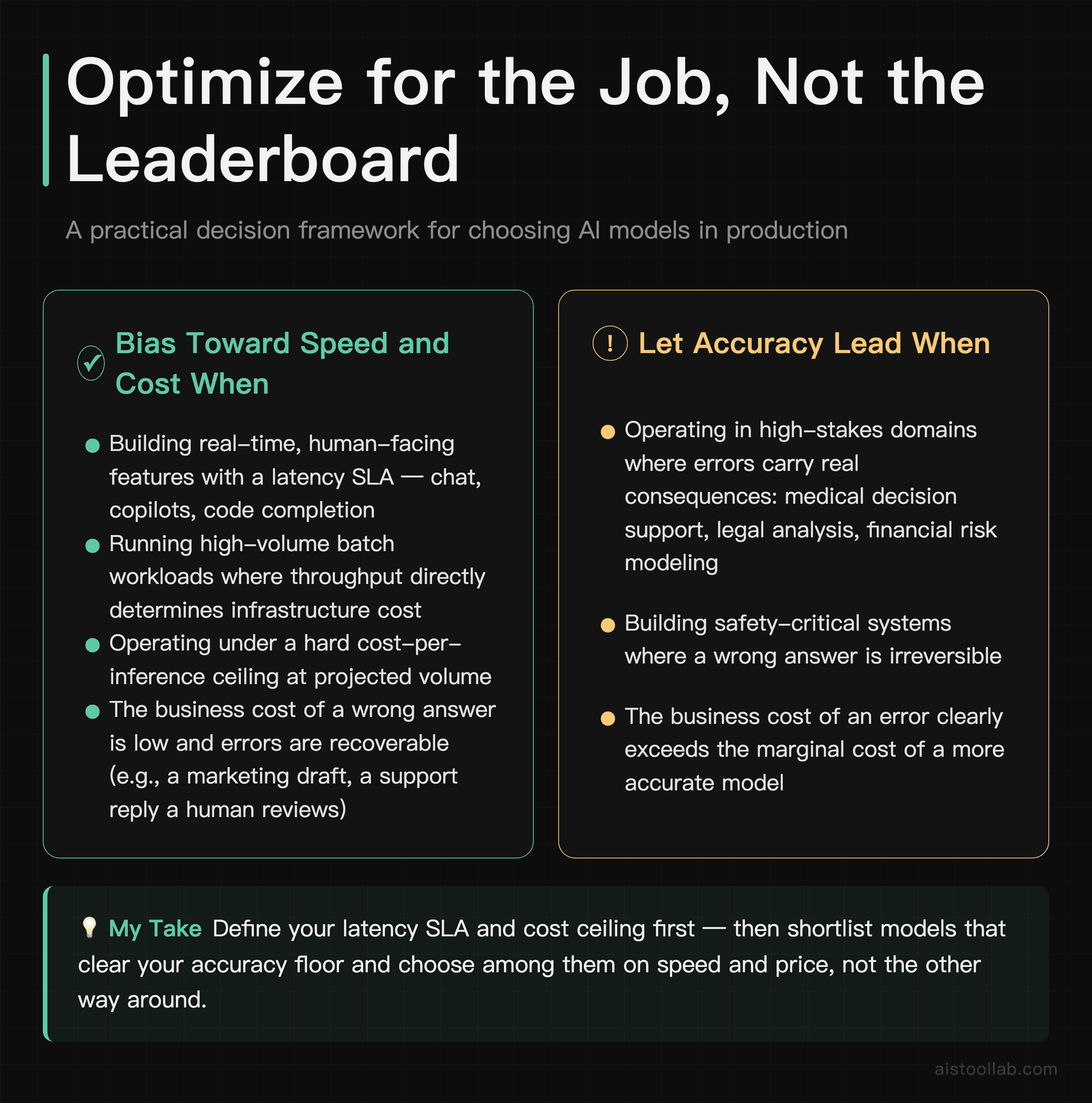
The accuracy-first mindset is a comfortable trap because leaderboards are simple, public, and feel objective. But shipping AI to real users is a multi-variable optimization problem where accuracy is just one input — and rarely the binding constraint. The teams winning in production aren’t the ones running the highest-MMLU model; they’re the ones who matched the right model to their actual latency requirements, throughput needs, and cost ceiling.
If it were my call on a real budget: start by defining your non-negotiables. What’s your latency SLA? What’s your cost-per-inference ceiling at projected volume? What’s the actual business cost of a wrong answer? Then shortlist models that clear the accuracy floor for your task and choose among them on speed and cost — not the other way around. For real-time, human-facing features, bias hard toward low TTFT and fast streaming. For batch and offline work, maximize throughput and ignore latency. For high-stakes correctness, and only there, let accuracy lead.
The next step is concrete and takes an afternoon: build a small evaluation set from your real prompts, load-test two or three candidate models against it at realistic concurrency, and watch the p99 latency and the cost meter together. You’ll learn more in that afternoon than from a month of staring at benchmark leaderboards — and you might be surprised which model you end up shipping.
Last updated: 2026
Found this review helpful?
👉 Browse the AI Tools Library to find the right tools for your workflow.