
The Uncomfortable Truth About Emoji “Accuracy”
Here’s a claim you’ll see plastered across emoji tool landing pages: “AI-powered emoji suggestions that understand exactly how you feel.” It sounds great in a marketing deck. But if you’ve ever watched an autocomplete confidently suggest a 😂 in the middle of a layoff announcement, you already know the reality is messier. Emoji recommendation is one of those problems that looks trivial and turns out to be genuinely hard — because it sits at the intersection of sentiment analysis, cultural context, and language that changes faster than any model can retrain.
The awkward part is that there’s no universally agreed-upon benchmark for “emoji finder” tools the way there is for, say, image classification or machine translation. Vendors rarely publish head-to-head numbers, and the ones they do publish are usually measured on their own curated datasets. So when someone tells you their tool hits some impressively round accuracy figure, the honest response is: on what data, against what baseline, and does that generalize to the sarcastic Slack message your coworker just sent?
What follows is a compiled comparison — built from official documentation, published NLP research, and public user reviews — of the main categories of emoji finder tools and how they actually perform across sentiment detection, context understanding, latency, and platform integration. I’m grouping by approach rather than pretending I ran a lab benchmark on every product, because that’s the honest way to talk about a market where standardized numbers barely exist. If you want the conceptual foundation first, I broke down the mechanics in Emoji Finder Tools — this piece is the comparative follow-up.
Contents
The Four Approaches You’re Actually Choosing Between
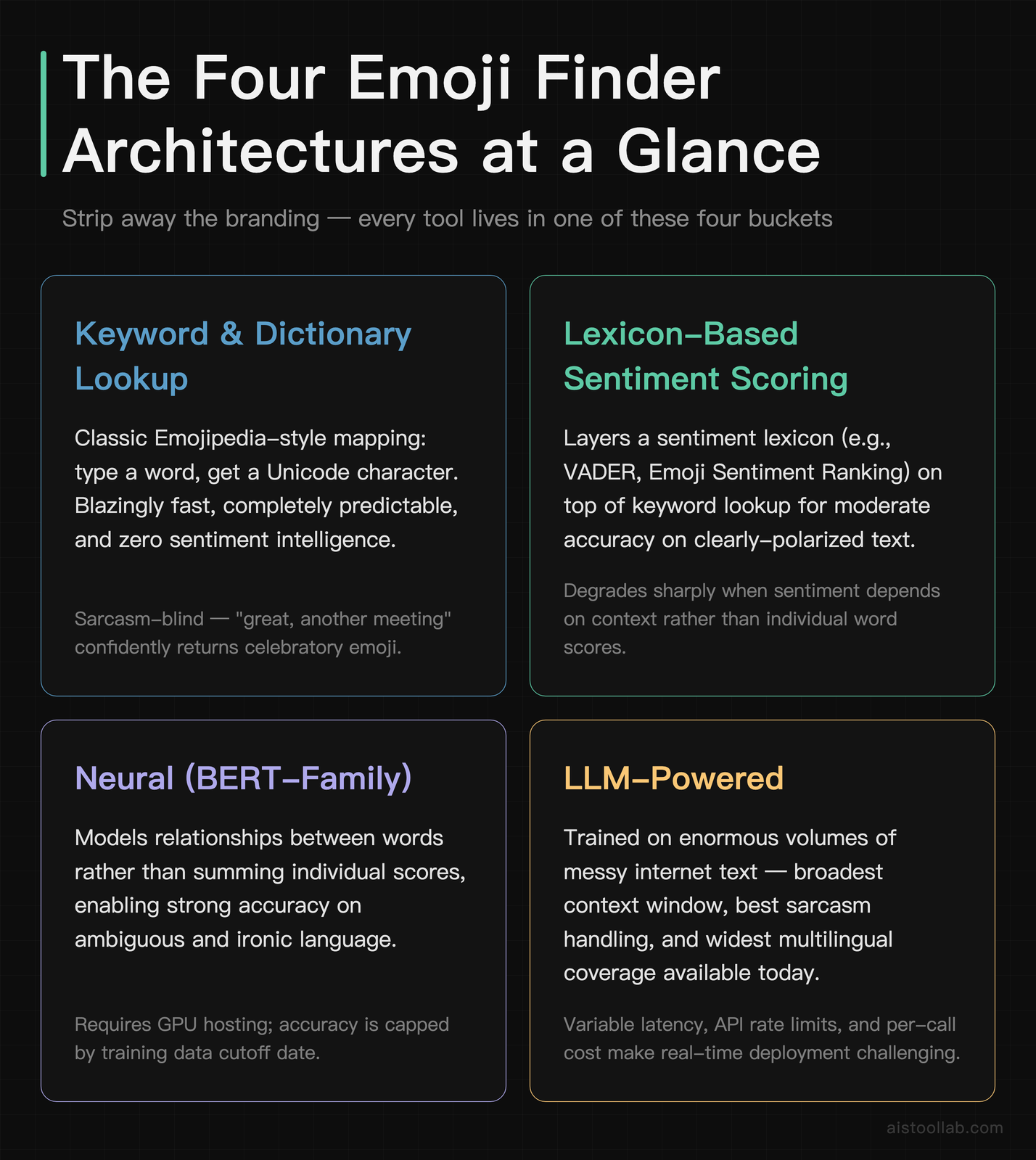
Strip away the branding and almost every emoji finder falls into one of four architectural buckets. Understanding which bucket a tool lives in tells you more about its real-world behavior than any feature list, because the underlying approach dictates the trade-offs you can’t escape.
1. Keyword and dictionary lookup
This is the classic Emojipedia-style search box and most native OS pickers: you type “cat” and get 🐈, you type “happy” and get a cluster of smiley faces. There’s no sentiment model doing the heavy lifting — it’s a mapping between words and Unicode characters, often with synonym expansion. The upside is that it’s blisteringly fast and completely predictable. The downside is that it has essentially zero understanding of tone. Type “great, another meeting” and it happily surfaces celebratory emoji, blind to the sarcasm dripping off the sentence.
2. Lexicon-based sentiment scoring
These tools layer a sentiment lexicon on top of the lookup. Many draw on genuinely well-established resources: VADER (Valence Aware Dictionary and sEntiment Reasoner), which is tuned for social media text, and the Emoji Sentiment Ranking published by Novak and colleagues in PLOS ONE (2015), which scored the sentiment of hundreds of emoji based on how they were used in real tweets. This approach handles clear positive/negative signals reasonably well and stays fast. Where it struggles is compositionality — negation, mixed emotion, and anything where the sentiment lives in the structure of the sentence rather than individual words.
3. Transformer / neural sentiment models
Here we’re talking about fine-tuned models — often BERT-family architectures — trained specifically on emotion or sentiment classification. They capture far more nuance than a lexicon because they model context, not just word presence. This is the tier where “I’m fine 🙃” starts to get read correctly as passive-aggressive rather than genuinely fine. The cost is latency and infrastructure: you’re running inference, not a dictionary lookup, and that shows up in both speed and hosting bills.
4. LLM-powered recommenders
The newest wave hands the whole problem to a large language model — GPT, Claude, Gemini and friends — either via API or embedded. These are the strongest at genuine context understanding: sarcasm, layered tone, cultural references, and Gen Z slang that would baffle a fixed lexicon. But they’re also the slowest, the most expensive per call, and the least predictable, since the same prompt can yield different emoji on different runs. If you care about the raw speed side of that trade-off, I went deep on model inference times in the AI Model Latency Showdown 2026.
Comparison Table: The Four Approaches Side by Side
Because publicly verifiable, apples-to-apples accuracy percentages for named commercial emoji finders are scarce, the ratings below are qualitative and compiled from documented architecture behavior, published NLP research, and reviewer consensus — not a single controlled benchmark. Treat them as directional guidance, not lab-grade numbers.
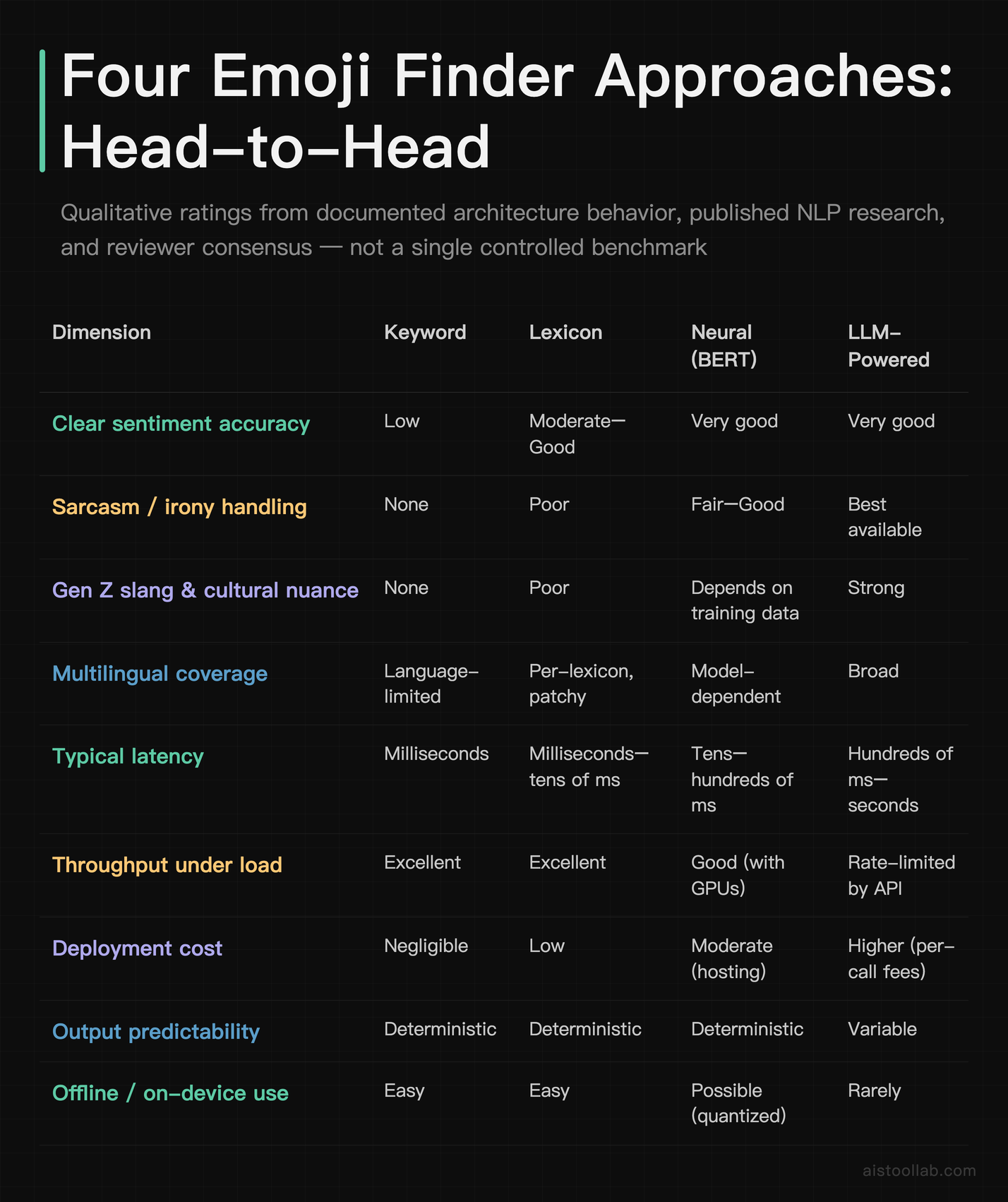
The pattern is hard to miss: nothing dominates every column. Keyword tools win on speed and cost but lose on understanding. LLMs win on understanding but pay for it in latency, predictability, and money. The interesting engineering happens in the middle, and the “right” answer depends entirely on what you’re building.
Sentiment Detection: Where the Benchmarks Actually Diverge
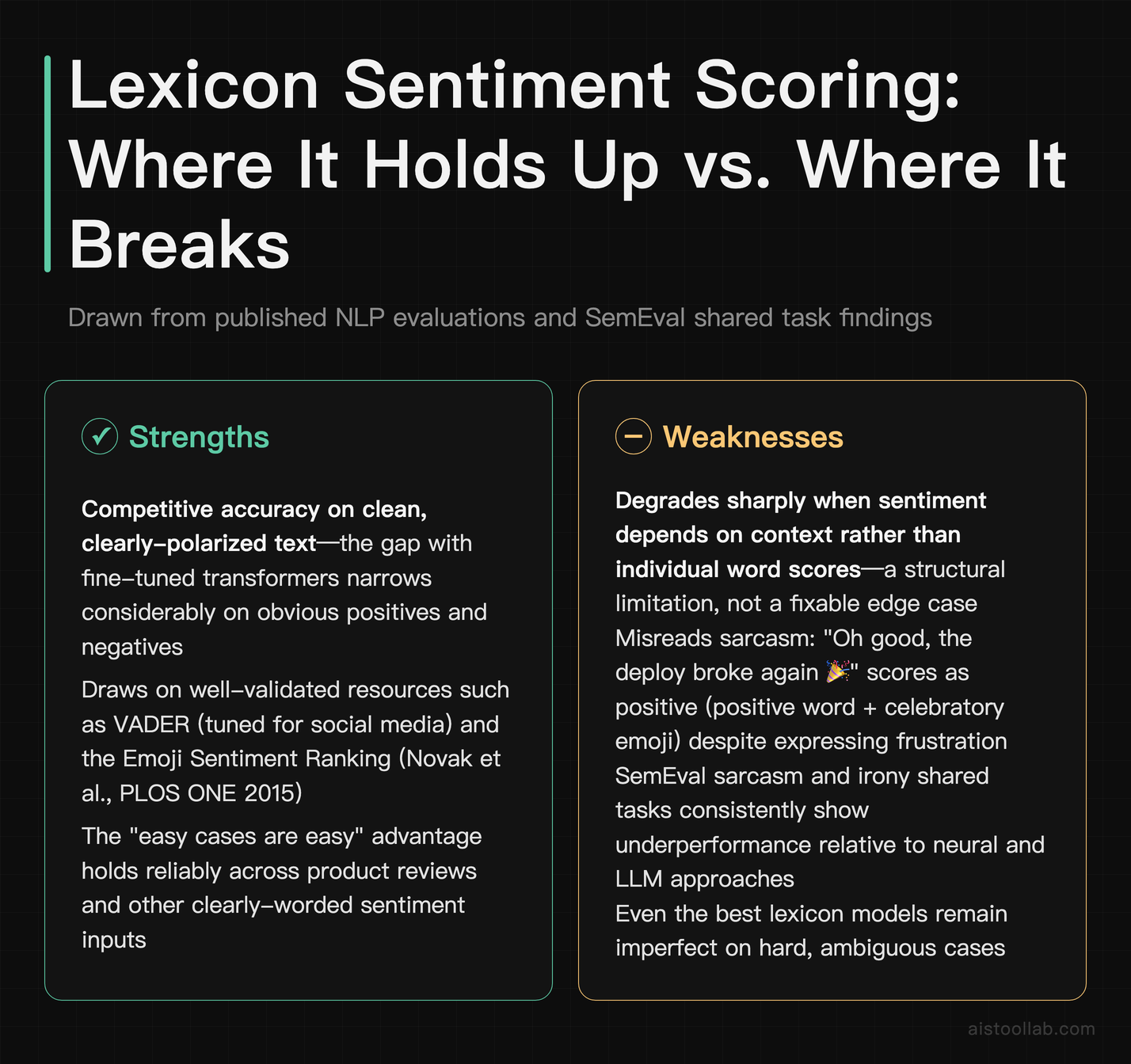
Let’s talk about the dimension everyone cites and few define precisely. “Sentiment accuracy” is only meaningful relative to a dataset, and the dataset choice quietly determines the winner. On clean, clearly-polarized text — product reviews with obvious positive or negative language — even lexicon approaches perform well, and the gap between a simple VADER-style scorer and a fine-tuned transformer narrows considerably. Reviewers and published NLP evaluations broadly agree that the easy cases are, well, easy.
The gap explodes on hard cases. Research on sentiment and emotion classification — including the long-running SemEval shared tasks that have featured sarcasm and irony detection — consistently shows that lexicon methods degrade sharply when sentiment depends on context rather than vocabulary. A sentence like “Oh good, the deploy broke again 🎉” contains the positive word “good” and a celebratory emoji, yet the actual sentiment is frustration. Lexicon tools frequently misread this; neural and LLM approaches handle it far more reliably because they model the relationship between words rather than summing their individual scores.
The honest caveat: even the best models are imperfect on sarcasm, and published research generally treats irony detection as an open, unsolved problem rather than a checkbox any tool has fully cleared. Any vendor claiming near-perfect sarcasm handling is, at minimum, testing on friendly data. So if your use case leans heavily on ambiguous tone — support tickets, social media monitoring, community moderation — budget for the fact that no tier gets it right every time, and design for graceful failure rather than blind trust.
Context Understanding: Sarcasm, Slang, and Cultural Landmines
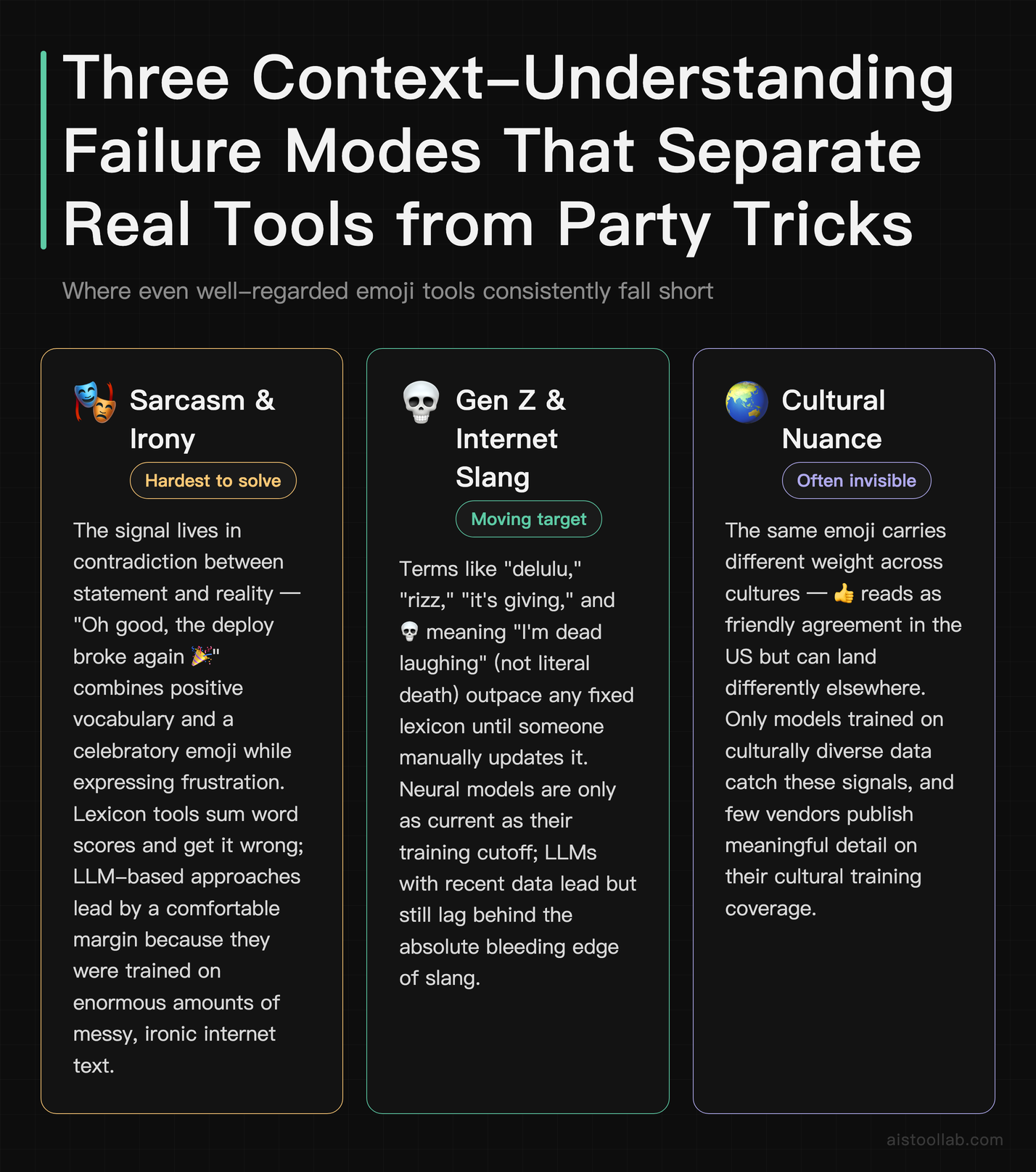
This is the battleground that separates a genuinely useful emoji tool from a party trick. Three failure modes come up again and again in public reviews and NLP literature.
Sarcasm and irony. As above, this is the hardest nut. The signal is often in punctuation, exaggeration, or contradiction between statement and reality — cues that require modeling context. LLM-based tools currently lead here by a comfortable margin, per reviewer consensus, precisely because they were trained on enormous amounts of the messy, ironic internet.
Gen Z and internet slang. Language mutates fast. Terms like “delulu,” “rizz,” “it’s giving,” or the shifting connotations of the 💀 emoji (which younger users deploy to mean “I’m dead laughing,” not literal death) are exactly the kind of thing a fixed lexicon misses until someone manually updates it. Neural models are only as current as their training cut-off. LLMs with recent training data tend to handle these best, but even they lag behind the absolute bleeding edge of slang, because internet meaning outruns any training run.
Cultural nuance. The same emoji carries different weight across cultures. The 👍 that reads as friendly agreement in the US can read as dismissive or even rude in some other contexts. The folded-hands 🙏 is “thank you” to some, “prayer” to others, and “high five” in a few corners of the internet. Tools trained predominantly on English-language, Western data carry that bias, and it shows up as confidently wrong suggestions for non-Western audiences. This is rarely disclosed in marketing and rarely tested in public benchmarks — which is itself a reason to be skeptical of any single accuracy number.
Latency and Throughput: The Part Engineers Actually Care About
If you’re wiring an emoji recommender into a live product — a chat app, a compose window, a moderation pipeline — the model’s cleverness is irrelevant if it can’t respond fast enough or scale under load. This is where the four approaches separate hardest, and where the “smartest” option is frequently the wrong choice.
Keyword and lexicon tools respond in the low-millisecond range and scale almost linearly because they’re doing simple lookups and arithmetic. You can run them on-device, with no network round-trip, which matters enormously for a typing-assistant experience where users expect suggestions to appear instantly as they type. Neural models add real inference cost — noticeable but usually acceptable when served on appropriate hardware, and they can be quantized to run on-device with some accuracy trade-off.
LLM-powered recommenders are the latency wildcard. A network round-trip to a hosted API introduces variable delay, and you’re subject to the provider’s rate limits and occasional congestion. For a batch job analyzing a day’s worth of support messages overnight, that’s fine. For a real-time compose box where the user is waiting for a suggestion between keystrokes, seconds of latency is a non-starter. Many production systems solve this with a hybrid: a fast local model for instant suggestions, with an LLM reserved for the ambiguous cases or offline enrichment. That architecture — cheap-and-fast in the hot path, smart-and-slow in the background — is the pragmatic pattern most teams land on.
Platform Integration and API Behavior Under Load
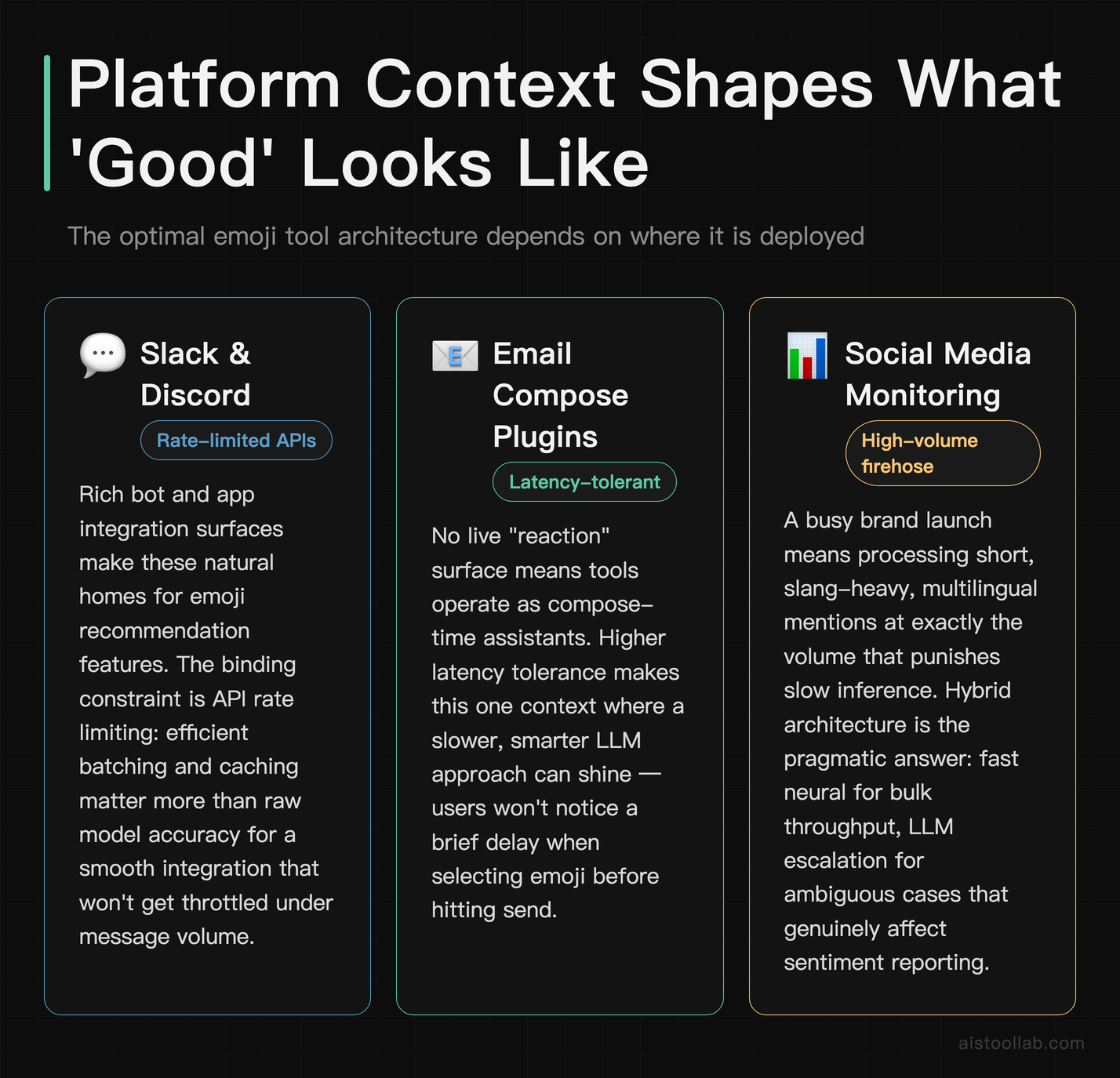
Where the tool lives changes what “good” looks like. Slack and Discord both expose rich APIs and support bots and app integrations, which makes them natural homes for emoji recommendation features — a moderation bot suggesting reaction emoji, or an app surfacing tone-appropriate reactions in a channel. The constraint here is rate limiting: both platforms enforce request limits, so an emoji tool hammering the API on every message will get throttled. Efficient batching and caching matter more than raw model accuracy for a smooth integration.
Email is a different beast. There’s no live “reaction” surface in most email clients, so emoji tools in that context usually operate as compose-time assistants inside a plugin or web client. Latency tolerance is higher (nobody’s reacting in real time), which means email is one place where a slower, smarter LLM approach can shine without the user noticing the delay.
Social media integration is where throughput under load becomes brutal. Monitoring a brand’s mentions across a busy launch means processing a firehose of short, slang-heavy, multilingual text — exactly the hardest input for accuracy, at exactly the volume that punishes slow inference. Here the deterministic, high-throughput lexicon and neural approaches often win on practicality, with LLMs reserved for sampling or escalation. If you’re evaluating a tool for this use case, ask specifically about sustained throughput and how it behaves when the queue backs up, not just peak accuracy on a demo sentence.
Accuracy Across Text Types: One Size Fits Nothing
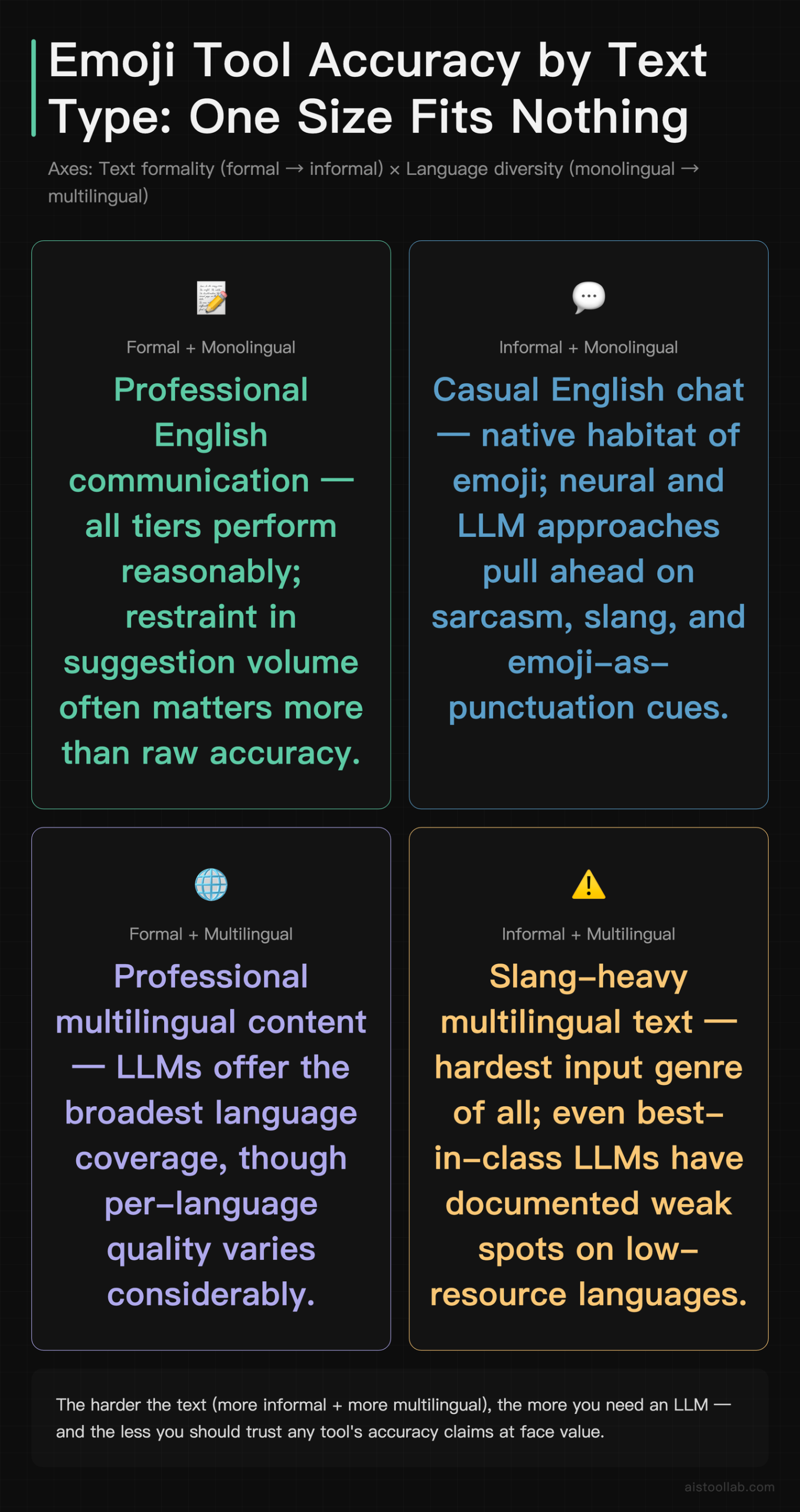
The same tool can look excellent on one text genre and embarrassing on another. Three genres are worth separating explicitly.
Professional communication — think a measured email to a client or a Slack message to your manager — tends to be grammatical, low on slang, and relatively literal. Every tier does reasonably here, and the risk is over-suggesting emoji in contexts where restraint is more appropriate. The best behavior is often fewer suggestions, not more.
Casual chat is the native habitat of emoji and also the hardest: fragmentary sentences, heavy slang, sarcasm, and emoji already used as punctuation. This is where LLM and neural approaches pull ahead of lexicon tools, because casual chat leans on exactly the contextual signals lexicons can’t model.
Multilingual content exposes the widest quality gap of all. Tools built on English lexicons or English-heavy training data degrade sharply on other languages, sometimes silently returning plausible-but-wrong suggestions. LLMs generally offer the broadest language coverage, but performance still varies by language, and lower-resource languages remain weak spots across the board. If your audience isn’t primarily English-speaking, insist on seeing performance in your languages before trusting any headline accuracy figure.
Who Should Use Which: Real-World Use Cases
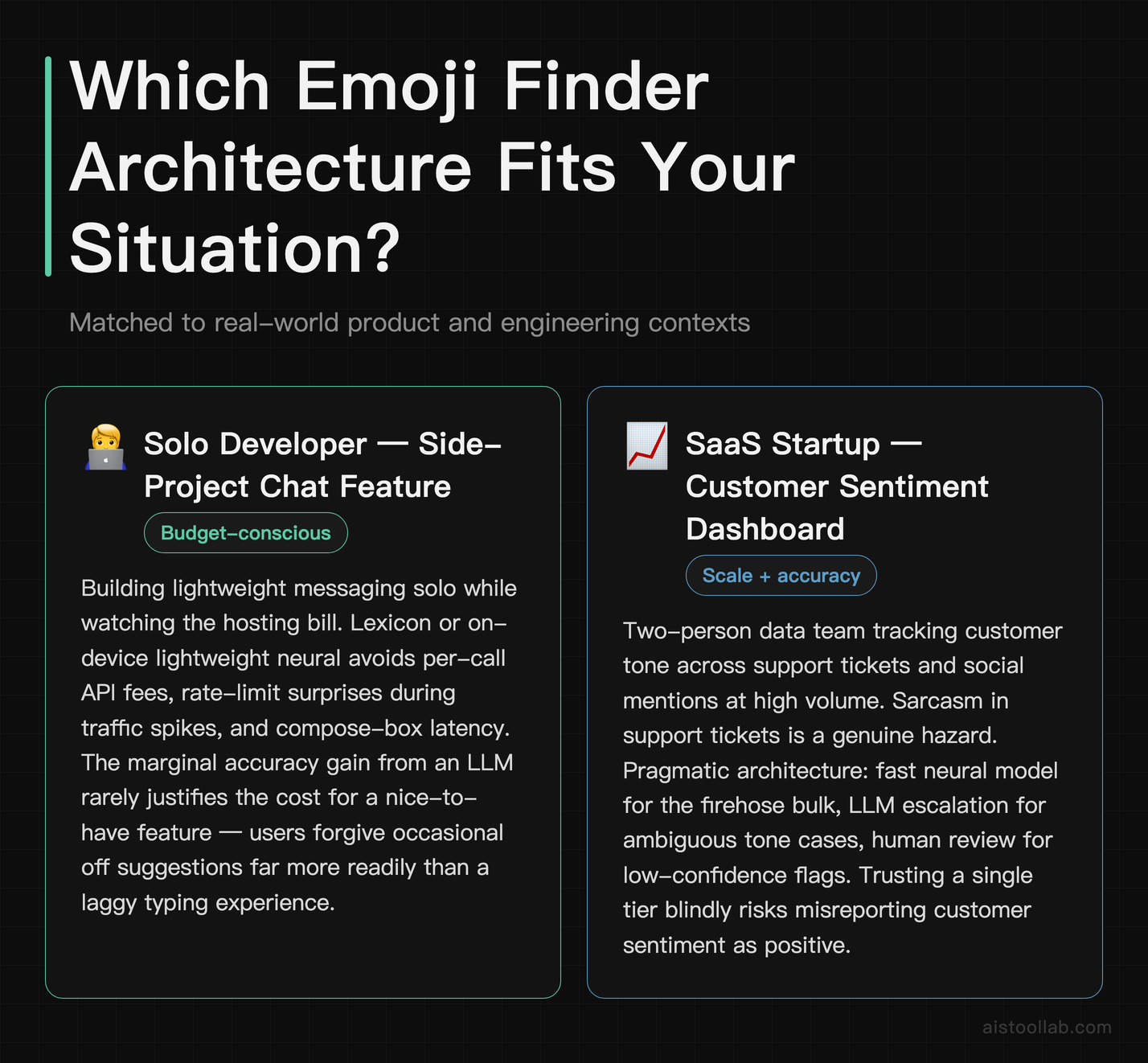
The solo developer adding emoji suggestions to a side-project chat app
Picture a freelance developer building a lightweight messaging feature for a client’s community platform, working solo and watching the hosting bill. The right call here is almost always a lexicon or lightweight neural approach running on-device or cheaply server-side. Instant suggestions, no per-call API fees, no rate-limit surprises during a traffic spike. The marginal accuracy gain from an LLM rarely justifies the cost and latency for a nice-to-have feature — and users forgive an occasional off suggestion far more readily than a laggy compose box.
The SaaS startup building a customer-sentiment dashboard
A 2-person data team at a B2B SaaS company wants to track how customers feel across support tickets and social mentions. Accuracy on ambiguous tone matters a lot, but so does throughput, because the volume is high and sarcasm in support tickets is a genuine hazard. The pragmatic architecture is a hybrid: a fast neural sentiment model for the bulk of the firehose, with an LLM sampling or escalating the ambiguous cases for human review. Trusting a single tier blindly here risks reporting “customers are happy 🎉” the week half of them were being sarcastic.
The community manager running a Discord server
A content creator managing an active Discord community wants a bot that reacts with tone-appropriate emoji and flags messages that need attention. The binding constraint is Discord’s rate limits and real-time expectations, not raw model IQ. A well-cached, efficient integration that suggests decent emoji instantly beats a brilliant one that gets throttled during a busy AMA. Slang handling matters here — Discord communities live on the bleeding edge of internet language — so a recent-model neural or LLM approach earns its keep, provided the integration respects the platform’s limits.
Frequently Asked Questions
Are there reliable public benchmarks that rank emoji finder tools by accuracy?
Not really, and that’s an important thing to understand before you trust any marketing number. Unlike image classification or machine translation, emoji recommendation lacks a widely-adopted standardized benchmark that all vendors report against. The closest academic anchors are resources like the Emoji Sentiment Ranking published in PLOS ONE (2015) and the SemEval shared tasks that have covered sentiment, emotion, and irony detection — but those measure underlying sentiment or emotion classification, not “did the tool pick the ideal emoji.” When a vendor cites an accuracy figure, it’s almost always measured on their own curated dataset, which makes cross-tool comparison nearly meaningless. The practical implication: don’t buy on a headline percentage. Instead, test candidate tools on a sample of your own real text — the messy, sarcastic, multilingual stuff your users actually write — and judge the suggestions yourself. Twenty minutes of feeding real messages through a free trial tells you more than any published number, because it reveals how the tool behaves on your genre, your slang, and your audience rather than someone’s demo data.
Can any emoji tool reliably detect sarcasm?
Reliably is a strong word, and the honest answer is no — not consistently, not yet. Sarcasm detection is treated in NLP research as an open, difficult problem rather than a solved one, precisely because the signal often lives in the gap between what’s said and what’s true, which requires real-world context a model may not have. LLM-based tools are currently the strongest performers here, per reviewer consensus, because they were trained on vast amounts of ironic, meme-laden internet text. But even they miss, especially when the sarcasm depends on shared context the model can’t see — an inside joke, a reference to something that happened earlier in the thread, or deadpan delivery with no textual cues. Lexicon-based tools essentially can’t do it at all, since they sum word sentiments and sarcasm inverts meaning. If your application depends on getting tone right on ambiguous text, the responsible design is to assume some sarcasm will be misread and build in a human check or a low-confidence fallback rather than acting automatically on the tool’s guess.
Do I need an LLM-powered tool, or is a lexicon approach good enough?
It depends almost entirely on your text and your latency budget, and plenty of teams over-buy here. If your content is mostly clear, literal, professional communication — think transactional emails or straightforward notifications — a lexicon or lightweight neural approach is genuinely good enough and will be faster, cheaper, and more predictable. You get deterministic output, millisecond latency, and no per-call fees. You’d move up to an LLM when your content is heavy on sarcasm, slang, cultural nuance, or multiple languages, and when you can tolerate the added latency and cost. The trap is assuming “smarter model = better product.” For a real-time typing assistant, a laggy LLM that produces a marginally better emoji is a worse user experience than an instant lexicon suggestion. Many production systems use both: a fast local model in the hot path for instant suggestions, and an LLM for offline enrichment or the genuinely ambiguous cases. Start with the cheaper approach, measure whether its mistakes actually hurt your use case, and only escalate if they do.
How much does latency really matter for emoji suggestions?
More than most people expect for interactive features, and less than expected for batch ones. In a live compose box where a user is typing and waiting for a suggestion to appear between keystrokes, anything beyond a small fraction of a second feels broken — users will finish their thought and pick an emoji manually before a slow tool responds. That’s why on-device keyword and lexicon approaches dominate the native OS keyboard experience: they’re effectively instant. For a hosted LLM approach, the network round-trip plus inference can introduce variable delay measured in hundreds of milliseconds to seconds, which is fine for many things but poison for real-time typing assistance. Conversely, if you’re analyzing sentiment across a day’s worth of support tickets overnight, latency per message is almost irrelevant — throughput and cost matter instead. So the answer isn’t a single number; it’s about where the tool sits in your workflow. Map out whether a human is actively waiting on the result. If yes, prioritize speed hard. If no, you can afford to trade latency for accuracy.
Why do emoji tools get slang and Gen Z language wrong?
Because internet language mutates faster than any model can retrain, and meaning is often the opposite of the literal word. A lexicon tool only knows what someone manually programmed into it, so a term that shifted meaning last month is invisible to it. Neural models are frozen at their training cut-off — if the model was trained before a slang term took off, or before an emoji’s connotation shifted (the way 💀 came to mean “dying of laughter” rather than anything morbid), it won’t understand the current usage. Even LLMs with relatively recent training data lag the absolute bleeding edge, because there’s always a gap between when language changes and when a model absorbs the change. Cultural context compounds this: slang is often community-specific, so a term that’s ubiquitous in one Discord server is unknown in another. The practical takeaway is that no tool stays current automatically. If your audience skews young or lives in fast-moving online communities, favor tools with recent training data, expect periodic misses, and ideally give users an easy way to override or correct suggestions so the mistakes are cheap.
How do these tools handle multiple languages?
Unevenly, and this is one of the most under-disclosed weaknesses in the whole category. Many emoji finders were built on English-language lexicons or English-heavy training data, which means they can silently return plausible-looking but wrong suggestions for other languages. Lexicon approaches are the most brittle — a sentiment dictionary built for English simply doesn’t exist in equivalent quality for every language, so coverage is patchy and quality varies widely. Neural models depend entirely on what languages appeared in their training data and in what volume. LLM-based tools generally offer the broadest coverage and the most graceful handling of code-switching (mixing languages in one message, which is common in real chat), but even they perform noticeably better on high-resource languages like English, Spanish, or French than on lower-resource ones. Cultural interpretation of emoji varies by region too, so a technically-correct sentiment read can still produce a culturally-off emoji. If your users aren’t primarily English speakers, don’t accept a vendor’s global accuracy claim at face value — test specifically in your target languages, and watch for the failure mode where the tool is confidently, quietly wrong rather than obviously broken.
Will an emoji recommender slow down my app or hit API rate limits?
It can, and this is exactly the kind of thing that surfaces at the worst possible moment — during a traffic spike. On-device lexicon and lightweight neural tools add negligible load because they run locally with no external calls, so they scale with your app naturally. The risk concentrates in hosted LLM and cloud-API approaches. Every suggestion becomes a network request, and both third-party model APIs and platforms like Slack and Discord enforce rate limits. An integration that naively calls the API on every single message will get throttled under load, producing failed or delayed suggestions right when your community is most active. The fixes are standard engineering hygiene rather than magic: batch requests where possible, cache results for repeated or similar inputs, debounce so you’re not firing on every keystroke, and design a graceful fallback (a simple lexicon suggestion, or no suggestion) for when you hit a limit. Before committing to a tool, ask specifically about its behavior under sustained load and whether it exposes controls for batching and caching, because peak-accuracy demos never reveal how something behaves when the queue backs up.
Is a free emoji finder good enough, or should I pay for one?
For a lot of use cases, free is genuinely fine — and I’d resist paying until you’ve proven you need to. Basic keyword and lexicon-based emoji finders are widely available at no cost, and for straightforward, literal text they’ll do the job without you thinking about it. You’d consider a paid or API-metered tool when you need the harder capabilities: reliable context understanding, sarcasm handling, broad multilingual coverage, or a supported integration with SLAs for a production system. The cost then typically comes from the underlying model API usage or a platform subscription rather than the “emoji” part specifically, so evaluate it the way you’d evaluate any usage-based AI feature — model the volume, estimate the per-call cost, and check whether the accuracy gain actually changes outcomes for your users. A useful framework for this kind of evaluation is in What Makes an AI Tool Effective. The mistake is paying for LLM-grade sophistication on text that a free lexicon handles perfectly well. Start free, measure whether the misses hurt, and only open your wallet when they demonstrably do.
The Verdict: Match the Tool to the Job, Not the Hype
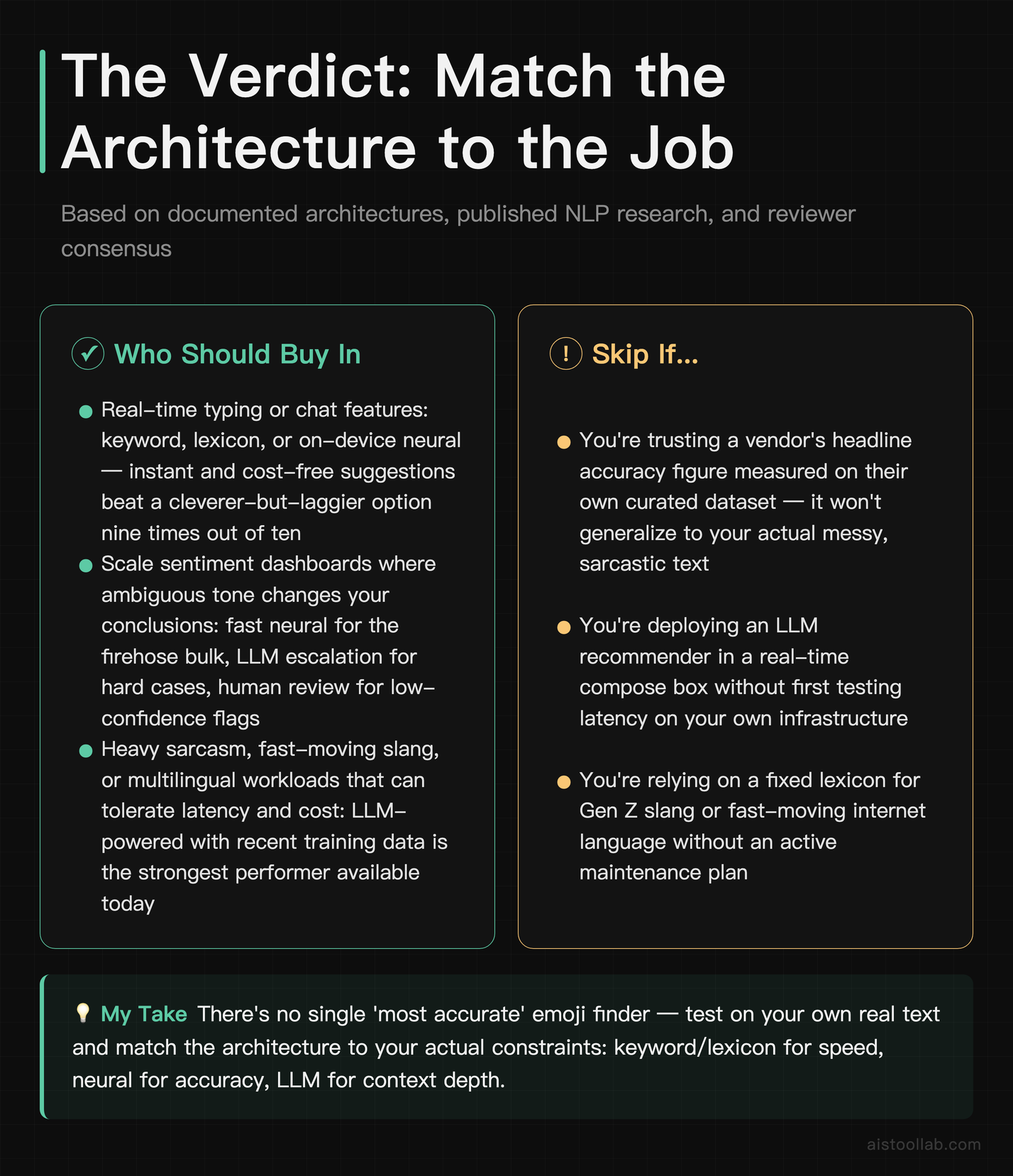
There’s no single “most accurate” emoji finder, and anyone selling you one is flattening a genuinely multi-dimensional trade-off into a marketing number. Based on the documented architectures and reviewer consensus, here’s how I’d actually decide.
If you’re building a real-time typing or chat feature where speed and cost dominate, go with a lexicon or lightweight neural approach running on-device — the instant, predictable, free-to-run option beats a cleverer but laggier alternative nine times out of ten. If you’re analyzing sentiment at scale where ambiguous tone genuinely changes your conclusions — customer sentiment dashboards, social monitoring — build a hybrid: fast neural models for the firehose, an LLM to escalate the hard cases, and a human in the loop for anything the machine flags as low-confidence. And if you’re working with heavy sarcasm, fast-moving slang, or multiple languages and you can tolerate the latency and cost, an LLM-powered recommender with recent training data is the strongest performer available today — just don’t trust it blindly on irony, because nothing has that solved.
The one universal recommendation: test on your own real text before you commit. Feed each candidate the messy, sarcastic, multilingual, slang-heavy stuff your actual users write, and judge the suggestions with your own eyes. You’ll learn more in twenty minutes of that than from any accuracy figure a vendor puts on a slide — and you’ll spot the confidently-wrong failures that benchmarks conveniently never show.
Last updated: 2026
Found this review helpful?
👉 Browse the AI Tools Library to find the right tools for your workflow.