
The Myth of “AI-Powered” Prime Checking (And What’s Actually Happening Under the Hood)
Here’s a claim you’ll see plastered across landing pages: “Our AI verifies whether a number is prime in milliseconds.” It sounds futuristic. It also, for the most part, isn’t true — at least not in the way the marketing implies. Determining whether a number is prime is one of the oldest problems in mathematics, and the algorithms that actually do the heavy lifting were invented long before the current machine-learning boom. Most of them don’t involve neural networks at all.
That’s not me being a killjoy. It’s genuinely important for beginners to understand, because if you’re a developer generating cryptographic keys or a student learning number theory, you want to know what’s really running when you paste a 200-digit number into a “prime checker.” Is it a deterministic proof? A probabilistic guess that’s right 99.9999% of the time? Or some opaque model that might quietly hand you a composite number pretending to be prime?
So let’s clear the fog. This is a beginner’s tour of how prime number checker tools actually work, where the “AI” label is marketing versus substance, how the classic algorithms compare on speed, and why any of this matters for the encryption protecting your bank login. I’ve compiled this from standard number-theory references, cryptography documentation, and how these tools describe themselves publicly — no hand-waving.
Contents
What a Prime Number Actually Is (The 30-Second Version)
A prime number is a whole number greater than 1 that has exactly two divisors: 1 and itself. So 2, 3, 5, 7, 11, and 13 are prime. The number 12 isn’t, because it divides evenly by 2, 3, 4, and 6. The number 2 is the only even prime, which trips up almost everyone the first time they hear it.
Primes matter far beyond math class because of a beautiful asymmetry: multiplying two large primes together is trivially fast, but taking the resulting product and figuring out which two primes made it is brutally hard. That one-way difficulty is the foundation of RSA encryption, which has protected online communication for decades. When your browser shows a padlock icon, there’s a decent chance large prime numbers are involved somewhere in the handshake.
The catch is that cryptography needs enormous primes — often hundreds of digits long. You can’t just eyeball those or check them by hand. You need efficient algorithms that can say “yes, this is prime” or “no, it’s not” quickly and reliably. That’s the entire job of a prime number checker, and it’s a harder engineering problem than it looks.
The Real Algorithms Behind Prime Checkers
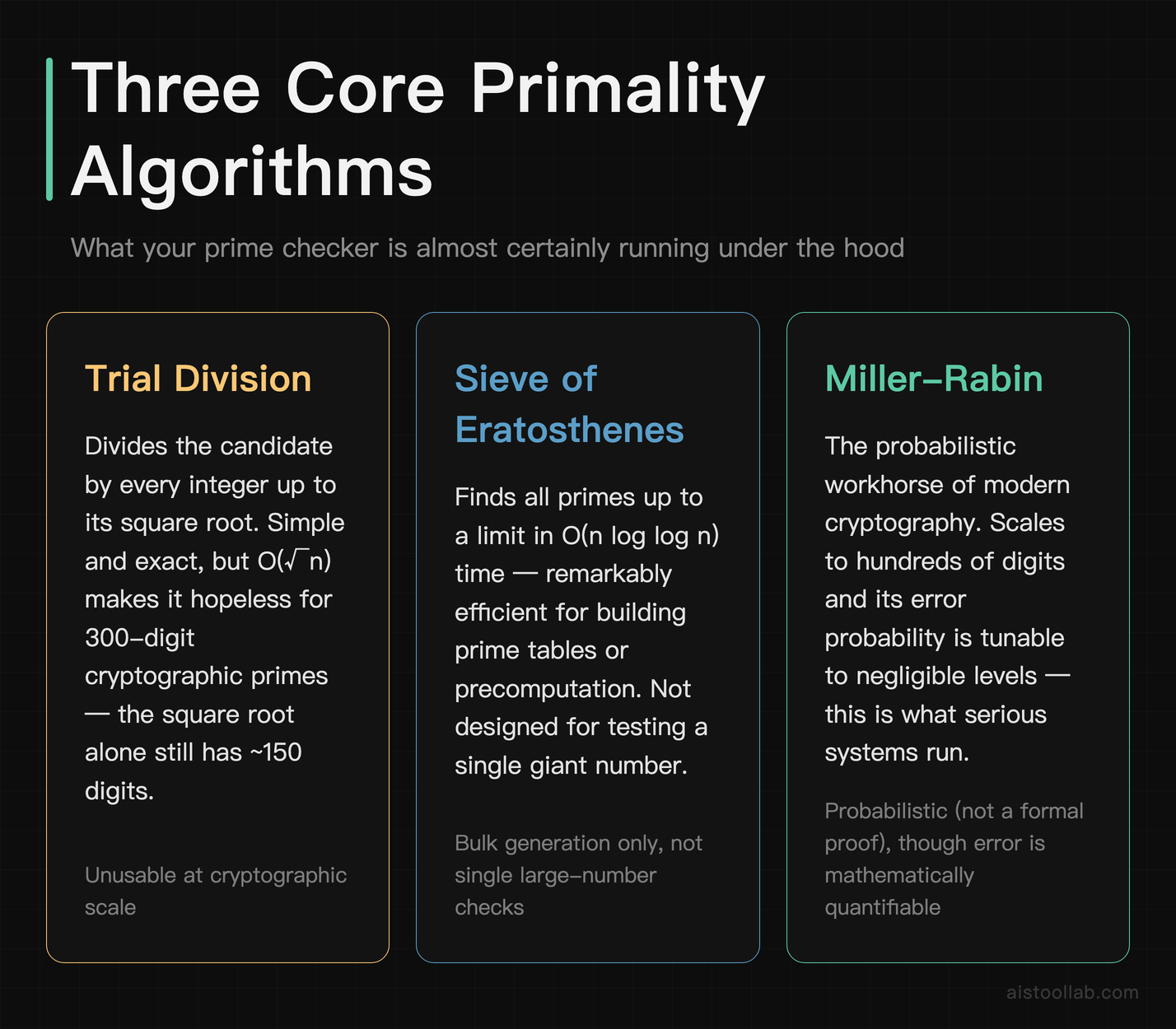
Before touching the AI question, you need to know the actual toolkit, because these are what your prime checker is almost certainly running.
Trial Division — the honest brute force
The simplest method: try dividing your number by every integer from 2 up to its square root. If nothing divides evenly, it’s prime. For a number n, this runs in roughly O(√n) time. That’s fine for checking whether 97 is prime. It’s hopeless for a 300-digit cryptographic prime, where the square root still has around 150 digits — more divisions than there are atoms in the observable universe. Trial division is the method every tutorial teaches and no serious system uses at scale.
Sieve of Eratosthenes — for finding many primes at once
If you want all primes up to some limit rather than checking one number, the ancient Sieve of Eratosthenes is your friend. It runs in about O(n log log n) time, which is remarkably efficient for generating prime tables. It’s great for precomputation but doesn’t help with a single gigantic number.
Miller-Rabin — the workhorse of modern cryptography
This is the one that actually powers most real-world prime checking. Miller-Rabin is a probabilistic test: it doesn’t prove primality outright, but it can prove compositeness, and with each round (“witness”) it either catches a composite or increases confidence that the number is prime. Run enough independent rounds and the probability of a false “prime” verdict drops astronomically low — low enough that libraries like OpenSSL rely on it for real key generation. It runs in roughly O(k log³ n) time for k rounds, which is dramatically faster than trial division for huge numbers.
AKS — the deterministic proof nobody uses in practice
The AKS primality test, published in 2002 by Agrawal, Kayal, and Saxena, was a landmark: it proved that primality can be determined in deterministic polynomial time. Mathematically, it’s a huge deal. Practically, its constant factors make it slower than Miller-Rabin for the number sizes people actually use, so you’ll rarely see it in production tools. It’s the theorem you cite, not the code you ship.
So Where Does AI Actually Fit In?
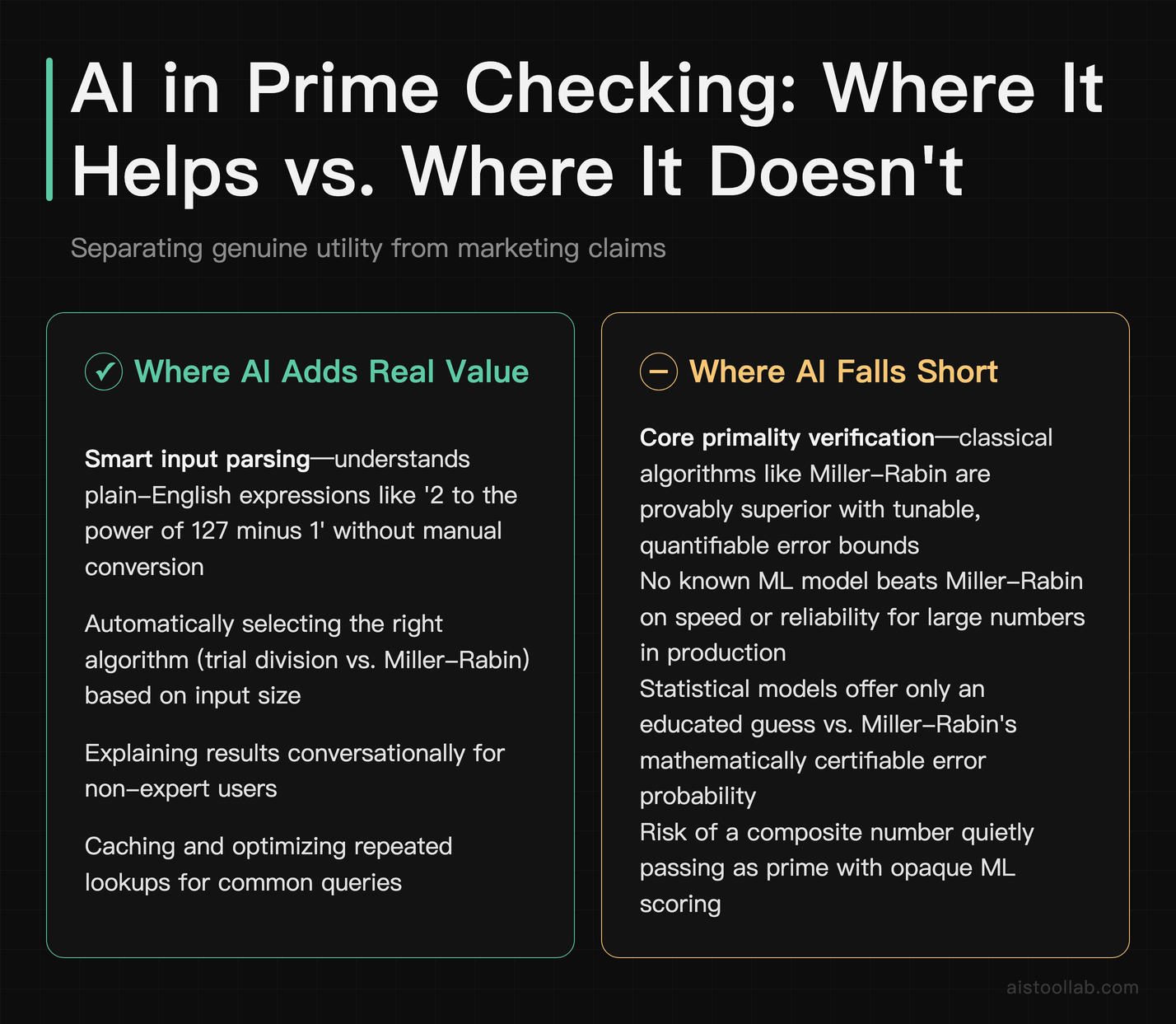
Now the honest part. For the core question — “is this specific number prime?” — machine learning is generally not the right tool, and reputable systems don’t rely on it. Number theory already gives us fast, rigorous algorithms with provable error bounds. A neural network that’s “probably right” is a downgrade from Miller-Rabin, which is probably right with a precisely quantifiable, tunable error probability. You don’t replace mathematical certainty with a statistical hunch.
There is genuine research exploring machine learning and pattern recognition around prime distribution — attempts to model the gaps between primes, or to explore structure in prime sequences. This is legitimate academic curiosity, and it’s interesting. But to my knowledge, none of it has produced a primality test that beats the established algorithms for reliability or speed in production. If you see a tool claiming its neural network “discovers” primes faster than Miller-Rabin, treat that with healthy skepticism.
Where AI-adjacent techniques do add value is around the edges: smart input parsing (understanding “check if 2 to the power of 127 minus 1 is prime” written in plain English), optimizing which algorithm to dispatch based on number size, batching and caching results, or explaining the result conversationally to a beginner. That’s real, useful engineering — it’s just not “AI verifying primes.” It’s AI wrapping a classical algorithm in a friendlier interface. Knowing that distinction protects you from tools that overpromise. This kind of honest evaluation is exactly what I dug into in What Makes an AI Tool Effective.
Comparing the Main Approaches
Here’s how the common methods and tool types stack up across the dimensions that actually matter for a beginner choosing one.
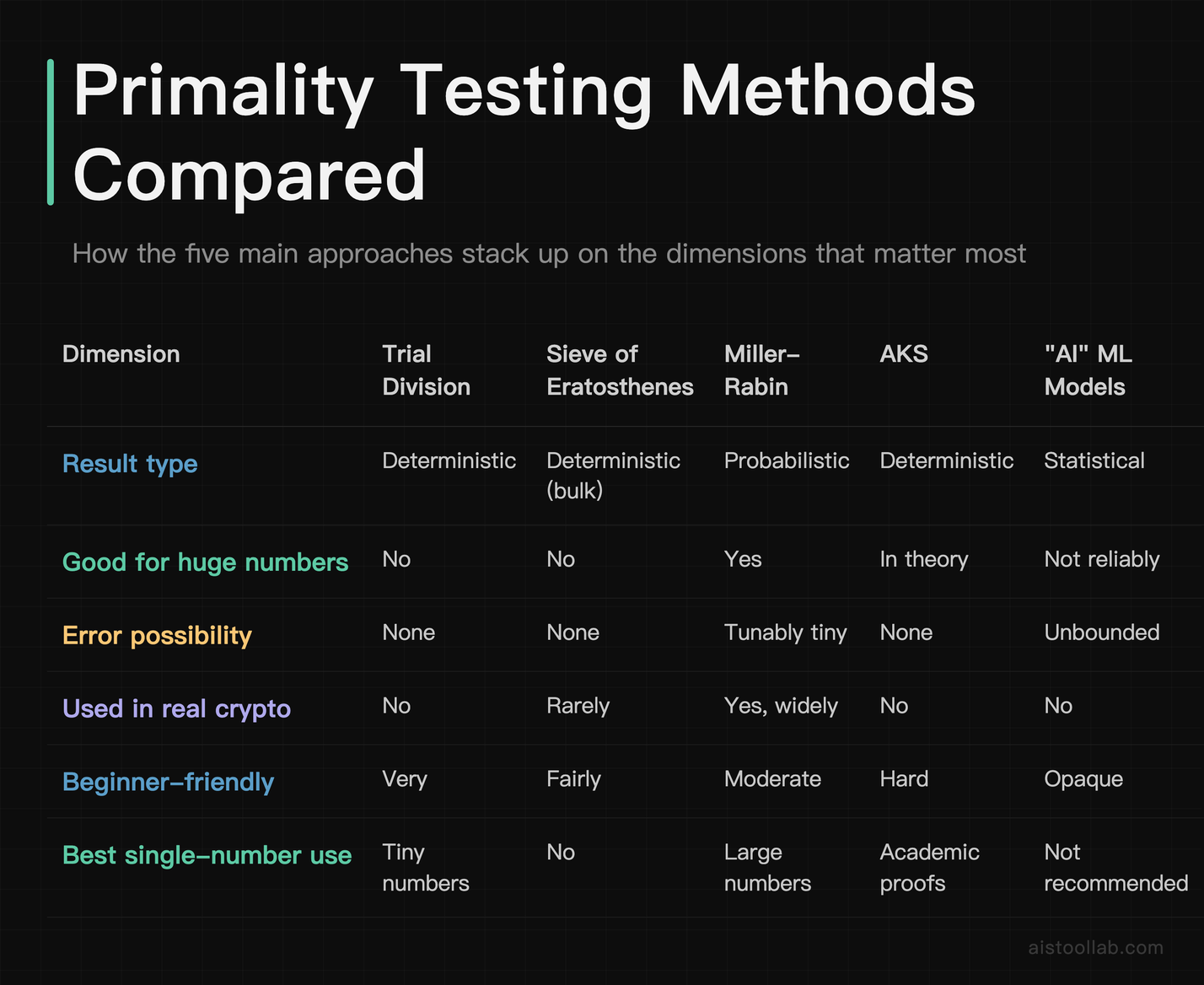
The takeaway: for almost any real task, a tool running Miller-Rabin (often combined with a quick trial-division pre-screen for small factors) is exactly what you want. Anything selling you a mysterious AI advantage over that should earn your suspicion, not your credit card.
A Beginner’s Step-by-Step Guide to Using a Prime Checker
Whether you’re using a web-based Prime Number Checker, a Python snippet, or a command-line utility, the workflow is broadly the same. Here’s how to do it without shooting yourself in the foot.
- Know what you’re checking. Are you verifying one specific number, or generating a fresh prime? Most online checkers verify. Cryptographic libraries generate. Decide before you start.
- Enter the number carefully. For large values, avoid manual typing — copy and paste. A single transposed digit gives you a completely different number and a meaningless answer. If the tool supports expressions like
2^61 - 1, use them to avoid typos. - Check which method it uses. Good tools disclose whether the verdict is deterministic or probabilistic. For casual use, probabilistic is fine. For anything security-sensitive, you want to know.
- Read the result honestly. “Probably prime” from a strong Miller-Rabin run is not a weakness — it’s the industry standard. Don’t panic at the word “probably.”
- Cross-check when it matters. If the answer feeds into something important, verify with a second independent tool or library. Two well-implemented checkers agreeing is about as good as it gets.
If you’d rather do it in code, Python’s ecosystem makes this trivial. The sympy library gives you a battle-tested check in one line:
from sympy import isprime

print(isprime(2**127 - 1))  # True — this is a Mersenne prime
print(isprime(561))         # False — a famous Carmichael number
That 561 example is worth remembering: it’s a Carmichael number, a composite that fools the naive Fermat primality test into thinking it’s prime. It’s exactly why Miller-Rabin, which is designed to catch these, became the default. A beginner tool built only on Fermat’s test would confidently give you the wrong answer here.
Real-World Use Cases
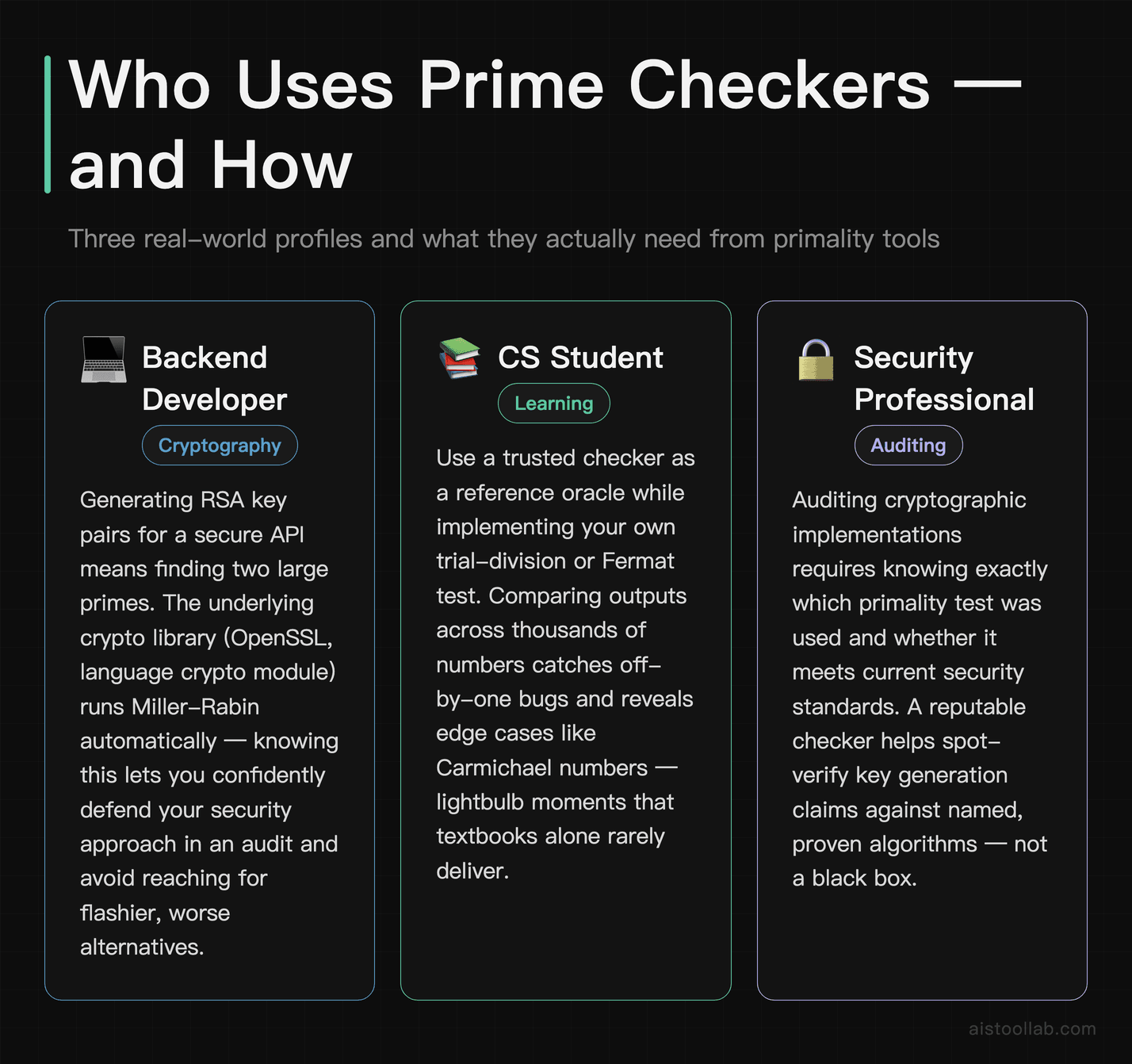
The developer generating encryption keys
Picture a freelance backend developer setting up a secure API for a client. Generating an RSA key pair means finding two large primes, and the library doing it — OpenSSL, or a language’s crypto module — leans on Miller-Rabin under the hood. The developer rarely calls a prime checker directly, but understanding that “probable prime with negligible error” is what secures the whole system helps them trust the tooling instead of reaching for something flashier and worse. If a security audit asks “how do you know these are prime?”, the answer is a named, respected algorithm — not a black box.
The computer science student learning number theory
A first-year CS student implementing primality tests for a course gets enormous value from a checker as a reference oracle. Write your own trial-division function, then compare its output against a trusted tool across thousands of numbers to catch off-by-one bugs (like forgetting that 1 isn’t prime, or mishandling 2). Seeing where a naive Fermat test disagrees with Miller-Rabin on Carmichael numbers is one of those lightbulb moments that a textbook alone rarely delivers.
The security professional auditing a system
Someone reviewing a codebase for weak cryptography needs to spot where primes are generated poorly — too few Miller-Rabin rounds, predictable random seeds, or reused primes. A standalone prime checker helps them quickly validate whether specific values pulled from logs or keys are actually prime, and whether suspiciously small or structured “primes” indicate a broken generator. In a world where weak key generation has caused real breaches, this verification step isn’t academic housekeeping — it’s the difference between secure and quietly exploitable.
The hobbyist chasing record primes
Projects like the Great Internet Mersenne Prime Search (GIMPS) rely on distributed volunteers running specialized primality tests (notably the Lucas-Lehmer test for Mersenne numbers) to discover record-breaking primes with tens of millions of digits. A curious hobbyist can join in, and understanding why a specialized deterministic test beats a general one for those specific numbers is half the fun.
Frequently Asked Questions
Do prime number checkers actually use artificial intelligence?
Mostly, no — not for the core verification. The reliable work of deciding whether a number is prime is done by classical number-theory algorithms, primarily Miller-Rabin for large numbers and trial division for small ones. These predate modern machine learning and remain superior for the task because they offer provable, tunable error bounds, whereas a statistical model offers only an educated guess. When a tool markets itself as “AI-powered,” the AI is usually handling the interface — parsing natural-language input, explaining results conversationally, choosing which algorithm to run, or caching answers. That’s genuinely useful, but it isn’t the neural network “finding” the prime. There is real academic research applying machine learning to study prime distribution and gaps, and it’s fascinating work, but to my knowledge it hasn’t produced a production primality test that beats the established algorithms on speed or reliability. As a beginner, the practical rule is simple: value the algorithm underneath, not the AI label on top.
What’s the difference between “prime” and “probably prime”?
A deterministic test like trial division or AKS proves primality with absolute certainty — there’s no chance of error. A probabilistic test like Miller-Rabin instead reduces the chance of a false “prime” verdict with each additional round of checking. After enough rounds, the probability of being wrong becomes vanishingly small — far smaller than the odds of a cosmic ray flipping a bit in your computer’s memory and corrupting the answer anyway. This is why “probably prime” isn’t the weakness it sounds like. The entire modern cryptographic infrastructure, including the keys protecting banking and messaging, is built on numbers that are “probably prime” in exactly this technical sense. The word “probably” is doing a lot of heavy, well-understood mathematical lifting. If you genuinely need a certificate of primality — for a mathematical proof, say — deterministic methods exist, but for practical security work, a strong probabilistic result is the accepted standard and nobody loses sleep over it.
Is a free online prime checker good enough, or do I need paid software?
For learning, experimenting, and most everyday tasks, free tools and open-source libraries are more than good enough — and often better than paid alternatives, because the algorithms are public, well-tested, and identical whether you pay or not. Miller-Rabin doesn’t run faster because you swiped a card. Python’s sympy, standard command-line utilities, and reputable web checkers cost nothing and are widely trusted. Where money might legitimately enter the picture is around infrastructure rather than the math itself: enterprise cryptography platforms, hardware security modules, or audited compliance tooling bundle prime generation into larger paid products where you’re paying for support, certification, and integration — not a secret prime algorithm. Be skeptical of any standalone consumer tool charging a premium specifically for “faster” or “smarter AI” prime checking, since the underlying methods are freely available and standardized. My honest advice for beginners: start free, and only pay when you’re buying a whole secure system with guarantees, not a number checker.
Why does cryptography need such enormous prime numbers?
The security of systems like RSA rests on the difficulty of factoring — taking a large number and finding the two primes that were multiplied to create it. Multiplying two primes is fast; reversing the process is extraordinarily slow with current knowledge, and that slowness is what protects your data. But the difficulty scales with size. Small primes produce products that a modern computer can factor quickly, breaking the encryption. So cryptography uses primes hundreds of digits long, producing products so large that factoring them would take longer than the age of the universe with today’s technology. This is also why key sizes have grown over the years — as computers get faster, yesterday’s “unbreakable” sizes become tomorrow’s weak spots. It’s an arms race between key length and computing power. Understanding this helps explain why efficient primality testing matters so much: you can’t secure anything if you can’t quickly find and verify the giant primes the whole scheme depends on.
Can a prime checker ever give me a wrong answer?
In practice, a well-implemented checker essentially never gives a wrong answer, but the theoretical picture depends on the method. Deterministic tests like trial division and AKS cannot be wrong (assuming correct code). Probabilistic tests like Miller-Rabin have a tiny, quantifiable chance of falsely declaring a composite number “prime” — but with enough rounds, that probability drops so low it’s negligible compared to hardware failure. The real-world risks come from implementation, not theory: a tool built on the weaker Fermat test can be fooled by Carmichael numbers like 561, and buggy code can mishandle edge cases such as 0, 1, 2, or negative inputs. This is exactly why cross-checking with a second reputable tool is smart when the stakes are high. If two independent, well-regarded checkers agree, you can be extremely confident. Disagreement is a red flag that usually points to a bug or a weak algorithm in one of them.
What is a Carmichael number and why should I care?
A Carmichael number is a composite number that behaves like a prime under the Fermat primality test, fooling that simpler test into a false “prime” verdict. The smallest is 561, followed by 1105 and 1729. They matter because they expose a real weakness in naive primality testing: if a tool or a piece of homework code relies only on Fermat’s little theorem, it will confidently misclassify these numbers. This is one of the historical reasons the stronger Miller-Rabin test became the standard — it’s specifically designed to detect Carmichael numbers and other Fermat pseudoprimes. For a beginner writing their own checker, testing against known Carmichael numbers is one of the best sanity checks you can run. If your function calls 561 prime, you’ve learned something important about the limits of the simple approach, and you’ll understand exactly why the industry moved to more robust methods rather than just trusting the elegant-but-fragile original.
Which algorithm should I use if I’m writing my own checker?
For learning, implement trial division first — it’s intuitive and teaches you the core idea, and it’s perfectly adequate for small numbers. Once you understand that, move to Miller-Rabin, which is the practical standard for anything larger. In most real projects, though, the right answer for a beginner is to not reinvent the wheel: use a well-tested library like Python’s sympy with its isprime function, which combines multiple techniques and handles edge cases correctly. Cryptography especially is a domain where rolling your own primality test invites subtle, dangerous bugs — too few Miller-Rabin rounds or a poor random source can compromise security in ways that aren’t visible until something breaks. Write your own for education and understanding, absolutely, but lean on audited libraries for anything that matters. This mirrors a broader principle in software: understand the fundamentals deeply, then use battle-tested tools in production rather than trusting your first implementation with real stakes.
How fast can these tools actually check a large number?
For the number sizes used in everyday cryptography, a modern implementation of Miller-Rabin verifies primality effectively instantly from a human’s perspective — you paste the number, you get an answer before you’ve finished blinking. The reason is the logarithmic complexity: Miller-Rabin’s running time grows roughly with the cube of the number of digits, which stays very manageable even for hundreds of digits. Trial division, by contrast, would choke completely on the same input because its cost grows with the square root of the number’s value, not its digit count. That gap between “square root of the value” and “polynomial in the digit count” is the entire story of why classical primality testing scales and brute force doesn’t. Exact timings depend on your hardware, the library, and how many rounds you run, so I won’t quote specific millisecond figures I can’t verify for your setup — but the practical experience for a beginner is that any competent tool feels instantaneous for normal use, and only feels slow if you feed it genuinely record-breaking, multi-million-digit numbers.
The Bottom Line for Beginners
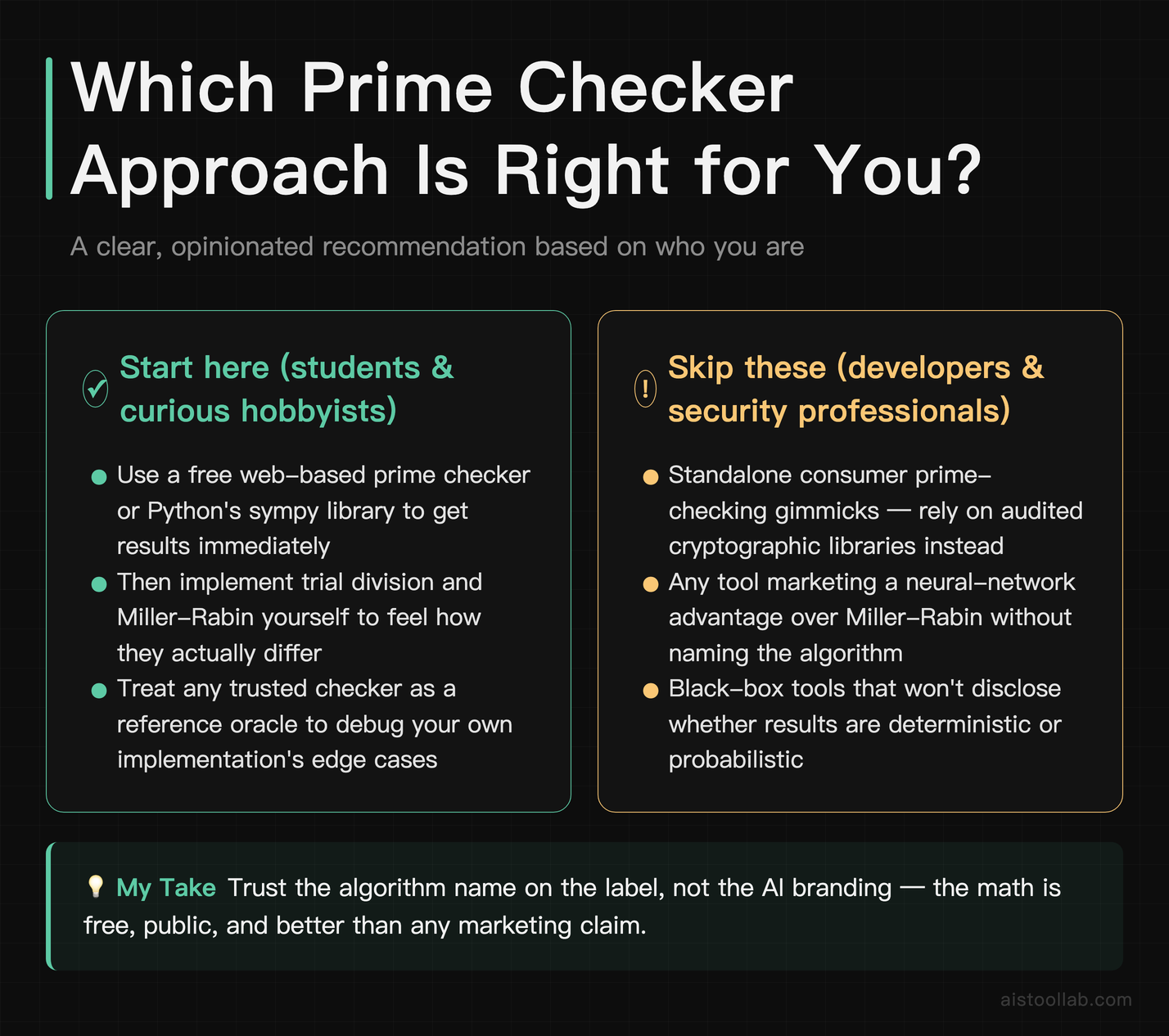
If you take one thing away, make it this: the impressive part of prime checking isn’t AI — it’s decades of elegant number theory, with Miller-Rabin quietly securing much of the internet while barely getting credit. A prime number checker is worth using, worth understanding, and genuinely important if you touch cryptography. But the tools that deserve your trust are the ones honest about running proven algorithms, not the ones dressing up classical math in a neural-network costume.
So here’s my recommendation, split by who you are. If you’re a student or curious hobbyist, start with a free web checker or Python’s sympy, then implement trial division and Miller-Rabin yourself to actually feel how they differ — that hands-on comparison teaches more than any explainer. If you’re a developer or security professional, skip the standalone consumer gimmicks entirely and rely on audited crypto libraries, using a second reputable checker only to spot-verify when the stakes are real. The math is free, public, and better than any marketing claim. Spend your skepticism wisely, and you’ll never overpay for a prime.
Last updated: 2026
Found this review helpful?
👉 Browse the AI Tools Library to find the right tools for your workflow.