

The Benchmark You’re Reading Probably Wasn’t Built for Your Job
Here’s a belief that quietly runs through almost every “best AI model” thread on Reddit and Hacker News: that there’s a single ladder of intelligence, and whichever model sits at the top of MMLU (or GPQA, or whatever leaderboard got screenshotted this week) is simply the smartest one. Pick that, the logic goes, and you’ve picked the best.
That assumption falls apart the moment you look at two leaderboards side by side. A model can top one benchmark, sit mid-pack on another, and quietly lose a third — all in the same week, with the same weights, no retraining involved. It’s not that one of the rankings is lying. It’s that each benchmark is measuring a different thing and calling it “intelligence.”
So the real question isn’t “which model wins?” It’s “wins at what, measured how, and does that have anything to do with what I’m actually building?” Let’s break down why MMLU, GPQA, and GSM8K hand out different crowns — and how to read those crowns without getting played.
Contents
What Each Benchmark Actually Tests (And Quietly Rewards)
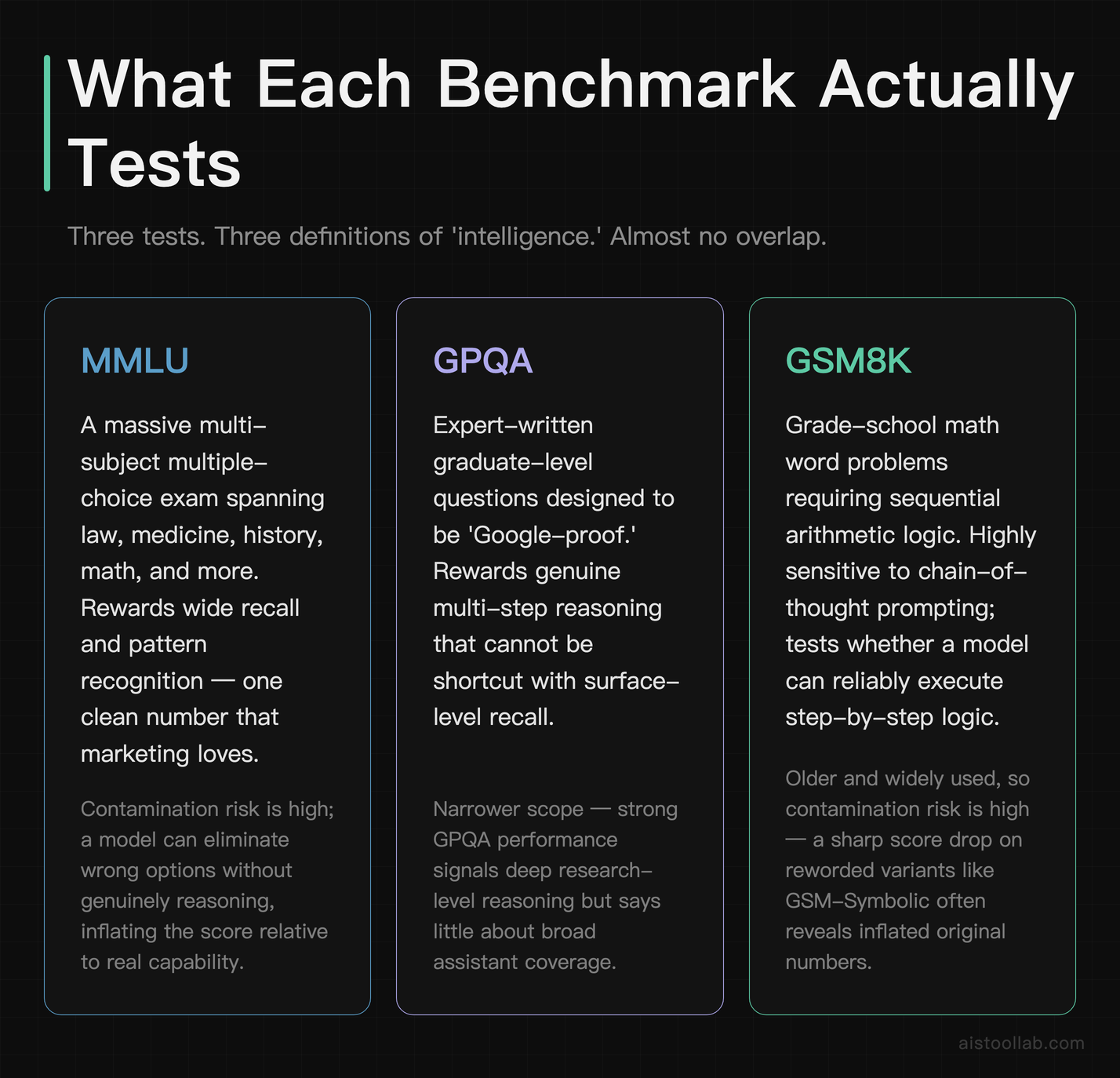
These three names get thrown around as if they’re interchangeable proof of “smartness.” They’re not. Each was designed with different assumptions baked in, and those assumptions decide who wins before a single model is even tested.
MMLU: Broad Knowledge, But It Loves a Good Pattern
MMLU (Massive Multitask Language Understanding) is a multiple-choice exam spanning dozens of subjects — law, medicine, history, math, computer science, you name it. It’s the closest thing the field has to a “general knowledge” test, and that’s exactly why marketing decks love it. One number that sounds like a GPA.
The catch: multiple-choice with four options rewards recognition more than reasoning. A model that has seen enough of the internet can often pattern-match its way to the right letter without genuinely working through the problem. It’s the difference between a student who studied and a student who’s just really good at eliminating two obviously-wrong answers. MMLU also has known issues with mislabeled or ambiguous questions, which is part of why the cleaner variant MMLU-Pro emerged. High MMLU tells you a model has broad coverage. It tells you much less about whether it can think.
GPQA: Designed to Be Un-Googleable
GPQA (“Graduate-Level Google-Proof Q&A”) was built specifically to defeat the pattern-matching shortcut. The questions come from PhD-level biology, chemistry, and physics, and they’re written so that even skilled non-experts with internet access struggle to answer them. The whole point is that you can’t retrieve your way to the answer — you have to reason through it.
This is why GPQA scores look brutal compared to MMLU. Where models post high numbers on broad knowledge, GPQA pulls everyone back down to earth because surface recall doesn’t help. A model that’s genuinely good at multi-step scientific reasoning will separate itself here in a way it never could on a four-option quiz. If MMLU rewards breadth, GPQA rewards depth — and the two don’t always live in the same model.
GSM8K: Grade-School Math, Adult-Level Diagnostics
GSM8K is a set of grade-school math word problems. They sound trivial — trains leaving stations, apples divided among kids — but each requires a chain of arithmetic steps where one wrong move tanks the whole answer. It’s a clean test of multi-step reasoning that you can grade objectively: the number is right or it isn’t.
GSM8K rewards models that can hold a logical chain together and execute it precisely. It’s also one of the benchmarks most sensitive to prompting technique — chain-of-thought prompting famously boosts performance because it forces the model to externalize its steps. The downside? GSM8K has been around long enough that contamination (training data leaking the test answers) is a real concern, which is why newer evaluations like GSM-Symbolic try to perturb the problems and see if performance holds.
Why the Same Model Tops Some Lists and Not Others
Take a question readers ask about constantly: why does a single model look dominant on one chart and merely competitive on the next? Our Claude 3.5 Sonnet review walks through exactly this kind of split. The short version is that a model’s ranking swings with the benchmark’s format and what it happens to reward — not because any single leaderboard is lying.
That’s not inconsistency — it’s design assumptions colliding with how a given model was built. A model whose training emphasized careful, step-by-step reasoning tends to separate itself on tests that reward that behavior, like GPQA and structured math, while gaining little extra on a recognition-heavy multiple-choice test where a broadly-trained competitor with wide recall can keep pace. The benchmark’s structure decides how much of a model’s real strength even shows up in the score. Which behaviors any specific model actually favors is something to confirm against that vendor’s own published figures and independent evaluations — not something to assume from a headline.
So when you see “Model X is #1,” the honest follow-up is: number one on a test that measures what kind of thinking? The crown is real. It just doesn’t transfer across categories the way a single headline implies. This pattern comes up again in the Google Gemini 2.0 Review 2026, where the same model swings ranking depending on whether you weight knowledge breadth or reasoning depth.
Benchmark Comparison: What Each One Really Measures
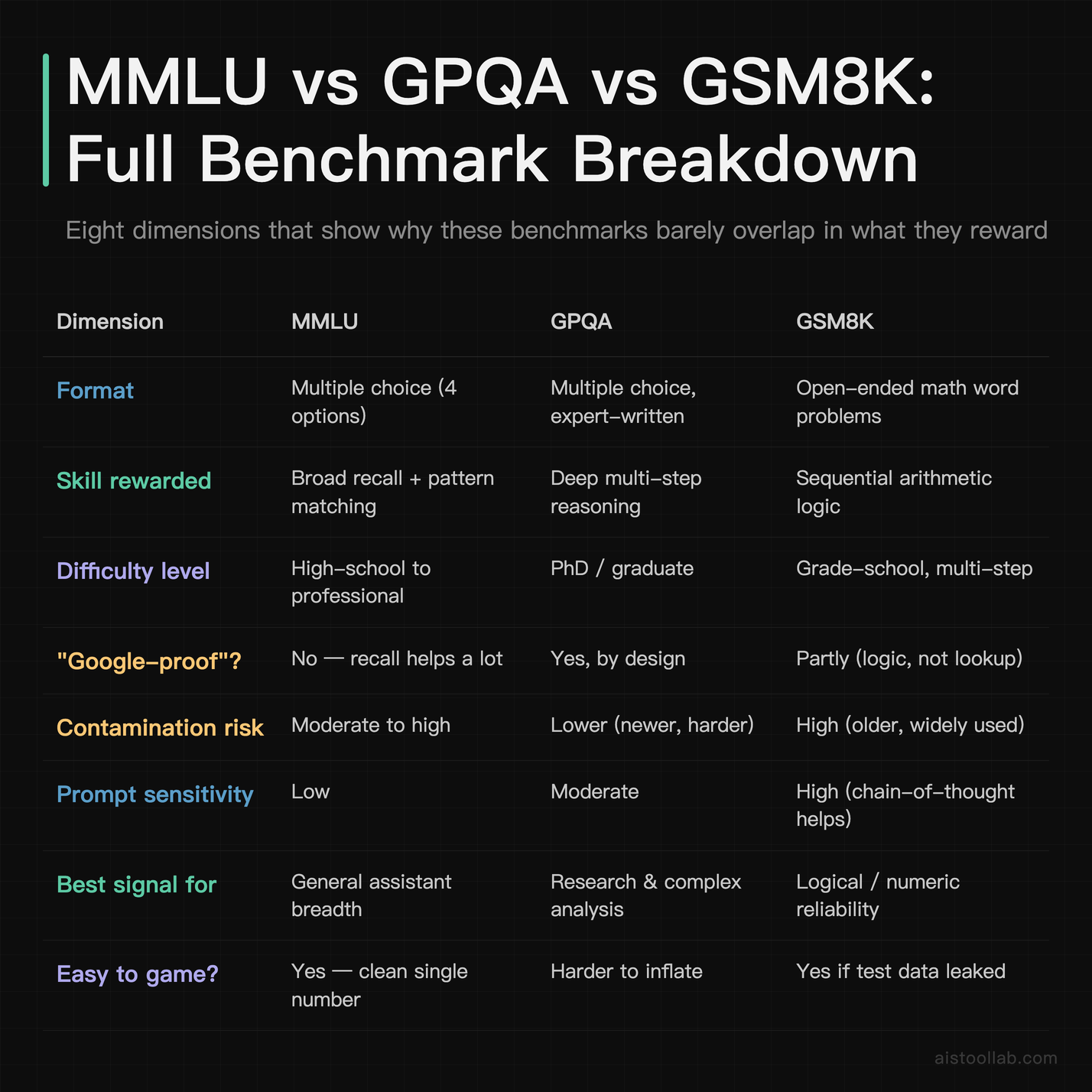
Read that table top to bottom and the takeaway is uncomfortable for anyone who likes tidy rankings: these three benchmarks barely overlap in what they reward. A model engineered to win one is not automatically built to win the others. Treating them as a single “smartness score” is like ranking athletes by averaging their marathon time, bench press, and chess rating.
The Circular Problem Nobody Puts in the Press Release
Here’s the part that deserves more skepticism than it gets. Commercial labs know exactly which benchmarks the press and procurement teams care about. That creates a strong incentive to optimize for those specific tests — through fine-tuning, prompt engineering in the eval harness, or training data that happens to resemble the benchmark distribution.
When that happens, the published metric becomes partially circular: the model scores high on the benchmark because the benchmark (or things very like it) shaped the model. This isn’t necessarily cheating in the cartoon sense. It’s more subtle — a slow drift where the test stops measuring general capability and starts measuring “how well did we prepare for this test.” It’s the AI equivalent of teaching to the exam.
The research community is well aware of this. Data contamination — where test questions leak into training sets — has been documented as a real and growing problem across popular benchmarks, and it’s precisely why “perturbed” variants like GSM-Symbolic and refreshed sets like MMLU-Pro keep appearing. When a model’s score drops sharply on a reworded version of the same problems, that’s a strong hint the original number was inflated by familiarity rather than reasoning. The lesson for you as a reader: a benchmark’s age and popularity are inversely related to how much you should trust a sky-high score on it.
How to Actually Read a Leaderboard for Your Use Case
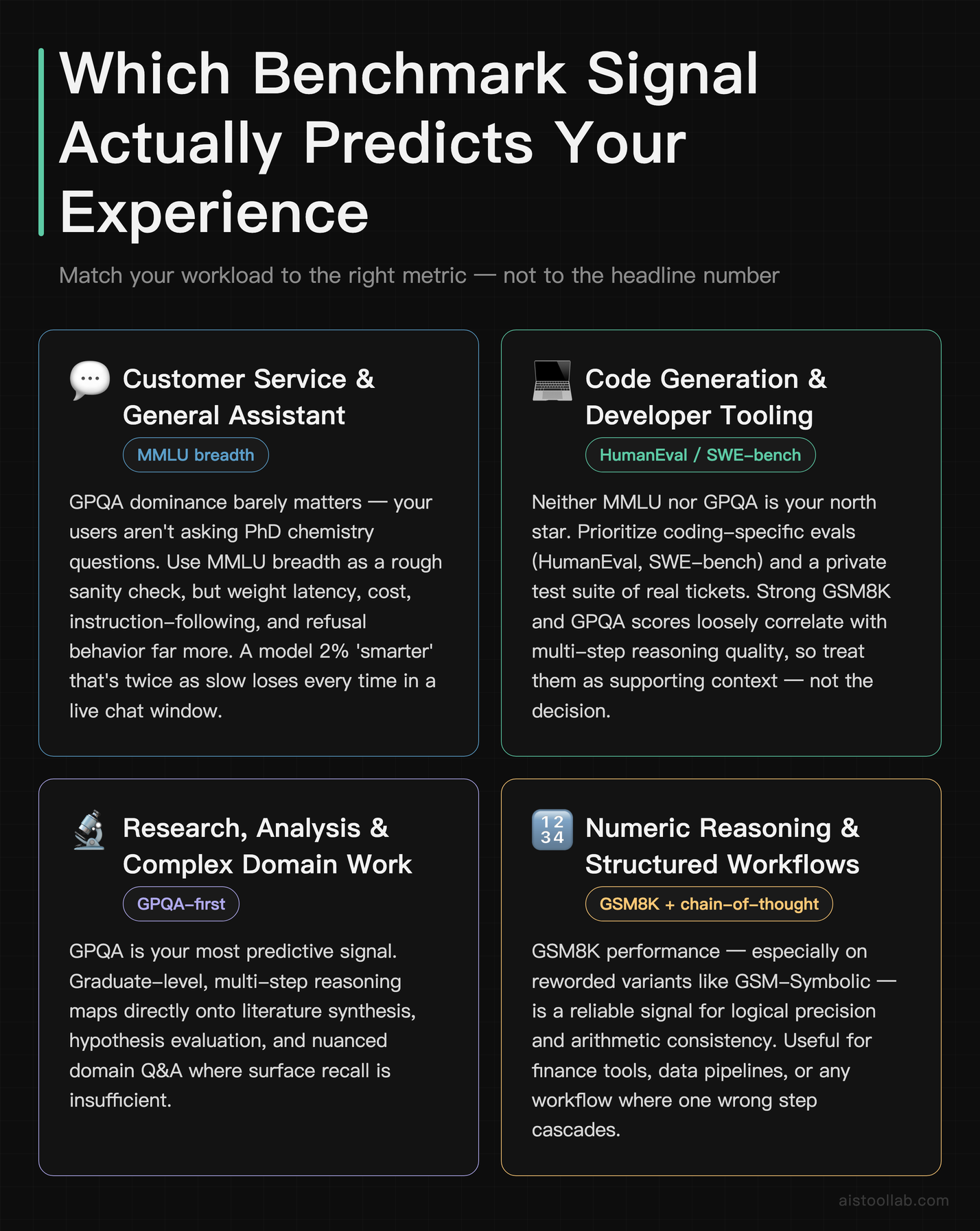
Stop asking “which model is best” and start asking “best at the thing I’m paying it to do.” The benchmark that predicts your real-world experience depends entirely on your workload. Here’s how the mapping tends to shake out.
Customer service & general assistant work
If you’re building a support bot or a general-purpose internal assistant, raw GPQA dominance barely matters — your users aren’t asking PhD chemistry questions. What matters is broad coverage, instruction-following, tone control, and consistency. MMLU-style breadth is a rough proxy, but honestly you should weight latency, cost, and refusal behavior far more heavily than any single accuracy number. A model that’s 2% “smarter” but twice as slow loses every time in a live chat window.
Code generation & developer tooling
For coding work, neither MMLU nor GPQA nor GSM8K is your north star — you want coding-specific evals (HumanEval, SWE-bench and similar) plus your own private test suite of real tickets. That said, strong GSM8K and GPQA performance correlates loosely with the structured, multi-step reasoning that good code requires, so they’re not useless context. I’d still trust a model that fixes ten of your actual bugs over one that tops a public coding chart.
Research, analysis & technical writing
This is where GPQA earns its keep. If your team uses AI to reason through complex scientific, legal, or financial material, you want the benchmark that punishes shortcuts and rewards genuine multi-step thinking. A model that’s merely good at recall will produce confident-sounding nonsense on hard problems; GPQA is the closest public signal for separating those from the genuinely capable reasoners.
Math-heavy & data pipeline work
For anything where a wrong number is catastrophic — financial modeling, data transformation, anything quantitative — GSM8K and harder math evals (like MATH) are the most relevant public proxies. But verify with your own numbers. Given the contamination concerns, I’d put more faith in a model that nails your arithmetic-heavy prompts than one boasting a near-perfect GSM8K score that might be partly memorized.
Frequently Asked Questions
Is a higher MMLU score always better?
No, and treating it that way is one of the most common mistakes in tool selection. MMLU measures broad, multiple-choice knowledge across many subjects, which makes it a decent rough indicator of general coverage — but it’s a weak signal for reasoning depth, reliability under pressure, or how a model behaves in your specific workflow. Because it’s a four-option format, a model can pattern-match its way to correct answers without genuinely reasoning, inflating the score relative to real capability. MMLU is also one of the older, more widely-used benchmarks, which means contamination risk is meaningful — some of that high score may reflect familiarity with the test rather than understanding. For most real applications, a one or two point MMLU difference between models is noise, not signal. You’re far better off weighting the benchmark that matches your actual use case, then validating with your own prompts. Use MMLU as a sanity check that a model isn’t broadly ignorant, not as the deciding factor.
Why does the same model rank differently on different benchmarks?
Because each benchmark rewards a different cognitive skill, and no model is equally strong across all of them. MMLU favors broad recall and pattern recognition; GPQA punishes shortcuts and rewards deep multi-step scientific reasoning; GSM8K tests precise sequential arithmetic logic. A model tuned toward careful step-by-step reasoning will shine on GPQA and math tasks but may gain nothing extra on a recognition-heavy quiz where a broadly-trained competitor keeps pace. The benchmark’s very structure decides how much of a model’s real strength shows up in the final number. There’s also the prompting variable — GSM8K results swing significantly with chain-of-thought prompting, so two reported scores for the “same” model can differ based purely on the evaluation harness. This is why you should never trust a single leaderboard screenshot. Look at how a model performs across several benchmarks that map to different skills, and weight the ones relevant to your job. A model swinging in rank is normal and expected, not a sign that someone’s numbers are wrong.
What is benchmark contamination and should I worry about it?
Contamination happens when test questions, or close variants of them, leak into a model’s training data. When that occurs, the model can recall answers rather than reason them out, inflating its benchmark score in a way that won’t transfer to genuinely novel problems you throw at it. It’s a documented, growing concern across the field — especially for older, widely-circulated benchmarks like GSM8K and original MMLU, whose questions have been copied across the internet for years. The telltale sign is when a model’s score drops sharply on a reworded or “perturbed” version of the same test, which is exactly why researchers built variants like GSM-Symbolic and MMLU-Pro. As a practical reader, you should treat suspiciously high scores on old benchmarks with healthy skepticism, and lean toward newer, harder, or perturbed evaluations when comparing models. Better still, maintain a small private test set of your own real tasks — questions the model has definitely never seen — and use that as your ground truth. Public numbers are a starting point, not a verdict.
Which benchmark matters most for a customer service chatbot?
Honestly, none of these three should be your top priority for support work. MMLU is the closest proxy because it reflects broad general knowledge, but a customer service bot rarely needs PhD reasoning or multi-step math — it needs reliable instruction-following, consistent tone, accurate retrieval from your knowledge base, and fast responses. Those qualities barely show up in MMLU, GPQA, or GSM8K. What you actually want to measure is latency under real load, how often the model refuses reasonable requests, how well it stays on-brand, and how gracefully it handles edge cases and ambiguous phrasing. A model that scores a couple points lower on knowledge benchmarks but responds in half the time and never goes off-script will deliver a noticeably better customer experience. Build a test set from your real support tickets, run candidate models against it, and judge by resolution rate and response quality — not by a leaderboard built for academic exams. The benchmark that matters most is the one you build from your own conversations.
Are commercial labs gaming these benchmarks?
“Gaming” is a strong word, but the incentive structure is real and worth understanding. Labs know which benchmarks the press, analysts, and enterprise buyers cite, so there’s a natural pull toward optimizing for those specific tests — via fine-tuning, careful prompt engineering in the eval setup, or training data that resembles the benchmark distribution. When that happens, the published score becomes partially circular: the model does well on the test partly because the test shaped the model. This isn’t usually cartoon cheating; it’s a subtle drift toward “teaching to the exam.” The result is that headline metrics can overstate general capability. Your defense is straightforward: don’t rely on any single vendor-reported number, prefer independent third-party evaluations where possible, favor newer or perturbed benchmarks that are harder to pre-optimize for, and always validate with your own private prompts. When a model’s marketing leans heavily on one specific benchmark, ask why that one — and what the less-flattering charts might look like.
What’s the difference between GPQA and MMLU in plain terms?
Think of MMLU as a broad trivia exam and GPQA as a graduate oral defense. MMLU spans dozens of subjects with four-option multiple-choice questions at high-school-to-professional difficulty — it rewards a model that has absorbed a lot of the internet and can recognize the right answer. You can often pattern-match your way through it without deep reasoning. GPQA is deliberately the opposite: PhD-level questions in biology, chemistry, and physics, written so that even skilled people with full internet access struggle. The whole design goal is to defeat the recall shortcut and force genuine multi-step reasoning. That’s why GPQA scores look so much harsher than MMLU scores — surface knowledge doesn’t rescue you. In practice, a strong MMLU number tells you a model is broadly informed; a strong GPQA number tells you it can actually think through hard, unfamiliar problems. For a general assistant, MMLU breadth might suffice. For research or complex analysis, GPQA is the far more honest signal of whether the model will hold up when the questions get genuinely difficult.
Do benchmark scores predict real-world performance?
Only loosely, and that gap trips up a lot of buyers. Benchmarks are standardized, static, and often contaminated; your real workload is dynamic, messy, and full of context the benchmark never contained. A model can top GSM8K and still stumble on your specific data pipeline because your problems are phrased differently, involve domain jargon, or require tool use the benchmark never tested. Latency, cost, context-window behavior, refusal rates, and consistency over long conversations matter enormously in production and are largely invisible in accuracy benchmarks. I covered the gap between lab and live performance more fully in the Production vs Synthetic breakdown, but the short version is: treat benchmarks as a filter, not a decision. Use them to shortlist two or three candidate models, then run those candidates against a private test set built from your actual tasks. Measure what you actually care about — resolution rate, error rate, speed, cost per request. The model that wins your private eval is the right choice, even if it ranks second or third on the public charts.
Should I pick a model based on one benchmark or several?
Always several, and ideally weighted toward your use case rather than averaged blindly. A single benchmark only captures one slice of capability, so optimizing for it alone is how you end up with a model that aces trivia but fumbles reasoning, or nails math but writes clunky prose. The smarter approach is to identify the two or three skills your application genuinely depends on — say, reasoning depth and instruction-following for a research assistant — and look at the benchmarks that map to those skills specifically. Then sanity-check across a couple of others to make sure there’s no glaring weakness. Don’t fall for the averaged “composite score” that some leaderboards publish; averaging across unrelated skills hides exactly the trade-offs you need to see. And whatever the public numbers say, finish with your own private evaluation on real tasks. Benchmarks narrow the field; your own data picks the winner. If you want a deeper framework for this, the site’s guide on How to Evaluate AI Model Performance Like a Pro walks through weighting metrics by use case in detail.
The Honest Takeaway
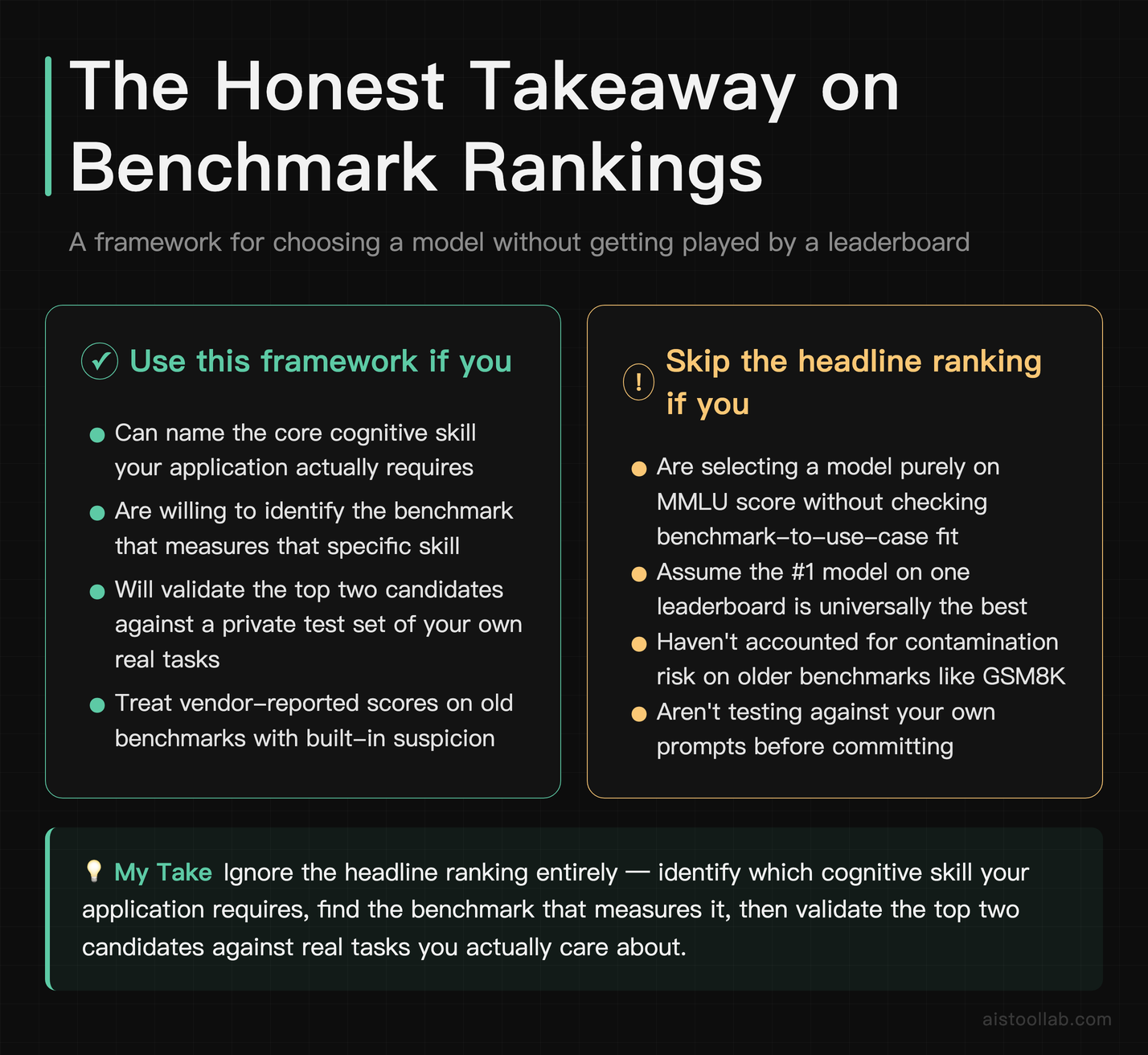
There is no single “smartest” AI model, and any leaderboard that implies otherwise is selling you a simplification. MMLU, GPQA, and GSM8K each crown a different winner because each measures a different kind of thinking — breadth, depth, and logical precision respectively — and those strengths rarely live in equal measure inside one model. A model topping one chart while sitting mid-pack on another isn’t a contradiction; it’s the system working exactly as designed.
If it were my money and my project on the line, here’s the rule I’d follow: ignore the headline ranking entirely. Figure out which kind of thinking your application actually requires, find the benchmark that measures that specific skill, treat vendor-reported numbers on old benchmarks with built-in suspicion, and then — this is the non-negotiable part — validate the top two candidates against a private test set built from your own real tasks. The best model isn’t the one with the highest score. It’s the one that does your job most reliably, and the only way to know that is to test it yourself.
Last updated: 2026
Found this review helpful?
👉 Browse the AI Tools Library to find the right tools for your workflow.