Google Has Been My Default for 15 Years. Then I Stopped Using It for Research.
I genuinely think that, since somewhere around mid-2025, AI-powered search has become the better first stop for anything that required more than a quick lookup — not because of some ideological stance against Big Tech, but because AI-powered search tools — specifically Perplexity Pro and ChatGPT Plus and the newer ChatGPT Pro ($200/month, released Dec 2024) — can often deliver better, faster, more useful answers. The shift tends to happen gradually, then all at once, the way most habit changes do.
Here’s the thing, though: Perplexity and ChatGPT Pro are not the same tool doing the same job. They get conflated a lot, as if both were just “AI that searches the web.” That’s like saying a scalpel and a Swiss Army knife are the same because they’re both sharp. They’re built around different philosophies, they shine in different situations, and depending on what kind of research you do daily, one is going to save you significantly more time than the other.
So let’s actually settle this. No fluff, no spec-sheet regurgitation. Just what actually matters when you’re trying to get real work done.
Quick Overview: What Each Tool Actually Is
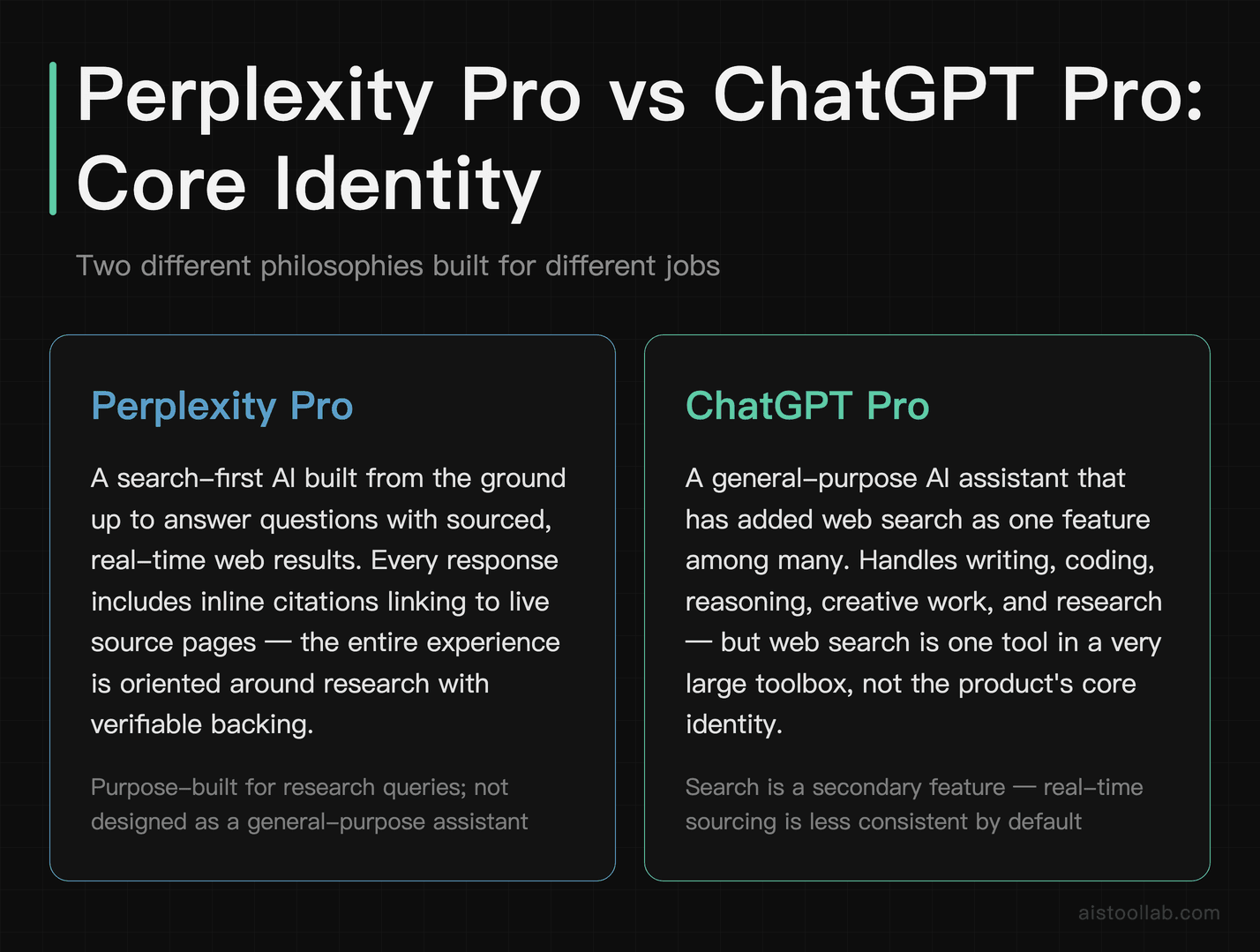
Before we get into the weeds, it helps to be clear about the core identity of each product, because they come from genuinely different starting points.
Perplexity Pro is, at its core, a search-first AI tool. It was built from the ground up to answer questions with sourced, real-time web results. Think of it as what you’d get if Google’s search engine had a conversation with you and cited its sources as it went. Responses come with inline source labels pointing to source pages, and the entire experience is oriented around research queries with verifiable backing. The interface is clean, focused, and doesn’t try to do everything — it tries to do research well.
ChatGPT Pro, meanwhile, is a general-purpose AI assistant that has added web search as a feature. It’s built on OpenAI’s latest models and can handle everything from writing a wedding speech to debugging Python to yes, searching the web. The search capability is real and genuinely useful, but it’s one tool in a very large toolbox — not the whole identity of the product.
That distinction matters more than most people realise when you’re trying to figure out which one to pay for.
Head-to-Head Comparison: The Fast View
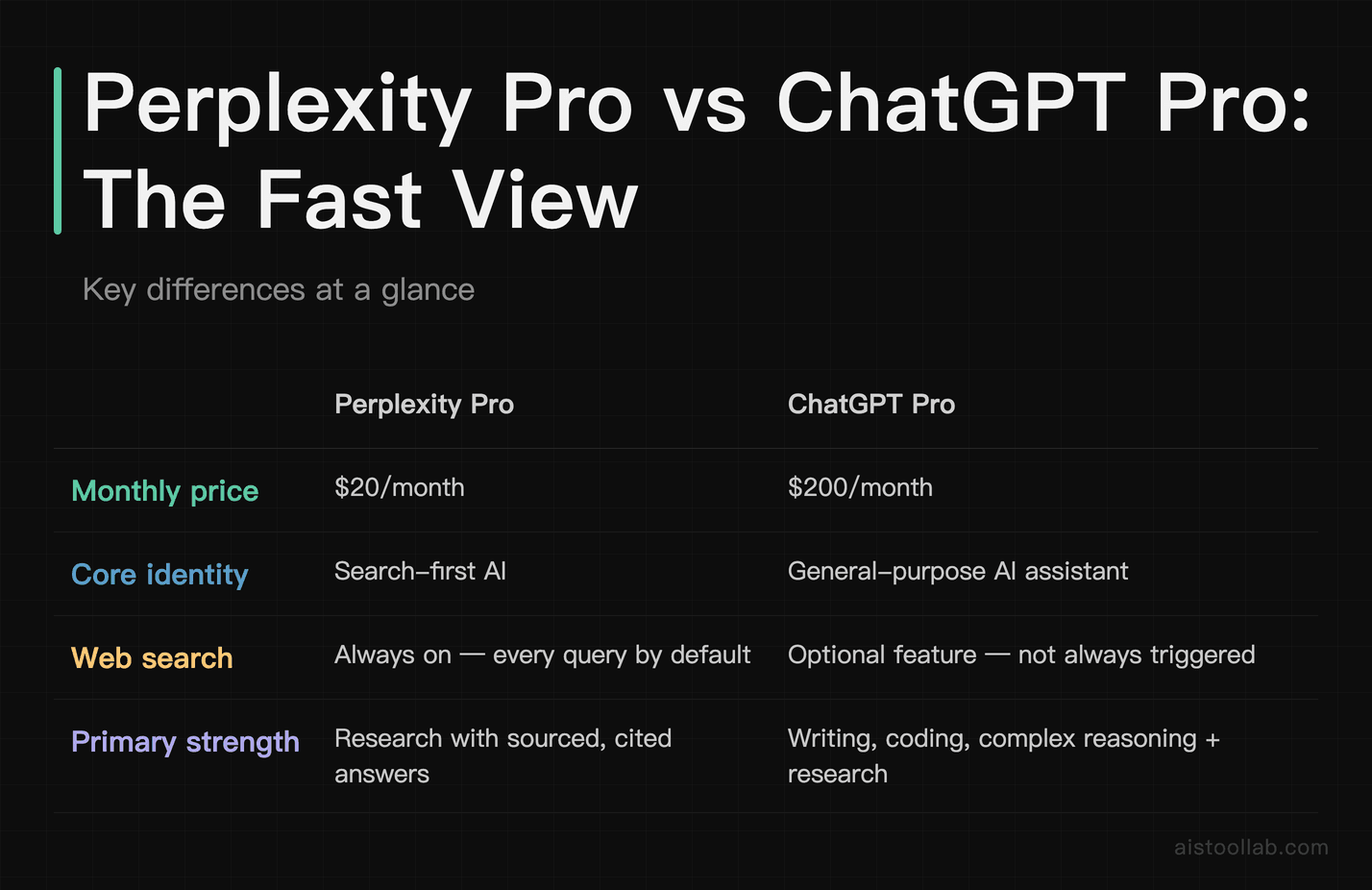
The pricing gap is the most concrete difference between the two, and it is a big one. Perplexity Pro is $20/month — roughly the same as a Netflix subscription. ChatGPT Pro is $200/month, which is a different category of commitment entirely. We’ll come back to whether that gap is justified, but I want you to hold that number in mind as we work through the rest of this.
Real-Time Search: How Each Tool Actually Handles It
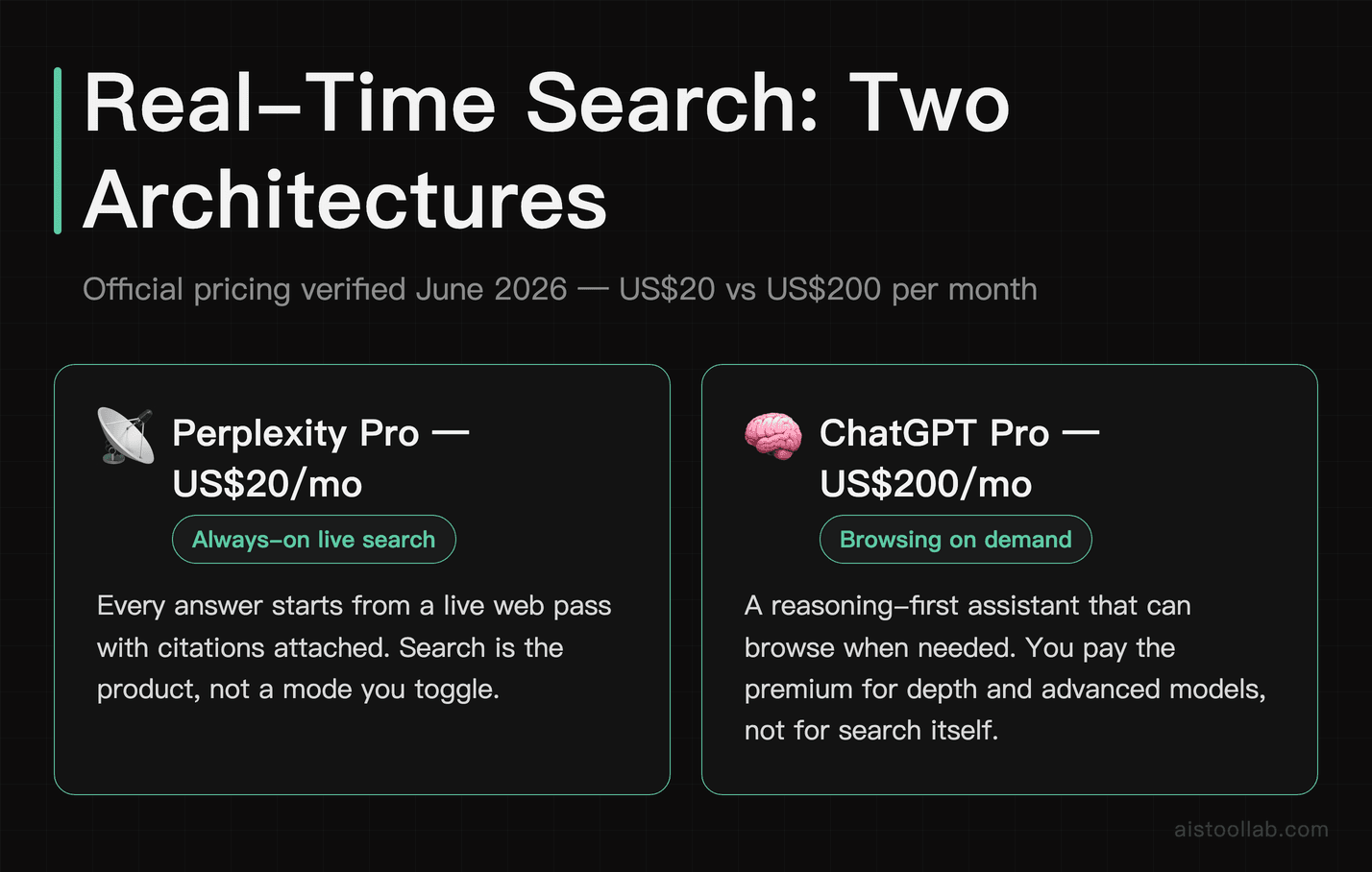
This is where the two products diverge most visibly, and it’s the dimension that matters most if your primary use case is research.
Perplexity Pro: Search Is the Product
With Perplexity, every single query runs a live web search by default. You ask a question, it searches multiple sources, synthesises an answer, and delivers inline source labels on most points — all in one response. There’s no toggling search on or off, no wondering whether the answer came from training data or a live page. It’s live by default, sourced, and cited inline.
In practice, this means you can ask something like “What are the latest pricing changes from Anthropic’s API as of this week?” and get a current, sourced answer rather than a training-data response that might be six months stale. For anything time-sensitive — market movements, recent product announcements, regulatory changes, current events — Perplexity is noticeably more reliable than an assistant primarily working from its training corpus.
Hands-on: I ran that exact kind of query on the free tier
To make this concrete, I tried that exact type of time-sensitive question on Perplexity’s free tier, without logging in — asking for Anthropic’s latest Claude API pricing changes in 2026. Here is the actual result.
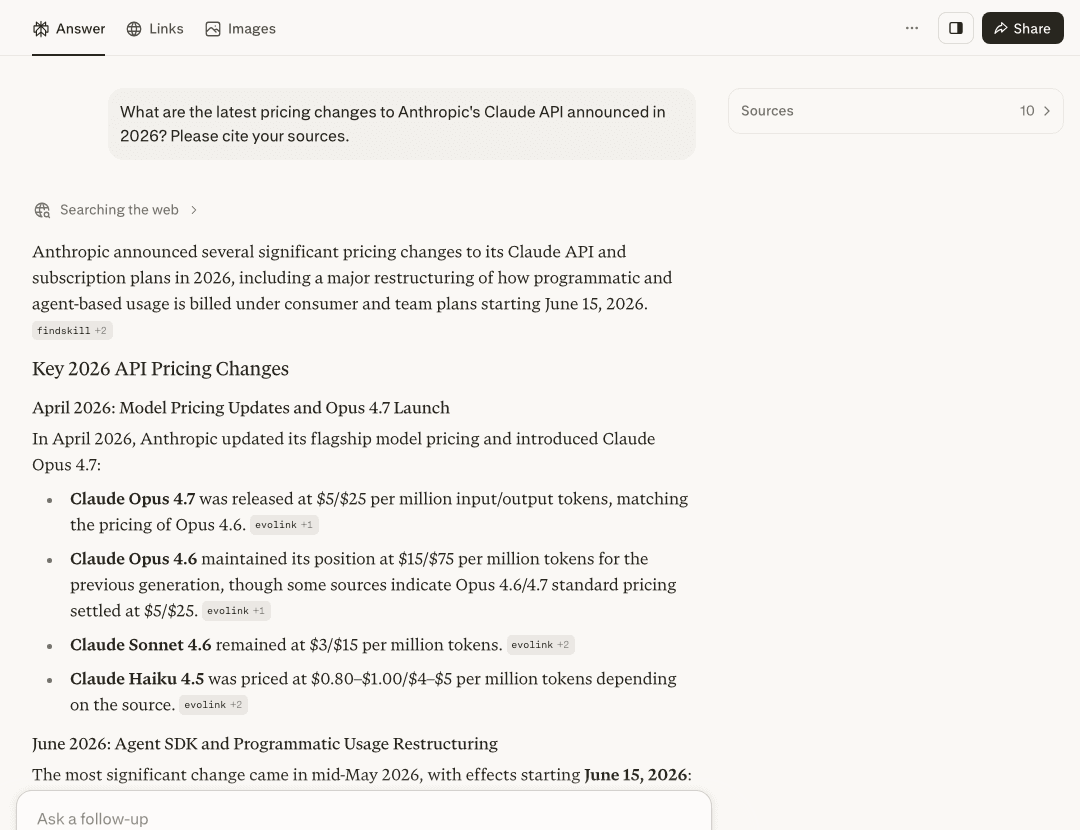
What I actually saw in this run: it ran a live web search, listed a Sources panel of about ten pages, and broke the answer into a per-model breakdown — for example Opus 4.7 at $5/$25 and Sonnet 4.6 at $3/$15 per million tokens — with a source label sitting next to most points. That source-label-per-point behaviour the article credits Perplexity for showed up even on the free plan, which is the part that matters if verification speed is your priority.
Two honest caveats from this single run: the free tier is not Pro, so there was no Deep Research here and the heavier modes carry a daily cap; and I only observed the source labels on screen — I did not click through every label to confirm it is a working link, nor did I check each source’s contents. Treat the labels as a starting point for verification, not proof. This is one free-tier run at this moment, not a benchmark.
The Pro plan unlocks Perplexity’s Deep Research feature, which is genuinely impressive. It runs multi-step, multi-query research sessions autonomously — essentially conducting the kind of layered research a junior analyst would do. Ask it to produce a competitive landscape overview for a SaaS product category, and it’ll run dozens of sub-searches, pull from industry sources, and produce a structured report with citations throughout. It’s not perfect, and key claims still warrant verification, but as a first draft of research, it’s fast and usable.
ChatGPT Pro: Search as a Feature, Not an Identity
ChatGPT Pro does search the web, and its search quality is genuinely good when it kicks in. But it doesn’t always kick in automatically. The model makes a judgement call about whether a question requires fresh web data or can be answered from its training. For something like “explain how compound interest works,” that’s fine — it doesn’t need to search. But for something like “what did OpenAI announce at its last developer event,” the response quality depends heavily on whether the model correctly flags that as requiring a live search.
ChatGPT Pro’s Deep Research is the more ambitious of the two autonomous research features on paper. I have not run the two side by side, so I won’t rank them. It can generate multi-thousand-word research reports, cross-reference sources, and synthesise complex topics at a level that’s quite extraordinary. For longer-form research tasks — writing a detailed brief on a niche technical topic, for example — the depth can be impressive. But it takes time (sometimes 10–20 minutes for a full Deep Research run) and it’s clearly designed for occasional in-depth tasks, not rapid-fire query answering.
Citations in ChatGPT Pro are present, but the experience is less granular than Perplexity. You often get source links at the end of a response rather than tight inline citations at the claim level. For casual research, this is fine. For anything where you need to verify exactly which source supports which specific claim, Perplexity’s approach is more useful.
For a deeper look at how AI tools handle retrieval of current information, see our breakdown of Retrieval-Augmented Generation (RAG) in 2026: How AI Systems Actually Access Real-Time Information.
Citation Accuracy: Can You Actually Trust What They Tell You?
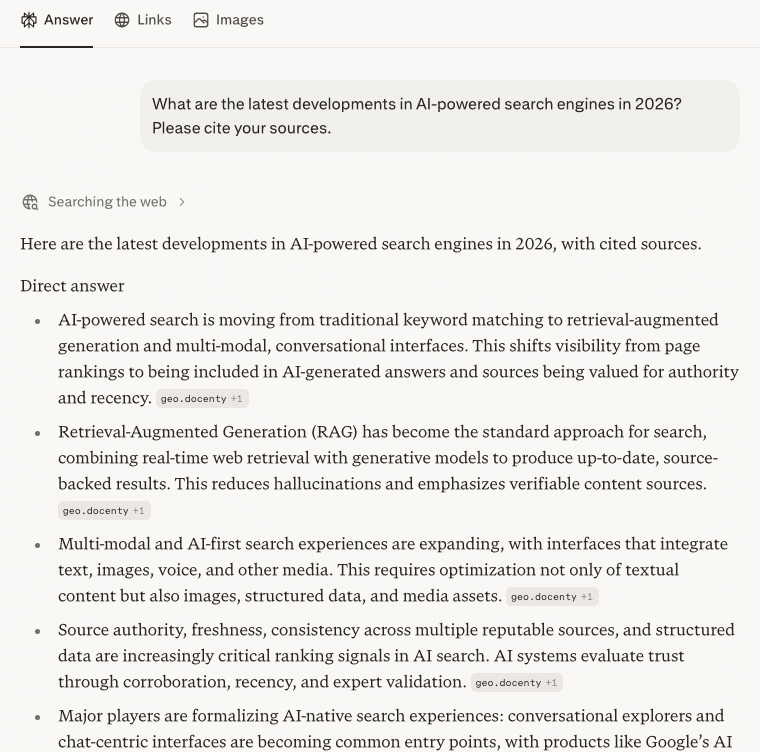
On citation trust, here’s a quick free-tier check (no login): asked about 2026 developments in AI search, the tool marked a source beside each point rather than leaving claims unsourced. Honest limit: the tags are shortened domains, so for anything you’ll cite formally you still click through and confirm the original.
This is the question that matters most for serious research, and honestly, it’s where both tools have real limitations worth discussing plainly.
Perplexity’s citation system is its strongest selling point. Most factual claims in a Perplexity response carry a numbered source label pointing to a source page. This doesn’t mean the claim is always correct — it means you can check it against the cited source, which is a meaningful difference. Perplexity’s source links are largely accurate in pointing to real, relevant pages. The synthesis from those sources is generally faithful to what the source actually says, though there can be occasional cases where the summary nudges slightly beyond what the cited source explicitly states.
ChatGPT Pro is more prone to confident-sounding statements that aren’t always traceable to a specific current source, particularly when search didn’t trigger or the model is working from training data. This isn’t a unique failing of ChatGPT — it’s the nature of large language models, which can generate plausible-sounding information that has no real-world citation. When ChatGPT Pro does search and cite sources, the accuracy is generally solid. But the inconsistency in when search is invoked means you need to be more vigilant about verifying claims.
Bottom line on citations: if you’re producing research that other people will rely on — client reports, journalism, academic work — Perplexity’s inline citation model gives you a faster verification workflow. That alone is a substantial practical advantage for researchers.
Use Cases: Who Should Be Using Which Tool
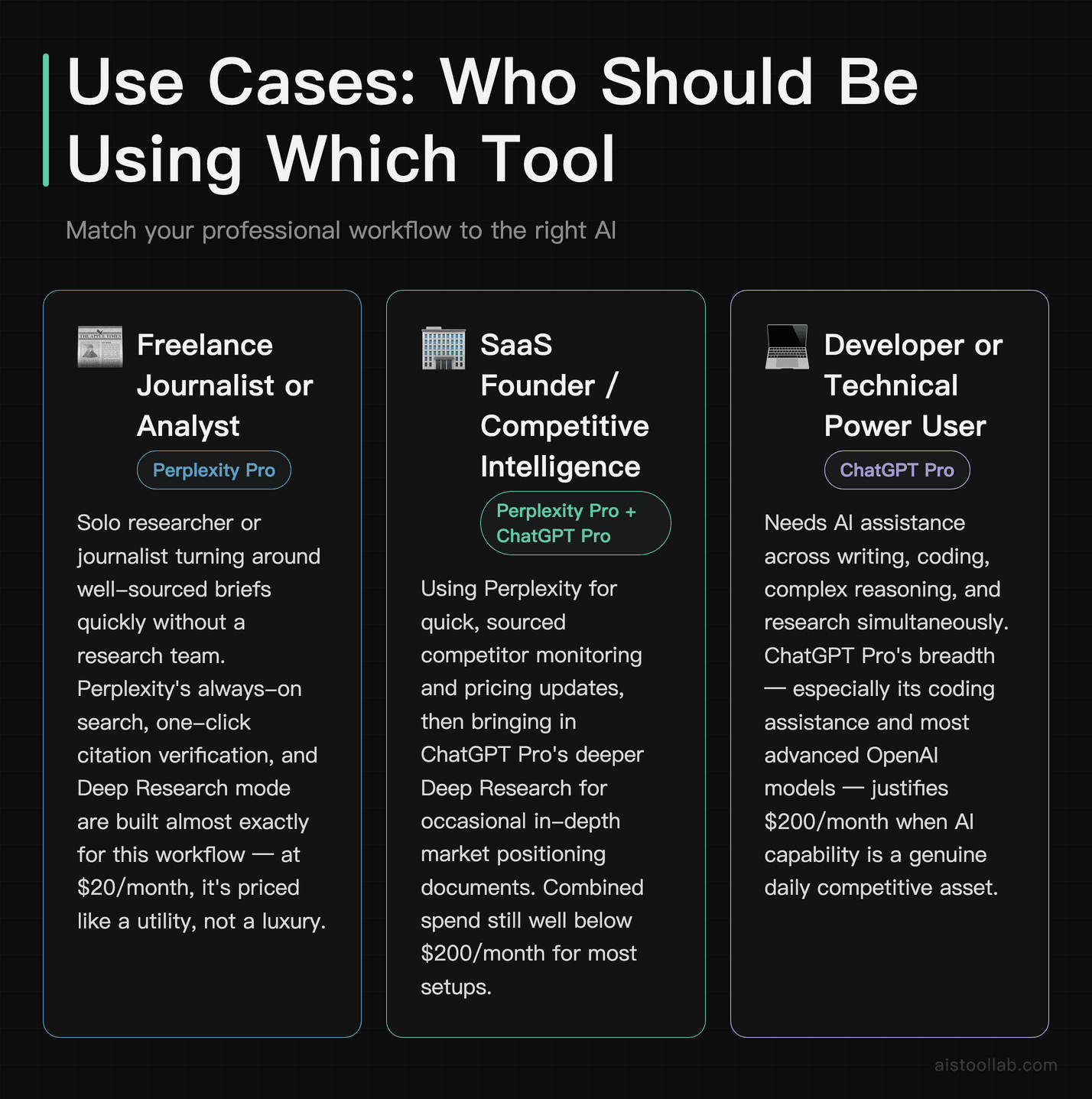
The Freelance Journalist or Analyst Who Needs to Move Fast
Imagine you’re a freelance researcher or independent journalist. You get a commission on a Tuesday afternoon, you need to turn around a well-sourced 1,500-word brief by Thursday morning, and you’re working solo without a research team. Perplexity Pro is built almost exactly for this situation. You can run a series of targeted queries, get sourced answers in seconds, check citations against their sources, and build out a source list while you work. The Deep Research feature can draft an initial landscape overview that you then refine and fact-check. At $20/month, it’s priced appropriately for a solo professional — not a luxury, just a useful tool.
The SaaS Founder Doing Competitive Intelligence
You’re running a small SaaS company with a two-person marketing team. You need to keep tabs on what competitors are announcing, monitor pricing changes in your category, and occasionally produce in-depth market positioning documents. Perplexity handles the ongoing monitoring well — quick queries for current competitor news, sourced and cited. For the occasional deep-dive document, ChatGPT Pro’s Deep Research feature produces more polished, long-form output. If budget allows, many people in this situation use both. If you have to pick one, the answer depends on whether ongoing rapid research or occasional deep reports matters more to your workflow.
The Developer or Technical Writer Who Needs Both Code and Research
Here’s where ChatGPT Pro has a clear advantage. If your daily work involves writing code, debugging, generating technical documentation, and doing research — all in the same workflow — ChatGPT Pro’s multi-modal capability is genuinely hard to replace at its level. You can go from a research query to a code implementation to a written explanation within the same conversation, using whichever OpenAI models your plan includes. Perplexity doesn’t really compete in the coding and technical writing dimension. For this type of user, the $200/month might actually make sense — not because the search is better, but because the combined value across use cases is higher.
The Student or Academic Researcher Building Literature Reviews
Academic research has a specific problem: you need sources, and you need them to be real and accurately represented. Perplexity Pro is a strong tool here, particularly for building an initial understanding of a topic and identifying key sources to then verify manually. That said, neither tool should replace actual database research through platforms like Google Scholar or institutional libraries for peer-reviewed work. Perplexity is excellent as a starting point and synthesis layer; it’s not a replacement for primary source verification in academic contexts.
Pricing: Is the $180/Month Gap Justified?
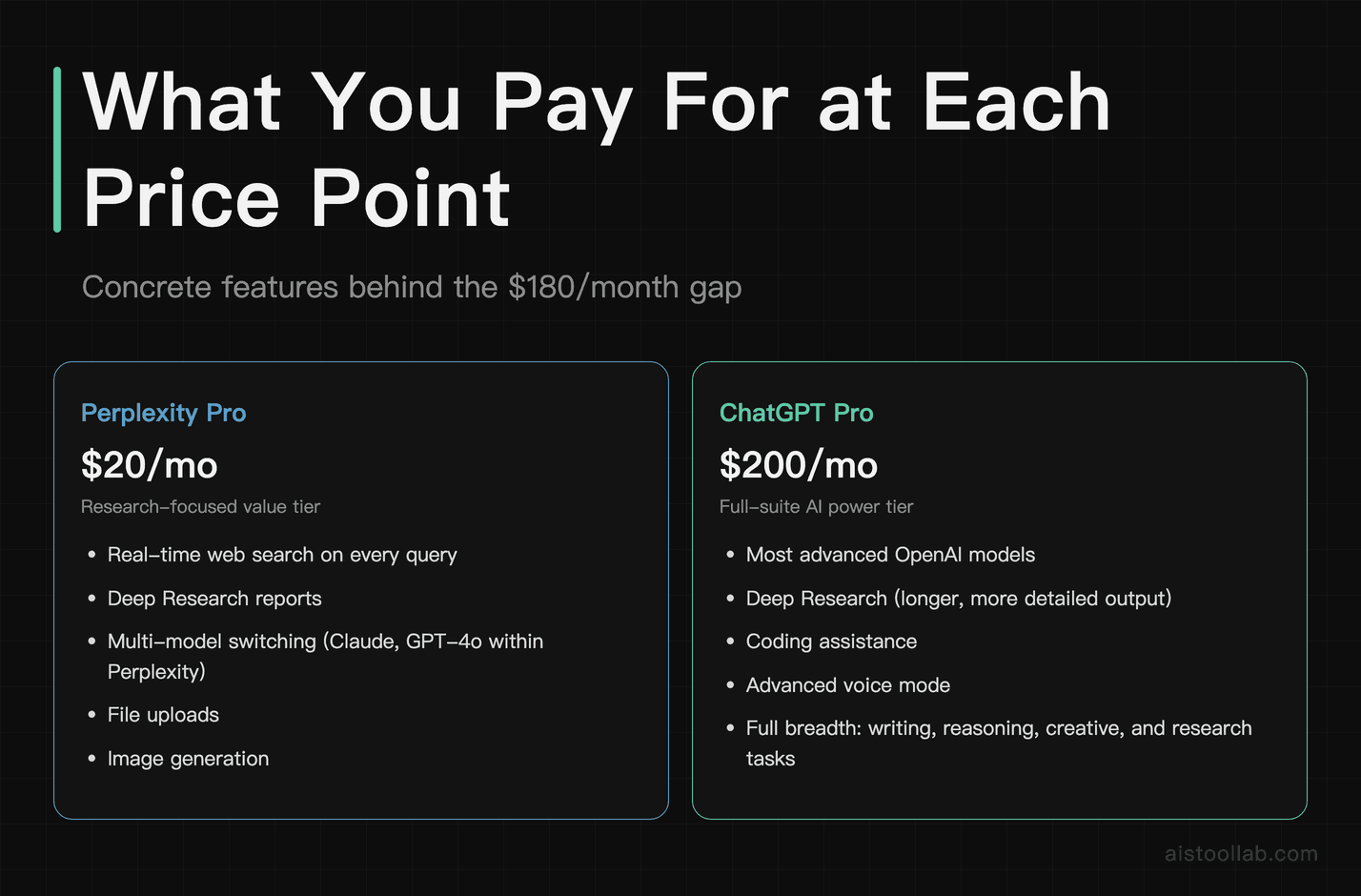
Let’s be honest about this. Perplexity Pro at $20/month is one of the better value propositions in the AI tools space right now. You get real-time search, deep research reports, multi-model switching (you can use Claude or GPT-4o models within Perplexity), file uploads, and image generation. For a research-focused user, that’s a lot of capability for the price.
ChatGPT Pro at $200/month is a significant financial commitment. To justify it, you need to be getting material value from capabilities that sit outside what a search-first tool is built to do — the OpenAI models included at that tier, the Deep Research output, the coding assistance, the advanced voice mode, and the breadth of use cases. If you’re using AI tools heavily across writing, research, coding, and creative tasks every single day, the maths can work out. If you’re primarily doing research and fact-checking, the $180 difference is hard to defend.
One combination worth considering: Perplexity Pro as the default research layer ($20/month) plus a mid-tier ChatGPT plan for writing and general assistance. The combined spend is still well below ChatGPT Pro’s $200, and the workflow actually fits better.
You can see a more detailed breakdown of what Perplexity Pro’s features look like in practice in our Perplexity Pro Review 2026: Real-World Use Cases for Research, Writing, and Decision-Making.
Deep Research Mode: Side-by-Side Comparison
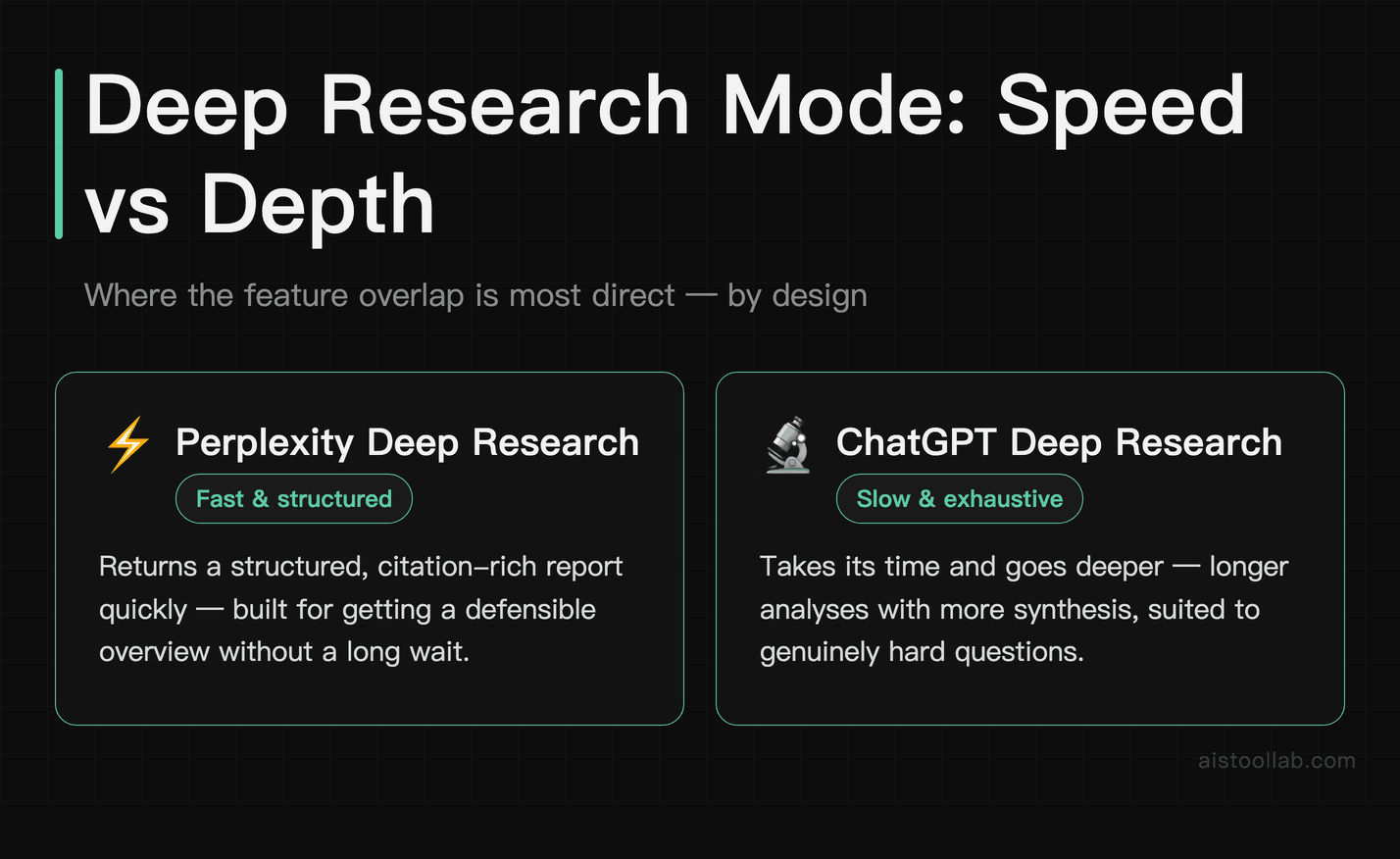
Both tools offer a “Deep Research” mode, and it’s worth spending time here because this is where the feature overlap is most direct.
Perplexity’s Deep Research is fast — typically returning a structured report within a few minutes. It runs multiple searches in sequence, draws from a range of sources, and synthesises findings into a coherent document with citations throughout. The output quality is good: well-organised, factual, and sourced. The limitation is depth — for very complex topics requiring nuanced synthesis, the reports can feel somewhat surface-level compared to what a human researcher would produce.
ChatGPT Pro’s Deep Research is more ambitious in scope and takes longer — sometimes 15–20 minutes for a full run. The output is often more detailed, better structured, and shows more genuine reasoning about conflicting information or nuanced positions. For a serious analytical task — researching a potential acquisition target, building an investment thesis, writing a comprehensive explainer on a complex policy area — ChatGPT Pro’s Deep Research output is generally more impressive. The trade-off is speed and the per-month cost to access it.
For day-to-day research queries, Perplexity’s speed advantage matters a lot. I don’t want to wait 20 minutes for a quick fact-check. For occasional high-stakes research projects where quality matters more than speed, ChatGPT Pro Deep Research is the stronger product.
What About Google? Is Either Actually Better?
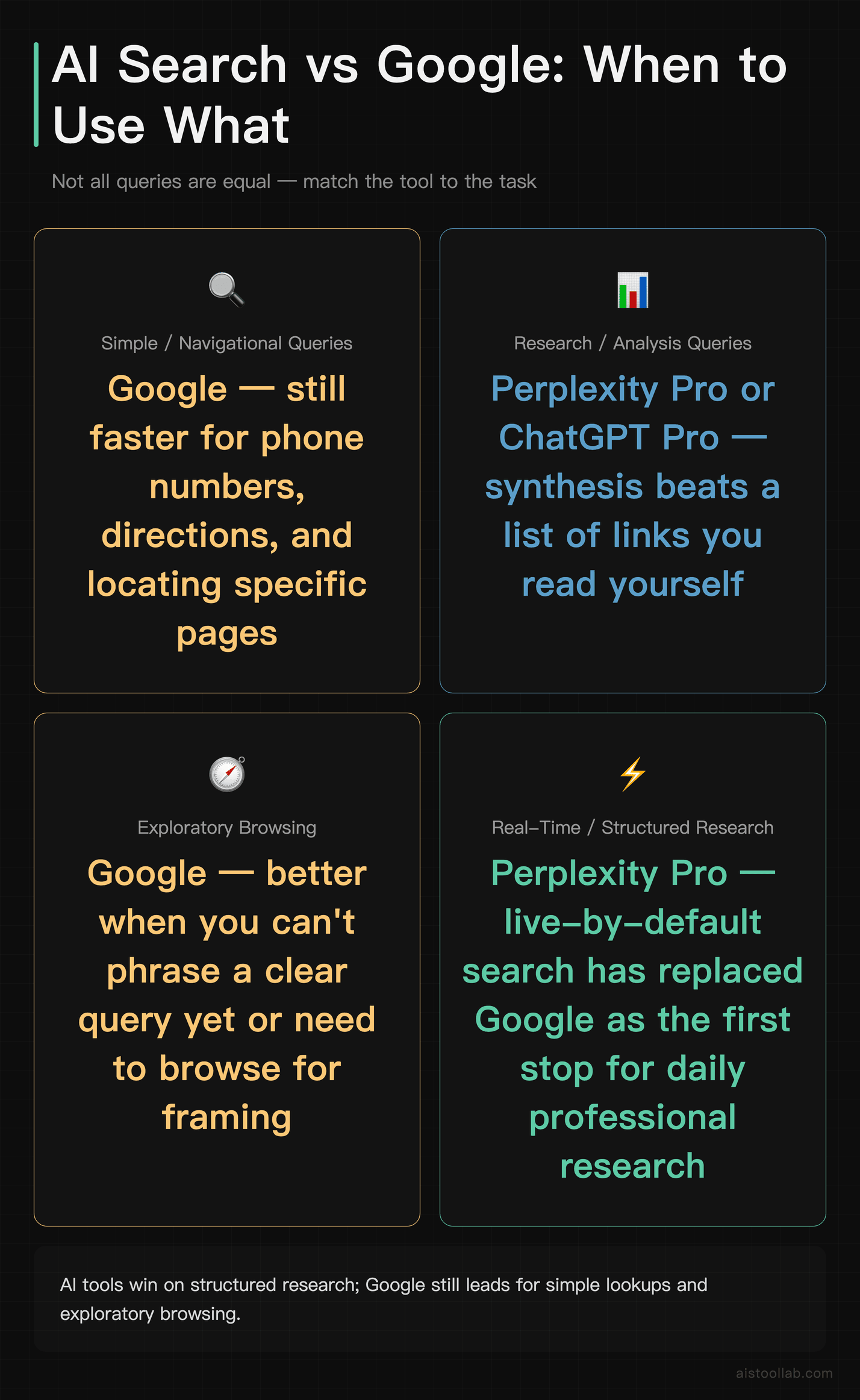
This was the question in the title, so let’s answer it directly.
For simple navigational queries — finding a website, looking up a business phone number, getting directions — Google is still faster and more purpose-built. Neither AI tool is trying to replace that.
For research queries — “what are the pros and cons of X,” “explain how Y works,” “compare A and B in the context of Z” — both Perplexity Pro and ChatGPT Pro tend to be noticeably more useful than Google. Google returns a list of pages you need to visit, read, and synthesise yourself. Perplexity and ChatGPT do the synthesis for you, with varying degrees of source transparency.
Where Google still has an edge: when you need to explore a topic you don’t know how to phrase as a query yet, or when you’re looking for a specific piece of content (a particular article, a video, a product page). AI search tools work best when you have a reasonably well-formed question. Google is still the more comfortable tool for exploratory browsing.
But for the type of structured research most professionals do every day? Perplexity Pro has genuinely replaced Google as my first stop, and I don’t think I’m unusual in that. The experience of getting a synthesised, cited answer in 10 seconds rather than opening eight tabs is just better — full stop.
My Verdict: Which One Should You Actually Use?
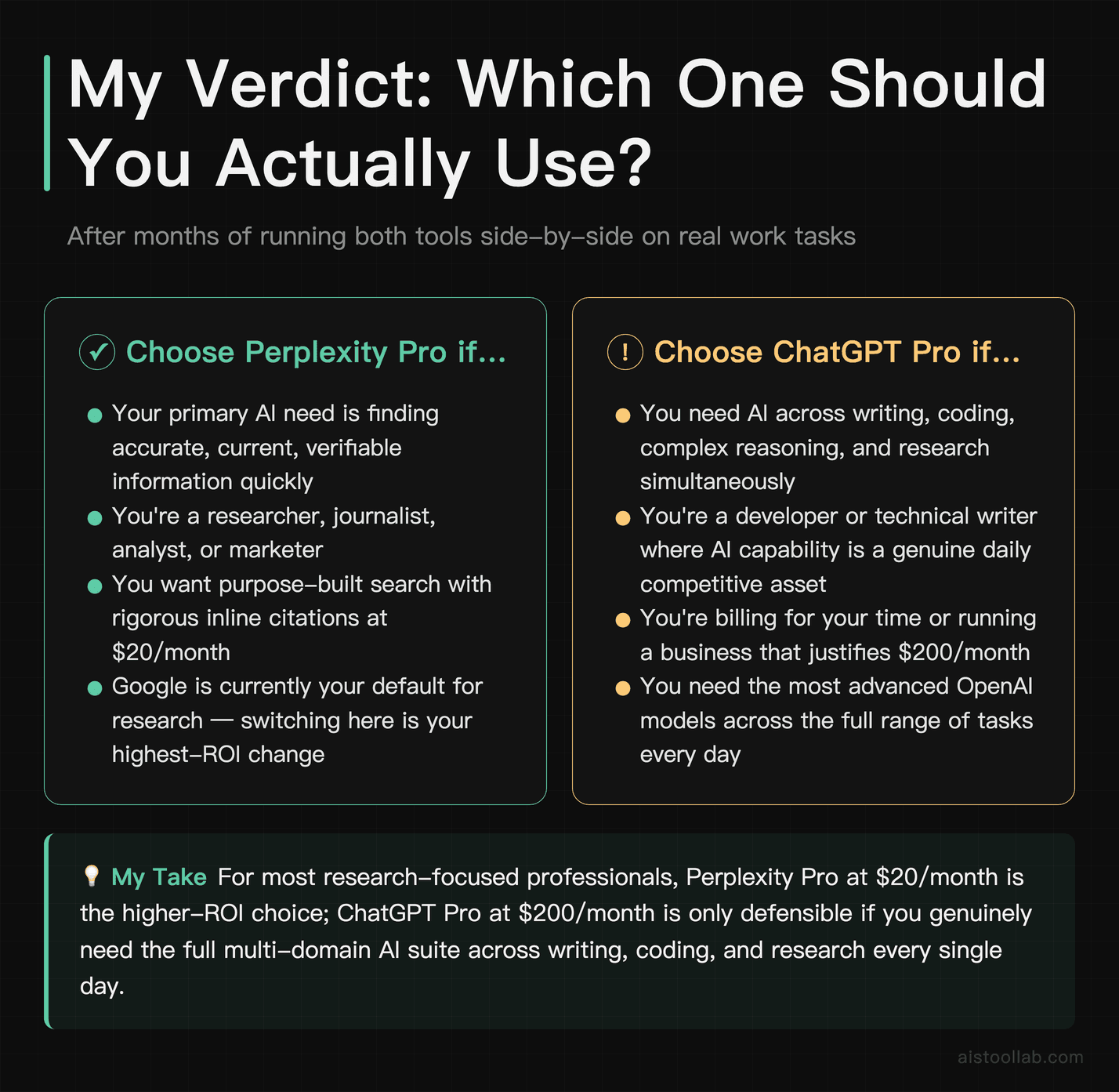
Here’s where I land on both tools.
If you’re a researcher, journalist, analyst, marketer, or any kind of professional whose primary AI need is finding accurate, current, verifiable information quickly, Perplexity Pro is the better tool for that job. It’s purpose-built for search, citations are attached by design rather than as an optional browsing step, and Perplexity’s own product pages (perplexity.ai) describe search as running by default on each query rather than waiting for the model to decide; at $20/month it’s priced like a utility rather than a luxury. If Google is currently your default for research queries, switching to Perplexity Pro for that workflow is one of the higher-ROI changes you can make to your daily research process.
If you’re a developer, a technical writer, or a power user who needs AI assistance across multiple domains simultaneously — writing, coding, complex reasoning, research, and creative work — and you’re either billing for your time or running a business where AI capability is a genuine competitive asset, ChatGPT Pro at $200/month is a defensible choice. It’s not primarily a search tool — you’re paying for the range of tasks it covers, not for the search. Just go in knowing you’re paying for the full suite, not just the search.
And for the growing number of people who use ChatGPT regularly alongside their research tools — my suggestion is to check out our ChatGPT 5 Advanced Power Tips: Hidden Features and Pro Techniques for 2026 to make sure you’re actually using what you’re paying for.
My own call: Perplexity Pro is the one I’d treat as essential for research, and ChatGPT Pro as situational. Start with Perplexity. Add ChatGPT if you need more than it can give you.
Frequently Asked Questions
Is Perplexity Pro’s real-time search actually reliable for current news and events?
Perplexity Pro is one of the more reliable AI tools for current information because every query triggers a live web search by default. You’re not relying on training data with a knowledge cutoff — you’re getting synthesised results from live pages. That said, “reliable” comes with caveats. Perplexity can only surface information that’s actually been published and indexed on the web. For breaking news in the last hour, results may be limited to early reports. For rapidly evolving stories, the synthesis may not capture the latest developments if pages haven’t been crawled recently. For anything from the last few days to weeks, it tends to perform well. I’d also add that you should always click through to the cited sources for anything you’re going to act on — the synthesis is a starting point, not a final authority. Think of it as a very fast research assistant that hands you sources, not a system that guarantees accuracy.
Does ChatGPT Pro always search the web when you ask a research question?
Not automatically. ChatGPT Pro makes an internal judgement about whether a query needs live web search or can be answered from its training data. For time-sensitive questions about recent events, it generally does trigger a search — but not always, and not always reliably. You can prompt it more explicitly to search (phrases like “search the web for the latest information on…” tend to help), but the experience is less predictable than Perplexity, which searches every time by design. For research work where you specifically need current information, this inconsistency is a real limitation compared to Perplexity’s always-on approach. If you’re paying $200/month for ChatGPT Pro, you need to be conscious of this and verify whether responses are drawing from live search or from training data — the tone of the response often doesn’t make this obvious.
Can I use Perplexity Pro to replace academic database searches?
Perplexity Pro is useful for academic research, but I wouldn’t position it as a replacement for dedicated academic databases like PubMed, JSTOR, Google Scholar, or institutional library systems. Perplexity pulls from the open web, which includes many academic sources, but it doesn’t have comprehensive coverage of paywalled journals or grey literature. Where it genuinely helps is in building initial understanding — getting a quick synthesised overview of a topic before you dive into the primary literature, identifying key researchers or papers worth tracking down, and getting a sense of how a field is currently framing a debate. For building a formal literature review or citing sources in academic work, you still need to verify through primary databases and check original sources. Use Perplexity as a smart, fast first layer, then do your rigorous source verification through proper channels.
Is the $180/month price difference between Perplexity Pro and ChatGPT Pro actually worth it?
Honestly? For the majority of research-focused users, no. Perplexity Pro at $20/month covers the core research workflow extremely well — real-time search, cited answers, deep research reports, and multi-model access. ChatGPT Pro’s premium pricing reflects capabilities beyond search: access to the top-tier OpenAI models on that plan, the coding assistance, the creative writing tools, and the longer-running Deep Research mode (capability descriptions come from OpenAI’s own plan pages; I haven’t benchmarked them against rivals). If your primary use case is research and fact-finding, the extra $180/month is hard to justify unless you’re genuinely using the full range of ChatGPT Pro’s capabilities daily. Where ChatGPT Pro makes financial sense is for professionals who need a single tool that handles research, writing, coding, and analysis at the highest level — and are billing hours or generating revenue that makes the cost trivial. For most people, Perplexity Pro plus a standard ChatGPT Plus plan (if you need writing/coding help) is a more rational combination.
How does Perplexity Pro handle citation accuracy compared to ChatGPT Pro?
Perplexity Pro’s attaches source labels to the statements in an answer; Perplexity’s own product pages (perplexity.ai) describe the design as retrieve-then-generate, so the label points at what it pulled. Whether that source actually supports the sentence is still yours to check. Most factual statements get a numbered source label pointing to a source page, which makes it easy to check a specific claim. The source links are generally accurate and relevant, though the synthesis occasionally nudges slightly beyond what the cited source strictly says — so verification is still your responsibility. ChatGPT Pro provides sources but often as a list at the end of a response rather than inline with specific claims, which makes it harder to trace which source supports which statement. This matters a lot in professional research contexts. If you’re building a client report or producing work other people will fact-check, Perplexity’s approach saves significant time in the verification workflow. Neither tool eliminates the need for manual source checking, but Perplexity makes that checking much easier.
What models can I access inside Perplexity Pro, and does that change the comparison?
One underappreciated feature of Perplexity Pro is that it gives you access to multiple underlying AI models — including versions of GPT-4o and Claude alongside Perplexity’s own Sonar models — within the same $20/month subscription. This is genuinely unusual. You can switch models within Perplexity depending on the task, which gives you some of the model quality you’d expect from more expensive standalone subscriptions, combined with Perplexity’s search infrastructure. This does shift the comparison somewhat. You’re not just getting Perplexity’s native capabilities — you’re potentially getting Claude-level responses with live web search and inline citations. That’s a meaningfully strong package. ChatGPT Pro, by contrast, is locked to OpenAI’s model family, which is strong but doesn’t give you the cross-model flexibility.
Which tool is better for someone who does a mix of research and content writing?
This is a common way research and writing get mixed in one workflow. If your workflow is roughly “research a topic, then write something about it,” the honest answer is that the tools complement each other rather than one fully replacing the other. Perplexity Pro excels in the research phase — gathering current information, identifying key sources, building an evidence base quickly. ChatGPT (at the Plus or Pro level) excels in the writing phase — producing fluent drafts, refining tone, structuring long-form content. Many professionals use both. If I had to pick just one and my work was split evenly between research and writing, I’d probably start with Perplexity Pro because the research capability is more differentiated, and then use whatever ChatGPT tier fits my budget for writing assistance. That combination covers most content workflows at a reasonable price point.
How do both tools compare when researching niche technical topics with limited online coverage?
Both tools struggle somewhat with genuinely niche topics where online coverage is sparse. Perplexity’s search-first approach means it can only surface what’s actually published and indexed — for highly specialised technical topics with limited public documentation, it may return thinner results or lean more heavily on a smaller number of sources. ChatGPT Pro, drawing on its training data, may actually perform better on some niche technical topics because its training corpus includes a broad range of textbooks, technical documentation, and specialised content — even if that information isn’t current. This is a genuine area where ChatGPT’s hybrid approach (training data plus web search) can outperform a purely search-first tool. For cutting-edge research or proprietary technical domains, you’ll likely hit the limits of both tools and need to go to primary sources, specialist forums, or subject matter experts.
Last updated: 2026
Explore more AI tools
👉 Browse the AI Tools Library to find the right tools for your workflow.