Who this is for: developers and technical writers building an assistant on top of their own documents, who need to know where grounding still breaks. If your question is instead how a system reaches current, changing information — embedding models, vector databases, chunking, frameworks — that stack is covered in the RAG stack guide.
The Hallucination Problem Nobody Talks About
Here’s a common assumption worth challenging: most people believe that bigger, newer AI models hallucinate less. Train on more data, scale the parameters, and the fabrications go away. It’s an intuitive idea — and it’s mostly wrong. The architecture of a standard large language model means it always generates plausible-sounding text based on statistical patterns. Whether that text is grounded in reality is a separate question entirely — one that model size alone doesn’t reliably solve.
In my view, having followed AI tools closely for years, the hallucination problem hasn’t disappeared with newer model generations. It’s shifted. Models have gotten better at sounding confident while being wrong in subtler, harder-to-catch ways. Ask a vanilla LLM about a court case from 2023, a niche software library’s API changes, or your company’s internal HR policy — and you can get a fluent, authoritative answer that may be completely fabricated. The model isn’t lying. It’s doing exactly what it was designed to do: predict the most statistically probable next token.
Retrieval-Augmented Generation — RAG — is the serious engineering answer to this problem. It’s not new (the foundational paper came out in 2020), but it’s become the backbone of almost every AI tool that claims to “use your data” or “stay up to date.” Perplexity runs on it. NotebookLM is essentially a RAG product with a very polished interface. When developers build document Q&A systems on the Claude or OpenAI APIs, they’re almost certainly implementing RAG in some form. Understanding how it actually works — not just the marketing version — will change how you evaluate every AI tool you use.
Grounding, Not Memory: What Retrieval Adds

RAG stands for Retrieval-Augmented Generation. The name is more descriptive than most AI acronyms: you retrieve relevant information, then use it to augment what the model generates. The core idea is to separate what the model knows by default (its parametric memory, baked in during training) from what it can look up on demand (non-parametric memory, stored externally and retrieved at inference time).
Think of it this way. A standard LLM is like a consultant who memorized everything they could before walking into your office — knowledgeable, fast, but potentially out of date and occasionally confabulating details they half-remember. A RAG-powered system is like that same consultant, except now they have a laptop in the meeting and can pull up the actual contract, the actual research paper, the actual support ticket before they answer. The underlying intelligence is the same. The grounding is completely different.
What RAG is not: it’s not fine-tuning. Fine-tuning bakes new information into the model’s weights — a slow, expensive process that requires retraining and still doesn’t prevent hallucination. It’s also not simple prompt stuffing, where you copy-paste a document into the context window. Context stuffing works for short documents but breaks down at scale — you can’t stuff 50,000 internal documents into a single prompt. RAG solves the scale problem by retrieving only the most relevant chunks at query time, keeping the context window focused and manageable.
The Technical Pipeline: Four Stages That Actually Matter
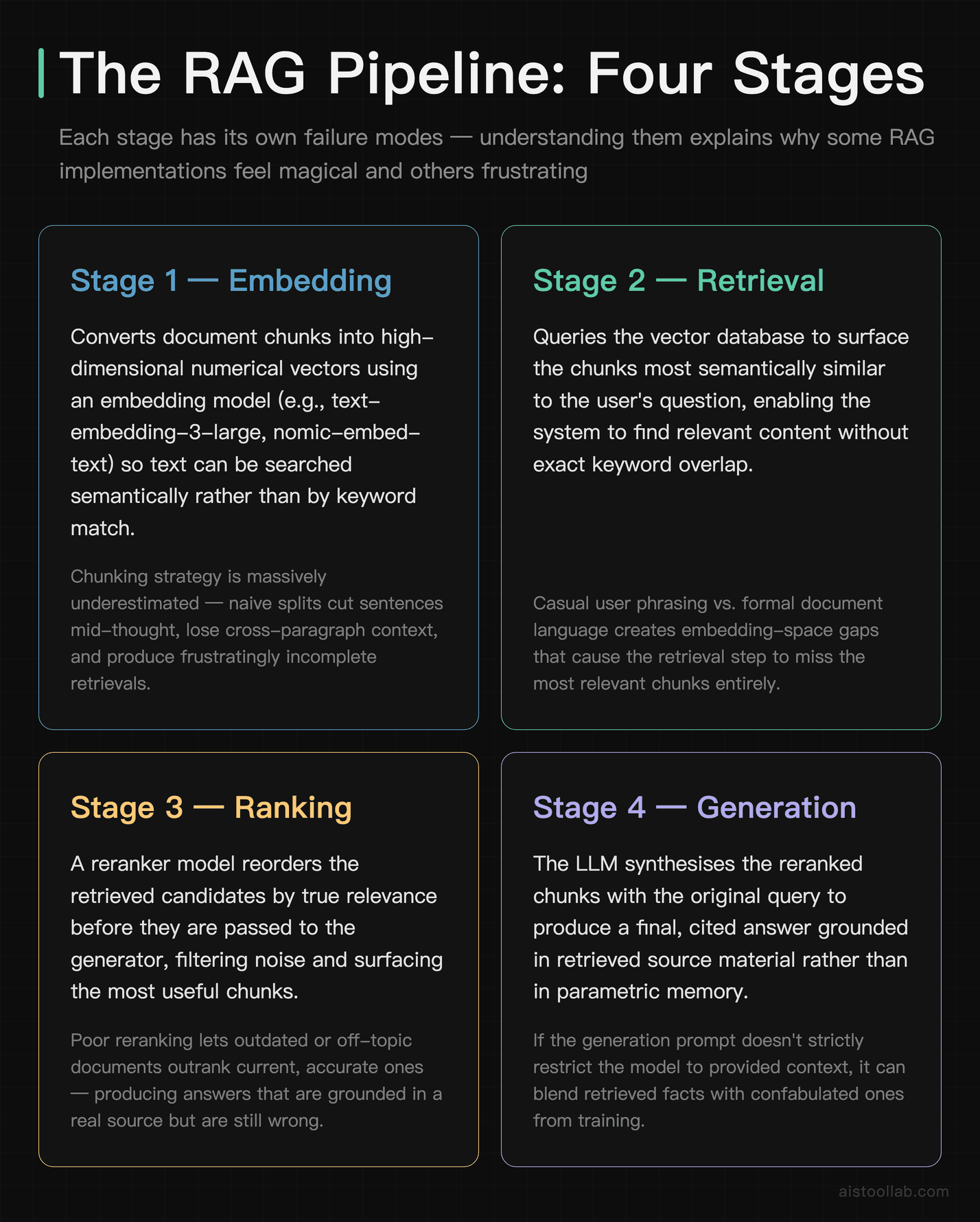
A production RAG system has four distinct stages: embedding, retrieval, ranking, and generation. Each stage has its own failure modes, and understanding them explains why some RAG implementations feel magical and others feel frustrating.
Stage 1: Embedding — Turning Text Into Searchable Math
Before any retrieval can happen, your documents need to be converted into a format that can be searched semantically, not just by keyword. This is the embedding stage. An embedding model — something like OpenAI’s text-embedding-3-large, Cohere’s embed models, or open-source alternatives like nomic-embed-text — reads a chunk of text and outputs a high-dimensional numerical vector. That vector captures the meaning of the text in a way that allows mathematical comparison.
The chunking strategy here matters enormously and is frequently underestimated. If you split a 50-page PDF into 500-word chunks naively, you’ll get chunks that cut off mid-sentence, lose context between paragraphs, and produce frustratingly incomplete retrievals. Good RAG implementations use overlapping chunks (so the end of one chunk appears at the start of the next), or hierarchical chunking (where both sentence-level and paragraph-level embeddings are stored). The vectors for every chunk are stored in a vector database — tools like Pinecone, Weaviate, Qdrant, or even PostgreSQL with the pgvector extension are commonly used here.
Stage 2: Retrieval — Finding What’s Actually Relevant
When a user submits a query, that query is also embedded using the same model that processed the documents. You now have a query vector and a database of document chunk vectors. The retrieval step finds the document chunks whose vectors are closest to the query vector — mathematically speaking, highest cosine similarity. This is Approximate Nearest Neighbor (ANN) search, and modern vector databases can do it across millions of vectors in milliseconds.
The naive implementation just takes the top-k most similar chunks and passes them along. Better implementations use hybrid search — combining dense vector retrieval (semantic similarity) with sparse retrieval methods like BM25 (traditional keyword matching). Why both? Because semantic search is great for conceptual similarity but can miss exact technical terms, product names, or specific codes that keyword search catches reliably. Hybrid retrieval is now widely considered table stakes for production RAG systems.
Stage 3: Ranking — Not All Retrieved Chunks Are Equal
Retrieval gives you a candidate set of potentially relevant chunks. Ranking — often called reranking — scores them more carefully before passing them to the language model. A retrieval step might return 20 candidate chunks; a cross-encoder reranker (which evaluates each chunk against the query together, rather than independently) then picks the top 5 that are genuinely most relevant to answer the specific question asked.
Reranking is computationally more expensive than initial retrieval, which is why it’s a second pass rather than the primary method. Cohere’s Rerank API and cross-encoder models from Hugging Face are commonly used here. Skipping this step is one of the most common reasons a RAG system returns technically relevant but practically unhelpful chunks — it retrieved documents that mentioned your topic but didn’t actually answer your question.
Stage 4: Generation — Where the LLM Finally Shows Up
Only at this final stage does the large language model do its thing. The retrieved and ranked chunks are injected into the prompt as context, typically in a format like: “Answer the following question using only the provided context. If the context doesn’t contain the answer, say so.” The model then synthesizes the context into a coherent response.
This prompt design — the instruction to use only the provided context — is critical. Without it, the model happily mixes retrieved facts with its parametric memory, which reintroduces hallucination through the back door. Citation mechanisms (where the model is instructed to reference which chunk number it’s drawing from) add another layer of accountability. When Perplexity shows you numbered citations next to its answers, that’s not decoration — it’s a verifiability layer built into the generation prompt.
Common Failure Modes (And How to Spot Them)
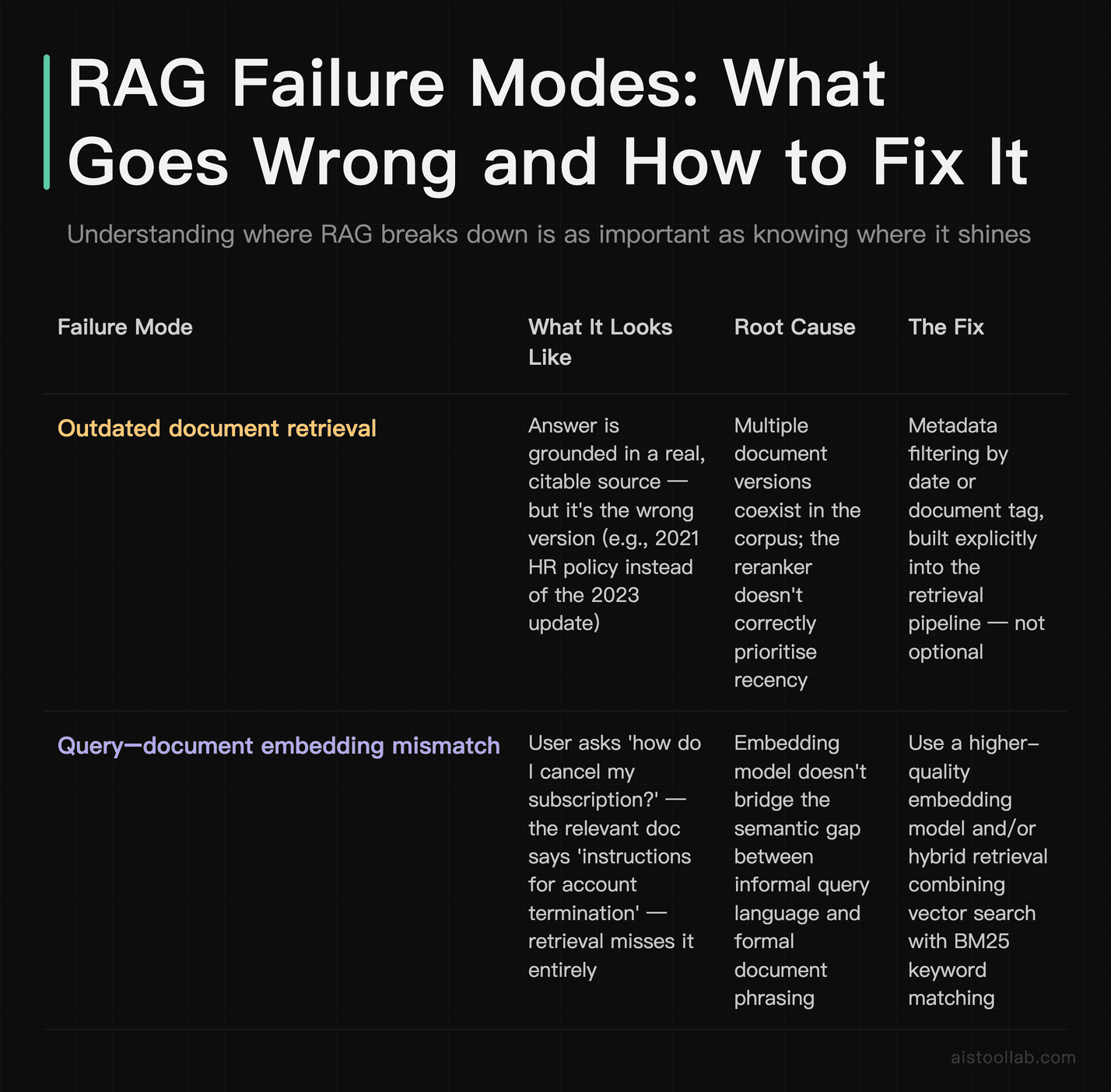
RAG is not a silver bullet, and understanding where it breaks down is as important as understanding where it shines. The most common failure mode in production systems is retrieval that’s technically relevant but contextually wrong. Imagine a document corpus with multiple versions of the same policy — an HR policy updated in 2023 and the original from 2021. A naive vector search might retrieve both, and if the reranker doesn’t correctly prioritize recency, the model generates an answer based on the outdated document. The answer is “grounded” in a real source. It’s still wrong. Metadata filtering (restricting retrieval to documents created after a certain date, or tagged with a specific category) is the fix — but it has to be built explicitly.
Another common failure: query-document mismatch in embedding space. A user asks “how do I cancel my subscription?” in casual language. The relevant document says “instructions for account termination.” If the embedding model doesn’t bridge that semantic gap effectively, the retrieval misses the relevant chunk entirely. This is why investing in a high-quality embedding model — and occasionally testing your system with adversarial queries phrased differently from your source documents — is non-negotiable for production systems.
Context window stuffing at the generation stage is a subtler problem. If you retrieve 15 chunks and dump them all into the prompt, the LLM’s attention mechanism may not equally weight all of them. Research — including work referenced in various NLP papers as the “lost in the middle” phenomenon — suggests models are often better at using information at the beginning and end of long contexts than in the middle. Keeping retrieved context concise and well-ordered isn’t just good practice; it’s architecturally important.
Use Cases: Who Actually Benefits From RAG
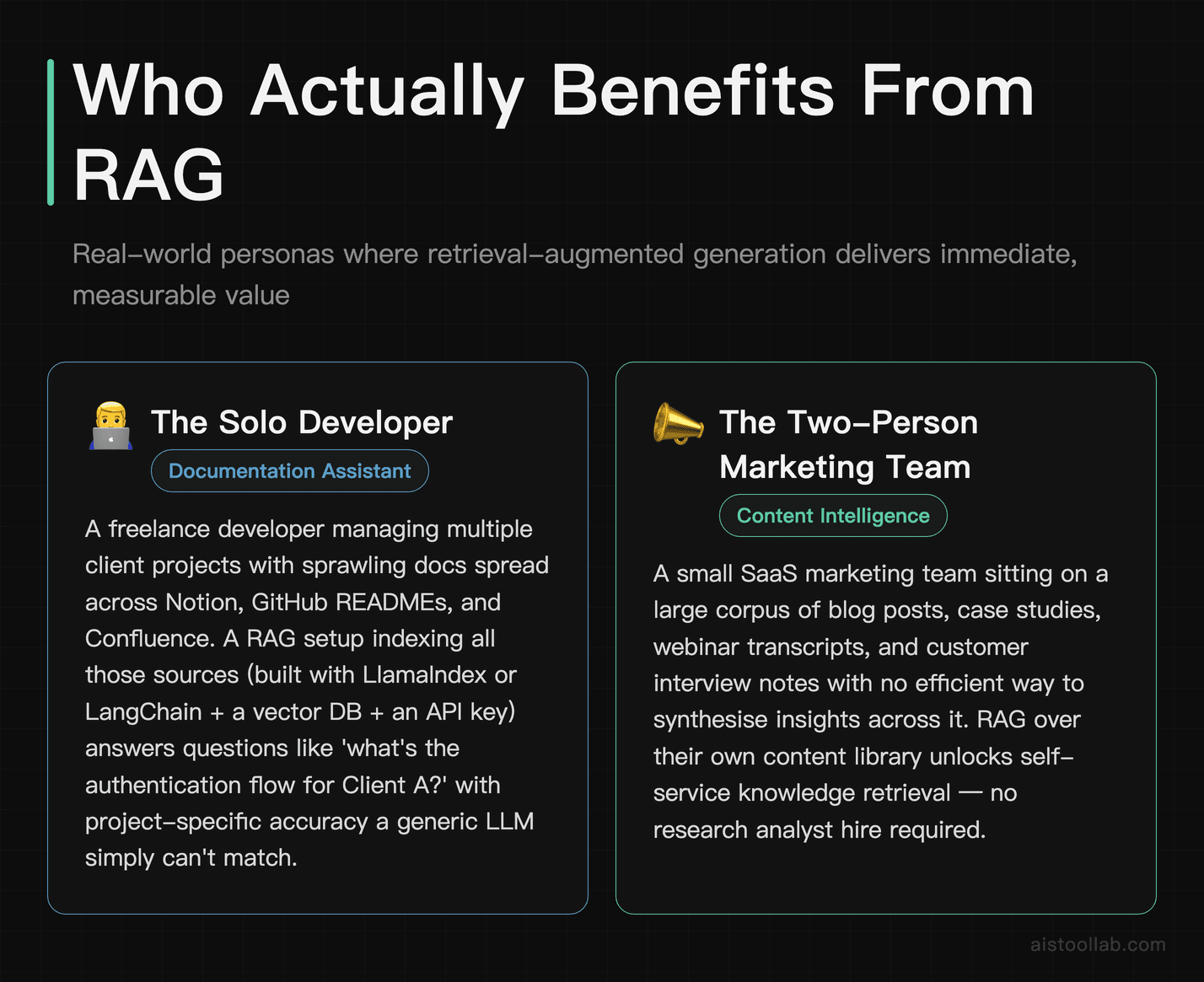
The Solo Developer Building a Documentation Assistant
Picture a freelance developer maintaining three client projects simultaneously, each with sprawling, inconsistently updated documentation spread across Notion pages, GitHub READMEs, and Confluence wikis. Asking a generic LLM about project-specific conventions is useless — it doesn’t know them. Fine-tuning isn’t practical for a solo operator updating docs weekly. A RAG setup that indexes all those documents and answers questions like “what’s the authentication flow for Client A’s API?” or “what does our error code 4023 mean?” is genuinely transformative. The developer can set this up today using tools like LlamaIndex or LangChain with a few hundred lines of code, a vector database, and an API key. The productivity gain is real and immediate.
The Two-Person Marketing Team at a SaaS Startup
A small marketing team at an early-stage SaaS company has a problem that’s almost embarrassingly common: they have a lot of written content — blog posts, case studies, webinar transcripts, competitor research, customer interview recordings turned into transcripts — and no way to quickly synthesize it. When a new team member joins and needs to understand the company’s positioning, or when someone needs to draft a sales email grounded in actual customer language, the knowledge is technically there. It’s just buried. A RAG system over that content corpus means querying “what words do our customers use to describe the pain we solve?” and getting answers drawn from actual interview transcripts, not a made-up summary. NotebookLM is essentially a productized version of this use case — drop your sources in, ask questions, get cited answers.
The Enterprise Legal Team Reviewing Contracts
Legal document review is one of the highest-stakes RAG applications. A team handling dozens of supplier contracts needs to answer questions like “which contracts have auto-renewal clauses with less than 30-day notice periods?” or “which agreements include unlimited liability provisions?” Keyword search misses paraphrased clauses. A junior associate reading every contract manually is expensive and error-prone. RAG over a contract corpus — with a reranker calibrated for legal language — can surface the relevant clauses with citations to the exact page and paragraph. The model doesn’t need to “know” contract law; it needs to retrieve and summarize what’s actually in the documents. The grounding is the entire point.
The Research Behind RAG: What the Evidence Actually Shows
The foundational RAG paper is Lewis et al. (2020), published by researchers at Facebook AI Research (now Meta AI), UCL, and New York University: “Retrieval-Augmented Generation for Knowledge-Intensive NLP Tasks.” The paper introduced the RAG architecture formally and demonstrated that combining retrieval with generation produced meaningfully better results on knowledge-intensive tasks compared to models relying solely on parametric memory. The researchers showed this on open-domain QA benchmarks including Natural Questions, TriviaQA, and WebQuestions — tasks where a model needs to answer factual questions from a large knowledge base. The paper is publicly available on arXiv (arXiv:2005.11401) and has been cited extensively across subsequent NLP research.
Since 2020, the research has developed considerably. Work on more sophisticated retrieval mechanisms — including iterative retrieval (where the model retrieves, generates a partial answer, then retrieves again based on what it learned), and self-RAG (where the model learns to decide when retrieval is needed at all) — has pushed the architecture further. A 2023 paper often referred to in RAG literature as work on “RAGAS” (RAG Assessment) introduced evaluation frameworks specifically designed to measure retrieval quality, faithfulness, and answer relevance independently — because optimizing one dimension without the others produces brittle systems.
Research from 2024 onward has focused heavily on long-context models as a potential alternative. The honest picture from available benchmarks is nuanced: very long context windows (models handling 128k or 1 million tokens) reduce the need for retrieval in some scenarios, but introduce their own problems — “lost in the middle” attention degradation, higher latency, and significantly higher inference costs. Research published through venues like EMNLP and ACL in 2024 generally suggests RAG and long-context approaches are complementary rather than competitive, with RAG remaining the better architecture when document corpora are large, dynamic, or proprietary.
It’s worth being honest about what the research doesn’t show cleanly: there’s no universally agreed-upon percentage improvement from RAG across all tasks. Results vary substantially depending on retrieval quality, domain, and the specific task. What the evidence consistently supports is that RAG reduces hallucination on factual, document-grounded questions — the claims get anchored to real text rather than parametric estimation.
How Different Tools Implement RAG (And Why It Matters)
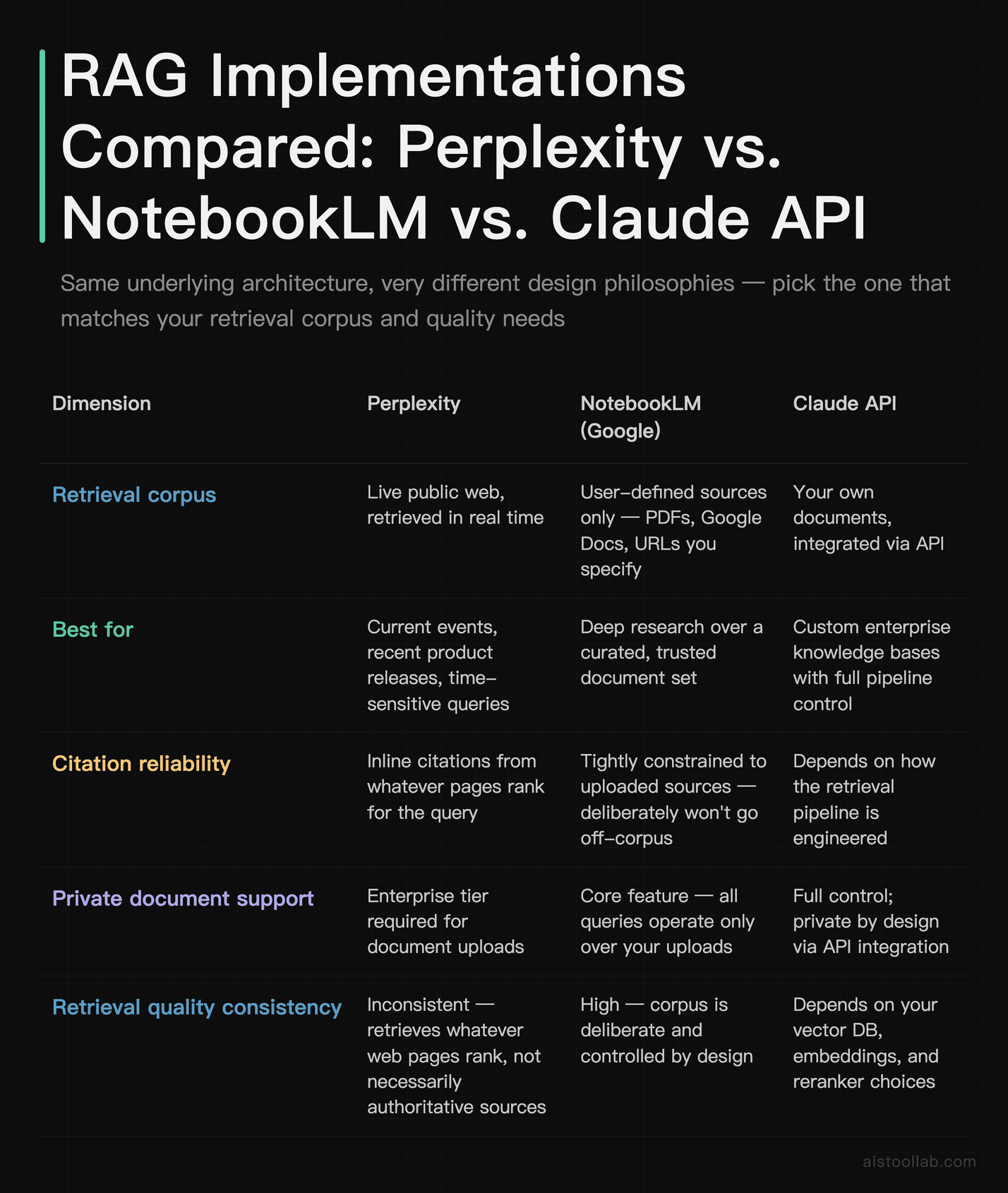
Not all RAG implementations are created equal, and understanding the differences helps you pick the right tool for the right job. Perplexity, NotebookLM, and the Claude API each take meaningfully different approaches.
Perplexity runs what’s essentially a live-web RAG system. When you ask a question, it retrieves from current web pages in real time, ranks them, and generates an answer with inline citations. The retrieval corpus is the live internet, which means it’s well suited for current events, recent product releases, and anything time-sensitive. The tradeoff is that web quality is inconsistent — it retrieves whatever pages rank for your query, not necessarily the most authoritative sources. It also means Perplexity can’t work over your private documents without the upload features on its higher tiers.
A Quick Look: What Perplexity’s Inline Citations Actually Look Like
Since the numbered-citation point is really the heart of why RAG matters, here is what it looks like in practice. For this piece, a single factual query was run on Perplexity’s free tier without logging in — asking what recent research says about whether standing desks improve health outcomes — and here is what that one run returned:

What stood out in this run: the answer led with a hedged summary (“help people sit less… not a major health fix”), then broke into “What the evidence shows” and an “Important caveat,” with a compact source label sitting next to several claims — including stacks.cdc (a CDC domain) and healthline. That is a visible example of the citation-label behavior described above: rather than a confident paragraph with no provenance, some claims name where they supposedly came from, giving you a lead to check instead of a black box.
The honest limits of this quick look: this was the free tier, not logged in, and a single query on one day — not a benchmark, and a cookie banner and a sign-up popup had to be dismissed first. Crucially, seeing a citation is not the same as verifying it — in the free view these labels are names rather than one-click links, and in this run the sources were not opened or traced to confirm each one actually supports the sentence it sits beside, which is precisely the failure mode this article warns about. The presence of the citation is the accountability mechanism; doing the checking is still on you.
NotebookLM (Google) takes the opposite approach: you define the corpus explicitly by uploading sources — PDFs, Google Docs, YouTube transcripts, web URLs you specify. RAG then operates only over those sources. This is deliberately constrained, and that constraint is the product. It won’t go off-piste into its training data. The cited answers feel more reliable for research and synthesis tasks precisely because the model is instructed to stay within your defined sources. The limitation is equally obvious: if the answer isn’t in your sources, NotebookLM says so rather than improvising.
Claude API implementations give developers full control over the RAG architecture. Anthropic has invested significantly in long context handling, which means developers can sometimes reduce RAG complexity by passing more context directly. But for large-scale document retrieval over thousands of files, developers still implement a full retrieval pipeline on top of Claude’s generation capabilities. Claude’s instruction-following and its tendency to represent uncertainty make it a strong generation layer in RAG pipelines — it’s relatively good at saying “the provided context doesn’t address this question” rather than filling gaps with confabulation. You can read more about how Claude compares to other models for practical tasks in the ChatGPT vs Claude vs Gemini: Which AI Assistant Actually Delivers in 2026 piece.
When Fine-Tuning or a Longer Prompt Beats Retrieval

The decision tree here is simpler than most blog posts make it sound. If your problem is getting the model to know specific facts from specific documents, RAG is almost always the right answer. If your problem is getting the model to behave in a specific way — matching a tone, following domain-specific formatting, or developing expertise in a specialized task — fine-tuning is worth exploring. If your documents fit in a context window and you’re prototyping, start with prompt stuffing and upgrade to RAG when it breaks.
The case where RAG clearly doesn’t help: if your documents are themselves low quality, contradictory, or poorly structured, RAG will faithfully retrieve and surface that bad information. Garbage in, garbage out still applies. RAG ensures the model uses your documents; it doesn’t make your documents better.
It’s also worth understanding how RAG fits into the broader direction AI systems are heading — particularly as agentic architectures start combining retrieval with multi-step reasoning. That’s covered in the Agentic AI in 2026: How AI Systems Are Moving Beyond Chatbots to Autonomous Agents piece, where RAG starts to look less like a standalone technique and more like a foundational module in larger AI workflows.
Where I’d Draw the Line on RAG
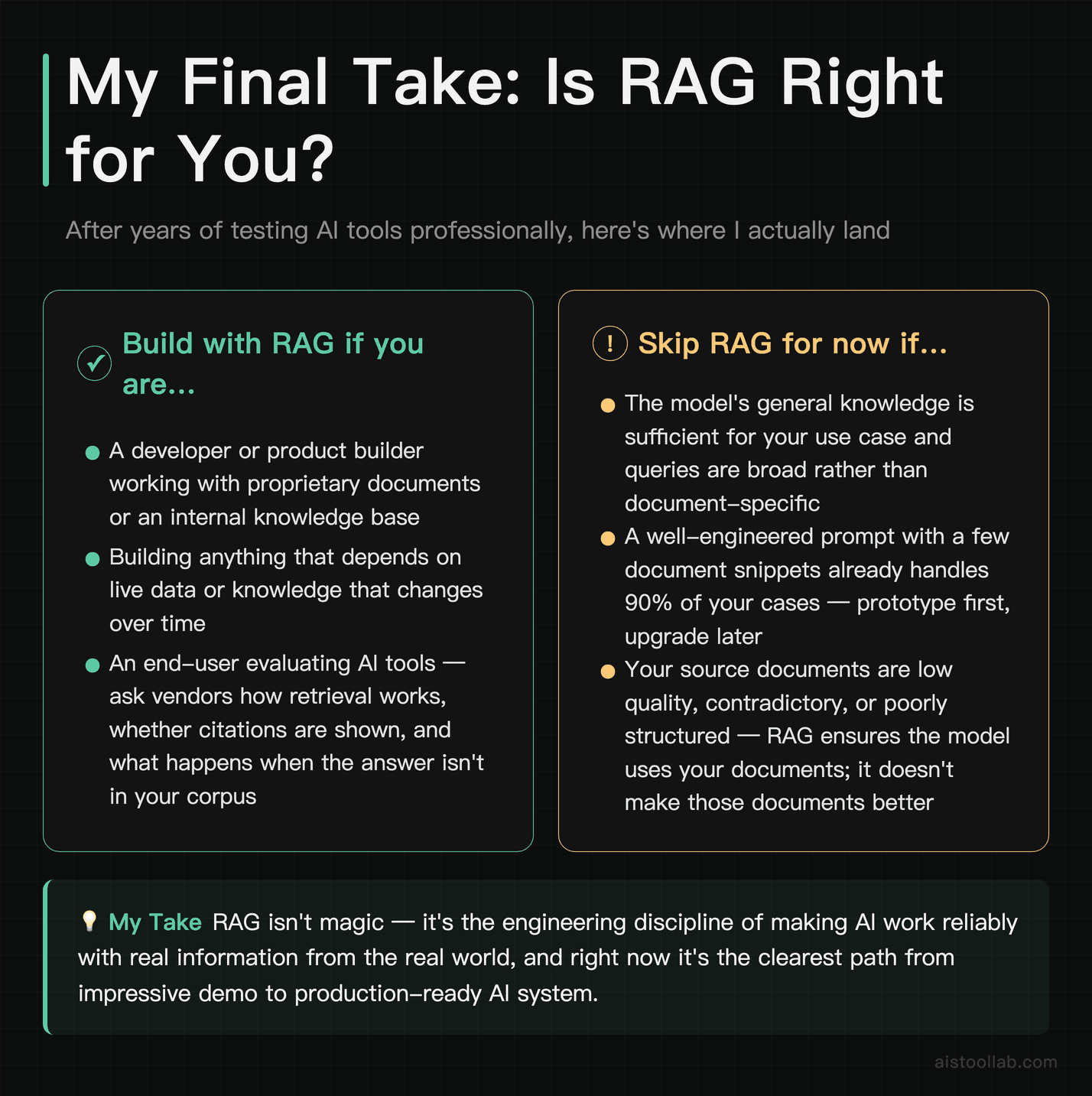
After everything above, here’s where I land: RAG is, in my view, the single most important architectural pattern in practical AI deployment right now. It’s not glamorous — it doesn’t involve a new model architecture or a research breakthrough that generates headlines. It’s the engineering discipline of making AI systems work reliably with real information from the real world.
If you’re a developer or product builder, the question isn’t whether to learn RAG — it’s whether you’re building something that needs it yet. The answer is yes if you’re working with proprietary documents, live data, or any knowledge base that changes over time. The answer might be no if you’re building something where the model’s general knowledge is sufficient, or where a well-engineered prompt with a few document snippets handles most of your cases.
If you’re an end user evaluating AI tools, understanding RAG makes you a sharper buyer. When a vendor says their AI “uses your data,” ask: how is retrieval implemented? Can I see citations? How do you handle document updates? What happens when the answer isn’t in my corpus? The answers to those questions tell you whether you’re looking at a production-grade RAG system or a demo that stuffs a few documents into a context window and calls it enterprise-ready.
The hallucination problem hasn’t been solved — but RAG is one of the most practical, verifiable, and scalable tools we have for keeping AI grounded in what’s actually true. That matters more as AI systems take on more consequential tasks. Getting the architecture right isn’t optional.
Frequently Asked Questions
Does RAG completely eliminate AI hallucinations?
No — and anyone claiming it does is overselling. RAG significantly reduces hallucinations on factual, document-grounded queries by forcing the model to work from retrieved source material rather than parametric memory alone. But hallucinations can still creep in through several mechanisms. If the retrieval step fails to find the relevant document, the model may fall back on its training data and confabulate. If the generation prompt isn’t carefully designed to restrict the model to provided context, it can blend retrieved facts with invented ones. If the retrieved documents themselves contain errors or outdated information, the model will faithfully reproduce those errors. RAG also doesn’t prevent hallucinations on questions that require reasoning across multiple retrieved chunks — synthesizing information from disparate sources introduces its own failure modes. The realistic picture is that RAG makes factual errors rarer, more traceable, and easier to diagnose — because when the model cites its sources, you can actually check whether the citation supports the claim. That’s a real and meaningful improvement over a black-box answer, even if it’s not a guarantee of accuracy.
What’s the difference between RAG and just uploading a document to ChatGPT?
When you upload a PDF to ChatGPT and ask questions about it, you’re experiencing a simplified version of retrieval — the file contents are processed and relevant sections are included in the model’s context window. For small documents, this works fine and is functionally similar to RAG. The difference becomes critical at scale. A production RAG system can handle document corpora with millions of pages because it retrieves only the relevant chunks at query time, rather than loading everything into a context window simultaneously. It also supports dynamic updates — you can add new documents to the vector index without re-uploading everything. Additionally, proper RAG systems implement ranking and reranking steps that the basic file-upload experience doesn’t. For personal use on a single document, uploading to ChatGPT is perfectly reasonable. For a business knowledge base, a customer support system, or anything with more than a few dozen documents, a proper RAG architecture is a different category of solution.
How do I evaluate whether a RAG system is actually working well?
Evaluation is genuinely hard, and it’s one of the more underappreciated challenges in building RAG systems. The RAGAS framework (introduced in research from 2023) offers a structured approach by measuring several dimensions independently: faithfulness (does the generated answer accurately reflect the retrieved context?), answer relevance (does the answer actually address the question asked?), context precision (are the retrieved chunks actually relevant?), and context recall (were all relevant chunks retrieved?). In practice, many teams start with manual spot-checking — creating a golden test set of 50-100 question/answer pairs and periodically running the system against it. Automated evaluation using a separate LLM as a judge (asking the evaluator model to score faithfulness and relevance) has become common, though it introduces its own biases. The key insight is that you need to evaluate retrieval quality and generation quality separately, because a good generator can’t compensate for bad retrieval, and vice versa.
Is RAG expensive to run at production scale?
The cost structure of RAG has several components: embedding costs (running your documents through an embedding model — typically done once at indexing time and again at query time for the user’s query), vector database hosting costs (which vary considerably between managed services like Pinecone and self-hosted options like Qdrant), and LLM generation costs (which are the dominant cost for most applications). Compared to fine-tuning, RAG generally avoids the significant GPU compute required to retrain a large model. Compared to basic prompting, RAG adds embedding and retrieval overhead but typically reduces LLM costs by keeping context windows focused rather than stuffing them with entire documents. For high-query-volume applications, hybrid approaches — caching common retrievals, using smaller open-source embedding models, choosing a self-hosted vector database — can bring costs down substantially. The honest answer is that costs vary enormously based on corpus size, query volume, and architectural choices, so benchmarking your specific setup is more useful than any general estimate.
What is “agentic RAG” and how is it different from standard RAG?
Standard RAG is a single-pass process: retrieve, rank, generate, done. Agentic RAG — increasingly common in more sophisticated AI systems — treats retrieval as a tool that an AI agent can invoke multiple times within a single reasoning chain. The agent might generate a partial answer, recognize a gap, issue a new retrieval query targeted at filling that gap, then revise its answer based on the new context. This iterative approach handles complex multi-hop questions much better than single-pass RAG — questions like “what was the revenue impact of the policy described in section 4 of the Q3 report on the product line mentioned in the 2022 strategy document?” require chaining multiple retrievals together. The tradeoff is higher latency and greater complexity. Agentic RAG also opens the door to tool use — an agent might retrieve from a vector database, then call an API for live data, then query a structured database, synthesizing all three sources. This is very much where a lot of production AI development is heading in 2025-2026, and it connects to the broader shift toward autonomous AI systems discussed in current AI research.
When should I use fine-tuning instead of RAG?
Fine-tuning makes sense when your problem is primarily about behavior and style rather than knowledge and facts. If you need a model that consistently formats outputs in a very specific way, responds in a particular brand voice, handles domain-specific tasks (like generating code in a proprietary internal language), or follows specialized instructions reliably, fine-tuning teaches those patterns into the model’s weights. Fine-tuning also helps when you have a high-volume use case where inference cost needs to be minimized — a smaller fine-tuned model can sometimes outperform a larger general model on a narrow task, at lower cost. Where fine-tuning is the wrong choice: when your knowledge changes frequently (fine-tuning is static), when you need cited, verifiable answers (fine-tuning doesn’t support citations), or when your knowledge corpus is large and diverse (fine-tuning on too much data can degrade rather than improve performance). Many mature production systems combine both — RAG for dynamic factual grounding, fine-tuning for consistent behavior — but that’s a significant engineering investment best saved for when you’ve validated the simpler approaches first.
What open-source tools can I use to build a RAG system myself?
The open-source RAG ecosystem has matured considerably. For orchestration — the glue that connects embedding, retrieval, and generation — LlamaIndex and LangChain are the two dominant frameworks, both with extensive documentation and active communities. For vector databases, Qdrant and Weaviate are well-regarded open-source options you can self-host; ChromaDB is popular for smaller-scale local development. For embedding models, the Massive Text Embedding Benchmark (MTEB) leaderboard on Hugging Face tracks open-source embedding model performance — models from Nomic AI and the BGE family from BAAI have strong reputations as of recent evaluations. For reranking, cross-encoder models from the sentence-transformers library on Hugging Face are a good starting point. A minimal RAG prototype can be built with LlamaIndex + ChromaDB + a local embedding model and an API-based LLM in an afternoon. Scaling it to production quality — with hybrid search, reranking, metadata filtering, and robust evaluation — is a project of weeks to months depending on your corpus and requirements.
How does RAG relate to the large context windows in newer models?
This is one of the genuinely interesting architectural questions in current AI development. Earlier long-context models such as Gemini 1.5 Pro, along with releases from Anthropic and OpenAI, pushed context windows to 128k tokens and beyond — enough to fit hundreds of pages of text in a single prompt (exact context limits vary by model and version, so check the official documentation for whichever model you use). The question of whether long-context models make RAG obsolete comes up frequently, and the honest answer is: probably not, for most serious use cases. The “lost in the middle” problem — where model attention can degrade for content buried in the middle of very long contexts — remains documented in the research literature. Very long context inference is also typically more expensive than focused retrieval. And for enterprise use cases with millions of documents, even a 1 million token context window isn’t large enough. The more nuanced view, which aligns with current research directions, is that long contexts and RAG are complementary: long contexts allow you to pass more retrieved chunks with better coherence, while RAG ensures you’re only passing the relevant material in the first place. For a broader look at how foundation model capabilities are evolving in ways that interact with retrieval architectures, the Multi-Modal AI and Foundation Models in 2026: How the Next Generation of AI Actually Works piece covers that territory well.
Last updated: 2026
Explore more AI tools
👉 Browse the AI Tools Library to find the right tools for your workflow.