The “Multi-Modal AI” Label Is Everywhere — But Most Explanations Are Wrong
Here’s a claim you’ll hear constantly in tech media right now: “AI can now see, hear, and read all at once — just like humans.” It sounds impressive. It’s also a bit misleading. The way multi-modal AI systems actually work under the hood is quite different from how human senses integrate information, and conflating the two leads to some genuinely confused expectations about what these systems can and can’t do. The gap between the marketing language and the technical reality is wider than most people realize.
That gap matters, practically speaking. If you think a multi-modal model is “just looking at your image the way you would,” you’ll be confused when it confidently misidentifies objects in a crowded scene or fails to connect obvious audio context to a video clip. Understanding the actual mechanics — even at a non-PhD level — changes how you use these tools, how you prompt them, and how you evaluate their outputs. It also helps you cut through the considerable noise around model announcements to figure out what’s actually new and what’s just rebranding.
So let’s break it down properly. What multi-modal AI actually means architecturally, how leading foundation models process different data types, what’s genuinely changed in recent model generations, and why any of this matters for people building or using AI-powered products in 2026. No PhD required, but we’re not going to skip the substance either.
What “Multi-Modal” Actually Means (And How It Differs From What Came Before)
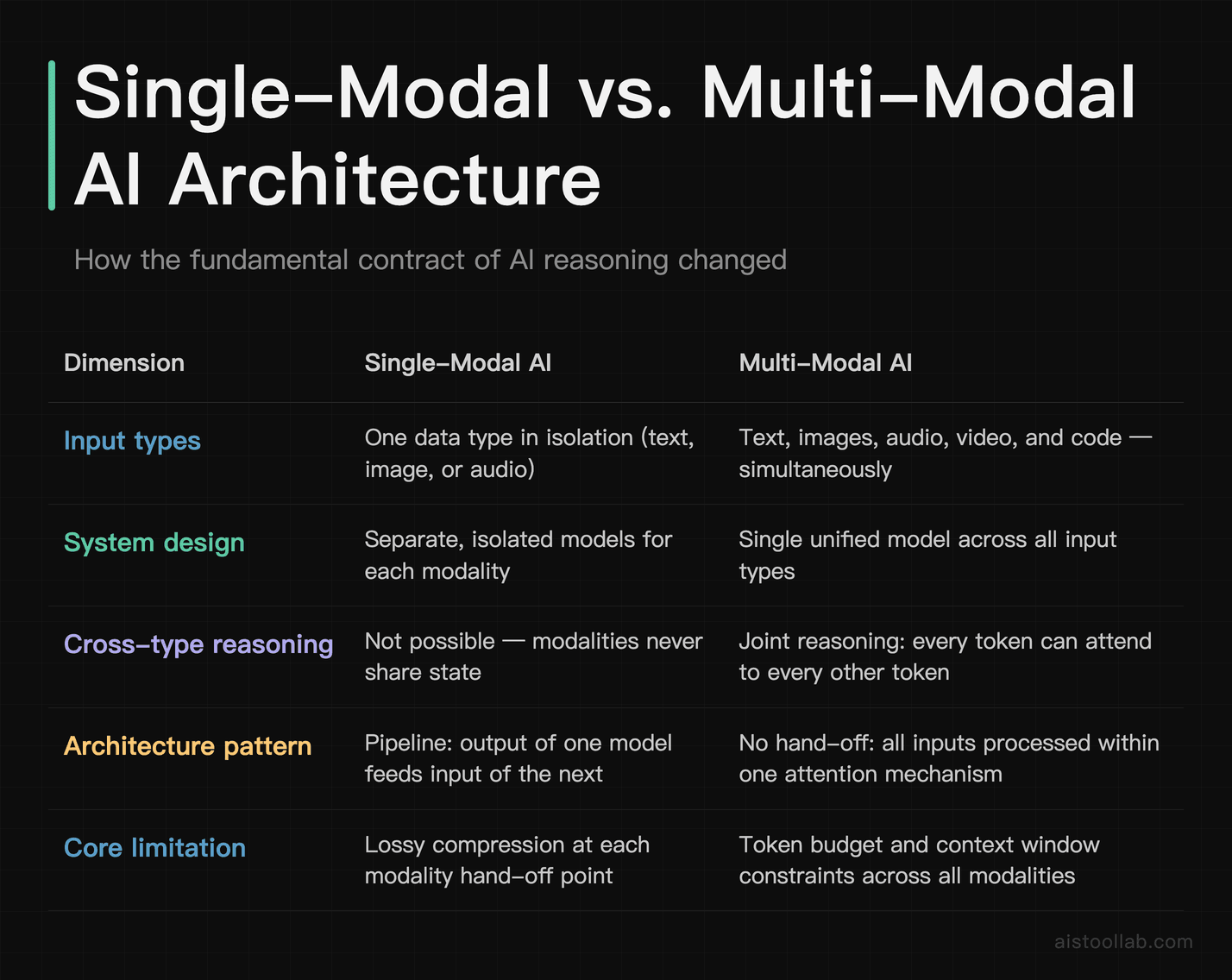
A single-modal AI system is exactly what it sounds like: one input type, one output type. Early versions of GPT processed text and returned text. Image classifiers took a picture and returned a label. Speech-to-text systems took audio and returned a transcript. Each of these was impressive in its own right, but they were fundamentally isolated — you couldn’t ask an image classifier a question about the image, and a language model couldn’t “see” anything.
Multi-modal AI changes the fundamental contract. A multi-modal model can accept inputs from multiple data types — text, images, audio, video, code, structured data — within a single unified model and reason across all of them simultaneously. The key word is simultaneously. Early multi-modal systems were often pipelines: an image recognition module fed output to a language model, which then generated a response. Those two models didn’t actually share representations or reason jointly — they were just plumbed together. The output of one became the input of another. Useful, but architecturally quite different from true joint reasoning.
What current foundation models aim for — and what the most capable ones are getting meaningfully closer to — is genuine cross-modal representation. When you send a model an image of a broken error message on a screen alongside a text question asking what went wrong, a well-implemented multi-modal model isn’t translating the image to text and then answering the text. It’s building a unified internal representation that integrates both signals before generating a response. The practical difference shows up in tasks where the answer depends on subtle interactions between modalities — something a pipeline approach handles much more clumsily.
How Foundation Models Actually Process Multiple Modalities
To understand what’s happening inside these models, you need to understand a few core concepts. None of this requires a math degree, but the terms matter.
Tokens All the Way Down
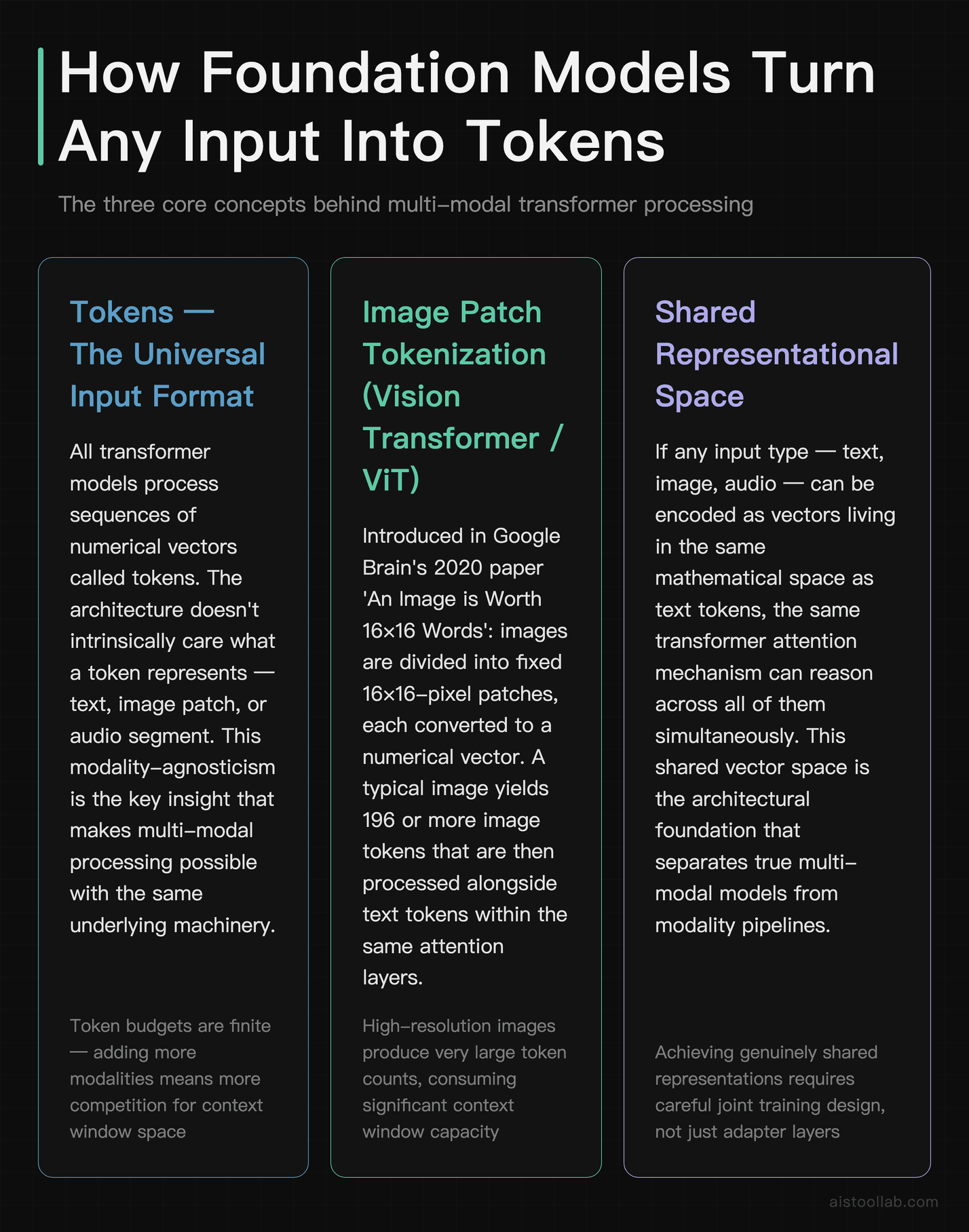
Modern transformer-based foundation models operate on tokens. For text, tokens are roughly word fragments (the word “tokenization” might become two tokens). But the transformer architecture itself doesn’t intrinsically care what a token represents — it just processes sequences of numerical vectors. This is the key insight that enables multi-modal AI: if you can convert any input type into a sequence of vectors that live in the same representational space as text tokens, the same transformer machinery can operate on all of them.
For images, the approach that became dominant after the Vision Transformer (ViT) architecture — introduced by Google Brain researchers in late 2020 and described in their paper “An Image is Worth 16×16 Words” — is to divide an image into fixed-size patches and treat each patch as a token. A typical image might be divided into 196 or more patches, each of which becomes a vector. These “image tokens” are then processed alongside text tokens in the same attention mechanism. Audio follows a similar principle: spectrograms (visual representations of audio frequencies over time) can be divided into patches, or raw waveforms can be encoded into vector sequences.
Video is the expensive version of this: it’s essentially a sequence of image frames, each producing its own token sequence, stacked temporally. This is why video understanding remains computationally heavier than image understanding — the token count scales with both spatial resolution and duration. A 30-second video clip at moderate resolution can generate an enormous token sequence, which is one reason native video understanding in language models is still being actively optimized.
Cross-Attention and the Unified Representational Space
The transformer’s attention mechanism is what makes cross-modal reasoning possible at a deep level. When a model processes a question about an image, the attention layers allow text tokens to “attend to” image tokens — meaning the model can learn which parts of the image are relevant to which parts of the question, and vice versa. This is fundamentally different from just converting an image to a text description first. The model can discover relationships that a text description would lose or abstract away.
The phrase “unified representational space” describes the goal of training all these different modalities so that semantically similar concepts end up close together regardless of their original format. The concept of “a dog running” should have a similar internal representation whether it comes from the text string, a photograph, or a video clip — at least in the layers where cross-modal reasoning happens. Research from various institutions, including Google DeepMind and the academic community around large-scale contrastive learning, generally suggests that achieving this alignment well requires careful training strategies and is still an active research problem. Current evidence suggests top models are meaningfully better at this than models from two or three years ago, but perfect modality-agnostic reasoning remains aspirational.
Encoders, Decoders, and the Architecture Choices That Matter
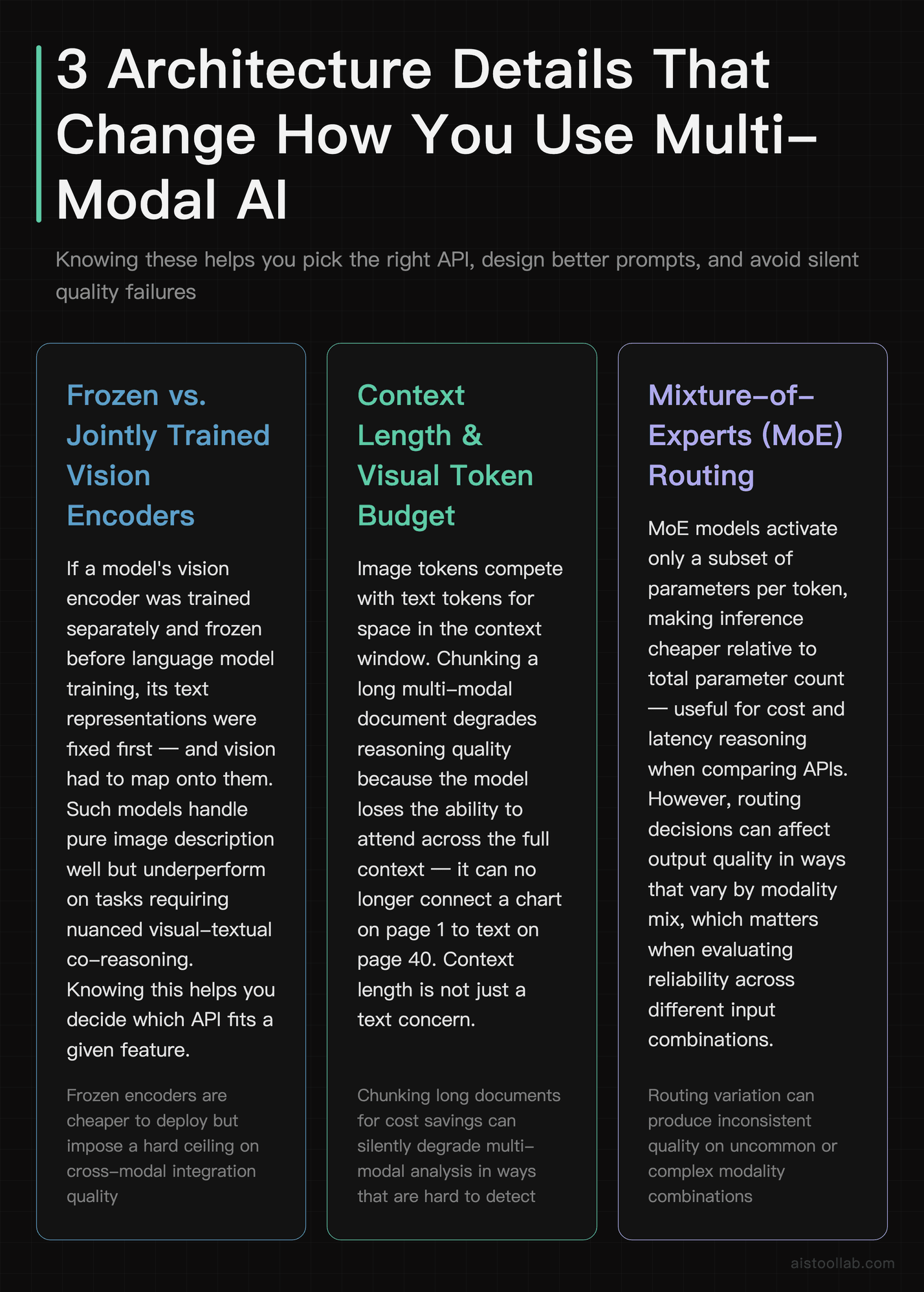
Early multi-modal approaches typically used separate encoder models for each modality — a vision encoder, an audio encoder — whose outputs were then fed into a language model decoder. Models like the original LLaVA (Large Language and Vision Assistant) from academic researchers used this approach: freeze a vision encoder like CLIP, add a small “projection layer” that maps vision encoder outputs into the language model’s token space, and fine-tune on image-text pairs. This is efficient and effective for many tasks, but the vision encoder is frozen — it wasn’t trained with the language model jointly, so its representations aren’t fully optimized for the joint task.
More recent approaches in leading commercial models have moved toward end-to-end training, where the vision processing components are trained jointly with the language model from early in the training process. This is more computationally expensive but generally produces better cross-modal reasoning, particularly on tasks that require genuinely integrating visual and linguistic understanding rather than just describing what’s in an image. According to official technical reports from organizations like Google DeepMind (for Gemini) and Anthropic, this architectural direction has been a deliberate design priority.
What’s Actually Changed in Recent Model Generations
This is where I want to be careful to separate genuine architectural advances from marketing noise. Here’s what the research and official documentation actually support as meaningful changes:
Native Multi-Modal Training vs. Bolt-On Vision
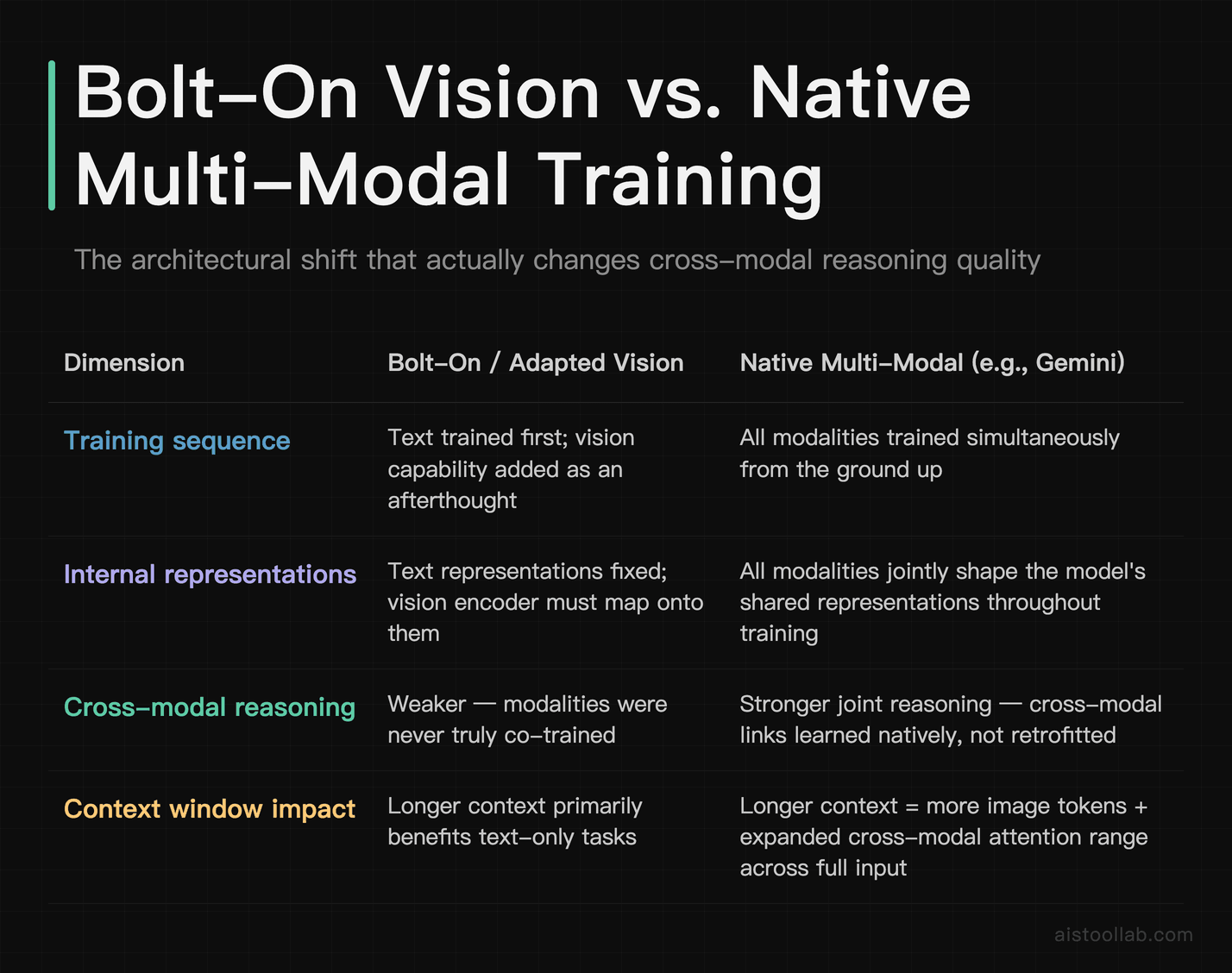
One of the most significant shifts in recent model generations is the move from adapting language models to handle vision as an afterthought, to training models with multi-modal inputs from the ground up. Google’s Gemini models were publicly described in their technical report as being designed natively for multi-modal inputs — trained on text, images, audio, and video simultaneously rather than text first and vision added later. This is architecturally meaningful because joint training means the model’s internal representations are shaped by all modalities throughout training, rather than the text representations being fixed and vision representations having to map onto them.
Longer Context Windows and Their Multi-Modal Implications
Context length has expanded dramatically across leading models over recent generations, and this matters more for multi-modal AI than it might seem at first glance. If you’re working with a long document and multiple images simultaneously, or an extended video, the model needs a context window large enough to hold all those tokens at once. Expanded context windows — now extending into the hundreds of thousands to millions of tokens in some models — make richer multi-modal tasks tractable that simply weren’t possible before, regardless of how good the individual modality encoders were.
Improved Spatial and Temporal Understanding
Early vision-language models were genuinely bad at tasks requiring spatial reasoning — answering questions about the relative positions of objects, counting items accurately, or understanding diagrams with precise spatial relationships. This was partly an architecture issue (patching an image loses some spatial structure) and partly a training data issue. More recent model generations have shown measurable improvements on spatial reasoning benchmarks, though current evidence still suggests this remains a weaker area relative to text-only reasoning for most models. Temporal understanding in video — tracking how things change over time in a clip — is improving but still lags behind human-level performance on complex temporal reasoning tasks.
Mixture-of-Experts at Scale
Mixture-of-Experts (MoE) architecture has become increasingly prominent in large foundation models. Rather than activating all model parameters for every token, MoE routes each token through a subset of specialized “expert” networks. For multi-modal AI, this is particularly interesting because it potentially allows different experts to specialize in different modalities or cross-modal interactions, while keeping inference cost manageable by not activating all experts simultaneously. According to various technical discussions and unofficial analyses of model architecture choices, MoE approaches are believed to be components of several leading frontier models, though companies vary in how much they disclose about specific architectural choices.
Comparison: How Leading Foundation Models Approach Multi-Modal AI
One thing worth noting: these capabilities are moving fast, and official documentation is often the most reliable source for current capabilities. For the most accurate current state of each model, the respective technical reports and API documentation are worth checking directly. The 15 AI Tools Worth Knowing in 2026 article covers the practical performance side of several of these models in more detail.
Use Cases: Where Multi-Modal Architecture Actually Changes Outcomes
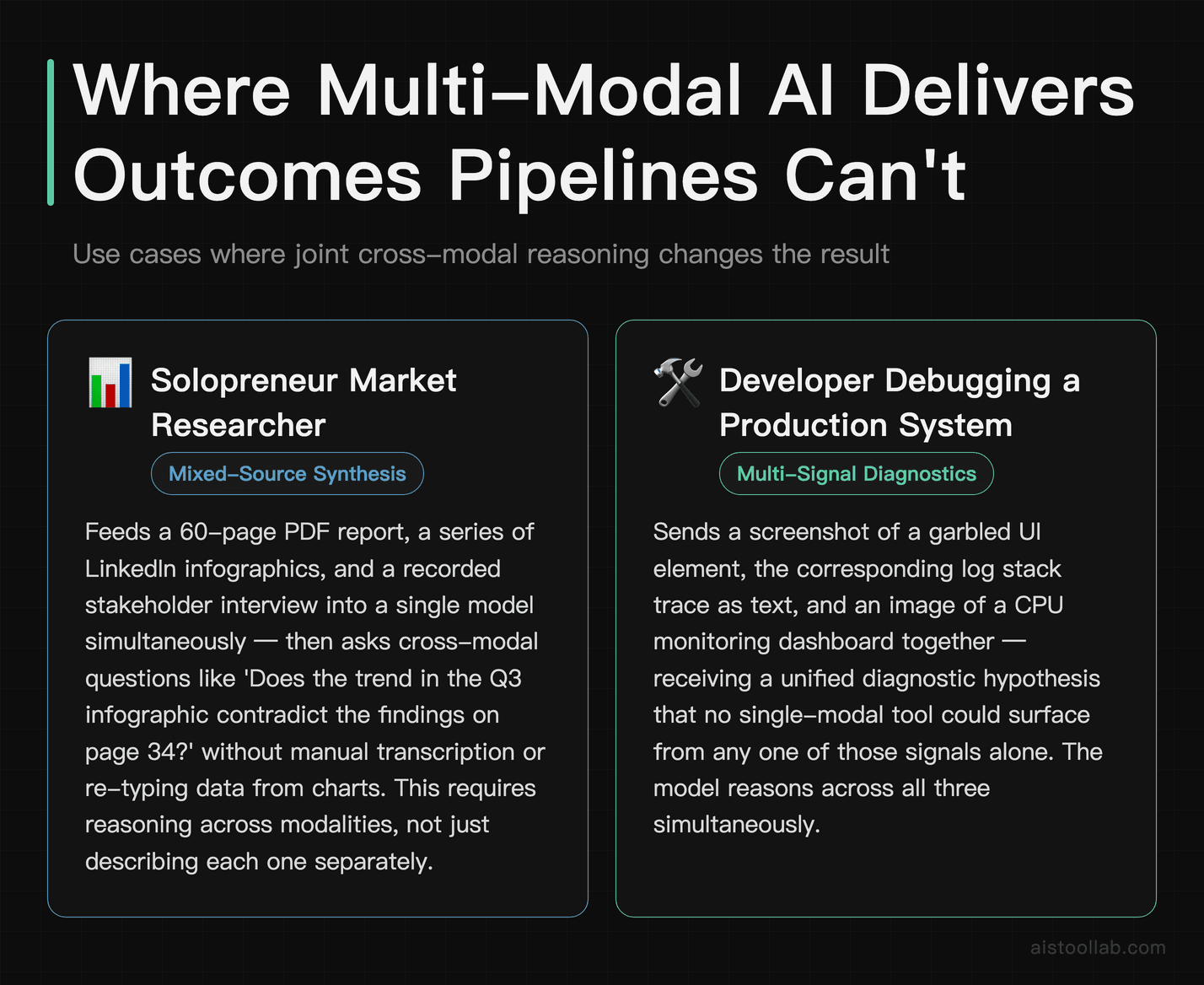
The Solopreneur Doing Market Research With Mixed Sources
Imagine a freelance market researcher who needs to synthesize findings from a 60-page PDF report, a series of infographics shared on LinkedIn, and a recorded stakeholder interview. In a single-modal world, they’d need to manually transcribe the interview, re-type data from the infographics, and then work with text throughout. With a genuinely capable multi-modal model, they can feed all three source types simultaneously and ask comparative questions — “Does the trend shown in the Q3 infographic contradict the findings on page 34 of the report?” That question requires the model to reason across modalities, not just describe each one separately.
The Developer Debugging a Complex System
A developer working on a production system might encounter a bug that manifests as a garbled UI element, with a corresponding stack trace in logs and an unusual CPU utilization pattern visible in a monitoring dashboard. Sending all three — a screenshot of the UI issue, the log output as text, and an image of the monitoring graph — to a multi-modal model and asking for a diagnostic hypothesis is genuinely more powerful than any single-modal approach. The model can consider how the visual anomaly, the error text, and the performance pattern might relate. This is a workflow I’ve seen developers increasingly adopt, and it genuinely surfaces hypotheses that text-only prompting misses.
The Content Creator Repurposing Video Across Platforms
A YouTube creator managing a channel needs to repurpose hour-long video content into blog posts, short clips, and social media captions. With a model that genuinely processes video — tracking what’s said, shown, and emphasized over time — they can ask for a structured breakdown of key moments, identify the best 60-second segment for a Shorts clip based on combined audio energy and visual interest, and generate platform-specific copy that references specific visual moments. The output is qualitatively better than working from a transcript alone, which loses the visual context that often makes a moment compelling. For a deeper look at how AI tools are changing content workflows, my 9 Best New AI Tools Launched in 2026: What Actually Works Beyond the Hype article covers several practical examples.
The Enterprise Team Analyzing Safety-Critical Visual Data
In industries like manufacturing, construction, or healthcare, visual data has always required expensive human expert review. A quality control team might receive thousands of inspection photographs alongside structured data from sensors and written incident reports. Multi-modal AI that can jointly reason over all three types — flagging cases where sensor data, visual evidence, and written description don’t align — provides a different category of analytical capability than routing each data type through a separate specialist model. This is one area where the “joint reasoning” property, rather than just “pipeline processing,” has concrete practical value.
Why Neural Architecture Improvements Actually Matter for Practitioners
Here’s an argument I want to make directly: understanding architectural improvements isn’t just academic. It changes how you evaluate model claims, how you design prompts, and how you architect AI-powered products.
If you know that a particular model’s vision capabilities come from a frozen encoder that was trained separately from the language model, you can predict that it’ll handle tasks requiring nuanced integration of visual and textual context worse than tasks where you just need image description. That’s useful information when deciding whether to use API-A or API-B for a given feature. Similarly, knowing that context length directly limits how much visual information (in token form) a model can hold at once helps you understand why breaking a long document into chunks can degrade multi-modal reasoning quality — the model loses the ability to attend across the full context.
The Mixture-of-Experts trend matters for cost and latency reasoning. If a model uses MoE, not all parameters are active for every token, which means inference can be cheaper relative to total parameter count — but also that routing decisions can affect quality in ways that aren’t always predictable. These are real engineering considerations for teams building production systems on top of foundation model APIs.
Architecture also signals where a model’s rough edges are likely to be. Models with strong text-first heritage and bolted-on vision tend to perform better on tasks where vision provides supplementary context to a primarily text-based question. Models with native multi-modal training from early in the process tend to handle tasks where the answer genuinely requires integrating signals from multiple modalities simultaneously. Neither is universally better — it depends on your use case.
If you’re thinking about how these architectural trends connect to agent-based and autonomous AI systems, my Agentic AI in 2026: How AI Systems Are Moving Beyond Chatbots to Autonomous Agents article covers the intersection of foundation model capabilities and agentic deployment patterns.
Frequently Asked Questions
What’s the difference between a multi-modal model and just connecting separate AI models together?
This is one of the most important distinctions in the field, and it’s genuinely significant rather than just semantic. When you connect separate models — say, a vision model whose output feeds into a language model — you’re creating a pipeline. The vision model produces a description or a set of labels, and the language model works from those intermediate outputs. The problem is that this intermediate step is a lossy compression: the vision model has to decide what’s worth representing in its output before the language model has any input, which means relevant details that the language model would have found useful can be discarded before it ever sees them.
A genuinely multi-modal model, by contrast, processes all modality inputs within the same attention mechanism, allowing any token — whether derived from text or image — to attend to any other token at each layer. This means the model can discover cross-modal relationships that neither modality’s specialist would surface on its own. In practice, the difference is most visible on tasks where the correct answer depends on subtle interactions between what’s written and what’s shown, rather than either one alone. For simpler tasks — “describe this image,” “translate this text” — pipeline approaches can work nearly as well and are often more efficient. For tasks requiring genuine cross-modal inference, the architecture difference matters considerably.
Are these models actually “understanding” images, or are they doing something much simpler?
The word “understanding” is doing a lot of philosophical heavy lifting here, and the honest answer is: it depends heavily on what you mean by understanding. What these models are doing is building internal representations from image patches that allow them to answer questions, generate descriptions, and reason about relationships in ways that often look like understanding from the outside. Whether there is anything like genuine semantic comprehension underneath — in the philosophical sense — is genuinely contested, and current evidence is mixed on how to even evaluate this question empirically.
What we can say more concretely is that these models are not simply doing pixel matching or template lookups. The attention mechanism allows them to identify relationships between image regions and textual concepts in ways that generalize to novel images they haven’t seen before. They can recognize unusual configurations of familiar objects, interpret diagrams with abstract spatial relationships, and answer questions that require inferring unseen context from visible evidence. Where they reliably fail — consistent object counting errors, specific spatial relationship confusions, sensitivity to unusual camera angles — tells us something about the limits of the representational approach. So “understanding” in a functional sense: often yes. Understanding in a deep semantic or consciousness-related sense: genuinely unknown, and anyone claiming certainty either way is overstating what we currently know.
How does audio processing work in models that support it, like GPT-4o?
Audio processing in models that support it natively typically works through one of a few approaches. The most common is spectral encoding: the raw audio waveform is converted into a spectrogram, which is essentially a 2D visual representation of how frequency content changes over time, and this is then treated similarly to an image — divided into patches and encoded into token vectors. An alternative approach encodes raw waveform data more directly using learned convolutional or recurrent components before transforming the output into the token space.
The interesting capability that native audio integration enables — compared to running speech-to-text first and then passing transcript to a language model — is that acoustic features like tone of voice, speaking pace, emotional prosody, and background sounds can influence model processing directly, rather than being stripped out by transcription. In GPT-4o’s voice mode, for example, the model’s responses are shaped partly by detected emotional tone in audio input, which wouldn’t be available in a transcript-first pipeline. The practical quality difference for most transcription-heavy tasks (summarizing a meeting recording, for example) is modest — but for tasks where acoustic context matters, native audio integration offers meaningful advantages. The technical implementation details for specific models vary, and companies release varying levels of documentation about their exact audio architectures. (GPT-4o is used here as a historical illustration of native-audio models available when this was written; for OpenAI’s current model lineup as of July 2026, see OpenAI’s model docs.)
What does “foundation model” actually mean, and why does the term matter?
The term “foundation model” was coined by researchers at Stanford’s HAI (Human-Centered AI) Institute in a 2021 paper and refers to large models trained on broad data at scale that can be adapted to a wide range of downstream tasks — either through fine-tuning, prompting, or use as a base for more specialized models. The “foundation” metaphor is intentional: like a building foundation, these models are designed to support a large variety of structures built on top of them.
The term matters because it captures something architecturally specific: these are not specialist models trained for one task. They’re general-purpose representations trained across huge datasets spanning many domains, which gives them the ability to transfer knowledge across tasks in ways that narrower models can’t. For practitioners, the implication is that a foundation model can handle novel task combinations — tasks the model wasn’t explicitly trained on — by composing its learned representations. A foundation model trained on medical text, general web content, scientific papers, and images can be useful for medical imaging analysis even if it wasn’t specifically fine-tuned for that use case, because it has relevant representations from all those training domains. This generality is the defining characteristic, and it’s what makes the multi-modal version of foundation models particularly powerful: the model has broad knowledge that it can apply to interpret and reason across any of its supported modalities.
Why do these models still make obvious errors on images that seem easy to humans?
This is a genuinely fascinating question and one where the research community doesn’t have a fully settled answer. A few mechanisms are reasonably well supported. Object counting errors are partly a consequence of how patching works: if multiple instances of an object span patch boundaries or overlap, the model’s token-level representation may not preserve the individuality of each instance clearly. Spatial relationship errors — “is the red ball to the left or right of the blue cube?” — likely reflect that the patch-based encoding, while preserving rough spatial structure, doesn’t enforce precise coordinate-level spatial relationships in the way the human visual system’s spatial processing does.
There’s also a distribution issue: these models are trained on vast amounts of text describing images, which means they can have statistical biases about what typically appears in certain contexts. An unusual arrangement of familiar objects might be interpreted through the lens of what usually appears in similar-looking scenes, rather than what’s actually shown. This can produce confident errors that look bizarre from a human perspective — the model essentially has strong priors from language that can override what the visual evidence shows. Research generally suggests these errors decrease with model scale and improved training techniques, but they haven’t been eliminated in any current model, and understanding exactly why they occur in specific cases remains an active research area.
Is open-source multi-modal AI catching up to closed frontier models?
The gap between open-weight models (like Meta’s Llama series with multi-modal variants, Mistral’s offerings, and various research releases) and closed frontier models (Gemini, Claude, GPT-4o) has been narrowing on text tasks for a while. For multi-modal specifically, the picture is more complicated. Native multi-modal training at frontier scale requires enormous computational resources and curated multi-modal training datasets that are harder to assemble than text-only datasets. This creates a resource asymmetry that’s harder for open-source efforts to close quickly.
That said, approaches like LLaVA and its successors have shown that you can build capable image-language models by combining open-weight language models with open-weight vision encoders (like CLIP) and training the connecting layer on publicly available image-text pairs. The resulting models are genuinely useful for many practical tasks. Where they tend to lag behind is on tasks requiring very long visual context, complex video understanding, and the kind of nuanced cross-modal reasoning that benefits most from end-to-end joint training. For teams with privacy or cost constraints that make closed API models impractical, the open-weight landscape in 2025-2026 is meaningfully more capable than it was two years ago — but for the most demanding multi-modal tasks, the frontier models still hold a meaningful lead, at least as of current releases.
How does multi-modal AI affect the AI image generation tools I’m already using?
Somewhat counterintuitively, the most capable image generators (Midjourney, DALL-E 3, Stable Diffusion variants, Google Imagen 3) are actually a slightly different category from the multi-modal reasoning models we’ve been discussing. Image generators are generative models trained primarily on the task of producing images from text prompts — they’re optimized for synthesis quality. Multi-modal foundation models are primarily reasoning and language models that can understand images as input.
The connection is becoming closer, though. More recent architectures are exploring “any-to-any” generation, where a single model might understand images, generate images, process text, and produce audio — all within one unified framework. This is where things like GPT-4o’s image generation capability, Google’s Gemini integrations with Imagen, and similar features start to blur the categorical lines. For practical users, the implication is that the boundary between “AI I use to analyze images” and “AI I use to generate images” is likely to keep blurring. My Google Imagen 3 vs Midjourney vs DALL-E: The Best AI Image Generator in 2026 article goes deeper on the generation side specifically.
What should I actually expect from multi-modal AI in the next year or two?
A few trends seem reasonably well supported by current architectural trajectories, though treating any specific prediction with appropriate skepticism is warranted. Video understanding is likely to improve significantly as inference efficiency improvements make processing longer token sequences more tractable. Spatial reasoning and precise counting are active research areas where published work suggests progress is possible with better training approaches and architectural modifications. Audio-visual integration — models that genuinely understand the relationship between what’s happening visually and what’s being said simultaneously — is likely to improve in real-time voice and video applications.
What’s less certain is the timeline and how much improvement will manifest as genuinely new capabilities versus incremental quality improvements on existing ones. The history of AI capability predictions over the past decade should make anyone humble about specific timelines. What seems reasonably safe to expect is that the modality coverage of leading models will continue to expand, the quality of cross-modal reasoning will continue to improve, and the cost of accessing these capabilities via API will continue to decrease as efficiency improvements accumulate. For practitioners, that suggests building workflows now that are multi-modal-aware, even if you’re not yet using all capabilities — because the ceiling on what these systems can do is likely to keep rising.
The Bottom Line on Multi-Modal Architecture in 2026
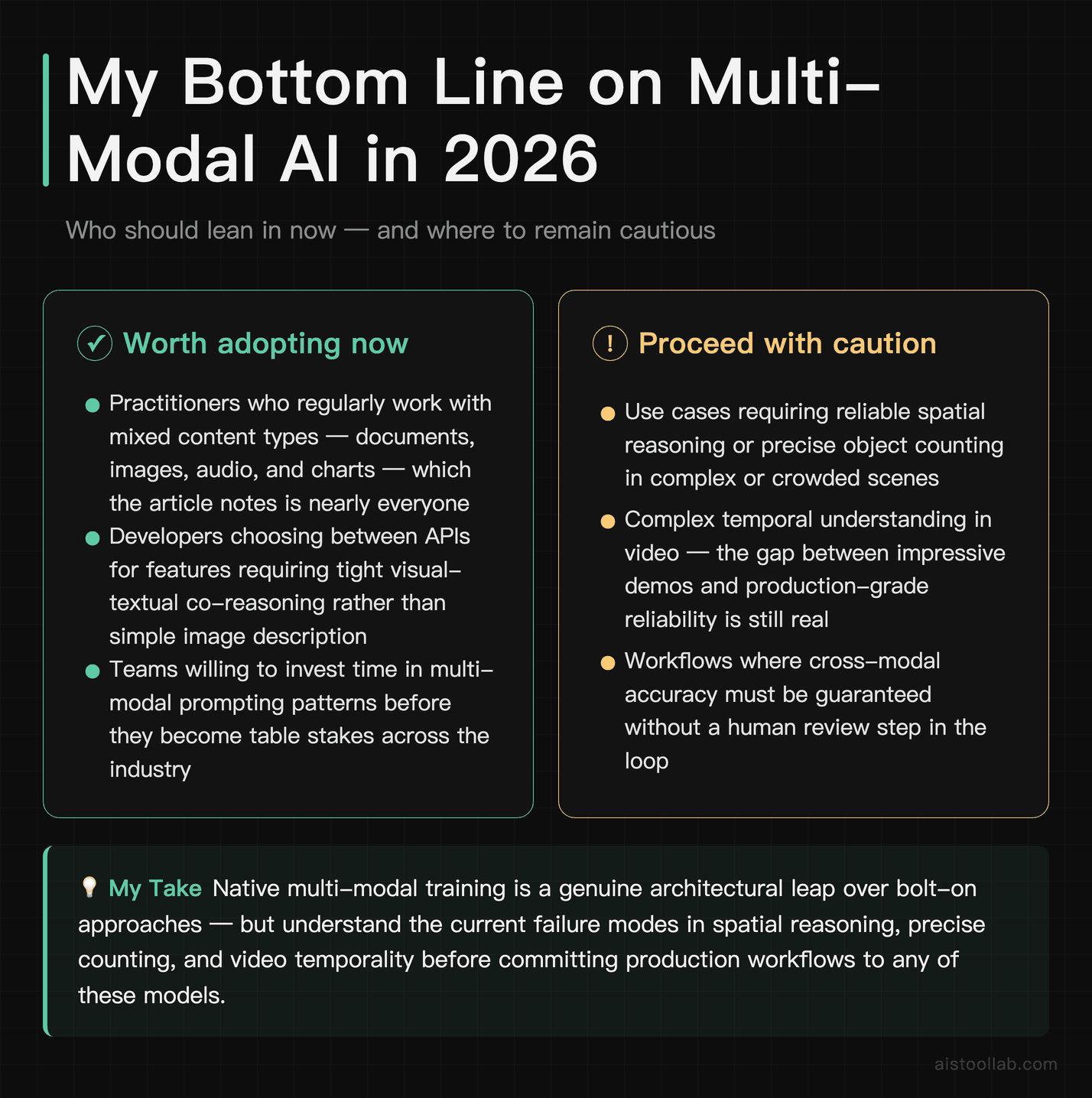
If you’ve made it this far, here’s the concise version of what I’d want you to take away. Multi-modal AI isn’t a gimmick or a feature list item — it’s a fundamentally different architectural approach to what AI can reason over and how. The shift from “bolt vision onto a language model” to “train natively across modalities from the start” is a real and meaningful one that shows up in real task performance, not just benchmark scores.
The models leading this space — Gemini in its current generation, the GPT-5 family from OpenAI, Claude with vision — are doing genuinely impressive things with cross-modal reasoning, but they still have characteristic failure modes that are worth understanding rather than being surprised by. Spatial reasoning, precise counting, complex temporal understanding in video — these are all areas where the gap between impressive demos and reliable production use is still real.
For practitioners: if your work involves mixing content types — which is almost everyone’s work — getting fluent with multi-modal prompting patterns now is worth the time investment. The architectural improvements being made are specifically expanding what’s possible in exactly those mixed-media workflows that used to require stitching together multiple specialist tools. That’s not just a technical upgrade. It’s a workflow change with real productivity implications, and it’s happening fast enough that keeping up with it is genuinely worth the effort.
Last updated: 2026
Explore more AI tools
👉 Browse the AI Tools Library to find the right tools for your workflow.
Related reading: Emoji Finder Tools Explained: How AI Sentiment Analysis and Context Understanding Recommend the Right Emoji