
Who this is for: operations, plant and clinical leaders assessing machines that act in the physical world. Two neighbouring questions are handled separately: who signs off when a system acts on its own is in autonomy and oversight, and the software-side architecture of agents is in chatbots vs agents.
The Factory Floor Isn’t Waiting for the Hype Cycle to Catch Up
Last year, I sat in on a product demo where a warehouse robot stopped mid-task, spun around, and gently tapped a human worker on the shoulder. Not because it malfunctioned — because it detected the worker was about to walk into its path and chose to alert them rather than just halt. The room went quiet. It wasn’t a scripted moment. That small interaction is exactly what people mean when they say Physical AI has crossed a threshold. It’s no longer about machines following rigid decision trees. It’s about systems that perceive, reason, and act in real environments — with real consequences.
For the better part of the last five years, “AI agents” meant a chatbot that could book your calendar or write a draft email. Useful, sure. But the conversation in 2026 has shifted dramatically. Physical AI — AI that operates in and interacts with the physical world — has become the load-bearing wall of the entire agentic systems movement. We’re seeing real deployments in manufacturing, logistics, healthcare, and construction. Not pilots. Not press releases. Actual operational systems running on actual production floors.
What changed? A few things converged at once: foundation models got small enough and fast enough to run on edge hardware, robot hardware got affordable enough for mid-sized businesses, and — maybe most importantly — the industry settled on a sensible design philosophy: autonomous AI with meaningful human oversight, rather than either full automation or glorified remote control. That middle ground is where everything interesting is happening right now.
Physical AI, Defined Narrowly Enough to Be Useful
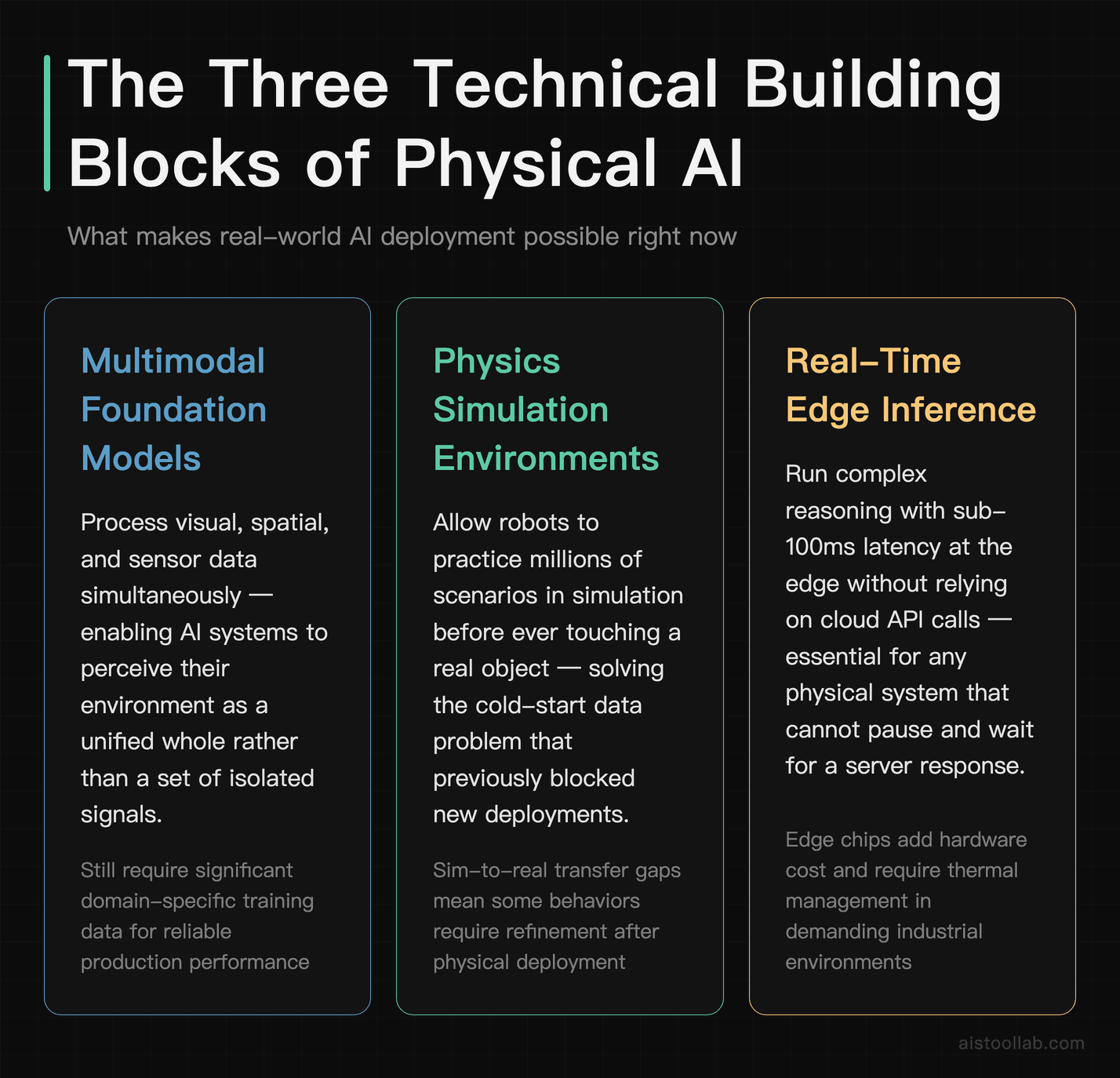
Let’s clear something up before we go further. Physical AI isn’t just “robots with better software.” The term, which has been popularized significantly by NVIDIA’s work on their robotics and physical AI platform, refers to AI systems that develop a genuine understanding of physical space, causality, and interaction. Think of it as the difference between a GPS that tells you to turn left and a self-driving system that understands why turning left into oncoming traffic is a bad idea even if the GPS says to.
The core technical ingredients that make this possible right now include multimodal foundation models that can process visual, spatial, and sensor data simultaneously; physics simulation environments used for training (so robots can “practice” millions of scenarios before touching a real object); and real-time inference chips that can run complex reasoning with sub-100-millisecond latencys at the edge, without phoning home to a cloud server. That last part matters enormously for anything operating in the physical world — you cannot have a robot arm pause for two seconds while it waits for an API call.
What Physical AI is not is fully autonomous terminator-style systems making unsupervised decisions. Every credible deployment right now includes what engineers are calling “human-on-the-loop” design — the AI operates independently within defined parameters, but humans can observe, intervene, and override at any time. This isn’t just a regulatory requirement in many industries; it’s genuinely better engineering. Edge cases in physical environments are infinite, and no training dataset covers all of them.
Use Cases: Where Physical AI Is Actually Deployed Right Now
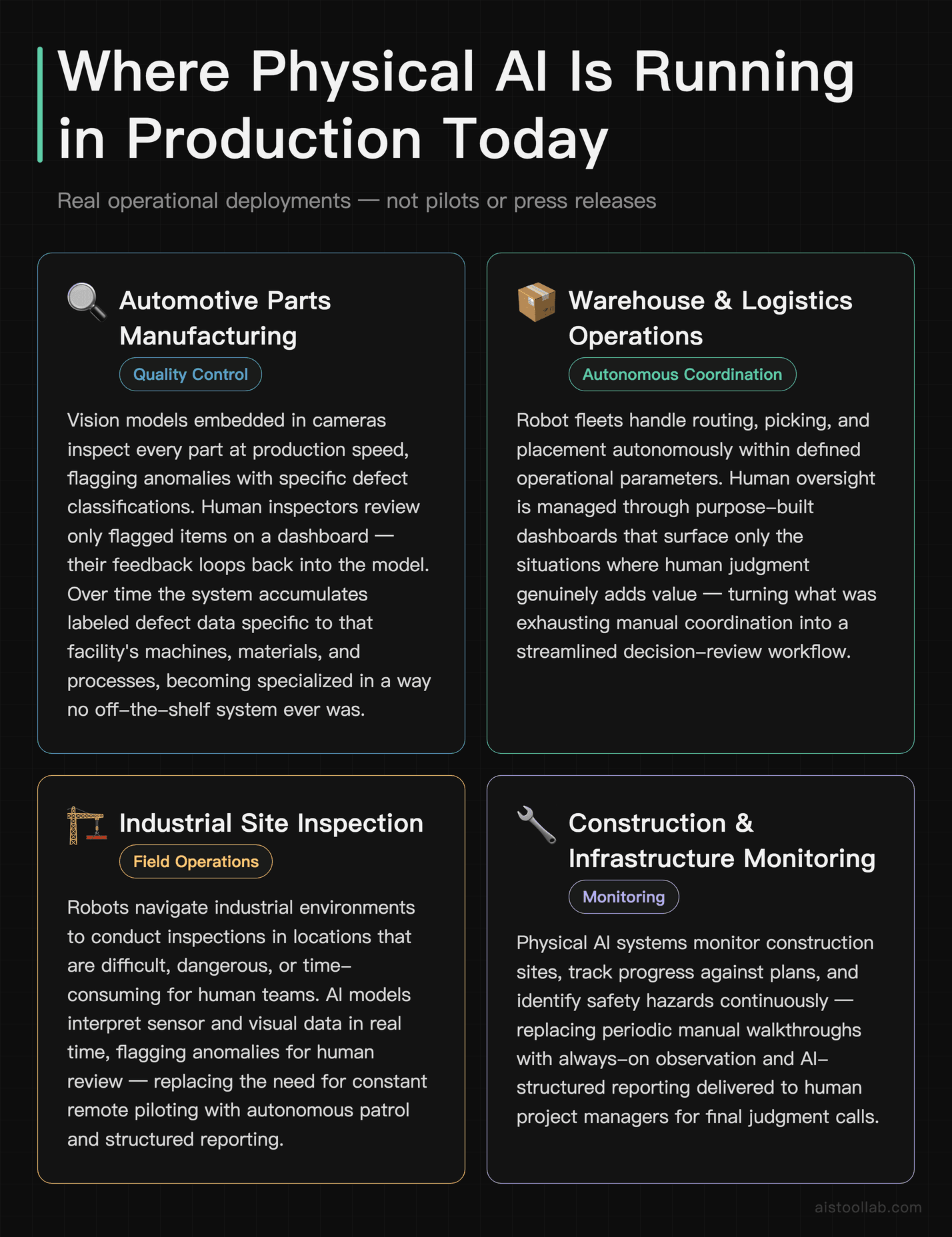
1. Autonomous Quality Control in Manufacturing
A mid-sized automotive parts supplier in the American Midwest — the kind of company with maybe 400 employees and three production lines — has replaced its visual inspection team with a hybrid AI system. Cameras with embedded vision models inspect every part at production speed, flagging anomalies with specific defect classifications. A human inspector reviews the flagged items on a dashboard, makes the final reject/accept call, and that feedback loops back into the model. What used to require multiple inspectors working in shifts now requires significantly fewer people monitoring a screenequires two people monitoring a screen, with the AI handling the high-volume pattern recognition work they’d find exhausting and error-prone after hour three of a shift.
The interesting part isn’t the cost savings (though they’re real). It’s the data. The system has accumulated labeled defect data specific to that facility’s machines over its operational period machines, materials, and processes. The model has become genuinely specialized to that production environment in a way no off-the-shelf inspection system ever was.
2. Logistics and Warehouse Navigation with Dynamic Replanning
Amazon and the big logistics players have been doing robotic warehouses for years — that’s old news. What’s new in 2026 is smaller 3PL (third-party logistics) operators deploying flexible robot fleets that can handle mixed inventory without being pre-programmed for specific SKU dimensions. A 50,000 square foot fulfillment center in Ontario is running a fleet where each unit uses a local foundation model to visually identify items it hasn’t “seen” before, figure out how to grasp them, and re-plan its route around dynamic obstacles — including humans, forklifts, and the general chaos of a busy warehouse at peak season.
The human oversight layer here is a control room operator who gets flagged whenever a robot encounters something it rates below a certain confidence threshold. They can give a simple text instruction — “that’s a fragile item, handle like glassware” — and the system updates its behavior for that item class for the rest of the shift. It’s conversational programming, essentially. You don’t need to be a robotics engineer to supervise these systems anymore, which is a genuinely significant shift.
3. Surgical Assistance and Clinical Workflow Automation
This is the use case that makes people most nervous, and honestly, the caution is warranted. But the reality on the ground is more nuanced than the headline “AI doing surgery.” What’s actually deployed in several hospital systems in the UK and Australia right now are AI-assisted surgical platforms where a robotic system handles the mechanical precision work — holding an endoscope perfectly steady for hours, making sub-millimeter incisions — while the surgeon makes every consequential decision. The AI removes the physical fatigue variable from procedures that require inhuman steadiness. The surgeon remains completely in control of the clinical judgment.
Beyond the OR, clinical workflow automation is transforming nursing workflows. AI systems that monitor vitals, flag early deterioration signals, draft notes, manage medication schedules, and coordinate handoffs are reducing the administrative burden that drives burnout in healthcare. A nurse in a busy ward in Melbourne described it to me as “like having a very detail-oriented assistant who never forgets anything and never goes on break.” The AI doesn’t make clinical decisions. It handles everything around the clinical decisions, which turns out to be an enormous chunk of the job.
4. Construction Site Monitoring and Safety Enforcement
One of the least glamorous but most impactful applications: AI systems that continuously monitor construction sites for safety violations. Camera networks with real-time inference models flag workers not wearing required PPE, detect unsafe proximity to heavy machinery, identify structural instability signals, and track whether work is proceeding according to the day’s plan. A large infrastructure contractor working on highway projects in the US Southwest deployed this system and reported a meaningful reduction in safety incidents within the first two quarters — not because the AI was disciplining anyone, but because workers knew the monitoring was consistent and immediate, and site managers were getting actionable alerts instead of weekly summary reports that nobody read.
How Human Oversight Is Being Redesigned — Not Removed
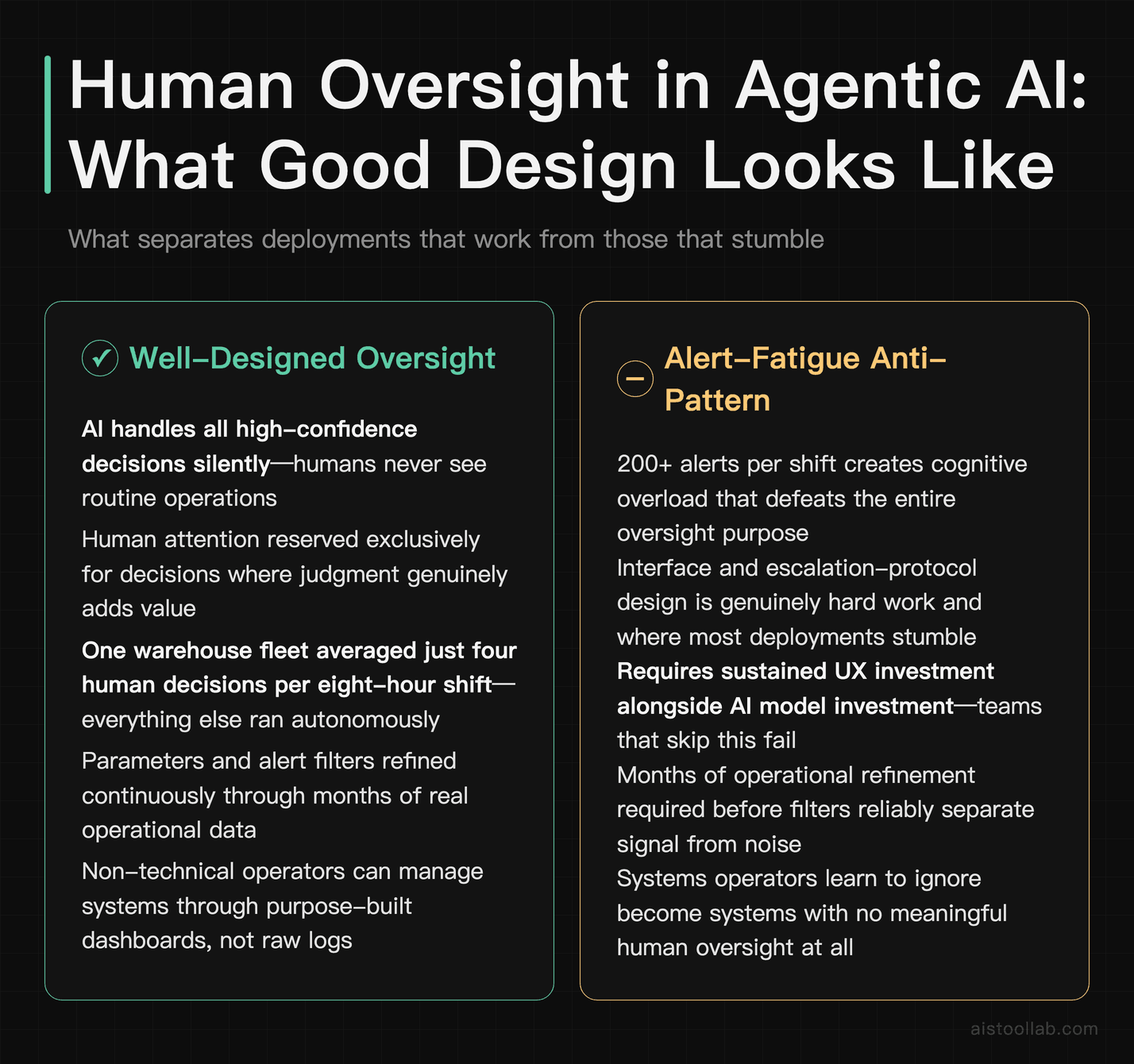
The most persistent misconception about agentic AI systems is that “autonomous” means “unsupervised.” In practice, the companies getting this right are investing heavily in the design of the human-AI interface — the dashboard, alert system, and escalation protocols that make oversight manageable for non-technical operators. This is genuinely hard design work, and it’s where a lot of deployments stumble.
Think about it from a practical standpoint. If your AI system generates 200 alerts per shift and a human operator is supposed to review them all, you haven’t built a human oversight layer — you’ve built alert fatigue. The well-designed systems in 2026 are ruthlessly filtered. The AI handles everything it’s confident about silently. It surfaces only the situations where human judgment adds value. One warehouse operations manager told me their system generates an average of four human decisions per eight-hour shift for the entire robot fleet. Four. Everything else runs autonomously within the parameters the team has defined and refined over months of operation.
This is the real workflow transformation happening right now. It’s not about replacing human judgment — it’s about applying human judgment exclusively to situations where it actually matters, and letting the AI handle the high-volume, pattern-matching work that humans are objectively worse at after hour six. If you’re curious how this intersects with the broader AI agent ecosystem, I covered some of the software-side tools driving these workflows in my 9 Best New AI Tools Launched in 2026: What Actually Works Beyond the Hype roundup.
What’s Still Genuinely Hard (The Hype Filter)
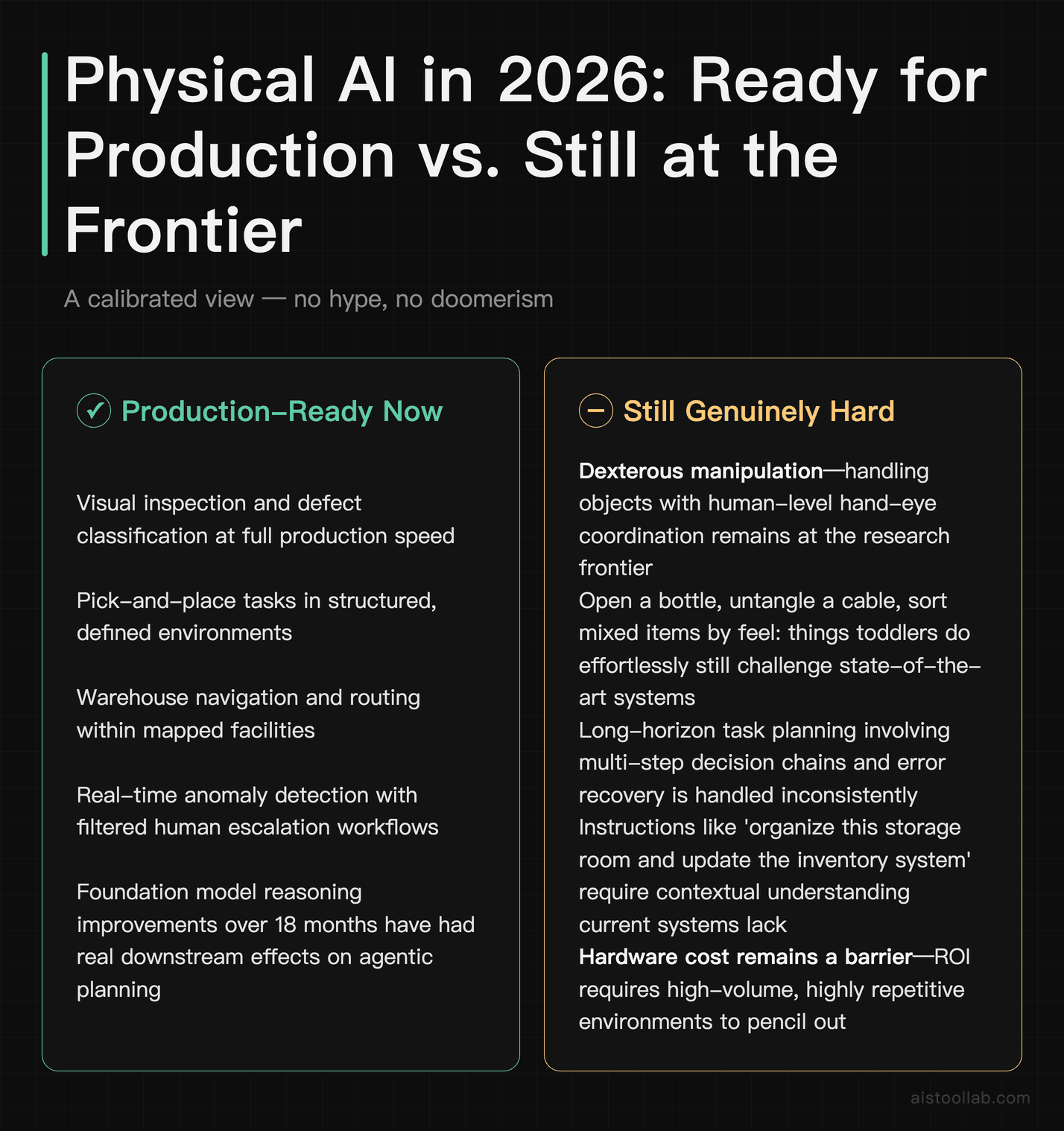
For all the real progress, it’s worth being honest about what isn’t working yet. Dexterous manipulation — getting a robot to handle objects with the kind of hand-eye coordination a human develops in the first few years of life — remains legitimately difficult. Open a bottle, untangle a cable, sort mixed items by feel: these things that toddlers do effortlessly are still at the frontier of robotics research. The gap between “can do this in a lab 70% of the time” and “reliable enough for a production floor” is enormous.
Long-horizon task planning is another genuine challenge. A robot can pick up a box and place it in a designated location reliably. Asking it to “organize the storage room by category and update the inventory system when done” involves a chain of decisions, error recovery, and contextual understanding that current systems handle inconsistently. This is improving — the reasoning improvements in foundation models over the last 18 months have had real downstream effects on agentic planning — but anyone telling you fully autonomous general-purpose robots are a 2026 product is overselling it.
The cost conversation also needs more honesty. Yes, deployment costs are coming down. But “coming down” from “enterprise-only” still means these systems are out of reach for most small businesses. A full physical AI deployment in a manufacturing environment — hardware, integration, training, ongoing maintenance — is still a six-figure minimum investment in most cases. The democratization story is real but it’s a 2028–2030 story for small businesses, not today.
The Platforms and Players Worth Watching
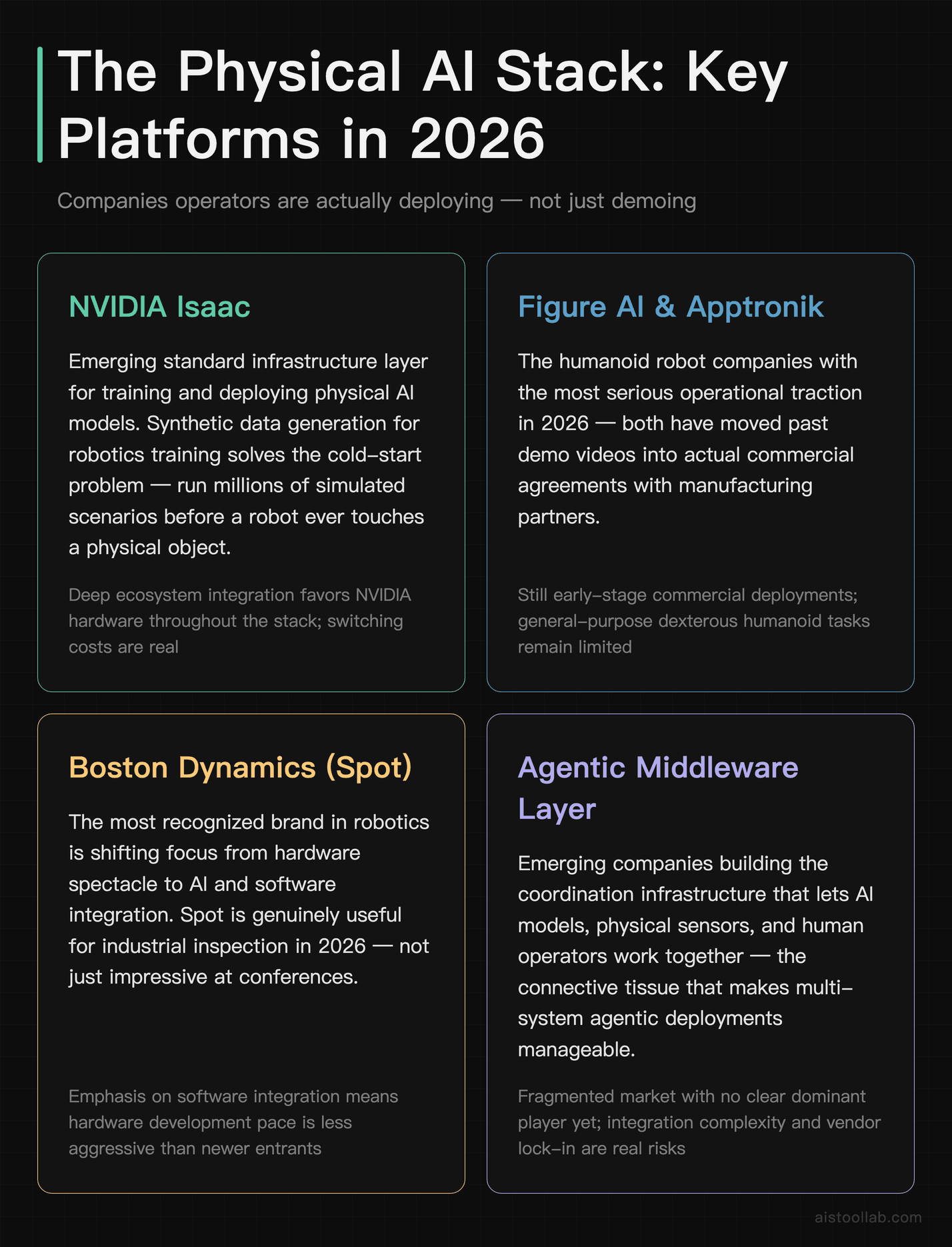
A few names come up consistently when you talk to operators actually deploying these systems. NVIDIA’s Isaac platform has become something of a standard infrastructure layer for training and deploying physical AI models — their work on synthetic data generation for robotics training is particularly important, because it solves the chicken-and-egg problem of needing lots of real-world data to train a robot that hasn’t been deployed yet. NVIDIA Isaac lets you run millions of simulated scenarios before a robot ever touches a physical object.
Figure AI and Apptronik are the humanoid robot companies getting the most serious operational traction — both have moved beyond demo videos into actual commercial agreements with manufacturing partners. Boston Dynamics remains the brand most people recognize, but in 2026 their focus is increasingly on software and AI integration rather than hardware spectacle. Their Spot robot is genuinely useful in industrial inspection now, not just impressive at parties.
On the software infrastructure side, companies building the “agentic middleware” — the systems that let AI models coordinate with physical sensors, human operators, and enterprise software simultaneously — are quietly becoming very important. This is less glamorous than the robot hardware, but it’s arguably where the actual value is being created. The foundation models being deployed in physical contexts are also closely related to the language and reasoning models driving software agents — which is why the trajectory of models like those covered in my GPT-5.5 vs Claude comparison piece matters directly to physical AI development timelines.
The Boring Deployments Are the Ones That Pay
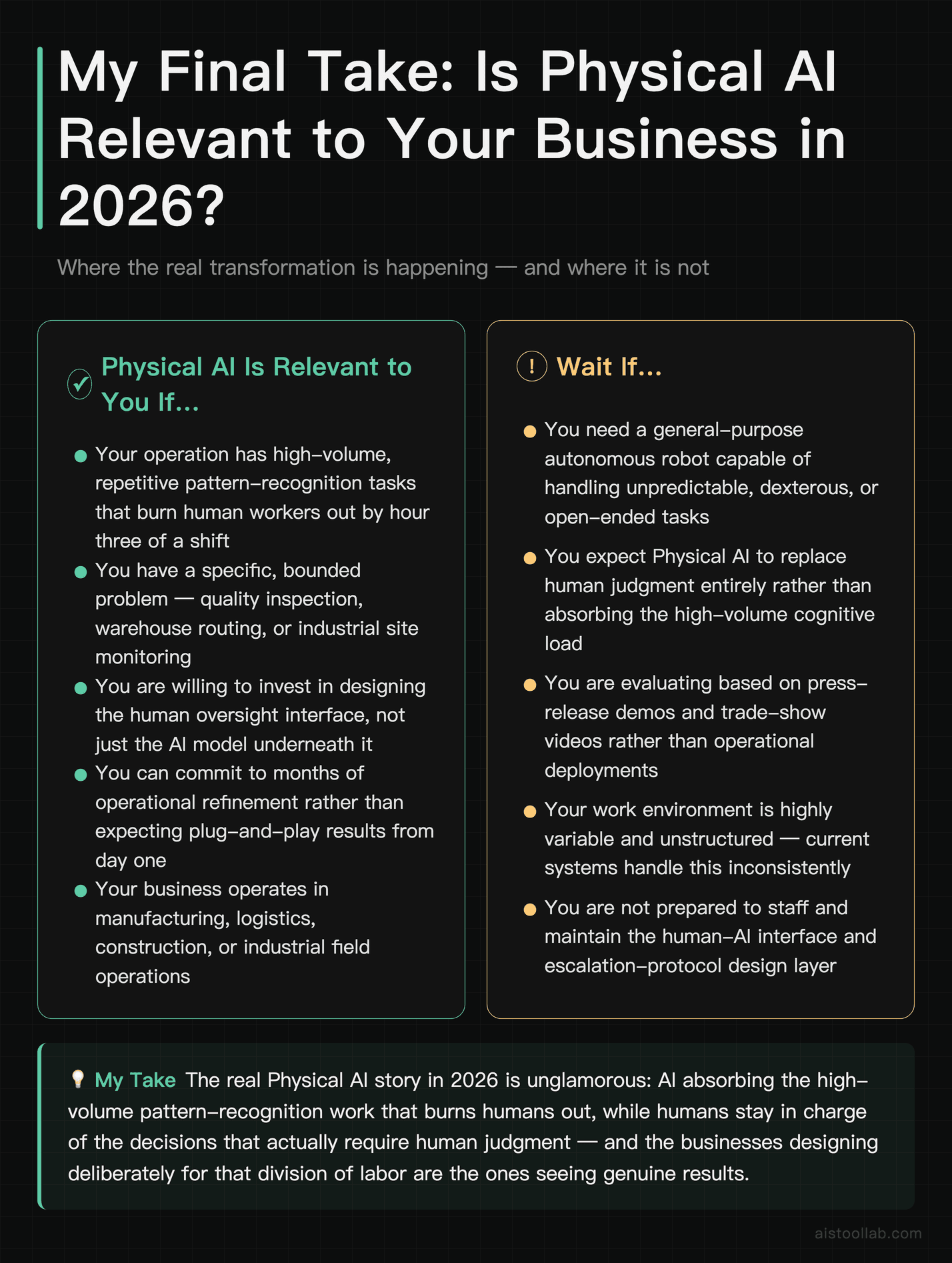
The news coverage of Physical AI tends to focus on the spectacular: humanoid robots, surgical robots, autonomous vehicles. These are real and important, but they’re not where the transformation is actually happening at scale in 2026. The more important story is unglamorous: a quality inspection station in a parts factory in Ohio that runs more accurately and consistently than it ever did with a human team, or a warehouse in Ontario where four human decisions per shift replace what used to be exhausting, error-prone manual coordination.
This is what “agentic AI transforming workflows” actually looks like on the ground. Not autonomy for its own sake, but AI that absorbs the high-volume cognitive and physical work that burns humans out, while keeping humans in charge of the decisions that genuinely require human judgment. That design philosophy — humble about what AI does better, clear-eyed about what humans do better — is the thing that separates the real deployments from the press-release ones.
If you’re evaluating whether Physical AI is relevant to your business in the next 18 months: the question isn’t whether the technology is ready. For specific, well-defined applications in structured environments, it is. The questions are whether you have the operational discipline to implement proper human oversight design, whether you can handle the workforce transition honestly, and whether the economics make sense before the cost curves drop further. For most businesses in manufacturing, logistics, and facilities management: start scoping a pilot now for a specific, contained application. The learning you get from a real deployment — even a small one — is worth more than another year of watching the hype cycle.
Frequently Asked Questions
What exactly is the difference between Physical AI and regular robotics automation?
Traditional robotics automation follows pre-programmed instructions. A robot on an assembly line knows exactly what to do because an engineer has specified every movement, every condition, every response. It’s deterministic: input A produces output B, every time. Physical AI is fundamentally different in that the system reasons about its environment rather than following a script. It can encounter an object it’s never seen before, assess its properties visually and physically, and figure out an appropriate approach. It can handle unexpected situations by drawing on general knowledge — similar to how a skilled human worker would improvise rather than just stop. This doesn’t mean Physical AI systems are infinitely flexible; they still have domains and constraints. But the mode of operation is reasoning and adaptation rather than rule-following. The practical implication is that Physical AI systems can be deployed in environments that were previously impossible to automate because they’re too variable or unpredictable — which covers most real-world workplaces.
How does human oversight actually work in these agentic systems?
The dominant model in 2026 is “human-on-the-loop” rather than “human-in-the-loop.” The distinction is important. Human-in-the-loop means a human approves or directs each significant action — this works at low volumes but doesn’t scale. Human-on-the-loop means the AI operates autonomously but within a monitored envelope. Human operators see what the system is doing, receive alerts when the AI reaches the edge of its confidence or encounters defined escalation triggers, and can intervene or override at any point. In practice, well-designed systems generate very few required human interventions — sometimes only a handful per shift across an entire facility. The human role shifts from doing or supervising tasks to setting policy, reviewing edge cases, and continuously refining the parameters the AI operates within. This requires a different skill set from traditional operations management, and training workers to operate in this model is one of the underrated challenges of real Physical AI deployments.
Which industries are seeing the most real Physical AI deployment right now?
Manufacturing and logistics are the furthest along, full stop. These environments have the combination of factors that make Physical AI deployments viable: repetitive enough tasks to make investment worthwhile, enough structure to limit the edge case universe, and sufficient volume to generate the data needed for ongoing improvement. Healthcare is moving fast but with appropriately high caution — the regulatory pathway is longer and the consequences of errors are higher. Construction and infrastructure inspection are seeing serious adoption for monitoring and safety applications specifically. Agriculture is further along than most people realize: autonomous tractors and crop monitoring systems are operational at commercial scale in Australia, parts of the US, and Europe. Retail is lagging, despite years of pilot programs — the combination of uncontrolled public environments and thin margins makes it genuinely difficult. Most of the autonomous checkout and shelf-stocking pilots have been quietly wound back.
Is Physical AI going to eliminate jobs, or does it actually create new ones?
This is the question everyone is actually asking, and the honest answer is: both, unevenly, with the costs and benefits falling on different people. Physical AI does eliminate certain job categories — specifically, repetitive physical tasks that are high-volume, low-variation, and physically taxing. Visual inspection, basic assembly, standard pick-and-pack operations: these are shrinking as job categories. At the same time, deployments create demand for people who can operate, maintain, configure, and improve these systems. The troubling reality is that these aren’t the same people. A worker whose job was manual inspection on a production line doesn’t automatically have the skills to become an AI system operator or robot maintenance technician. The workforce transition challenge is real and it’s not being adequately addressed by most companies deploying these systems. The technology is moving faster than the retraining infrastructure. That’s a policy and corporate responsibility issue as much as it is a technology story.
What are the biggest technical limitations of Physical AI systems in 2026?
Three areas stand out as genuinely unsolved or only partially solved. Dexterous manipulation — fine motor tasks involving unusual objects, soft materials, or high precision — remains hard. Most physical AI systems are good at specific manipulation tasks they’ve been trained for and poor at generalization. Long-horizon task planning is another frontier: orchestrating a sequence of interdependent actions over minutes or hours, with error recovery and replanning, is inconsistent. Current systems handle short-horizon tasks reliably and longer tasks with variable success. Power and footprint constraints for mobile systems are a third practical limitation — real-world robots have to run on batteries, operate in spaces designed for humans, and not weigh so much they become hazards. Balancing AI compute requirements with those physical constraints is ongoing engineering work. Progress is real but anyone claiming these are solved problems is pitching you something.
How does Physical AI connect to the AI agents I’m already using in software tools?
More directly than you might expect. The foundation models driving software agents — reasoning about tasks, planning multi-step actions, using tools and APIs — are the same architectural lineage as the models driving physical AI systems. The main differences are in the input modalities (physical AI adds vision, spatial data, sensor streams) and the output modalities (physical AI produces motor commands, not just text). As these models improve at reasoning and planning, both domains benefit simultaneously. There’s also increasing interest in unified systems where a software agent and a physical robot share context — a logistics AI that manages both the warehouse management software and the robot fleet as one integrated system, rather than two separate tools that have to talk to each other. This convergence is early but it’s the architectural direction most serious players are heading. See also my 15 AI Tools Worth Knowing in 2026 piece for context on how the software agent ecosystem feeds into this.
What does a realistic Physical AI deployment cost for a mid-sized business?
The honest range for a meaningful Physical AI deployment — not a pilot, but an operational system — starts around $150,000 to $250,000 for a focused application like automated quality inspection or a small robot fleet in a warehouse. That covers hardware, integration work, initial model configuration, and the first year of support. Larger or more complex deployments — multi-zone facilities, humanoid robots, surgical assistance platforms — are in the millions. The cost curve is declining, and several vendors are starting to offer robotics-as-a-service models where you pay per unit of work rather than owning the capital equipment outright. This model is interesting for businesses that don’t want to own and maintain robot hardware. Within two to three years, meaningful entry points for smaller businesses will likely drop into the $50,000–$80,000 range for specific, narrow applications. Right now, it’s still primarily a mid-market-and-above story.
How is Physical AI being regulated, and should businesses be worried about compliance?
The regulatory landscape is fragmented and evolving, which is both a risk and, in the short term, a relative freedom. In the US, there’s no comprehensive federal framework for Physical AI specifically — oversight falls under existing domain regulators (FDA for medical devices, OSHA for workplace safety, DOT for autonomous vehicles). The EU AI Act, which is in progressive enforcement, classifies many physical AI applications in safety-critical environments as high-risk AI systems, requiring conformity assessments, human oversight documentation, and specific transparency obligations. UK regulation is taking a more sector-by-sector approach. For businesses deploying Physical AI in 2026, the practical advice is: document your human oversight architecture thoroughly, because that documentation will be the foundation of any compliance argument regardless of which regulatory framework eventually applies. The companies that have designed genuine human-on-the-loop systems — not just claimed it in a press release — are in a much better compliance position than those who retrofitted an oversight narrative onto a system built for maximum autonomy.
Last updated: 2026
Explore more AI tools
👉 Browse the AI Tools Library to find the right tools for your workflow.