
The Real Problem With Picking AI Marketing Tools Right Now
Every week, there’s a new AI tool claiming it will 10x your content output, dominate your keyword rankings, and write ad copy that converts like crazy. The result? Most marketers end up with five half-used subscriptions, inconsistent brand voice across channels, and a nagging fear that Google is about to penalise every article their AI churned out last quarter. The overwhelm is real — and it’s costing time and money.
This guide is not a directory. You won’t find 40 tools with a paragraph each. Instead, this is a shortlist of the tools that actually move the needle for marketing and SEO in 2026 — whether you’re a solo consultant billing by the hour, an agency managing 20 clients, or an e-commerce brand trying to scale content without scaling headcount. Every tool here has been evaluated for output quality, pricing value, learning curve, and how well it holds up against the real pain points marketers face: AI content that loses brand voice, keyword strategies that don’t convert, and campaigns that are impossible to attribute.
We cover ChatGPT, Claude, Perplexity, Surfer SEO, Semrush AI, Canva AI, and Jasper — the tools that keep coming up in conversations with working marketers who are actually seeing results. Here’s what each one is genuinely good at, where it falls short, and who should be paying for it.
How We Picked These Tools
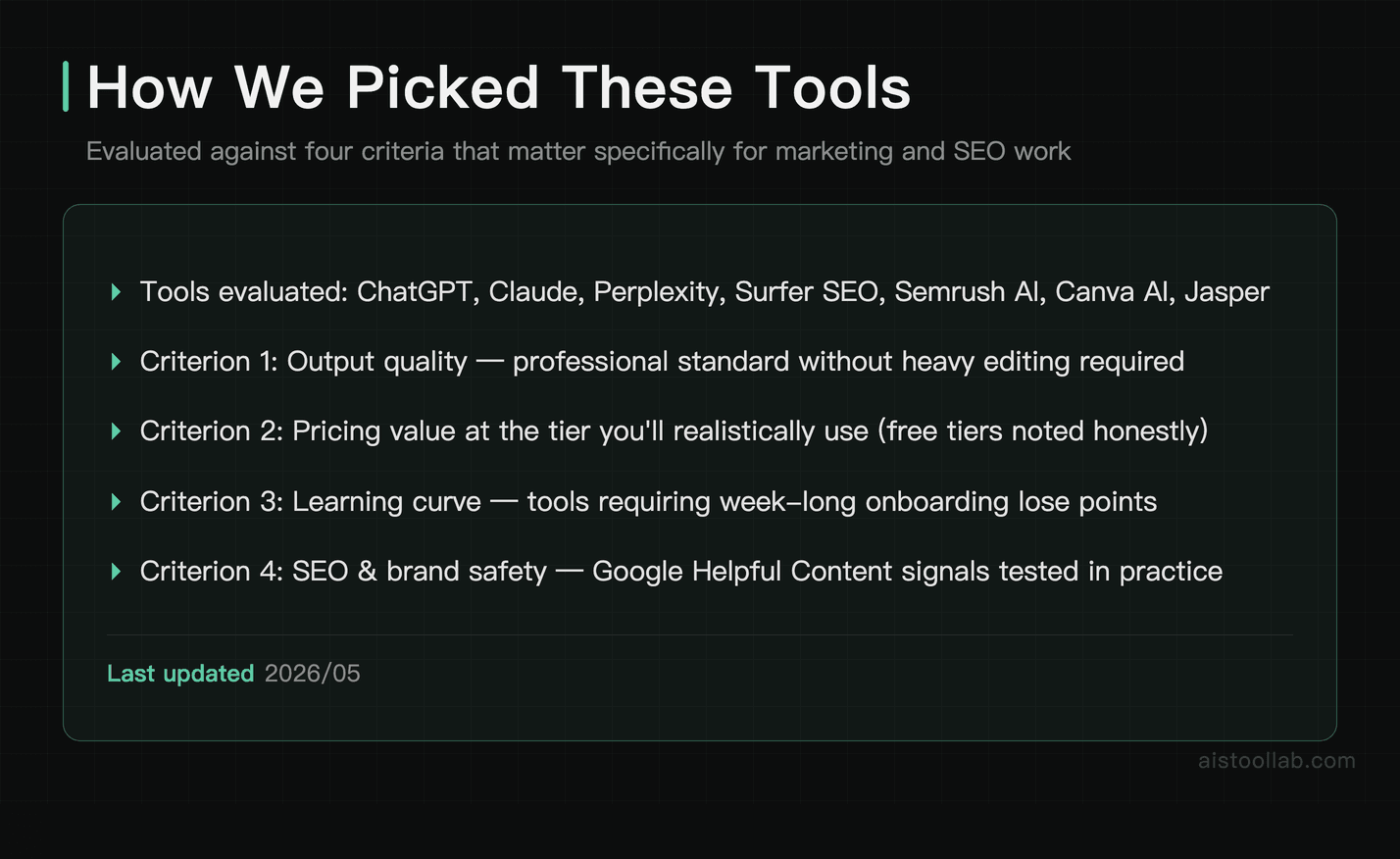
These tools were evaluated against four criteria that matter specifically for marketing and SEO work:
- Output quality for marketing tasks: Does the content, keyword data, or creative output actually meet a professional standard without heavy editing?
- Pricing value at the tier you’ll realistically use: Free tiers are noted, but we’re honest about which paid plans are genuinely worth it and which are overpriced for what you get.
- Learning curve: Marketers don’t have time for week-long onboarding. Tools that require significant technical setup lose points here.
- SEO and brand safety: In 2026, Google’s Helpful Content signals are more refined than ever. We looked at which tools help you create genuinely useful content — not just stuff that sounds like AI wrote it at 2am.
The Best AI Tools for Marketing and SEO in 2026
#1. ChatGPT — Best For Content Strategy and Campaign Ideation
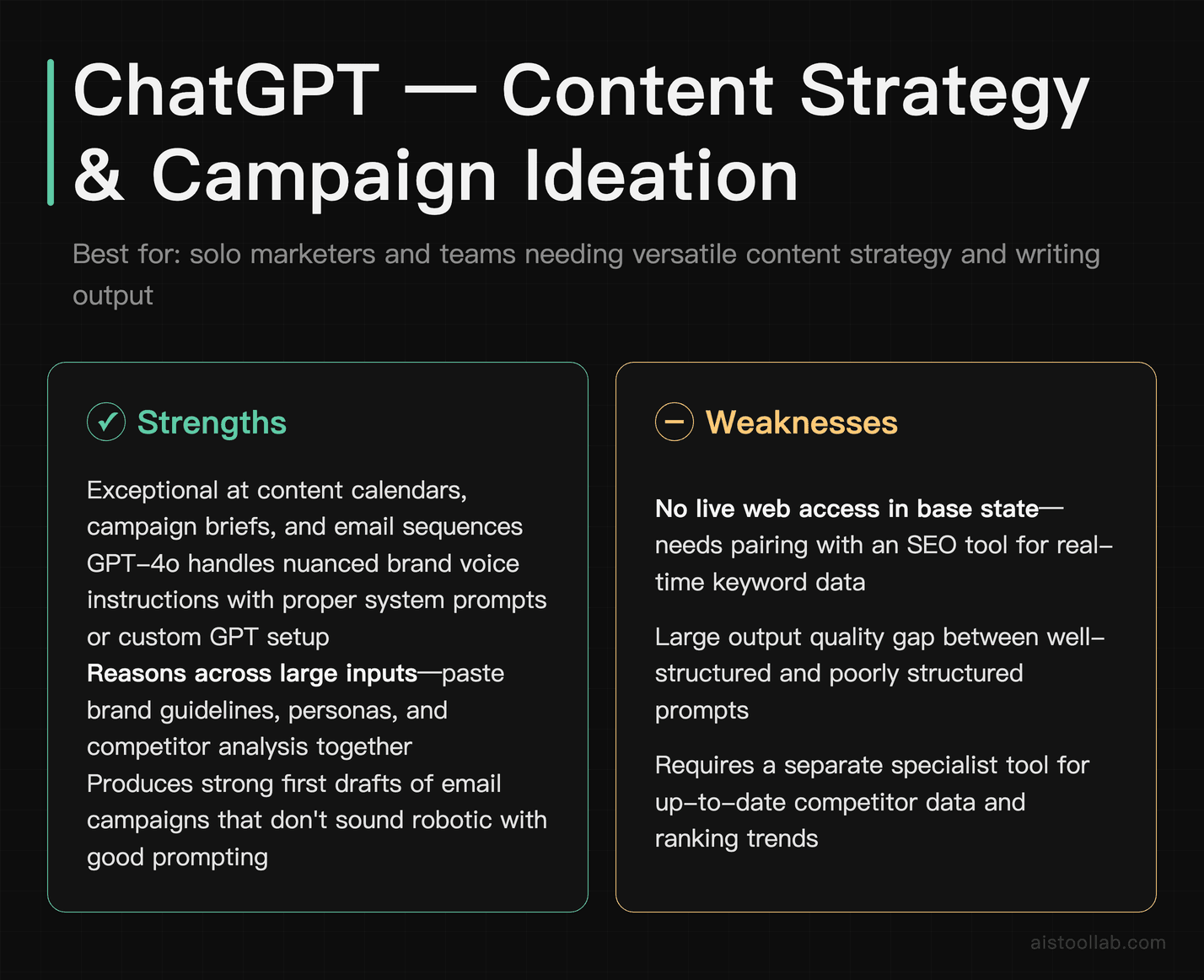
ChatGPT remains the workhorse of AI-assisted marketing, and for good reason. With the right prompting approach, it’s exceptional at building content calendars, drafting campaign briefs, generating email sequences, and brainstorming ad angles you wouldn’t have thought of yourself. The GPT-4o model handles nuanced brand voice instructions well when you give it enough context — a proper system prompt or custom GPT setup makes a noticeable difference in output consistency.
For content strategy specifically, ChatGPT’s ability to reason across large amounts of input (paste in your brand guidelines, competitor analysis, and audience persona) and produce a structured editorial calendar is genuinely useful. It’s also strong at writing first drafts of email campaigns that don’t sound robotic — provided you’re feeding it good instructions. If you haven’t yet mastered prompt structure, the gap between a mediocre and excellent output is enormous.
Real limitation: ChatGPT has no live web access in its base state (though plugins and the browsing feature help). For real-time keyword trends or up-to-date competitor data, you’ll need to pair it with a dedicated SEO tool. It also doesn’t know your brand’s history, tone, or customer data unless you tell it every session — or build a custom GPT with that context baked in.
Pricing: Free tier (GPT-4o with usage limits). ChatGPT Plus is $20/month and gives you reliable access to GPT-4o plus access to advanced voice mode and custom GPTs. ChatGPT Team starts at $25/user/month and adds shared workspaces — worth it for agencies. The free tier is genuinely useful for light use but hits limits fast in a real workflow.
Verdict: The right starting point for almost any marketer. If you’re only going to pay for one AI tool, start here.
#2. Claude — Best For Long-Form Content and Brand Voice Consistency
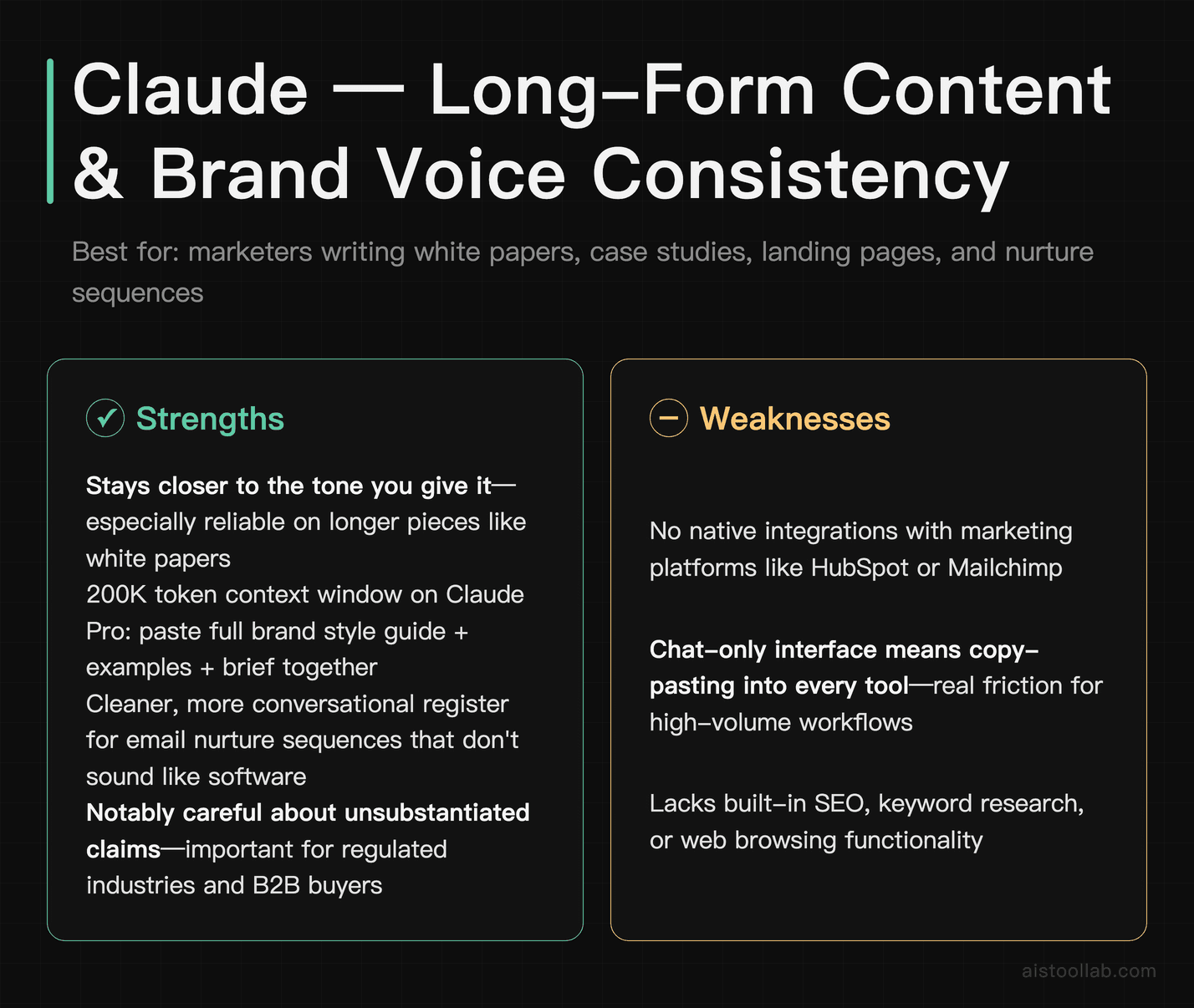
Claude (Anthropic’s model) has quietly become the preferred writing assistant for marketers who care about voice consistency at scale. Where ChatGPT can drift into generic-sounding output, Claude tends to stay closer to the tone you give it — especially on longer pieces like white papers, case studies, and detailed landing pages. The 200K token context window on Claude Pro means you can paste in a full brand style guide, multiple content examples, and a detailed brief, and get output that actually reflects all of it.
For email campaigns, Claude writes with a cleaner, more conversational register than most AI tools. It’s particularly good at nurture sequences where tone matters — the kind of emails that don’t sound like they were generated by software. It’s also notably careful about making unsubstantiated claims, which matters when you’re writing for regulated industries or B2B buyers who will scrutinise every word.
Real limitation: Claude doesn’t have native integrations with marketing platforms like HubSpot or Mailchimp. You’re working in a chat interface and copy-pasting, which adds friction to high-volume workflows. It also doesn’t do keyword research or SEO analysis — it’s purely a writing and reasoning tool.
Pricing: Free tier available with limited usage. Claude Pro is $20/month for individuals and gives priority access plus the full context window. Claude for Teams is $25/user/month. Worth every dollar if your work involves long-form content or maintaining brand voice across a content team.
Verdict: The best AI writing tool for brand voice consistency. Agencies managing multiple client voices should strongly consider this over Jasper at a fraction of the price.
#3. Perplexity — Best For Real-Time Research and Keyword Intelligence
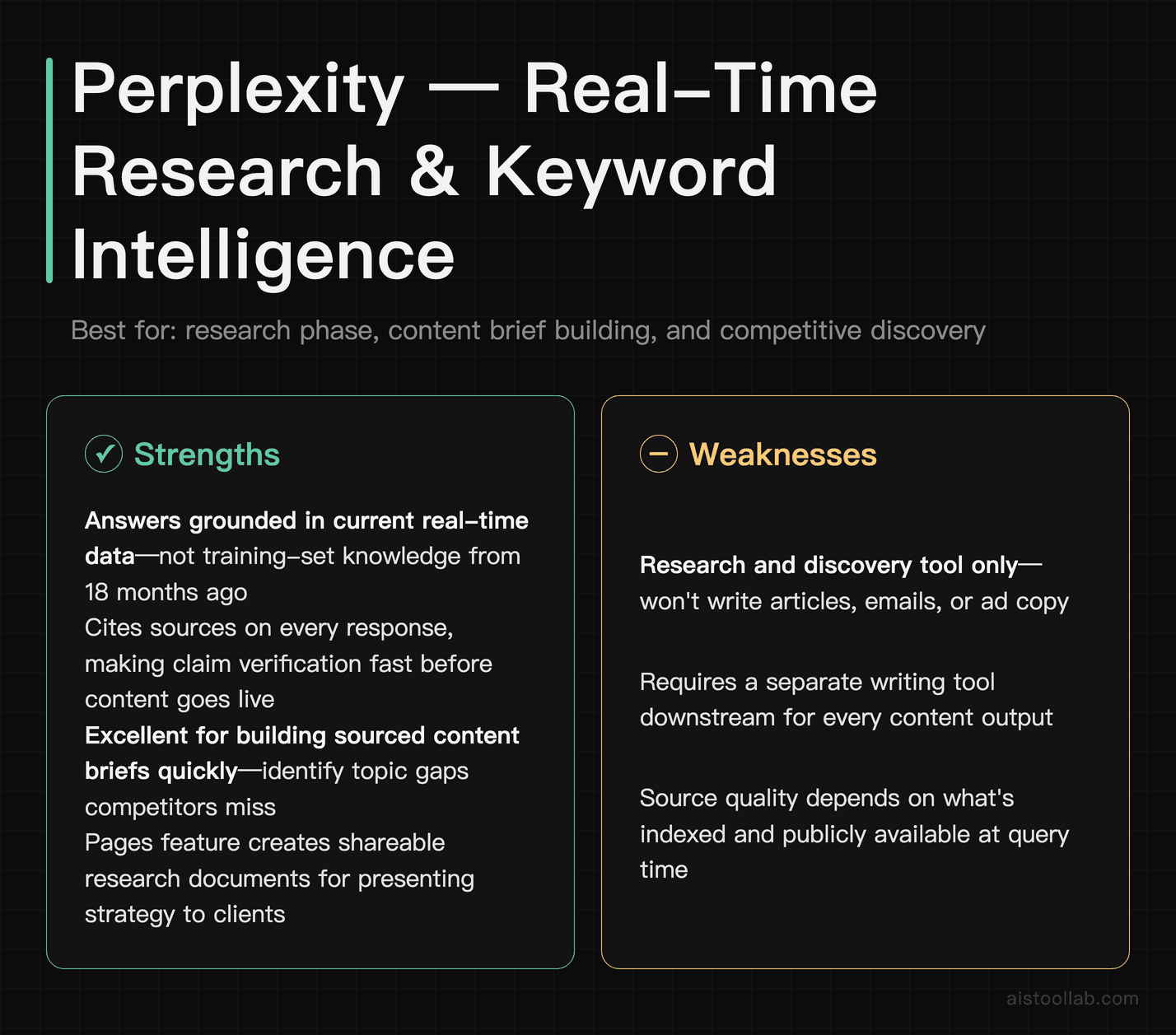
Perplexity is what you use when you need answers grounded in current reality, not a model’s training data from 18 months ago. For marketers, this is most valuable during the research phase: understanding what your audience is actually searching for right now, what competitors are publishing, and what topics are gaining traction in your niche. Perplexity’s AI search cites its sources, which makes it dramatically easier to verify claims before they end up in your content.
In practice, Perplexity Pro is excellent for building content briefs fast. Ask it about a topic, get a sourced overview, then identify the gaps your content can fill. It’s also useful for competitive research — you can ask it to summarise what a competitor’s content strategy looks like based on their published material. The Pages feature lets you build shareable research documents, which is handy for presenting strategy to clients or stakeholders.
Real limitation: Perplexity is a research and discovery tool, not a content creation engine. It won’t write your article or your email campaign. You’ll still need a writing tool downstream. Also, while it’s better than most AI tools at citing sources, it can occasionally misattribute or pull from low-quality sources — always click through.
Pricing: Free tier is functional for casual research. Perplexity Pro is $20/month and adds access to more powerful models, unlimited Pro searches, and image generation. For marketers doing regular content research, Pro is worth it. The free version will frustrate you quickly with rate limits.
Verdict: Essential for marketers who want to base their content strategy on what’s actually happening in their market right now, not stale training data.
#4. Surfer SEO — Best For On-Page SEO Optimisation
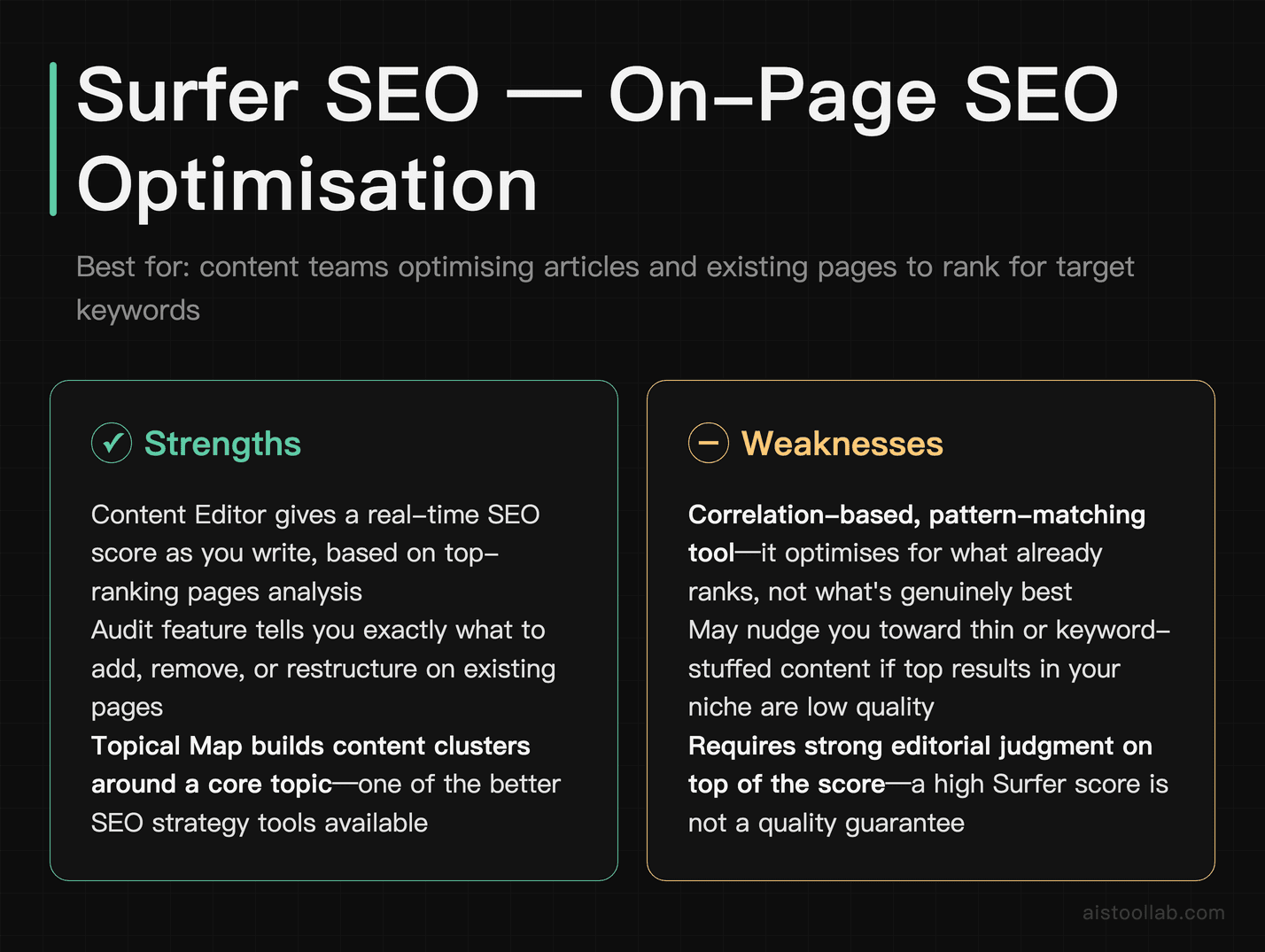
Surfer SEO is the tool that actually closes the loop between “write content” and “rank content.” Its Content Editor analyses the top-ranking pages for your target keyword and gives you a real-time score as you write, based on factors like word count, keyword usage, headings structure, and NLP terms that the top results include. It’s not magic — it’s correlation-based analysis — but it consistently improves the technical completeness of SEO content.
For marketing teams producing SEO content at scale, Surfer’s Audit feature is genuinely time-saving. Upload your existing pages and it tells you exactly what to add, remove, or restructure to improve ranking potential. The Topical Map feature, which helps you build content clusters around a core topic, is one of the better implementations of content strategy thinking in any SEO tool right now.
Real limitation: Surfer optimises for what’s already ranking — it’s fundamentally a pattern-matching tool. If the top results in your niche are all thin, keyword-stuffed articles, Surfer may nudge you toward producing similar content. Good editorial judgment still needs to sit on top of the score. Also, the AI writing feature (Surfer AI) produces generic output that requires significant editing — use it as a scaffold, not a finished draft.
Pricing: Plans start at around $89/month for the Essential tier, which covers a limited number of articles and audits per month. The Scale plan at around $129/month is where most agencies will land. There’s no meaningful free tier — just a trial. Pricey, but if you’re serious about SEO content, it pays for itself.
Verdict: The best tool for marketers who need to systematically improve SEO content quality. Non-negotiable for content-led SEO agencies.
When optimising content URLs, our free Slug Generator turns any title into an SEO-friendly URL format — useful when Surfer or Semrush suggest new page targets and you need to create slugs quickly without a CMS open.
#5. Semrush AI — Best For Keyword Research and Competitor Analysis
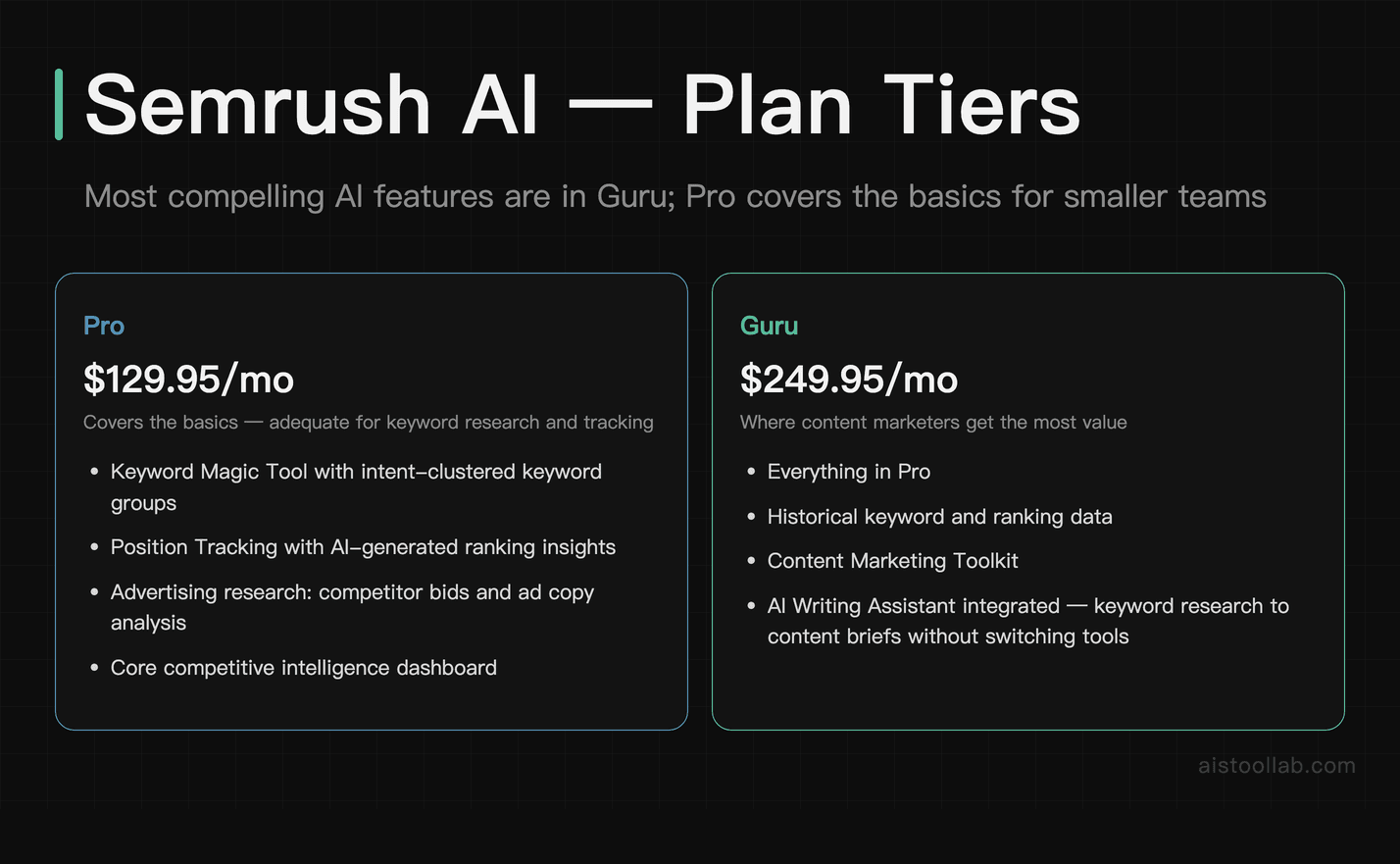
Semrush has been the industry standard for keyword research and competitive intelligence for years, and its AI-assisted features have meaningfully improved the speed at which you can turn data into strategy. The AI-powered Keyword Magic Tool now surfaces intent-clustered keyword groups faster, and the AI Writing Assistant integrated into the platform helps you go from keyword research directly into content briefs without switching tools.
For paid advertising, Semrush’s advertising research tools let you see what competitors are bidding on and what ad copy is performing — genuinely useful intelligence when you’re setting up a new Google Ads campaign. The Position Tracking feature with AI-generated insights surfaces ranking changes with context, not just raw data, which saves time interpreting reports.
Real limitation: Semrush is expensive, and most of the compelling AI features live in the higher tiers. The $129.95/month Pro plan covers the basics but the Guru plan at $249.95/month is where content marketers get the most value (historical data, content marketing toolkit). For small teams or solo marketers, this is a significant spend and you need to actually use it daily to justify it.
Pricing: Pro plan starts at $129.95/month. Guru is $249.95/month. There is a limited free account that lets you run a small number of searches — useful for evaluating the tool but not for real work. Annual billing reduces costs meaningfully.
Verdict: The right choice for agencies and in-house SEO teams who need a comprehensive data platform. Hard to justify for solos unless keyword research is a daily activity.
#6. Canva AI — Best For Ad Creative and Social Content at Scale
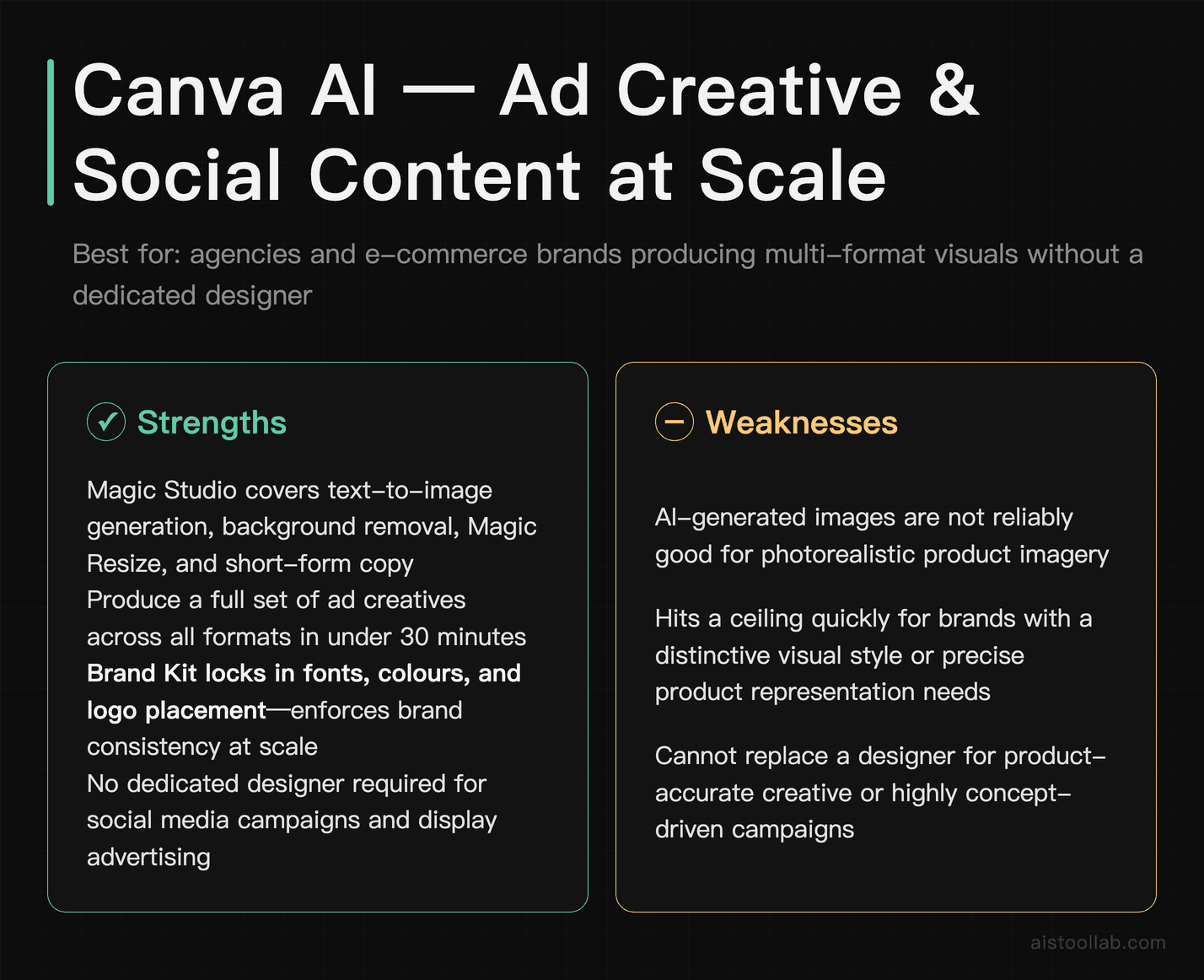
Canva’s AI features have matured into a genuinely capable toolkit for marketers who need to produce visual content without a dedicated designer. Magic Studio — Canva’s suite of AI tools — includes text-to-image generation, background removal, Magic Resize (resizing one design for every ad format instantly), and Magic Write for short-form copy. For social media campaigns and display ads, the ability to generate a set of on-brand visuals in minutes rather than hours is a real operational advantage.
The Brand Kit feature, which lets you lock in fonts, colours, and logo placement, is what makes Canva actually useful for agencies and in-house teams maintaining brand consistency. Combine it with Magic Resize and you can produce a full set of ad creatives across formats in under 30 minutes — something that used to take half a day with a designer.
Real limitation: Canva’s AI-generated images are decent for generic purposes but not reliably good for photorealistic product imagery or highly specific concepts. If your brand relies on a distinctive visual style or requires precise product representation, you’ll hit the ceiling quickly. The AI image generator produces recognisably “AI-looking” images in many cases. Use it for illustrations, backgrounds, and supporting graphics — not hero imagery.
Pricing: Free tier is genuinely useful for basic design work. Canva Pro is $15/month per user (or around $120/year) and unlocks the full AI feature set, Brand Kit, and expanded template library. Canva Teams starts at $10/user/month (minimum 3 users). Pro is excellent value — one of the better-priced tools on this list.
Verdict: Essential for any marketer who produces regular visual content without a design team. The ROI on Canva Pro is obvious within the first week.
#7. Jasper — Best For Enterprise Content Teams Needing Brand Guardrails
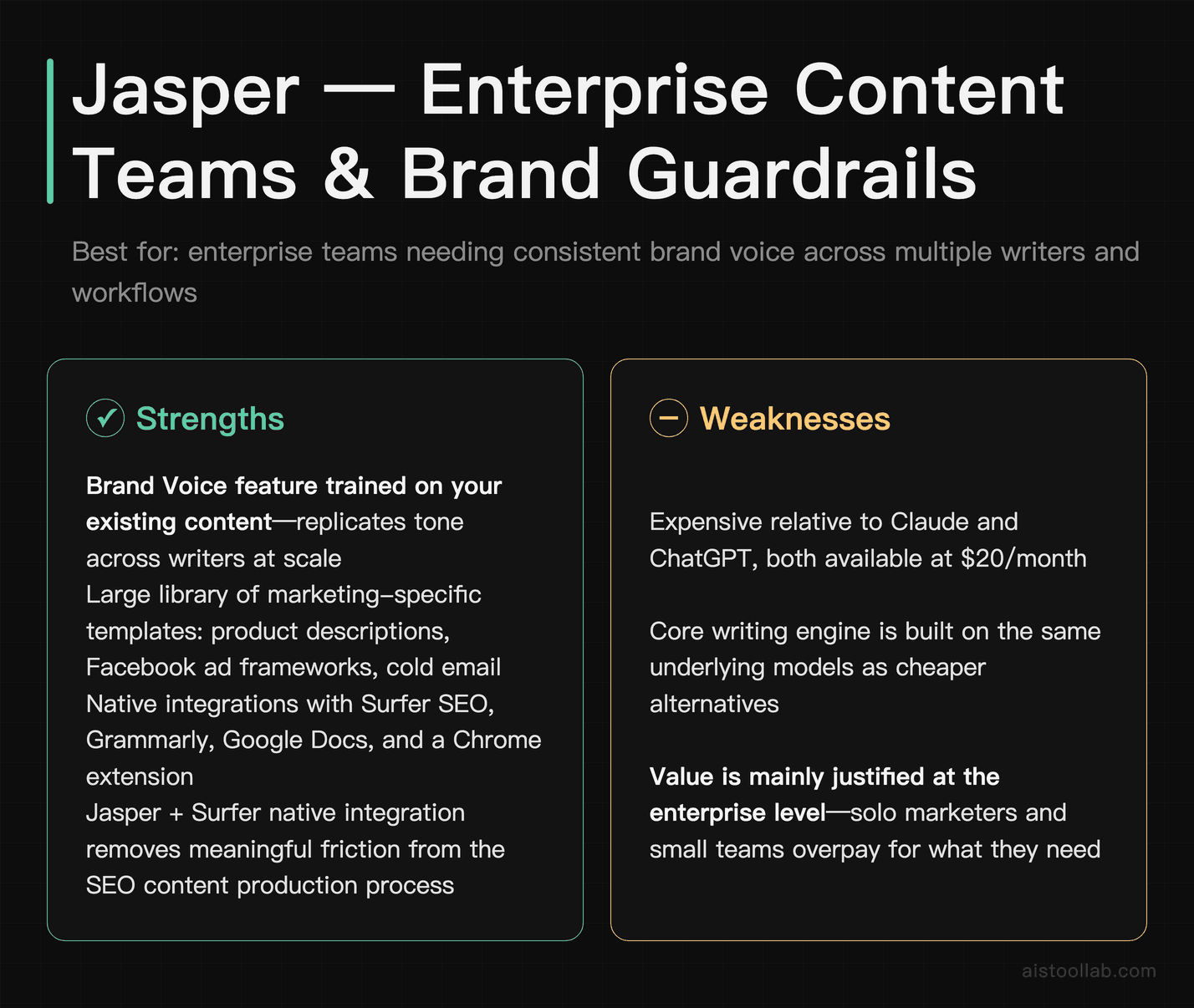
Jasper’s main differentiator in 2026 is its Brand Voice feature — you train it on your existing content and it learns to replicate your tone across outputs. For enterprise marketing teams where multiple writers need to produce content that sounds like the same brand, this is a meaningful capability. Jasper also has a large library of marketing-specific templates (product descriptions, Facebook ad frameworks, cold email frameworks) that reduce the blank-page problem for marketers who aren’t confident writers.
Jasper’s integrations — Surfer SEO, Grammarly, Google Docs, Chrome extension — make it easier to embed into existing workflows than tools that require you to work exclusively in their interface. For teams already using Surfer for SEO optimisation, the native Jasper + Surfer integration removes a meaningful amount of friction from the content production process.
Real limitation: Jasper is expensive relative to what you get when Claude and ChatGPT are both available at $20/month. The core writing engine is built on the same underlying models, and experienced prompt engineers will get comparable output from ChatGPT at a lower price. Jasper’s value is in the workflow structure and brand training features — if you don’t need those specifically, it’s hard to recommend over Claude at the same price point.
Pricing: Creator plan starts at $49/month for one user. Pro plan is $69/month for up to 5 seats. Business pricing is custom. Jasper is genuinely overpriced for solo marketers — the value case is stronger for teams of 3+ where the Brand Voice training pays off across multiple users.
Verdict: Worth considering for enterprise teams needing brand consistency guardrails across multiple content creators. Solo marketers should use Claude or ChatGPT instead and save the money.
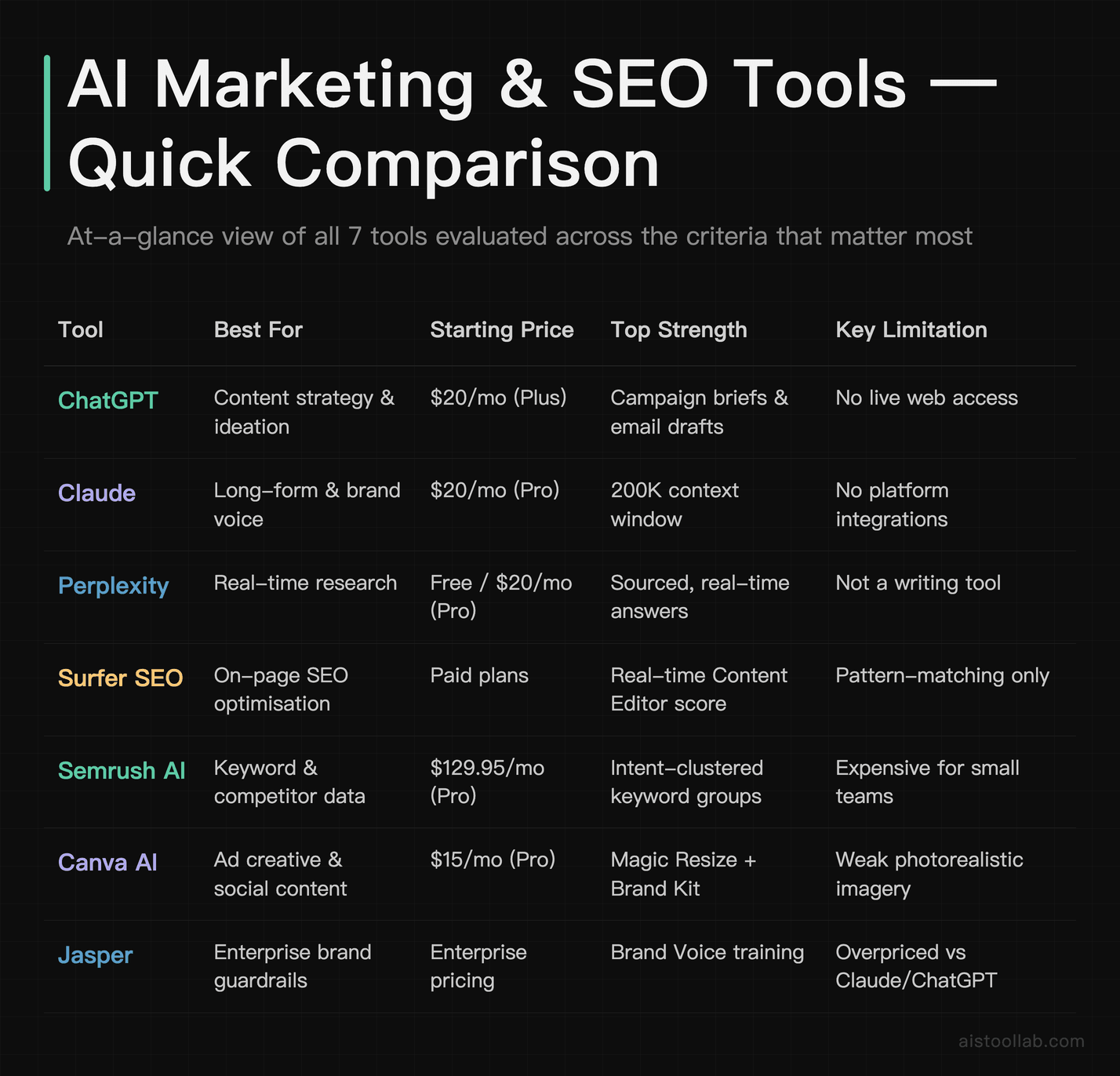
Quick Comparison Table
How to Choose the Right Tool for Your Situation
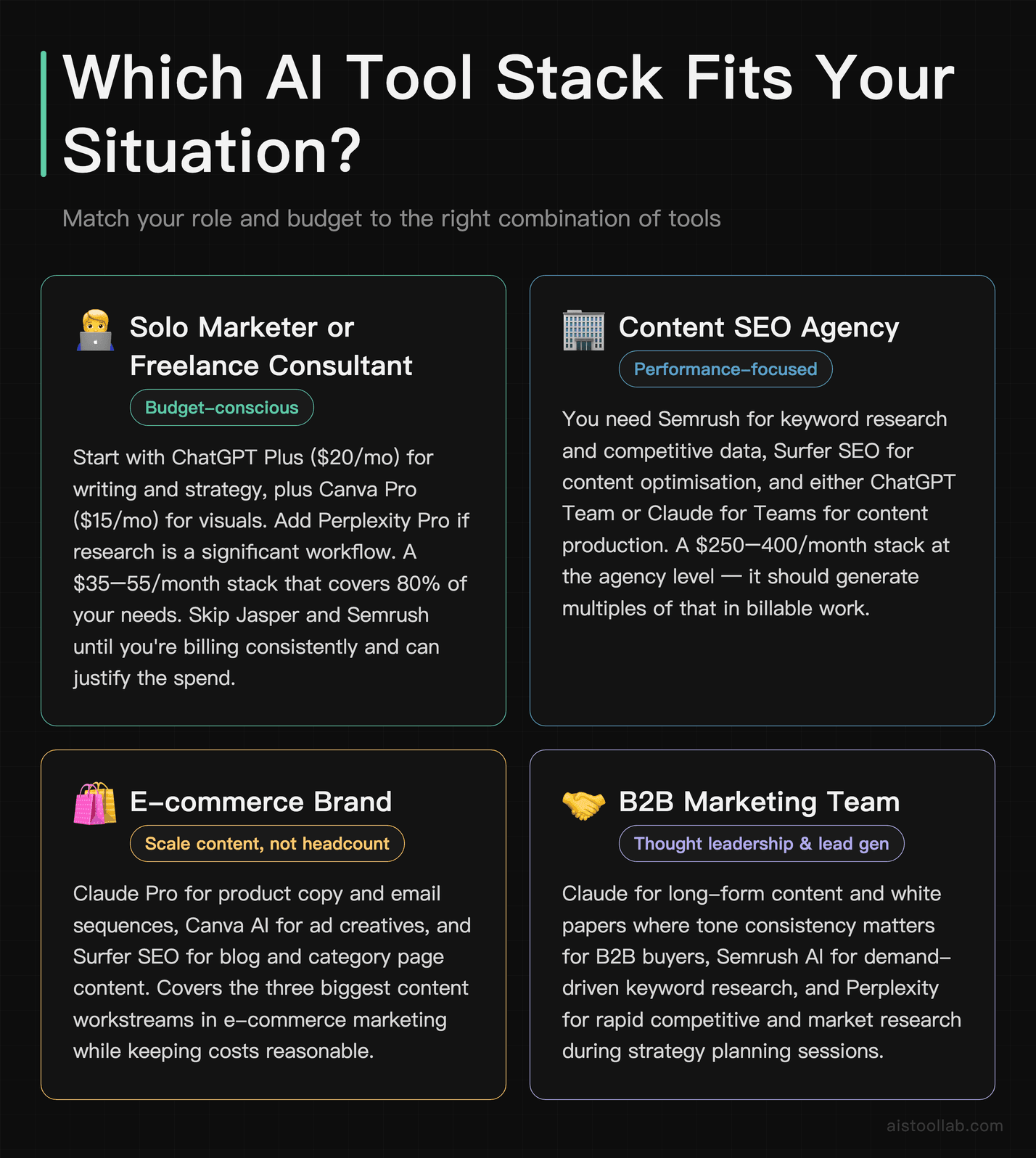
Not every marketer needs the same stack. Here’s a direct recommendation based on your actual situation:
- If you’re a solo marketer or freelance consultant billing by the hour: Start with ChatGPT Plus ($20/month) for writing and strategy, and Canva Pro ($15/month) for visuals. Add Perplexity Pro if research is a significant part of your workflow. That’s a $35–55/month stack that covers 80% of what you need. Skip Jasper and Semrush until you’re billing consistently and can justify the spend.
- If you run a content SEO agency: You need Semrush for keyword research and competitive data, Surfer SEO for content optimisation, and either ChatGPT Team or Claude for Teams for content production. This is a $250–400/month stack at the agency level, but it should be generating multiples of that in billable work.
- If you’re an e-commerce brand producing product and campaign content at scale: Claude Pro for product copy and email sequences, Canva AI for ad creatives, and Surfer SEO for your blog and category page content. This keeps costs reasonable while covering the three biggest content workstreams in e-commerce marketing.
- If you’re in B2B marketing producing thought leadership and long sales cycles: Claude is your primary writing tool — it handles nuance, avoids overclaiming, and produces the measured tone that B2B buyers respond to. Pair it with Perplexity for research and Semrush if organic search is a serious channel for you.
- If you’re just starting out and want to test before committing: Use the free tiers of ChatGPT, Claude, and Perplexity plus Canva’s free plan for at least a month. You’ll quickly learn which workflows you actually use daily — then pay only for those. Most marketers find they need one strong writing tool and one visual tool before anything else.
- If your team has struggled to maintain brand voice with AI content: Jasper’s Brand Voice feature is worth evaluating if you have a team of 3 or more content creators. Alternatively, build a detailed custom GPT in ChatGPT with your brand guidelines embedded — it’s free at the Plus tier and gets you 80% of the way there without the Jasper price tag.
Frequently Asked Questions
What’s the best free AI tool for marketing in 2026?
ChatGPT’s free tier is the most capable free option for content and strategy work. It gives you access to GPT-4o with usage limits — enough to draft email campaigns, write ad copy, and develop content briefs without paying anything. Canva’s free plan is also genuinely useful for visual content, not just a teaser for the paid version. If you need research capabilities, Perplexity’s free tier runs real-time web searches with source citations. A combination of these three free tiers is a surprisingly capable starting stack for a marketer on a tight budget.
Will AI-generated marketing content get penalised by Google?
Google’s stated position is that it evaluates content based on quality and helpfulness, not how it was produced. AI content is not automatically penalised — but thin, templated, low-value content is, regardless of whether a human or an AI wrote it. The risk with AI marketing content isn’t the AI itself; it’s the temptation to publish at volume without editorial review. Tools like Surfer SEO help ensure technical completeness, but human judgment about whether the content is actually useful to the reader is still essential. The marketers seeing penalties in 2026 are the ones who treated AI as a replacement for editorial quality control, not as a production accelerator.
Is Jasper worth it for a solo marketer?
Honestly, no. At $49/month for the Creator plan, Jasper is hard to justify when Claude Pro and ChatGPT Plus are both $20/month and produce comparable or better writing output for most tasks. Jasper’s real value is in its Brand Voice training and team workflow features — those matter when you have multiple people producing content that needs to sound consistent. For a solo marketer, a well-crafted system prompt in Claude or a custom GPT in ChatGPT gets you most of the same brand consistency benefit at a significantly lower cost.
How do I measure ROI on AI marketing tools?
The honest answer is that most marketers don’t measure this rigorously, and they should. A practical approach: track the time you spend on specific tasks (content drafting, research, design) before introducing a tool, then measure again after 30 days. Time saved multiplied by your hourly rate (or the cost of outsourcing that task) gives you a baseline value. For SEO tools like Surfer or Semrush, track ranking changes on the pages where you applied their recommendations over a 60–90 day window. Attribution is imperfect, but directional data is enough to make keep-or-cancel decisions on most subscriptions.
Can I use these AI marketing tools without technical knowledge?
Yes, for most of them. Canva AI, Perplexity, and ChatGPT have near-zero technical barriers — if you can use Google, you can use these tools on day one. Surfer SEO and Semrush have more complex interfaces with a real learning curve, but neither requires technical or coding knowledge — just time to understand the data they’re showing you. The tools where quality degrades fastest without skill are the writing tools: ChatGPT and Claude will produce mediocre output if you give them vague prompts. Learning to write better prompts is the highest-ROI skill investment a marketer can make right now, and it applies across every AI writing tool on this list.
Last updated: 2026